
A Reindeer Bone at Doneraile31565 BCE
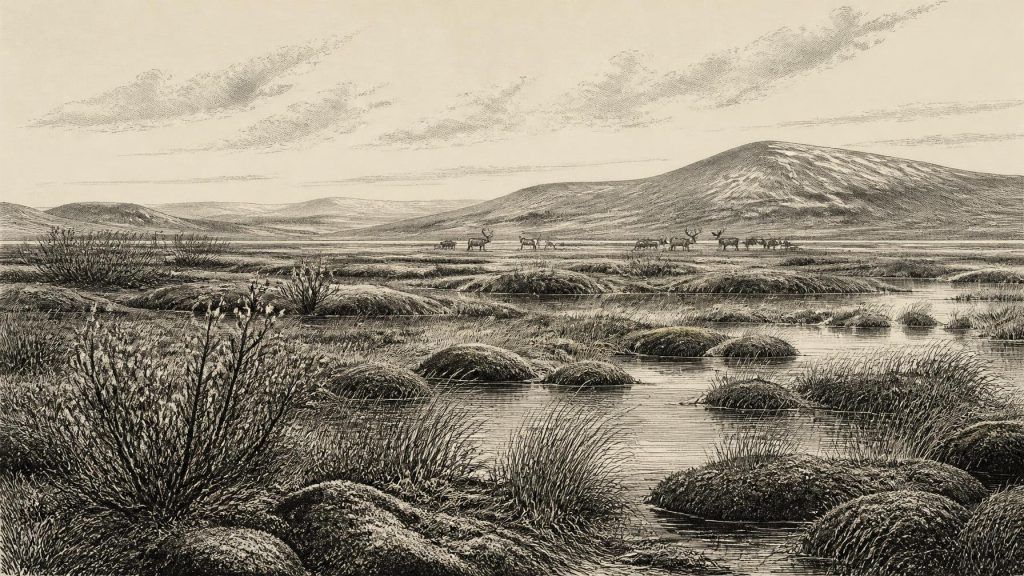
Around 31,565 BCE, Ireland’s record is environmental rather than historical, and cannot support calendar precision or claims of settlement. Derryvree, County Fermanagh, preserves a broadly dated MIS 3 interstadial deposit, indicating locally ice-free, periglacial tundra with freshwater wetlands, open vegetation and severe seasonal conditions. Castlepook Cave near Doneraile contains cold-stage fauna including reindeer, mammoth, giant deer, predators and lemmings, although deposits may combine separate episodes. A scored reindeer femur, perhaps 33,000 years old, may show stone-tool butchery and Ireland’s earliest human trace. It cannot establish a kill site, continuous occupation, settlement, society, travel routes or a single specific dated event.
Dateline
Modern calendar-year precision is not available for Ireland in 31,565 BCE. Nobody on the island recorded years, and archaeological dating at this depth of time cannot identify an event in one particular season, let alone one day. The number is a modern chronological label: it falls roughly 33,514 years before the conventional radiocarbon reference year of AD 1950. The responsible frame is a broad period in the Late Pleistocene, within Marine Isotope Stage 3, rather than a year-by-year narrative of identifiable people or happenings.
That distinction is fundamental. Ireland’s evidence for this horizon consists chiefly of buried sediments, plant remains, animal bones and the traces left by ice. Later glaciers repeatedly eroded, transported and sealed older landscapes. Caves preserved some animal remains, but many were excavated before modern standards of stratigraphic recording. Consequently, the evidence can reveal that particular environments and animals existed during broad intervals; it cannot furnish rulers, communities, political boundaries, battles, religious observances or a settled population in 31,565 BCE.
An Interval, Not a Dateline
The nearest securely relevant environmental sequence comes from Derryvree, near Maguiresbridge in County Fermanagh. Road construction in 1969 cut through a drumlin and exposed organic freshwater silts and fine sands enclosed between two tills: unsorted sediment deposited by glacier ice. The sequence records an earlier glacial episode, a subsequent interval in which freshwater sediment and organic material accumulated locally, and a later advance that buried the deposit beneath fresh till.
Organic material from Derryvree produced the conventional radiocarbon determination Birm-166, 30,500 radiocarbon years before present, with a large uncertainty of +1,170/−1,030 years. Calibration is necessary because radiocarbon years are not calendar years. Published discussion using modern calibration expresses the age broadly as about 36,900–31,700 calibrated years BP. The notional date 31,565 BCE falls within that wide span, but it does not date the deposit to that particular year. It is evidence for a lengthy phase of environmental possibility, not a dated episode.
The interval preceded the fullest expansion of the last British–Irish Ice Sheet, conventionally placed later, with maximum ice volume around 23,000 years ago. This does not mean that all Ireland was comfortably habitable in 31,565 BCE, nor that ice was absent everywhere. Ice-sheet margins changed regionally, while uplands, coastlines, rivers and lowlands responded differently to cold. The Derryvree evidence demonstrates local ice-free conditions at some point within its broad range; it should not be turned into a map of the whole island in a single year.
Derryvree’s Wet Tundra
The buried Fermanagh deposits offer a rare environmental view. Pollen was poorly preserved, but plant macrofossils, mosses and other biological remains indicate open, treeless tundra vegetation and a periglacial climate. Periglacial does not simply mean an unbroken frozen desert. It denotes country strongly shaped by intense frost, repeated freezing and thawing, short growing seasons and generally cold conditions near glaciers or ice sheets. At Derryvree there were freshwater pools, saturated ground and vegetated margins within that severe setting.
Grasses, sedges, herbs, mosses and low shrubs are more appropriate images than forest. Finds associated with plants such as bogbean, water-milfoil, mountain avens and dwarf willow help explain a landscape with shallow water, wet hollows and patches of open ground. Such species do not reconstruct one neat modern habitat. They instead indicate a mosaic: waterlogged places capable of supporting aquatic and marsh vegetation, exposed mineral ground, and colder or drier surfaces where low-growing tundra plants could persist.
This was therefore neither the familiar green, wooded Ireland of later millennia nor a landscape necessarily devoid of life. During favourable parts of a short summer, wetland vegetation and open forage could support insects, small mammals and grazing animals. Winter, however, would have imposed formidable limits. Seasonal snow cover, frozen soils, wind exposure and uncertain access to food would have structured animal movements. The environmental record supports this cold, varied setting; claims about exact temperatures, local snow depth or the appearance of a particular valley go beyond it.
Castlepook’s Animal Archive
The principal southern Irish evidence relevant to this broad horizon lies at Castlepook Cave, also called Mammoth Cave, near Doneraile in north County Cork. Excavations led by Richard J. Ussher between 1904 and 1912 recovered an important collection of Pleistocene animal remains. Subsequent study, including renewed radiocarbon work using improved pretreatment methods, has shown that some of the older dates obtained from Irish cave collections had underestimated their antiquity. Castlepook is now central to the study of Ireland’s pre-Last Glacial Maximum fauna.
Its collection includes reindeer, woolly mammoth, giant deer, brown bear, wolf, fox, mountain hare, lemmings and spotted hyaena. This assemblage establishes that animals now absent from Ireland occurred there during the wider cold-stage past. Reindeer and lemmings particularly suit open, cold-adapted habitats; mammoth and giant deer point to the capacity of parts of the landscape to sustain large herbivores; wolves and hyaenas reveal predators and scavengers within the wider ecological network.
Yet the list must be handled carefully. Cave deposits can combine bones brought in during different episodes. Carnivores may drag in prey or scavenged carcass parts; water, collapse and digging can move material; early excavators did not always preserve the contextual information expected today. It would be unsound to picture every recorded species gathered outside Castlepook at once, or to treat the cave as a simple domestic shelter. It could have functioned at different times as a carnivore den, natural trap, refuge and sedimentary archive.
The Marked Femur
One Castlepook object gives this period exceptional significance for Irish history: a reindeer hind-leg femur reported as approximately 33,000 years old and presented by County Cork heritage material as dating to about 31,000 BCE. Zooarchaeologist Ruth Carden identified a deep linear modification on the bone as consistent with a sharp stone tool used while the bone was fresh. If that interpretation is upheld, it is potentially the earliest evidence that people handled and processed an animal in Ireland.
The claim is important precisely because it is limited. The bone is evidence of a reindeer and of a mark on its surface; the interpretation of that mark as deliberate butchery is a specialist taphonomic judgement. A radiocarbon determination dates the animal’s death, not automatically the moment of the incision, the location where the carcass was killed, or the identity of the maker. Nor is the femur from a modern excavation of an intact occupation floor. No securely associated stone-tool assemblage, hearth, dwelling, human burial or concentration of food waste of comparable age has been recovered at Castlepook.
Accordingly, the safest interpretation is not a permanent Irish colony or a village of hunters at Doneraile. If people made the mark, it may represent a brief incursion by a very small Upper Palaeolithic party, perhaps involving the processing of a reindeer carcass. Reindeer could in principle have offered meat, fat, marrow, hide, sinew, antler and bone, but this single specimen does not demonstrate which resources were taken. Nor can Irish evidence establish whether any visitors travelled over exposed shelf terrain, crossed water, followed animal movements, or arrived by another route.
Society Beyond Recovery
There is no evidence from Ireland around this date for political institutions, diplomacy, warfare, named groups, trade partnerships, formal religion, art, language or learning in the historical sense. There are no houses, graves, monuments, workshops or tools securely tied to this horizon. It is therefore misleading to fill those absences with generic stories of “tribes”, shamans or chiefs. Even if the Castlepook mark proves human, it would tell us about one act of animal processing, not the social organisation, beliefs or cultural identity of the people responsible.
Comparison with Upper Palaeolithic groups elsewhere in Europe can suggest possibilities: mobile foragers commonly relied on detailed ecological knowledge, stone technology and flexible seasonal movement. But comparison is not direct evidence for Ireland. The island, or a geographically changing western peninsula, lay at the Atlantic edge of those wider worlds. Any human presence may have been intermittent and precarious. A lack of known camps may partly reflect later glacial destruction and the submergence of former coastal landscapes, but it cannot itself prove that extensive settlement once existed.
What This Date Can Mean
For 31,565 BCE, the most defensible history is environmental and evidential. Ireland contained, during the broad later-MIS 3 interval represented by Derryvree, locally ice-free periglacial ground with freshwater wetlands and open tundra vegetation. In southern Ireland, Castlepook preserves a remarkable cold-stage fauna that included reindeer and mammoth alongside predators and scavengers. The island’s landscapes were changing under powerful climatic pressures, well before the later maximum of the last ice sheet.
The scored reindeer femur from Doneraile is the human question embedded in that landscape. It may preserve a fleeting trace of Palaeolithic butchery at Ireland’s western edge. It does not demonstrate continuous occupation, settled society or an event in the calendrical year 31,565 BCE. That restraint is not a failure of the record. It is what the record responsibly allows: a cold wetland beneath a Fermanagh drumlin, a cave assemblage in north Cork, and one bone whose significance lies as much in what remains to be tested as in what can already be claimed.
Primary Sources
- A Middle Midlandian Freshwater Series at Derryvree, Maguiresbridge, County Fermanagh, Northern Ireland
- Palaeoecology: Quaternary Research Association Field Guide No. 16
- Early Midlandian–Middle Midlandian, Pleistocene, Northern Ireland
- A Reconsideration of the Radiocarbon Dating of the Marine Isotope Stage 3 Fauna from Southern Ireland
- The Irish Quaternary Fauna Project
- Occurrence of Mammalia Relicts at Site Castlepook Cave
- The Exploration of Castlepook Cave, County Cork
- Heritage Artefacts of County Cork
- 2022:564 – Castlepook Cave, Castlepook South, Cork
- New Insights on the Fauna of Ireland's Younger Dryas and Early Holocene from Alice & Gwendoline Cave
- Growth and Retreat of the Last British–Irish Ice Sheet, 31,000 to 15,000 Years Ago: the BRITICE-CHRONO Reconstruction
- Growth and Retreat of the Last British–Irish Ice Sheet, 31,000 to 15,000 Years Ago: the BRITICE-CHRONO Reconstruction
- Deglaciation Chronology of the Donegal Ice Centre, North-West Ireland
- Trimlines, Blockfields and the Vertical Extent of the Last Ice Sheet in Southern Ireland
- New Data for the Last Glacial Maximum in Great Britain and Ireland
- The Problem of a Late Quaternary Landbridge Between Britain and Ireland
- Deglaciation, Earth Crustal Behaviour and Sea-Level Changes in the Determination of Insularity: A Perspective from Ireland
- Ireland: Submerged Prehistoric Sites and Landscapes
- The IntCal20 Northern Hemisphere Radiocarbon Age Calibration Curve (0–55 cal kBP)
- Composition and Consequences of the IntCal20 Radiocarbon Calibration Curve
- Red Deer in Ireland: Genetic Diversity and Population History
- Mammoth and Musk Ox ESR-Dated to the Early Midlandian at Aghnadarragh, County Antrim, Northern Ireland, and the Age of the Fermanagh Stadial
- Middle Midlandian Interstadial Deposits at Greenagho, Near Belcoo, County Fermanagh, Northern Ireland