
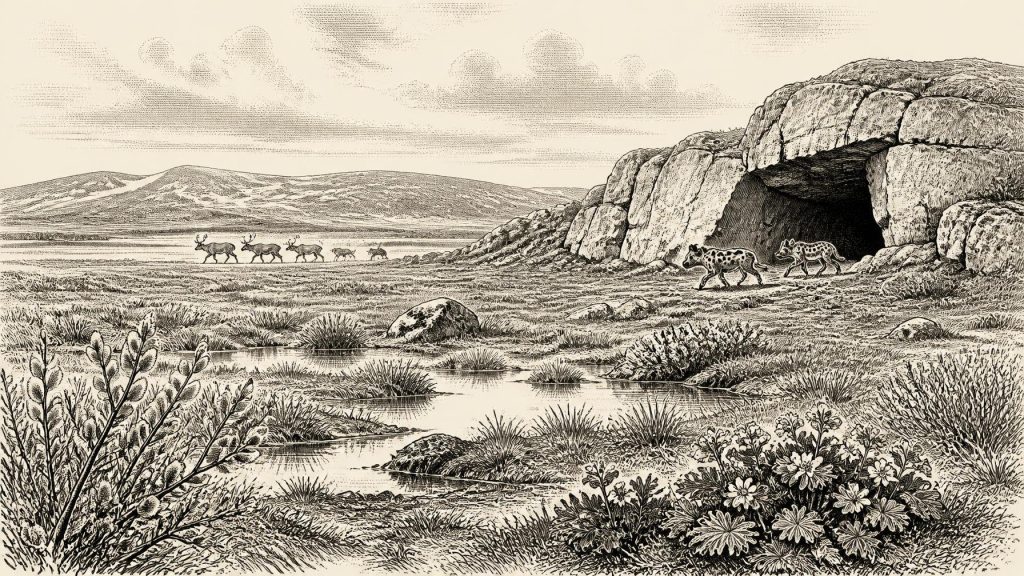
Crocuta at Mammoth Cave31564 BCE
Around 31,564 BCE, Ireland lay in a cold, unstable Late Pleistocene interval of Marine Isotope Stage 3, before the Last Glacial Maximum. Dating is necessarily approximate: evidence indicates ice-free patches, not conditions across the entire island. Organic sediments beneath tills at Derryvree, County Fermanagh, preserve wet tundra vegetation, including sedges, mosses and dwarf willow. Castlepook Cave, County Cork, produced MIS 3 remains of mammoth, reindeer, giant deer, bears, wolves, Arctic foxes, lemmings and spotted hyaenas. Changing sea levels and ice permitted intermittent animal movement. A cut-marked reindeer femur may indicate human butchery, but cannot establish settlement or a permanent population.
Dateline
The label “31,564 BCE” is useful for placing this entry in a long chronological sequence, but it cannot identify an Irish event in a particular calendar year. No people in Ireland then used a calendar that can be translated into a modern year, and the surviving evidence is far too sparse for annual history. In archaeological terms, the point falls roughly 33,500 calibrated years before present (cal BP, with “present” conventionally fixed at AD 1950), during the Late Pleistocene and Marine Isotope Stage 3. It belongs to a cold, unstable world that preceded the maximum spread of the last British–Irish Ice Sheet. What can responsibly be described is not a year of Irish politics or a named community, but an interval in which parts of Ireland supported tundra and open-country fauna, while glaciers, sea level and shifting coastlines continually altered the possibilities for movement.
Dating a Deep Past
The distinction between radiocarbon years and calibrated calendar ranges matters especially at this depth. Radiocarbon measurements are estimates with uncertainties; calibration translates them through a curve that itself becomes less precise further back in time. The older Irish literature often used broad phase names such as the Middle Midlandian or Derryvree Cold Phase. These are valuable regional frameworks, but they are not annual calendars. A determination from Derryvree near Maguiresbridge, County Fermanagh, of 30,500 ± 1,100 radiocarbon years BP has commonly been placed in a broadly late-MIS 3, cold but non-glacial interval. Calibrated ranges and correlations have changed as dating methods improve. The responsible conclusion is therefore approximate: around the later 30,000s cal BP, some Irish ground was ice-free and supported cold-adapted life; the precise extent of that ground at 31,564 BCE cannot be mapped with confidence.
This was also before the fullest expansion of the last ice sheet over Ireland and the surrounding shelf. The major British–Irish Ice Sheet build-up usually associated with Marine Isotope Stage 2 followed later, with its greatest overall volume around 23,000 years ago. That later ice profoundly reshaped Ireland, eroding older surfaces and burying, redepositing or destroying many possible archaeological deposits. Its consequences explain the peculiar character of the evidence for this earlier time: caves, protected pockets of sediment and organic layers sealed beneath glacial deposits preserve far more than open-air landscapes do.
Derryvree’s Buried Wetland
The clearest Irish environmental window relevant to this date comes not from a settlement but from the sediments at Derryvree. There, organic silts were found between two tills beneath a drumlin. Their position is important. The lower till records an earlier glacial episode; the organic bed indicates a subsequent interval in which water, plants and animals occupied an exposed landscape; the upper till shows that ice later returned. This is powerful evidence for environmental change, but it is not a continuous diary of life in Fermanagh.
Pollen, seeds and other plant remains from the freshwater deposits point to a treeless muskeg or wet tundra setting. Sedges, mosses, bogbean, dwarf willow, mountain avens and other cold-tolerant plants indicate shallow pools, saturated ground and open vegetation rather than forest. Such evidence does not mean that every valley in Ireland looked identical. It records conditions at a particular basin, and pollen can travel. Yet the combined plant assemblage strongly supports a landscape with short growing seasons, exposed soils and little woody cover. In modern terms, it would have appeared more like a patchwork of wet ground, grassy or herb-rich open country and low Arctic-alpine vegetation than the wooded, farmed island familiar today.
Water would have been a principal organiser of this terrain. Seasonal thaw could feed pools and streams; freezing and thawing could disturb soils; wind could move fine sediment across sparse vegetation. There is no warrant for imagining peatlands of the modern Irish type, formed under later climates and vegetation, but the Derryvree evidence does show permanently damp ground capable of preserving organic matter. It also demonstrates that Ireland’s Pleistocene environment was not simply an unbroken white ice cap. Ice margins, periglacial ground and habitable open patches could coexist across a rapidly changing region.
The Castlepook Animal World
County Cork’s Castlepook Cave, also called Mammoth Cave, supplies a different kind of testimony. Excavations in the early twentieth century produced an exceptional collection of Pleistocene animal remains, now principally held by the National Museum of Ireland. Reassessment of the material with improved bone pretreatment and radiocarbon techniques has shown that several older measurements underestimated the age of the fossils. The cave’s pre-Last Glacial Maximum fauna is now understood to belong broadly within Marine Isotope Stage 3, not to a single neatly defined occupation horizon.
The animals represented are striking: woolly mammoth, reindeer, giant deer, brown bear, wolf, Arctic fox, mountain hare, lemmings and spotted hyaena. The hyaena is especially revealing. Spotted hyaenas are absent from modern Ireland and Europe, but in the Pleistocene they were large carnivores of open and mixed environments. Castlepook has yielded skulls, bones and traces consistent with a cave used within the movements and feeding activities of carnivores. Mammoth bones do not prove that mammoths died in the cave, nor does every bone prove a hyaena kill. Caves accumulate remains through natural death, scavenging, transport by predators, water movement and later disturbance. The assemblage nonetheless establishes that an unexpectedly rich large-mammal community reached Ireland during the wider 45,000–30,000-years-ago interval.
For the date represented here, the safest image is therefore not of a settled Ice Age village beside a mammoth carcass, but of a cold open landscape intermittently used by animals. Reindeer could have found grazing among herbs, grasses, sedges and lichens; hares and lemmings occupied smaller ecological niches; wolves and hyaenas followed prey or scavenging opportunities. Brown bears, whose Pleistocene diets could be substantially plant-based, remind us that animal roles cannot be reduced to a simple predator hierarchy. The fossil record provides species lists and dates, not a complete food web or a census of local numbers.
Land, Sea and Movement
Ireland was not environmentally isolated in the modern sense. Lower global sea levels during the glacial cycle changed the outlines of the Irish Sea basin and reduced distances between Ireland and Britain. The arrival of large mammals proves that routes were available at least during favourable phases. It does not, however, identify one permanent land bridge at this exact date, still less a single migration route. Ice, sea, rivers, exposed shelf and changing coastal barriers created a variable geographical threshold. Animals and any people who entered Ireland may have done so only during particular windows.
That mobility has implications for economy, though not for trade in the historical sense. There is no evidence at this date for farming, herding, metalworking, market exchange, boats, storehouses or managed territory in Ireland. The economy visible in the evidence is ecological: wild animals feeding, moving and competing across an open landscape. If humans did visit, their subsistence would necessarily have depended on hunting, scavenging, gathering and the skilled use of portable materials. But this is an inference from comparable Upper Palaeolithic societies in north-west Europe, not a description of a documented Irish community.
A Human Trace, Not a Population
Castlepook has become central to discussion of the Irish Palaeolithic because a reindeer femur from the old collection bears a deep incision interpreted by zooarchaeologist Ruth Carden as consistent with stone-tool butchery. Heritage publications have associated the bone with roughly 33,000 years ago, making it directly relevant to the broad period of this entry. If the mark was made by a tool on fresh bone, it would indicate that a person handled and processed reindeer in Ireland during MIS 3. That would be momentous: it would push potential human activity on the island far earlier than the long-established post-glacial record.
Yet the limits of the claim are as important as its promise. A dated bone establishes the age of the animal, not a precise day when a surface mark was made. A single modified specimen does not demonstrate a camp, hearth, stone-tool assemblage, dwelling, burial, repeated seasonal visit or continuous population. Recent fieldwork at Castlepook has sought surviving Pleistocene deposits, but the cave’s old excavations, complex sediment movement and later intrusions make secure association difficult. The most prudent wording is that the femur is possible evidence of human butchery, not proof of an established Irish population in 31,564 BCE.
What Cannot Be Written
There were no known Irish kingdoms, chiefs, borders, treaties or diplomatic institutions that can be placed in this period. Nor is there evidence for organised warfare, formal religion, language, art, named kin groups or learning traditions in Ireland. The absence of evidence does not prove that visiting people lacked beliefs, social ties, stories or technical knowledge. Upper Palaeolithic groups elsewhere in Europe possessed sophisticated stone technologies, social networks and symbolic practices. But Ireland has yielded no securely associated artefacts from this time that would allow those wider patterns to be assigned here.
Consequently, Ireland around 31,564 BCE is best understood as a palaeoenvironmental and archaeological horizon rather than a chapter of conventional national history. Beneath Fermanagh’s later glacial deposits lay cold freshwater wetlands; in a Cork cave lay evidence of mammoths, reindeer and hyaenas; beyond them stretched a changing north-west European world in which land, ice and sea repeatedly opened and closed routes. The potential cut on a reindeer bone invites the possibility of a fleeting human encounter. The sediments and fossils make the Ice Age landscape certain. The people, if any stood within it, remain almost entirely beyond recovery.
Primary Sources
- A reconsideration of the radiocarbon dating of the Marine Isotope Stage 3 fauna from southern Ireland
- Growth and retreat of the last British–Irish Ice Sheet, 31,000 to 15,000 years ago: the BRITICE-CHRONO reconstruction
- A Middle Midlandian Freshwater Series at Derryvree, Maguiresbridge, County Fermanagh, Northern Ireland
- Quaternary deposits and glacial stratigraphy in Ireland
- The Irish Quaternary Fauna Project
- Occurrence of mammalia relicts at site Castlepook Cave
- Spotted Hyena Skull
- Heritage Artefacts of County Cork
- 2022:564 – Castlepook Cave, Castlepook South, Cork
- Archaeology Research Excavation Grant 2022
- Ireland before 3000 b.c.
- Figure 6.— The subdivision of the Quaternary Period in Ireland
- The deglaciation of the western sector of the Irish Ice Sheet from the inner continental shelf to its terrestrial margin
- The Last Glacial Maximum British–Irish Ice Sheet: a reconstruction using digital terrain mapping
- New insights on the fauna of Ireland's Younger Dryas and Early Holocene from Alice & Gwendoline Cave
- New insights on the fauna of Ireland's Younger Dryas and Early Holocene from Alice & Gwendoline Cave
- The IntCal20 Northern Hemisphere Radiocarbon Age Calibration Curve (0–55 cal kBP)
- IntCal Publications
- NGRIP Ice Core Data and Greenland Ice Core Chronology
- The Greenland Ice Core Chronology 2005, 15–42 ka. Part 2: Comparison to other records
- Revisiting Alice and Gwendoline Cave, Co. Clare: New light on the 1902 excavations
- Looking for the Irish Palaeolithic: new research projects on old animal bones and cave sediments