Castlepook’s Reindeer Groove31347 BCE
Around 31,347 BCE, Ireland lay within a cold, regionally varied Late Pleistocene landscape between ice advances. Derryvree in Fermanagh preserves freshwater sediments showing tundra-like wetlands with sedges, mosses, herbs and productive summers, rather than permanent ice cover. Castlepook Cave in Cork yielded reindeer, mammoth, giant deer and other cold-adapted fauna, although its disturbed collections cannot represent one moment. A grooved reindeer femur may record stone-tool butchery by an Upper Palaeolithic visitor, but does not prove settlement. Subsequent ice-sheet expansion erased or buried much early evidence, leaving a cautious environmental and palaeontological reconstruction rather than a recorded national history for Ireland.
Dateline
The label 31,347 BCE is a modern chronological convenience, not a year that anyone in Ireland could have named or recorded. No written calendar existed, no settlement has been dated so precisely, and neither radiocarbon science nor glacial stratigraphy can identify an Irish event within a single year more than 33,000 years ago. The responsible task is therefore to place this notional date within a broad Late Pleistocene setting: Marine Isotope Stage 3, during the last Ice Age, before the fullest expansion of the British–Irish Ice Sheet.
For this stretch of time, Ireland’s history is principally environmental and palaeontological. A calibrated age range is more meaningful than an exact BCE date. Organic sediments at Derryvree, near Maguiresbridge in County Fermanagh, produced a radiocarbon determination of about 30,500 radiocarbon years before present, with substantial uncertainty. Using modern calibration, this has been placed broadly at about 36,900–31,700 calendar years before present, approximately 34,950–29,750 BCE. That wide span includes 31,347 BCE, but does not establish that the Derryvree deposits formed in that particular year. They illuminate a phase of cold-stage Ireland rather than a dated episode in a national narrative.
A Landscape Between Ice Advances
Derryvree is important because its freshwater silts, sands and organic material lay between two tills: sediments deposited directly by glacier ice. The lower till demonstrates an earlier ice advance; the upper till records renewed glaciation after the organic beds formed. Between those advances, at least this part of Fermanagh was not buried beneath active ice. It contained standing or slowly moving freshwater and waterlogged ground capable of preserving pollen, seeds, mosses, insects and other fragile traces. The sequence does not prove that all Ireland was simultaneously ice-free, nor that conditions in Fermanagh can simply be projected onto Cork, the western seaboard or the Irish Sea basin. It does show that the island’s glacial history was uneven, mobile and regionally varied.
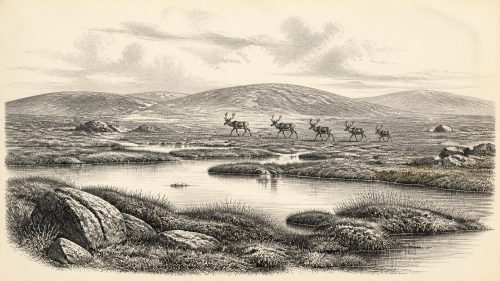
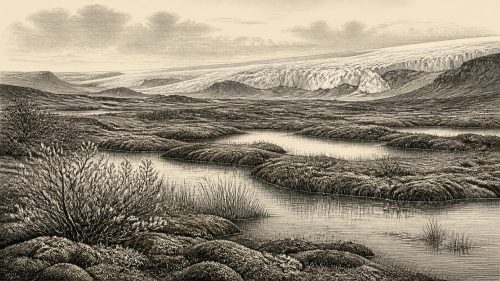
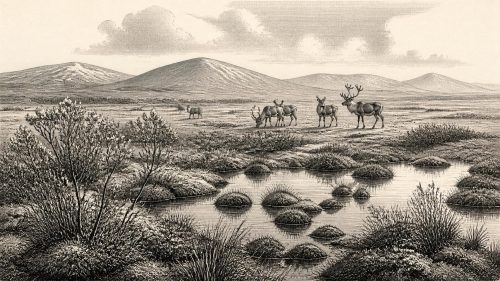
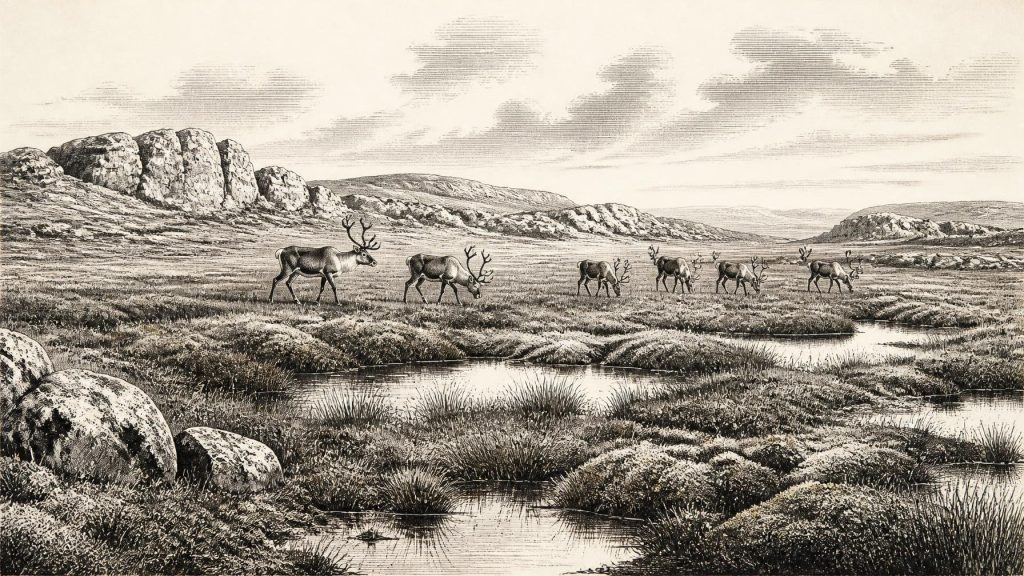
The environmental evidence points to an open, largely treeless landscape often described as tundra or muskeg-like wetland. Such terms should not conjure a uniform, lifeless plain. Pollen and plant macrofossils indicate herbs, sedges and mosses, with wet hollows and shallow pools among more exposed ground. Finds include bogbean, Menyanthes trifoliata, and cold-tolerant plants such as mountain avens, Dryas octopetala. Insect remains add to the picture of cold conditions and short, ecologically productive summers. Frost, seasonal snow cover and strong winds were likely major forces in shaping soils and vegetation. Yet the preserved flora also makes clear that liquid water and plant growth persisted locally during the warm season.
This was not the familiar green Ireland of woodland, pasture and enclosed fields. Forest had no secure place in the Derryvree reconstruction. Nor, however, should the country be imagined as permanently sealed under snow. The evidence supports a patchwork in which wet ground could nourish sedges and aquatic plants while adjacent surfaces remained sparsely vegetated and vulnerable to frost action. Mammals moving through such country would have found forage concentrated by season and terrain. For people, if people were present, water, animal movement and sheltered limestone country would have mattered more than any later county boundary or routeway.
The Doneraile Fauna
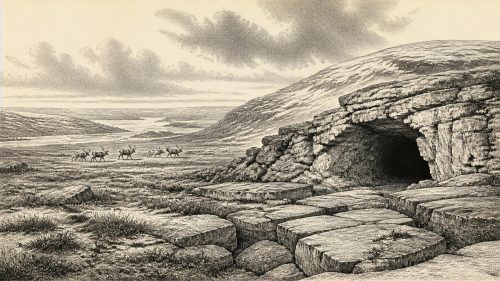
The most vivid evidence from roughly this deep period comes from Castlepook Cave, also known as Mammoth Cave, near Doneraile in north County Cork. Its old excavated collections, now principally associated with the National Museum of Ireland, preserve an exceptional assemblage of Late Pleistocene animal remains. Reindeer, woolly mammoth, giant deer, brown bear, wolf, Arctic fox, mountain hare, stoat, lemmings and spotted hyaena have all been reported from the cave’s deposits or collections. Taken together, they establish that cold-adapted mammals reached Ireland during intervals of the last glacial cycle.
They do not represent a census taken in one season. A cave is a complicated archive. Carnivores may drag in prey; animals may die in or near an entrance; water can move bones; frost and collapse disturb sediments; and early excavations rarely recorded position and layering to modern standards. A mammoth bone marked by carnivore damage is a useful warning against easy storytelling. Castlepook’s fauna offers strong evidence for an ecological community, but its individual bones may have entered the cave years, centuries or millennia apart. The cave cannot be treated as the remains of a single hunting camp, a single den or a single moment.
Nevertheless, the animal list helps make the Derryvree environmental record tangible. Reindeer and lemmings belong to cold, open conditions; Arctic fox and mountain hare likewise indicate a markedly different ecological setting from modern Ireland. Woolly mammoth and giant deer signal the availability, at least intermittently, of broad grazing country. Spotted hyaena, wolf and bear show that large carcasses were contested resources and that caves could become places of carnivore activity. The food web was not a tranquil tableau: it was shaped by mobility, scavenging, predation and seasonal scarcity.
A Single Human Possibility
One object gives 31,347 BCE special historical interest: a reindeer femur from Castlepook bearing a deep groove interpreted by zooarchaeologist Ruth Carden as a cut made with a sharp stone tool during carcass processing. Public heritage material has assigned the bone broadly to about 31,000 BCE. If the modification is confirmed as human-made and contemporary with the animal’s death, it may be evidence that a person used a lithic cutting edge on a reindeer carcass in Ireland during the Upper Palaeolithic. That would be a strikingly early trace, far older than Ireland’s long-established late-glacial evidence for human activity.
Its implications must remain narrow. The radiocarbon result dates the animal bone, not automatically the making of the groove, the site of butchery or the duration of a visitor’s stay. The mark itself requires taphonomic judgement: specialists must distinguish a stone-tool incision from damage caused by teeth, trampling, weathering, excavation or later handling. Moreover, the femur comes from an antiquarian cave collection rather than a modern excavation of an undisturbed occupation surface. Recent work at Castlepook has sought surviving stratified deposits and fresh evidence, but has not yet supplied a securely associated hearth, stone-tool assemblage, dwelling floor or human remains of this age.
The prudent conclusion is that Castlepook offers a potentially crucial indication of human contact with a reindeer carcass, not proof of a settled Irish population. Even if the groove was made by a person, it cannot tell us whether that person killed the animal, scavenged an already dead carcass, removed meat, opened the bone for marrow, cut hide or sinew, or processed the limb elsewhere before carnivores brought it into the cave. “Hunters” is a plausible interpretation, but not an established fact. A brief visit by a small mobile group is more compatible with the surviving evidence than any claim of permanent occupation.
Society Beyond Recovery
There is no evidence on which to build a political history for Ireland at this date. No rulers, territories, alliances, conflicts, diplomatic exchanges or named communities can be identified. There are no known Irish monuments, burials, houses, artworks, ornaments, hearths or workshops securely belonging to this horizon. Equally, there is no basis for assigning a language, ethnicity, religion or ritual tradition to any possible visitors. The sophisticated art, tailored clothing, hunting technologies and long-distance social networks known from contemporary Upper Palaeolithic Europe demonstrate what humans elsewhere could achieve; they cannot be imported as Irish facts.
Economy and trade are similarly beyond direct recovery. If the Castlepook cut mark proves anthropogenic, it supports only the modest proposition that someone had access to a sharp stone edge and found a reindeer carcass worth processing. Reindeer could provide food, fat, hide, sinew, bone and antler, but none of these materials survives at Castlepook in a securely organised human assemblage. There is no evidence for exchange, repeated seasonal gatherings or a stable route between Ireland and Britain or continental Europe. Lower global sea levels altered coastlines, but changing sea level does not by itself demonstrate a traversable land bridge or a known migration corridor.
The Approaching Ice Age Crisis
In the longer view, this was a world approaching major transformation. Large parts of the British–Irish Ice Sheet expanded and reorganised over the following millennia, while different sectors reached their maxima at different times. The great Irish Sea Ice Stream later advanced across the Celtic Sea shelf, with evidence placing major expansion there broadly between about 27,000 and 24,000 calendar years before present. Subsequent glacier movement eroded, buried and rearranged older landscapes. That destructive power is one reason Ireland preserves so little secure archaeological evidence for this early period.
Thus the history of Ireland around 31,347 BCE is not a tale of a recorded people or a datable event. It is a carefully bounded reconstruction from buried wetlands, cave bones, radiocarbon measurements and glacial deposits. Derryvree documents a cold but biologically active freshwater landscape between ice advances. Castlepook demonstrates that Ice Age animals, including reindeer, occupied or reached the island; its marked femur raises the possibility of a human encounter. Beyond that threshold lie questions still awaiting evidence rather than stories ready to be told.
Primary Sources
- Irish Quaternary Association Field Guide No. 16: Fermanagh
- Figure 6.— The Subdivision of the Quaternary Period in Ireland
- Early Midlandian–Middle Midlandian, Pleistocene, Northern Ireland
- BSBI: Menyanthes trifoliata
- Heritage Artefacts of County Cork
- Archaeology Research Excavation Grant 2022
- 2022:564 – CASTLEPOOK CAVE, Castlepook South, Cork
- Occurrence of mammalia relicts at site Castlepook Cave
- Middle Midlandian Interstadial Deposits at Greenagho, Near Belcoo, County Fermanagh, Northern Ireland
- New insights on the fauna of Ireland's Younger Dryas and Early Holocene from Alice & Gwendoline Cave
- Growth and retreat of the last British–Irish Ice Sheet, 31,000 to 15,000 years ago: the BRITICE-CHRONO reconstruction
- BRITICE-CHRONO Maps and GIS Data of the Last British-Irish Ice Sheet 31 to 15 ka
- The IntCal20 Northern Hemisphere Radiocarbon Age Calibration Curve (0–55 cal kBP)
- IntCal Publications
- Advance and Retreat of the Marine-Terminating Irish Sea Ice Stream into the Celtic Sea During the Last Glacial: Timing and Maximum Extent
- Ice Sheet Extension to the Celtic Sea Shelf Edge at the Last Glacial Maximum
- Stratigraphic and Palaeo-Geomorphological Evidence for the Glacial-Deglacial History of the Last British-Irish Ice Sheet in the North-Western Irish Sea
- Oscillating Retreat of the Last British-Irish Ice Sheet on the Continental Shelf Offshore Galway Bay, Western Ireland
- The Problem of a Late Quaternary Landbridge Between Britain and Ireland
- The Mesolithic in Ireland: When Was It?