
Doneraile’s Ice-Age Femur31292 BCE
31,292 BCE cannot identify a discrete Irish event, but falls within climatically unstable Marine Isotope Stage 3. Before maximum glaciation, Ireland contained varied, partly ice-free landscapes, although routes from Britain or Europe remain unproven. Derryvree sediments in Fermanagh preserve evidence of treeless, periglacial wetland supporting cold-adapted plants, insects and herbivores between ice advances. Castlepook Cave in Cork contains diverse cold-stage fauna, including mammoth, reindeer and hyaena, accumulated over different periods. A cut-marked reindeer femur may indicate Upper Palaeolithic butchery, but cannot prove settlement. Subsequent glaciation probably destroyed evidence, leaving only a possibility of brief human visits during this remote period.
Dateline
31,292 BCE is a modern numerical label, not a recoverable year in Ireland’s prehistoric record. No contemporary Irish calendar, written account, settlement sequence or annually resolved archaeological layer can identify what happened in that particular year. The responsible approach is therefore to place it within broad, calibrated chronological ranges. It lies roughly 33,242 years before the conventional 1950 ‘present’ used in archaeological dating, within Marine Isotope Stage 3 (MIS 3), a long and climatically unstable part of the last Ice Age. Dates of this antiquity normally carry uncertainties of centuries or millennia; calibration converts radiocarbon measurements into probability ranges rather than exact historical anniversaries.
A Landscape Before the Maximum Ice
Ireland at this point was not the familiar green, wooded island of later millennia. It was part of a cold North Atlantic world in which climate swung repeatedly between relatively milder interstadial episodes and harsher stadials. The great British–Irish Ice Sheet had not yet attained its maximum extent. Current reconstructions place its major growth from about 31,000 years ago, with maximum volume around 23,000 years ago; at the time represented by 31,292 BCE, the island’s environmental history was already moving towards more extensive glaciation, but substantial tracts could still be ice-free.
That does not mean a uniform open plain from Cork to Antrim. Ice margins, frozen ground, wind-blown sediment, rivers, wetlands and local relief created varied conditions. The position of seasonal snow, the duration of summer thaw and the accessibility of valleys could alter sharply over relatively short distances. Nor can modern coastlines be projected backwards uncritically. Sea level was lower than today because vast volumes of water were stored in ice sheets, but the changing Irish Sea basin, glaciers and channels make it unsafe to imagine a simple, continuous land bridge linking Ireland, Britain and continental Europe. Any route taken by animals or people remains unproven for this particular interval.
Derryvree’s Buried Wetland
The clearest Irish environmental evidence relevant to this broad date comes from Derryvree near Maguiresbridge in County Fermanagh. Road works in 1969 cut through a drumlin and exposed freshwater silts and fine sands enclosed between two thick tills: sediments laid down by ice. The organic deposit produced a radiocarbon determination of 30,500 +1,170/−1,030 radiocarbon years BP. Later discussion places its calibrated span broadly around 36,900–31,700 calendar years BP, approximately 34,950–29,750 BCE. This wide range overlaps 31,292 BCE, but it cannot pinpoint that year.
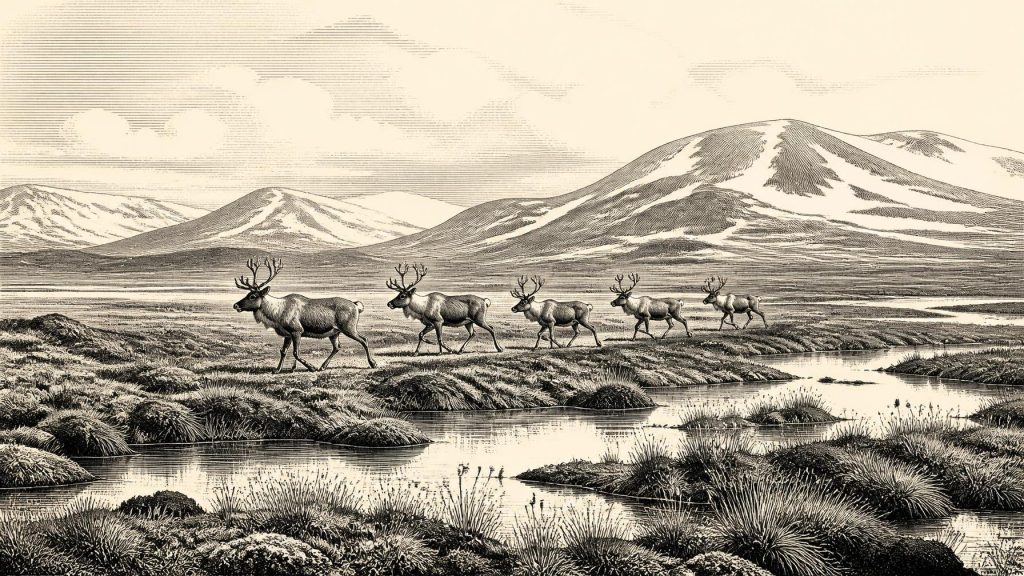
What Derryvree does preserve is a rare local picture of conditions between glacial advances. Plant macrofossils, pollen and insects indicate open, treeless tundra or muskeg: wet ground with pools, mosses, sedges, grasses, dwarf shrubs and herbs rather than forest. Fossils include plants associated with cold climates, among them bogbean, mountain-avens, Arctic willow and rosy saxifrage. Beetle evidence supports a periglacial wetland with standing water and decaying plant matter. This was not lifeless frozen desert. It was a severe but productive mosaic in which liquid water persisted locally during the growing season.
The distinction matters. Derryvree is evidence for a particular northern Irish deposit, not a complete map of all Ireland, and its plants do not yield a precise mean temperature for 31,292 BCE. Yet it firmly overturns any picture of an island wholly sealed under ice or ecologically blank. At least during the formation of these sediments, northern Ireland had an exposed landscape capable of supporting wetland vegetation, insects and herbivores. The later upper till demonstrates how vulnerable such habitats were: a renewed advance buried and preserved them beneath glacial sediment.
Castlepook’s Animal Archive
In the south, Castlepook Cave near Doneraile, County Cork—also called Mammoth Cave—provides Ireland’s most important pre-Last Glacial Maximum animal archive. Antiquarian excavations recovered large quantities of bone from its passages in the early twentieth century. The collection includes remains attributed to woolly mammoth, reindeer, giant deer, brown bear, wolf, Arctic fox, mountain hare, collared lemming, Norwegian lemming and spotted hyaena. Such a list evokes an unfamiliar Ireland, one connected ecologically with the cold-stage fauna of north-west Europe.
It would nevertheless be wrong to turn that list into a single dramatic scene set in 31,292 BCE. Castle deposits accumulated through many processes and over long periods. Carnivores could carry bones into caves; animals could die in fissures; water could move material; and early excavation methods did not preserve the detailed stratigraphic context expected today. Some specimens are demonstrably of different ages. Improved ultrafiltration and radiocarbon methods have also shown that several older Irish cave dates needed reassessment, pushing parts of the Castlepook fauna farther back into MIS 3. The cave is therefore an archive of recurring animal presence and changing conditions, not a sealed one-day hunting camp.
Even with those cautions, the fauna is historically important. Reindeer and lemmings indicate cold, open country; mammoths and giant deer suggest substantial grazing landscapes; wolves, bears and hyaenas show that large carnivores occupied or ranged through the same wider world. Spotted hyaena is especially striking because Castlepook is Ireland’s key locality for the species. Hyaenas are not evidence of an African-type climate: Late Pleistocene spotted hyaenas were part of European cold-stage ecosystems. Their denning and scavenging behaviour may itself explain why portions of the bone collection came to rest underground.
The Reindeer Femur
The one object that makes this period particularly consequential for Irish human history is a fragment of reindeer femur from Castlepook. Re-examination of the bone identified a deep surface incision interpreted by zoologist Ruth Carden as a cut made with a sharp stone tool while fresh tissue was still present. Public heritage interpretation has placed the find at about 31,000 BCE, broadly close to the date considered here. If that diagnosis is sustained, it would indicate that at least one person processed a reindeer in Ireland during the Upper Palaeolithic, vastly earlier than the formerly accepted evidence for human activity on the island.
But the wording ‘if’ is essential. A radiocarbon result dates the death of the animal, not automatically the moment when a mark was made, the place where butchery occurred, or the identity of the maker. The bone came from a disturbed cave collection rather than a secure, excavated occupation surface. There is no stone-tool assemblage, hearth, dwelling, human burial or repeated processing floor from Ireland of comparable age. The 2022 Castlepook Caves Project recovered animal bones and investigated surviving deposits, but it did not establish a Palaeolithic cultural layer or artefact assemblage.
The careful conclusion is modest but significant. Castlepook offers possible evidence of human handling of a reindeer, not proof of a permanent population, village, named people or established hunting territory. A carcass could have been processed in the open and a discarded element later drawn into the cave by scavengers. Equally, an ephemeral visit by a small mobile party could leave only such a fragmentary trace, especially in a landscape later altered by advancing ice, erosion and rising seas. The absence of a camp is not proof that no one came; nor does one marked bone demonstrate sustained settlement.
People Without Polities
For conventional political history, 31,292 BCE is silent. There were no identifiable Irish states, rulers, borders, diplomatic missions or wars in the evidence. Nor can archaeology responsibly assign any possible visitors to an Aurignacian, Gravettian or other named continental tradition, because Ireland has not produced diagnostic toolkits from this time. Continental Upper Palaeolithic communities certainly possessed sophisticated knowledge of stone-working, clothing, fire, hunting and long-distance social connections, but those broader European facts cannot simply be imported to Ireland as local evidence.
The same restraint applies to religion, culture and learning. No Irish cave art, portable art, grave, ritual deposit, musical instrument, personal ornament or symbolic object can presently be dated to around 31,292 BCE. There is consequently no basis for describing beliefs, languages, kinship systems or ceremonies. If people were present, their practical knowledge would have been formidable: reading animal movement, locating fuel and shelter, managing cold exposure and navigating a changing terrain. Yet this is an inference from survival requirements and comparative Upper Palaeolithic evidence, not a directly observed Irish social world.
Subsistence, Movement and Loss
No economy in the later sense can be reconstructed. There were no farms, fields, livestock, metalworking or documented trade networks. The plausible resources in a cold open landscape included reindeer meat, marrow, hide, sinew, antler and bone, alongside smaller animals and wetland plants, but Castlepook cannot establish which materials were used or whether its reindeer was hunted rather than scavenged. A single bone does not reveal seasonal rounds, exchange relationships or population size.
What can be said is that Ireland lay on a shifting north-western edge of humanly habitable territory. Its animal record shows that cold-adapted mammals reached the island during MIS 3. Its buried sediments show that some landscapes supported plant and insect communities between episodes of ice expansion. Its possible human trace suggests that people may have entered that world too. Subsequent glaciation would reshape the land and severely reduce the chance that open-air camps survived. The historical importance of 31,292 BCE therefore lies not in a named event but in a threshold: Ireland was an intermittently viable Ice Age landscape, with the faint possibility that human visitors briefly shared it with reindeer, mammoths and hyaenas.
Primary Sources
- A Middle Midlandian Freshwater Series at Derryvree, Maguiresbridge, County Fermanagh, Northern Ireland
- The Irish Quaternary Fauna Project
- A Reconsideration of the Radiocarbon Dating of the Marine Isotope Stage 3 Fauna from Southern Ireland
- Trimlines, Blockfields and the Vertical Extent of the Last Ice Sheet in Southern Ireland
- Growth and Retreat of the Last British–Irish Ice Sheet, 31,000 to 15,000 Years Ago: the BRITICE-CHRONO Reconstruction
- Episodic Speleothem Deposition Tracks the Terrestrial Impact of Millennial-Scale Last Glacial Climate Variability in SW Ireland
- A Stratigraphic Framework for Abrupt Climatic Changes During the Last Glacial Period Based on Three Synchronized Greenland Ice-Core Records
- The IntCal20 Northern Hemisphere Radiocarbon Age Calibration Curve (0–55 cal kBP)
- The Problem of a Late Quaternary Landbridge Between Britain and Ireland
- Deglaciation, Earth Crustal Behaviour and Sea-Level Changes in the Determination of Insularity: A Perspective from Ireland
- Ireland: Submerged Prehistoric Sites and Landscapes
- New Insights on the Fauna of Ireland’s Younger Dryas and Early Holocene from Alice & Gwendoline Cave
- First Evidence of a Late Upper Palaeolithic Human Presence in Ireland
- Castlepook Caves Project: Archaeology Research Excavation Grant 2022 Final Report
- 2022:564 – Castlepook Cave, Castlepook South, Cork
- Heritage Artefacts of County Cork
- Palaeoecology: Quaternary Research Association Field Guide
- The Subdivision of the Quaternary Period in Ireland
- Pleistocene Vertebrates in the British Isles
- Dimensions and Chronology of the Last Ice Sheet in Western Ireland
- Stratigraphic and Palaeo-Geomorphological Evidence for the Glacial-Deglacial History of the Last British-Irish Ice Sheet in the North-Western Irish Sea
- Irish Caves Database: Mammoth Cave