Fermanagh’s Thirty-Millennia Silt31208 BCE
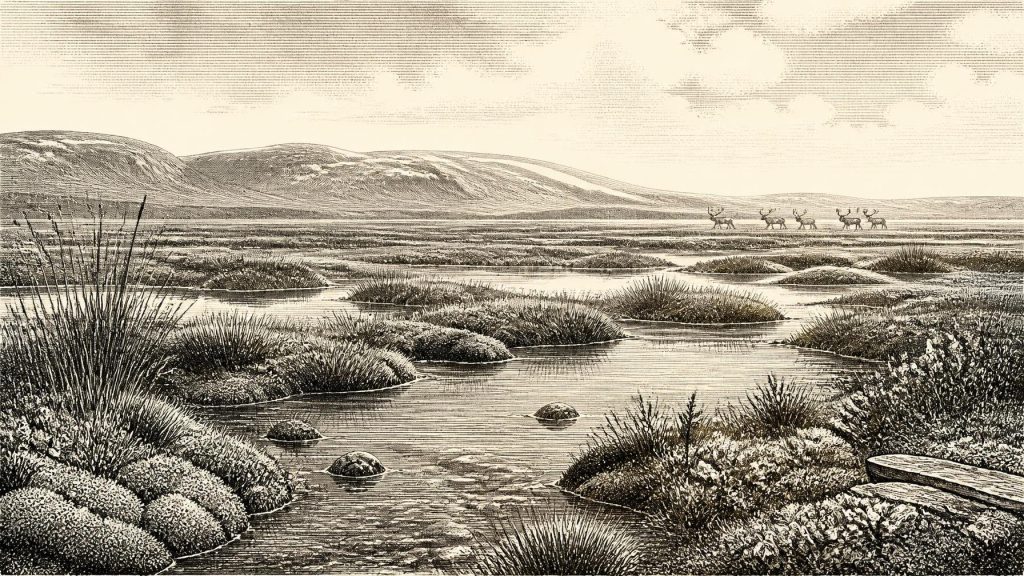
31,208 BCE is a modern label rather than a recoverable Irish year; radiocarbon calibration permits only broad chronological ranges. At Derryvree, County Fermanagh, freshwater silts between tills, dated broadly to 36,900–31,700 calibrated years BP, record a local ice-free, treeless wetland of sedges, mosses and arctic-alpine plants during unstable MIS 3 conditions. Cave calcite confirms climatic fluctuation, while ice extent remains uncertain. Castlepook Cave, County Cork, preserves mixed remains of Pleistocene mammals, suggesting intermittent access for fauna. A marked reindeer bone may indicate early human butchery, but disturbed deposits preclude claims for settlement. No evidence supports polities, farming, occupation, or events.
Dateline
31,208 BCE is a modern chronological label, not a date that can be recovered from an Irish annal, seasonal camp, or individual archaeological layer. It stands about 33,157 years before AD 1950, the conventional “present” of radiocarbon reporting, but that arithmetic does not turn it into a precisely knowable year. At this depth in time, radiocarbon determinations require calibration and commonly yield ranges of centuries or millennia. The responsible subject is therefore Ireland around this point in the later part of Marine Isotope Stage 3 (MIS 3), within the last Ice Age, rather than an invented event on a particular day or in a particular year.
Evidence Beneath a Drumlin
The closest well-dated Irish environmental evidence comes from Derryvree, near Maguiresbridge in County Fermanagh. Roadworks in 1969 cut through a drumlin and revealed freshwater silts and fine sands trapped between two thick sheets of glacial till. The deposit is exceptionally valuable because it demonstrates an interval in which this locality was not overridden by ice: water, sediment and vegetation accumulated before a later ice advance sealed the evidence. A conventional radiocarbon determination, BIRM-166, was reported as 30,500 +1,170/−1,030 radiocarbon years BP. Later calibration places the organic deposit broadly within about 36,900–31,700 calibrated years BP, a span that includes the notional year considered here.
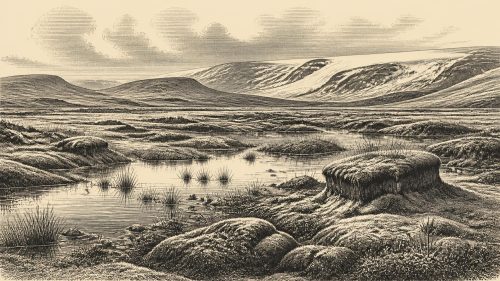
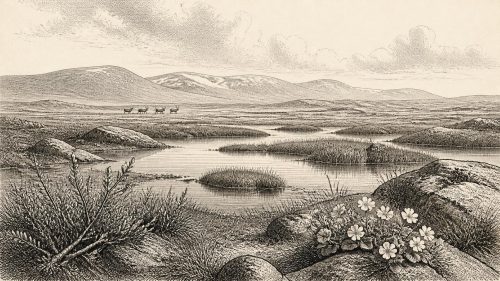
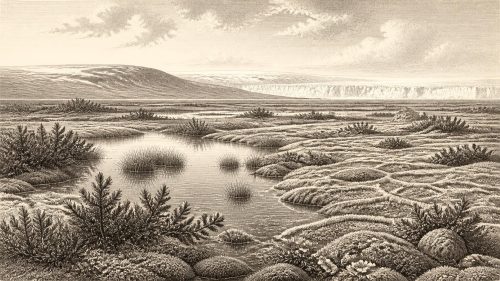
That range is not an annual diary. It cannot tell us what happened in 31,208 BCE at Derryvree, nor prove that the whole island shared the same conditions at the same moment. Yet it provides an unusually direct local picture of an Irish landscape during the right broad interval. Plant macrofossils, pollen and other biological remains point to a treeless, cold freshwater wetland or muskeg: pools and slow water bordered by sedges, mosses and low-growing arctic-alpine vegetation. Such evidence records habitats, not political borders or human communities. It nevertheless establishes that parts of Ireland could support freshwater ecosystems during an otherwise severe glacial age.
A Changeable Ice-Age Island
At this time Ireland belonged to a climate system that changed abruptly and repeatedly. Greenland ice-core records identify a sequence of stadial and interstadial shifts during the last glacial period; warming episodes could unfold rapidly by geological standards, while colder phases curtailed plant growth and encouraged the advance of ice. Irish cave calcite from Crag Cave, County Kerry, provides an independent terrestrial indication of this instability. Stalagmites form only when liquid water can percolate through the cave, and their episodic growth in MIS 3 is consistent with intervals of climatic amelioration alternating with much colder conditions.
It would be misleading, however, to picture either a uniformly frozen Ireland or a comfortably habitable green island. The distribution of ice, snow, exposed ground and wetlands varied regionally and changed through time. Modern reconstructions can model ice cover at thousand-year steps, but their most detailed island-wide sequence begins around 31,000 years ago, later than this nominal date. Work on the wider British–Irish Ice Sheet also emphasises that pre-Last Glacial Maximum ice growth and retreat during MIS 3 remain less securely resolved than the final maximum and subsequent retreat. Derryvree’s inter-till sediments therefore matter precisely because they demonstrate local ice-free conditions within an uncertain, dynamic wider picture.
The landscape around the Derryvree wetland was not forested. Long winters, short growing seasons, frost-shattered ground and sparse plant cover would have constrained both animals and any passing people. In sheltered low ground, summer thaw could sustain water plants and grazable vegetation; on exposed uplands and open plains, wind and cold would have been formidable. The evidence permits an interpretation of a mosaic of pools, sedge-rich margins, damp ground and open tundra-like terrain. It does not permit a map of every river, coast or ice margin, still less a reconstruction of weather in a single named year.
Castlepook and the Human Question
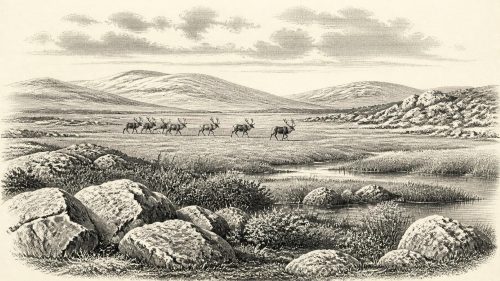
South-west of Derryvree, Castlepook Cave near Doneraile in north County Cork is the principal faunal archive for this distant period. Its historical excavations produced remains attributed to a striking range of Pleistocene mammals, including mammoth, giant deer, reindeer, horse, bear, wolf, Arctic fox, lemmings and spotted hyaena. Direct dating from the wider Castlepook collection indicates that mammals reached Ireland during several separate phases between at least about 45,000 and 20,000 radiocarbon years ago. The cave is therefore evidence for an intermittently accessible Irish landscape, not for one simultaneous “Ice Age fauna”.
The site has special relevance because a reindeer femur from Castlepook has been reported as around 33,000 years old and bears a deep mark interpreted as having been made by a sharp stone implement during fresh-bone butchery. If that diagnosis is sustained, it may be evidence that people processed a reindeer in Ireland tens of millennia earlier than the traditionally accepted terminal-Pleistocene record. It is an important proposition, but not a licence to describe a settlement, tribe or hunting expedition in 31,208 BCE. The femur provides a possible trace of activity within a broad period, rather than a date-stamped event.
Caution is especially necessary because Castlepook’s deposits were explored in the early twentieth century, long before present-day standards of stratigraphic excavation, screening, microscopic taphonomic study and accelerator dating. Carnivores, water movement, collapse and earlier collecting all affected the cave archive. A radiocarbon date measures when the animal died, not necessarily the instant at which any surface mark was made; identifying that mark as humanly produced is a separate zooarchaeological judgement. Earlier work on Irish cave faunas repeatedly found that bones of very different ages had become mixed in apparently similar contexts. Castlepook is consequently best treated as a vital but complicated archive.
Animals, Subsistence and Mobility
The faunal evidence makes clear that Ireland was not biologically empty during the broader MIS 3 interval. Reindeer imply open vegetation and seasonal grazing opportunities; mammoth and giant deer belong to the wider cold-stage large-mammal world; hyaena and wolf indicate predators and scavengers within the same broad ecological network. But individual species’ dates need not overlap exactly, and cave assemblages may represent denning, scavenging, natural deaths or material washed into chambers. The secure conclusion is that animal populations entered and used parts of Ireland at different points before the fullest expansion of the last ice sheet.
If humans did visit, their economy would have depended on mobility, knowledge of animal movements, fuel, shelter and the seasonal availability of food rather than farming or permanent village life. Reindeer meat, marrow, hide, sinew and bone would have been useful resources, but Castlepook has not produced a securely associated hearth, dwelling floor, tool assemblage or processing area of this age. Nor is there evidence for agriculture, livestock, pottery, metalworking, monuments, burial practice or a settled population. A brief foray by a very small group and a longer occupation would leave different archaeological signatures; neither can presently be demonstrated for Ireland around this date.
No Polities, No Proven Diplomacy
Political affairs, warfare, diplomacy, law, religion and formal learning cannot responsibly be reconstructed for Ireland in this period. There are no names, written records, settlements or ritual structures. Likewise, no evidence identifies trade routes or exchange partnerships. It is reasonable to infer that any people capable of reaching Ireland were part of wider Upper Palaeolithic worlds beyond the island, but it is not evidence that they maintained a regular Irish population or a defined maritime network. Even the practical route remains unresolved: lowered sea levels altered coastlines, yet the exact crossings, exposed shelves and ice barriers relevant to any visit cannot be specified from the present evidence.
The cultural achievement visible here is instead modern scientific reconstruction. At Derryvree, sediments, pollen and plant fragments preserve a brief environmental window between glaciations. At Castlepook, bones preserve evidence of animals and a provocative possible human action, while simultaneously demonstrating how difficult cave deposits are to interpret. These archives shift attention away from imagined chiefs and battles towards the real drama of deep Irish time: climate oscillation, advancing ice, freshwater refuges, animal movement and the possibility of a fleeting human presence at Europe’s Atlantic edge.
For 31,208 BCE, then, the most defensible account is deliberately modest. Ireland contained, at least in some regions and at some points within this broad calibrated interval, cold open landscapes capable of supporting wetlands and large mammals. Derryvree proves one local ice-free freshwater episode; Castlepook preserves a long, mixed faunal record and a potentially momentous but still limited clue to human butchery. Beyond that, modern calendar-year precision disappears. The evidence illuminates conditions and possibilities, not a recoverable Irish “year” in the historical sense.
Primary Sources
- A Middle Midlandian Freshwater Series at Derryvree, Maguiresbridge, County Fermanagh, Northern Ireland
- Dublin Radiocarbon Dates II
- The Irish Quaternary Fauna Project
- The Exploration of Castlepook Cave, Co. Cork. With 3 Plates.
- Heritage Artefacts of County Cork
- Episodic Speleothem Deposition Tracks the Terrestrial Impact of Millennial-Scale Last Glacial Climate Variability in SW Ireland
- Growth and Retreat of the Last British–Irish Ice Sheet, 31,000 to 15,000 Years Ago: The BRITICE-CHRONO Reconstruction
- The Timing and Magnitude of the British–Irish Ice Sheet Between Marine Isotope Stages 5d and 2: Implications for Glacio-Isostatic Adjustment, High Relative Sea Levels and ‘Giant Erratic’ Emplacement
- Exploring Controls on the Last Deglaciation of the Northern Sector of the British–Irish Ice Sheet
- Dimensions and Chronology of the Last Ice Sheet in Western Ireland
- Cosmogenic 10Be Chronology of the Last Deglaciation of Western Ireland, and Implications for Sensitivity of the Irish Ice Sheet to Climate Change
- Deglaciation Chronology of the Donegal Ice Centre, North-West Ireland
- The IntCal20 Northern Hemisphere Radiocarbon Age Calibration Curve (0–55 cal kBP)
- A Stratigraphy Framework for Rapid Climatic Changes During the Last Glacial Period Based on Three Synchronized Greenland Ice-Core Records
- Figure 6.— The Subdivision of the Quaternary Period in Ireland
- Publications
- Field Guides
- New Insights on the Fauna of Ireland’s Younger Dryas and Early Holocene from Alice & Gwendoline Cave
- Archaeological Excavations at Killuragh Cave, Co. Limerick: A Persistent Place in the Landscape from the Early Mesolithic to the Late Bronze Age
- The Geological Heritage of County Leitrim
- The Glacial Stratigraphy of the Sperrin Mountains and Its Relation to the Glacial Stratigraphy of North-West Ireland
- The Irish Quaternary Fauna Project
- Irish Pleistocene Biostratigraphy
- Timing, Pace and Controls on Ice Sheet Retreat: An Introduction to the BRITICE-CHRONO Transect Reconstructions of the British–Irish Ice Sheet