Derryvree’s Treeless Shore30187 BCE
30,187 BCE is a modern label within climatically unstable Marine Isotope Stage 3, not a recoverable Irish year. Derryvree, County Fermanagh, preserves freshwater silts beneath later glacial till, indicating treeless, cold wetland habitats with hardy plants and local biological productivity between ice advances. Castlepook Cave, County Cork, contains diverse late-Pleistocene fauna, including mammoth, reindeer, giant deer, hyaena and horse, though remains need not be contemporaneous. Ice expansion later erased much evidence. A marked reindeer femur may indicate Upper Palaeolithic butchery, but cannot demonstrate settlement or permanent population. No named communities, political structures, culture, routes or beliefs can be securely reconstructed.
Dateline
30,187 BCE is a modern chronological label, not a recoverable year in Irish history. It corresponds to roughly 32,136 years before the radiocarbon convention of AD 1950, but no Irish deposit can identify what happened in that particular twelve-month interval. There were no written records, named peoples, rulers or calendar systems from which to construct an annual narrative. The responsible historical setting is the later part of the Late Pleistocene, within Marine Isotope Stage 3 (MIS 3): a long, climatically unstable phase of the last Ice Age.
The closest evidence is neither a settlement nor a human grave. It is a buried freshwater deposit at Derryvree, near Maguiresbridge in County Fermanagh, and a scattered fossil record from caves, especially Castlepook Cave near Doneraile in north County Cork. These places do not give Ireland a diary for 30,187 BCE. They nevertheless show that parts of the island, in the wider millennia around that date, could be cold, open and biologically varied rather than uniformly entombed beneath ice.
A Date Without a Diary
Dates of this antiquity must be handled as ranges. Radiocarbon years are not identical to calendar years, because atmospheric carbon levels have changed through time; results must be calibrated against independently dated records. The main Derryvree measurement, BIRM-166, came from organic silts and fine sands and produced a conventional radiocarbon age of 30,500 years before present, with a large laboratory uncertainty. Published calibrations place its possible calendar age broadly in the late-thirty-to-low-thirty-thousand-years-before-present range. Thus 30,187 BCE lies within the broad horizon that Derryvree may illuminate, not at a pinpoint event visible in its sediments.
This distinction matters because the Irish record has been repeatedly disrupted. Glaciers eroded surfaces, redeposited sediments and later buried older landscapes under till. Caves collected bones through predation, scavenging, water movement and collapse; many were excavated before modern recording standards. Absence of evidence is therefore not proof that no person ever entered Ireland, but neither can gaps be filled by claims of lost tribes, villages or migrations.
Fresh Water Beneath the Ice
Derryvree was revealed during roadworks when a drumlin was cut open. Beneath a later sheet of glacial till lay freshwater silts and sands; below them was an older till. This layered sequence is unusually valuable. It demonstrates that, between episodes of glaciation, the locality supported standing or slow-moving fresh water and wet ground before ice again crossed the area and sealed the deposit.
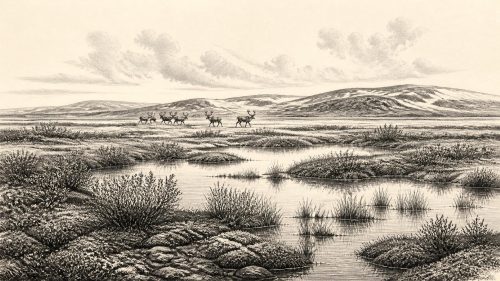
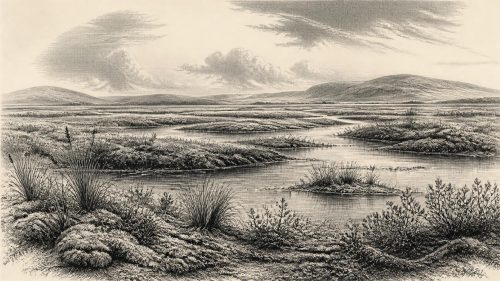
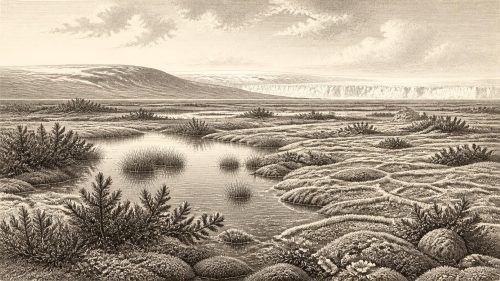
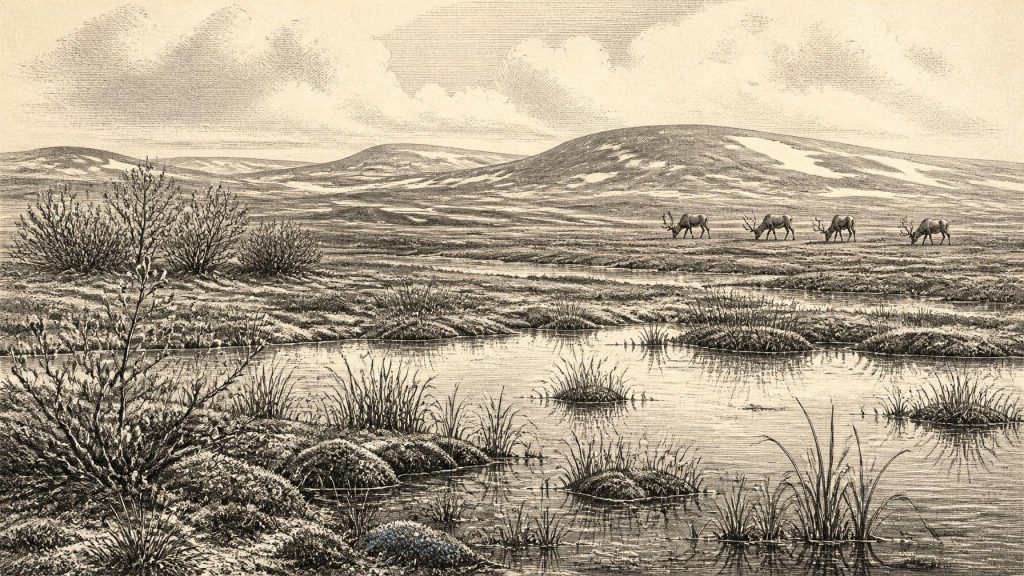
Plant and animal remains in the organic layer indicate a treeless, cold-climate wetland or muskeg. Sedges, mosses, dwarf willow and other hardy plants, along with aquatic species such as water-milfoil and bogbean, point to shallow pools, saturated margins and open vegetation. Such evidence does not justify imagining a single uniform tundra from Cork to Donegal. It does show that north-western Ireland had local freshwater habitats in an exposed, periglacial landscape. In a cold world, the difference between a sedge-fringed pool, a damp hollow and windswept mineral ground would have been ecologically decisive.
These plants also qualify the common image of an entirely lifeless Ice Age Ireland. There were no forests comparable to those of later millennia, but there was enough seasonal productivity to sustain insects, small animals and grazing mammals in favourable places. The Derryvree flora belongs to a living community, not merely to wind-blown fragments arriving from afar. Yet it is a local sample: it cannot establish annual temperatures, snowfall or vegetation cover for every Irish region.
Before the Greatest Ice Expansion
The year-label falls before the fullest known development of the last British–Irish Ice Sheet. Modern reconstructions show that ice-sheet growth and maximum extent were not simultaneous in every sector. Across Ireland and its surrounding shelf, expansion unfolded over thousands of years; the ice sheet’s greatest total volume is placed at about 23,000 years before present, while individual sectors reached their maxima at differing times between roughly 30,000 and 22,000 years ago.
Accordingly, Ireland around this broad horizon should not be described simply as either ice-free or wholly ice-covered. Ice masses, snowfields, frozen ground, meltwater channels and open ground could coexist across a changing landscape. The later advance was historically important in the deepest sense: it removed, rearranged or concealed much of the evidence that might otherwise tell us more about earlier animals and any people. Many apparent blanks in Ireland’s Palaeolithic record are therefore geological as well as archaeological.
MIS 3 was marked across the North Atlantic region by abrupt shifts between colder stadials and relatively milder interstadials. Greenland ice-core records provide the clearest chronology for these swings, but they cannot be translated mechanically into a weather report for Fermanagh or Cork. For Ireland, the safe conclusion is variability: climates, sea level, glacier margins and available habitats changed on scales far longer than a human year, but sometimes rapidly in geological terms.
Animals of an Open Country
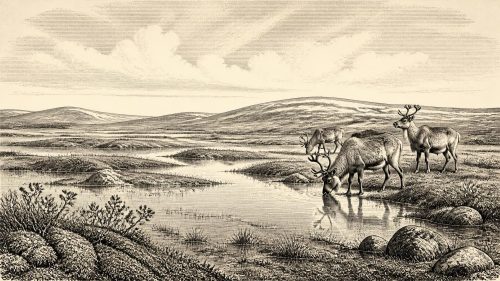
Castlepook Cave provides a striking complement to Derryvree. In the Awbeg Valley, it has yielded one of Ireland’s richest late-Pleistocene faunal collections: woolly mammoth, reindeer, giant deer, brown bear, spotted hyaena, wolf, Arctic fox, wild horse, hare and lemmings are among the animals reported from the cave system and its older collections. Re-dating has shown that several southern Irish cave faunas are substantially older than earlier measurements suggested, placing important elements within MIS 3 and indicating that giant deer and spotted hyaena may have disappeared locally before the Last Glacial Maximum.
That list is evidence for a very different Irish ecology, but it must not become an instant tableau. Not every species was necessarily alive together, every animal did not live beside the cave, and a cave’s bones need not represent ordinary local abundance. Hyaenas and other carnivores could have dragged carcass parts inside. Some bones may derive from natural deaths or be moved by sediment. Still, reindeer and horse are consistent with open grazing country; lemmings and Arctic fox with severe cold; and large herbivores with landscapes capable, at least intermittently, of producing substantial forage.
There is no basis for presenting mammoth as a routine feature of every Irish valley in 30,187 BCE. Its remains show that mammoths reached Ireland during the broader Ice Age, not that one stood at Derryvree in the nominated year. The same caution applies to giant deer, the animal later mythologised as the “Irish elk”. The Irish evidence belongs to shifting Pleistocene communities, not to a stable national fauna.
The Human Question
The most provocative object for this period is a reindeer femur from Castlepook, publicly reported as about 33,000 years old and bearing a deep linear mark interpreted by palaeozoologist Ruth Carden as consistent with fresh-bone cutting by a sharp stone tool. If the interpretation and chronology are sustained by further analysis, it could indicate that a person processed a reindeer in Ireland during the Upper Palaeolithic, far earlier than the better-established terminal-Pleistocene evidence from Alice and Gwendoline Cave in County Clare.
It does not establish a settlement. No securely associated hearth, stone-tool assemblage, house floor, burial, artwork or stratified camp of comparable age has yet been recovered at Castlepook. Nor does a single marked bone reveal whether an individual or small party hunted the animal, scavenged a carcass, visited once, returned seasonally, or crossed by a route now altered by sea-level change and glaciation. The bone’s old excavation history further limits contextual certainty. The appropriate description is possible evidence of human activity, not evidence of a permanent Irish population.
For the same reason, political affairs, diplomacy and organised conflict are beyond the evidence. There were no states, frontiers, kings or tribes identifiable by name. If people were present, they would have belonged to mobile Upper Palaeolithic hunter-gatherer worlds known elsewhere in north-west Europe, but assigning a particular archaeological culture to Ireland on this evidence would exceed what the record allows. There is likewise no evidence for formal religion, monuments, burial rites, trade networks or teaching institutions on the island at this date.
Life, Resources and Connections
Where human presence remains uncertain, economy can only be discussed conditionally. A person who cut a reindeer limb would have been obtaining meat, marrow, hide or sinew: resources central to hunter-gatherer survival in cold environments. That inference follows from the anatomy of a butchered carcass, not from a demonstrable Castlepook camp. Stone tools could have been carried in, used briefly and taken away, leaving little trace; but no tools have yet been found that prove such a scenario.
Lower global sea levels changed the outlines of surrounding coasts and exposed areas now submerged, yet this did not automatically create a simple dry-land bridge into Ireland. Routes were shaped by the evolving Irish Sea basin, glacier margins, rivers, coasts and seasonal hazards. Any connection with Britain or continental Europe is therefore best understood as a geographical possibility requiring more evidence, rather than as a proven migration corridor or trade route.
Culture and learning are similarly recoverable only in the most limited sense. The possible cut mark implies skilled use of a sharp edge; Derryvree’s deposits reveal the environmental knowledge that any visitor would have needed to acquire in order to move through open, wet and cold ground. But there is no direct Irish evidence here for language, art, belief or social organisation. The most important history of 30,187 BCE is therefore not a story of named people. It is the survival of a few fragile archives: a wetland preserved between tills, cave bones reassessed with modern methods, and the possibility—still unconfirmed in its full implications—that people briefly entered an Ice Age Ireland later transformed by advancing ice.
Primary Sources
- A Middle Midlandian Freshwater Series at Derryvree, Maguiresbridge, County Fermanagh, Northern Ireland
- Growth and Retreat of the Last British–Irish Ice Sheet, 31,000 to 15,000 Years Ago: The BRITICE-CHRONO Reconstruction
- Growth and Retreat of the Last British–Irish Ice Sheet, 31,000 to 15,000 Years Ago: The BRITICE-CHRONO Reconstruction (PDF)
- A Reconsideration of the Radiocarbon Dating of the Marine Isotope Stage 3 Fauna from Southern Ireland
- The Irish Quaternary Fauna Project
- Castlepook Caves
- Castlepook Cave, Cork: Excavation Report 2022:32564
- Archaeological Heritage of County Cork
- Introduction to the Late Quaternary and Holocene of Northern Ireland
- The Subdivision of the Quaternary Period in Ireland
- References and Recommended Reading: Irish Quaternary Association Guide
- Freshwater Organic Deposits and Stratified Sediments Between Early and Late Midlandian (Devensian) Till Sheets, at Aghnadarragh, County Antrim, Northern Ireland
- New Data for the Last Glacial Maximum in Great Britain and Ireland
- The IntCal20 Northern Hemisphere Radiocarbon Age Calibration Curve (0–55 cal kBP)
- The IntCal20 Northern Hemisphere Radiocarbon Age Calibration Curve (Full Text)
- Dansgaard–Oeschger Events in Climate Models: Review and Baseline Marine Isotope Stage 3 Protocol
- The Nature of MIS 3 Stadial–Interstadial Transitions in Europe: New Insights from Model–Data Comparisons
- Gulf Stream Variability During Marine Isotope Stage 3
- First Evidence of a Late Upper Palaeolithic Human Presence in Ireland
- New Insights on the Fauna of Ireland's Younger Dryas and Early Holocene from Alice and Gwendoline Cave