The Doneraile Reindeer Incision31156 BCE
Circa 31,156 BCE, Ireland was a climatically unstable Late Pleistocene landscape, not a precisely datable historical year. Before the Last Glacial Maximum, parts of the island remained ice-free, with Fermanagh sediments indicating cold, open wetlands, freshwater and sparse tundra vegetation. Castlepook Cave, County Cork, preserves fauna including reindeer, mammoth, giant deer, bear, wolf and hyaena, demonstrating ecological links with north-west Europe. A marked reindeer femur may record stone-tool butchery and possible Upper Palaeolithic human presence. However, its context is uncertain, and no associated settlement evidence exists. Ireland’s record supports cautious inferences about environments, roaming fauna and possible short-term human incursions.
Dateline
“31,156 BCE” is a modern numerical label, not a year that anyone then living in Ireland could have named or recorded. No written calendar, settlement sequence or archaeological layer can be fixed to that single year. In conventional archaeological terms, it falls at roughly 33,100 calibrated years before AD 1950, within the Late Pleistocene and Marine Isotope Stage 3, a climatically unstable stretch of the last Ice Age. The responsible account of Ireland at this point is therefore one of dated ranges, buried sediments, animal remains and carefully limited inference—not a chronicle of events.
An Island Before Full Glaciation
The best current reconstructions suggest that much of Ireland was not yet buried beneath the expanded ice sheet that would dominate the island during the Last Glacial Maximum. That maximum came later, broadly between about 26,500 and 19,000 years ago, although the exact advance and retreat of ice varied by region. For the time represented by 31,156 BCE, the evidence points instead to a cold, exposed and changing landscape in which ice, water and permafrost-like ground conditions could all be important without making the whole island uniformly glaciated.
North-central Ireland provides a particularly valuable clue. At Derryvree, near Maguiresbridge in County Fermanagh, road works exposed organic-rich silts and fine sands lying between two tills: deposits left by glacier ice. The freshwater sediments were laid down during an ice-free interval and later overridden or sealed by renewed glaciation. A radiocarbon determination from the sequence, when calibrated, spans approximately 36,900–31,700 calibrated years before present. That broad range encompasses the modern date used here, but it does not date a particular season, generation or occurrence in 31,156 BCE. It establishes that an ice-free freshwater environment existed in this part of Ireland during the wider interval.
Other sites reinforce the point that Ireland’s last glacial history was episodic rather than a single uninterrupted freeze. Deposits at Greenagho in Fermanagh and Aghnadarragh beside Lough Neagh preserve sediments formed between phases of ice advance. Geological evidence from southern and offshore Ireland shows that the major late-glacial expansion was still developing over many millennia. Regional conditions need not have been identical: a wet basin in Fermanagh, an upland slope in Munster and a cave in north Cork could each have experienced the same broad cold stage differently.
Wet Tundra, Open Ground
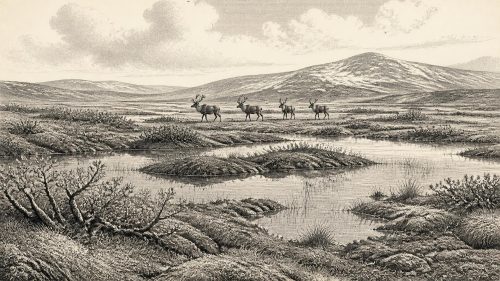
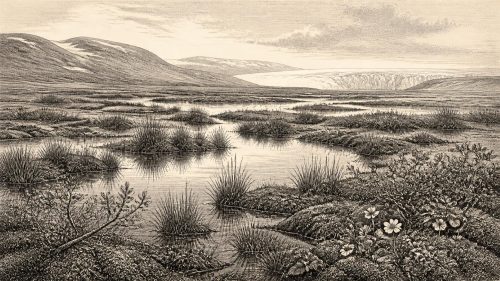
Derryvree is important because its fossils turn a geological interval into an ecological setting. Pollen, plant macrofossils, mosses and insect remains indicate sparse, predominantly open vegetation rather than continuous woodland. The landscape is commonly interpreted as tundra or tundra-like muskeg: damp, sedgy and mossy ground around shallow freshwater, with herbs and low shrubs able to survive short growing seasons, frost disturbance and severe winters. Such terms describe a reconstructed habitat, not a photograph of the whole island. The surviving sediments are local records, and the plants represented in them grew through an interval rather than on one precisely recoverable day.
The implication is nevertheless substantial. Parts of Ireland contained liquid freshwater, vegetation and animal forage during a period often casually imagined as a featureless white wilderness. There may have been marshes, pools, stream margins and better-drained open patches within a broader cold environment. Snow cover, frozen soils, seasonal flooding and wind exposure would have shaped where plants and animals could persist. This was not the later green, wooded Ireland familiar from Holocene archaeology; nor was it necessarily barren. It was a northern landscape with productivity concentrated in particular seasons and places.
Castlepook’s Faunal World
The clearest southern Irish evidence comes from Castlepook Cave near Doneraile, County Cork. Excavations there in the early twentieth century recovered an extraordinary collection of Late Pleistocene animal remains. Later radiocarbon work, including re-dating using improved bone-treatment methods, has shown that some of the cave’s fauna belongs to Marine Isotope Stage 3, much earlier than had once been thought. The collection includes reindeer, woolly mammoth, giant deer, brown bear, wolf, hare, fox, lemmings and spotted hyaena. These species were not necessarily contemporaries: cave deposits accumulated, were disturbed, and include material from different episodes. Yet together they demonstrate that Ice Age Ireland could, at intervals, support or receive a diverse cold-country fauna.
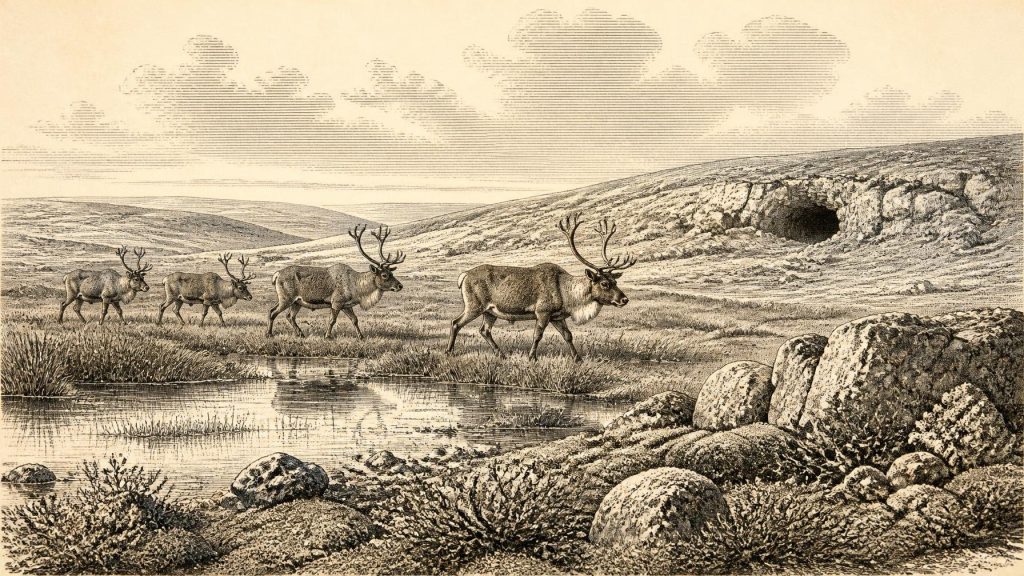
Reindeer are particularly evocative because they suit open, seasonal country and may have moved across wide territories. Mammoth, giant deer and hyaena point to connections with the wider north-west European mammal world, but fossils alone cannot reveal population size, migration routes or whether animals crossed a dry land corridor at this exact time. Lower global sea levels exposed more of the surrounding continental shelf than exists today, while changing ice margins, rivers and coastlines made routes complex. Ecological connection is securely suggested; a simple, permanent land bridge is not.
A Single Incision, A Large Question
The date is especially relevant because of a reindeer femur from Castlepook. Public accounts and local heritage interpretation have presented the bone as dating to about 31,000 BC and carrying a deep mark identified by palaeozoologist Ruth Carden as a stone-tool incision made while the animal was butchered. If that interpretation is confirmed, it would be striking evidence that people handled reindeer in Ireland during the Upper Palaeolithic, far earlier than the island’s long-established Mesolithic record.
Its limits are as important as its promise. The femur is not a house floor, hearth or tool kit. No securely associated stone tools, butchered assemblage, dwelling, grave, ornament, cave art or stratified occupation surface has yet been recovered from Castlepook for this phase. The cave’s early excavation history and its complex deposits make context difficult. A radiocarbon result dates the animal bone; determining whether a surface mark was produced by a human tool, carnivore activity, sediment movement or another process requires separate microscopic and taphonomic assessment. The prudent conclusion is that Castlepook offers a serious and potentially transformative indication of human activity, not proof of an established Irish population in this particular year.
Society Beyond the Evidence
There is no evidence from Ireland around this date for political communities, rulers, warfare, diplomacy, territorial boundaries or institutions. There is likewise no Irish evidence from which to reconstruct language, religion, kinship, formal learning, artistic traditions or trade. It would be tempting to borrow the richly documented Upper Palaeolithic cultures of continental Europe and Britain—mobile hunting groups, elaborate stone technologies, ornaments and images—and assign them to Ireland. That would turn regional analogy into fact. At most, a genuine humanly made cut on the Castlepook femur would imply practical knowledge of a sharp stone implement and the processing of an animal carcass.
Nor can “economy” be used in its later sense. If people were present, their survival would have depended on mobility, seasonal judgement and access to animal and plant resources in a severe environment. Reindeer flesh, hide, sinew, bone and antler would have been useful resources to Upper Palaeolithic hunters elsewhere, but no Irish assemblage demonstrates how such materials were used here. The safest description is of possible short-term incursions into a landscape inhabited by large herbivores and predators, rather than a permanent settlement or trading society.
What Can Be Said Responsibly
Ireland around the notional date of 31,156 BCE was part of a dynamic Ice Age zone, not yet the fully ice-covered island of the later glacial maximum. Freshwater deposits beneath Fermanagh tills preserve evidence of cold, open wetland environments during a date range that includes this point. Caves in north Cork preserve the remains of mammals adapted to, or capable of occupying, open northern landscapes. The Castlepook reindeer femur raises the possibility that people also reached Ireland during this phase.
That is already a remarkable historical picture, even without invented chiefs, battles or campsites. The material record shows an Ireland repeatedly reshaped by climatic change, linked ecologically to neighbouring regions and capable of sustaining a distinctive Ice Age fauna. It also shows why certainty must remain limited. Each new radiocarbon measurement, re-excavation and microscopic study has the potential to alter the story. For now, the most honest history of this numbered year is a landscape of cold wetlands, roaming animals, advancing future ice—and one contested cut on a reindeer bone.
Primary Sources
- A Reconsideration of the Radiocarbon Dating of the Marine Isotope Stage 3 Fauna from Southern Ireland
- The Irish Quaternary Fauna Project
- Trimlines, Blockfields and the Vertical Extent of the Last Ice Sheet in Southern Ireland
- Growth and Retreat of the Last British-Irish Ice Sheet, 31,000 to 15,000 Years Ago: The BRITICE-CHRONO Reconstruction
- Stratigraphic and Palaeo-Geomorphological Evidence for the Glacial-Deglacial History of the Last British-Irish Ice Sheet in the North-Western Irish Sea
- Late Pleistocene Chronostratigraphy and Ice Sheet Limits, Southern Ireland
- Timing and Pace of Ice-Sheet Withdrawal Across the Marine-Terrestrial Transition West of Ireland During the Last Glaciation
- The Deglaciation of the Western Sector of the Irish Ice Sheet from the Inner Continental Shelf to its Terrestrial Margin
- Irish Pleistocene Biostratigraphy
- Freshwater Organic Deposits and Stratified Sediments Between Early and Late Midlandian (Devensian) Till Sheets at Aghnadarragh, County Antrim, Northern Ireland
- Aghnadarragh
- Mammoth and Musk Ox ESR Dated to the Early Midlandian at Aghnadarragh County Antrim, Northern Ireland and the Age of the Fermanagh Stadial
- The IntCal20 Northern Hemisphere Radiocarbon Age Calibration Curve (0–55 cal kBP)
- IntCal
- A 60,000 Year Greenland Stratigraphic Ice Core Chronology
- Stratigraphic Framework for Abrupt Climatic Changes During the Last Glacial Period Based on Three Synchronized Greenland Ice-Core Records
- High-Resolution Record of Northern Hemisphere Climate Extending into the Last Interglacial Period
- New Insights on the Fauna of Ireland’s Younger Dryas and Early Holocene from Alice & Gwendoline Cave
- The Exploration of Castlepook Cave, County Cork
- Heritage Artefacts of County Cork
- Ireland’s Palaeolithic Archaeology – Fleeting Footprints in a Frozen Land
- The Mesolithic in Ireland: When Was It?