

Cork’s Pre-Ice Reindeer Cutmark31143 BCE
Around 31,143 BCE, Ireland experienced the unstable Late Pleistocene climate of Marine Isotope Stage 3, before maximum glaciation. Evidence is fragmentary and local. Derryvree, County Fermanagh, preserves an ice-free periglacial wetland, dated broadly to 36,900–31,700 years ago, supporting tundra vegetation, insects and shallow pools before later burial by ice. Castlepook Cave, County Cork, contains mixed remains of reindeer, mammoth, giant deer and predators, demonstrating cold-adapted fauna but not a single contemporary ecosystem. A reindeer femur may bear a stone-tool cutmark, suggesting brief Upper Palaeolithic carcass processing. However, it does not establish settlement, routes, culture or permanent human occupation in Ireland.
Dateline
“31,143 BCE” is a modern chronological label, not a year that anyone in Ireland could have named or recorded. At this depth of time there were no written calendars, dated settlements, rulers or events on the island. Calendar-year precision is unavailable: the label corresponds only approximately to 33.1 thousand calibrated years before present, where “present” conventionally means AD 1950. The responsible history of Ireland at this point is therefore not an annual chronicle, but a reconstruction from cave bones, buried wetland sediments, pollen, insects, mosses, landforms and radiocarbon measurements with wide uncertainty ranges.
A Late Pleistocene Interval
The notional date falls in the later part of Marine Isotope Stage 3, a climatically unstable phase of the last Ice Age. It preceded the fullest expansion of the last British–Irish Ice Sheet, which reached its major maximum only later, broadly during the period from about 27,000 to 23,000 calibrated years before present in Irish waters and on the surrounding shelf. Ireland was not yet simply a country entombed beneath a single unbroken ice sheet. Conditions differed sharply by region and changed repeatedly through time; ice margins, periglacial ground, wetlands, caves and more open terrain all belonged to a changing northern Atlantic landscape.
This distinction matters. Later glaciation eroded, transported and buried much evidence from earlier periods, so apparent absences in the archaeological record cannot automatically mean that people or animals were absent. Equally, the survival of a bone or sediment bed does not prove that its conditions extended across the whole island at one moment. The evidence offers local windows, not a complete map. Its strongest value lies in establishing what kinds of environments and animals were possible in Ireland over broad spans, rather than supplying a precise scene for a particular modern calendar year.
Derryvree’s Buried Wetland
The clearest Irish environmental evidence relevant to this approximate horizon was found at Derryvree, near Maguiresbridge in County Fermanagh. Roadworks in 1969 exposed organic silts and fine sands caught between two thick tills within a drumlin. The deposit produced a conventional radiocarbon determination of 30,500 +1,170/−1,030 radiocarbon years BP. Later calibration places it broadly between about 36,900 and 31,700 calibrated years BP, a range that includes the notional date considered here. It is not a deposit laid down on one day, one season or one named year; it accumulated through an interval.
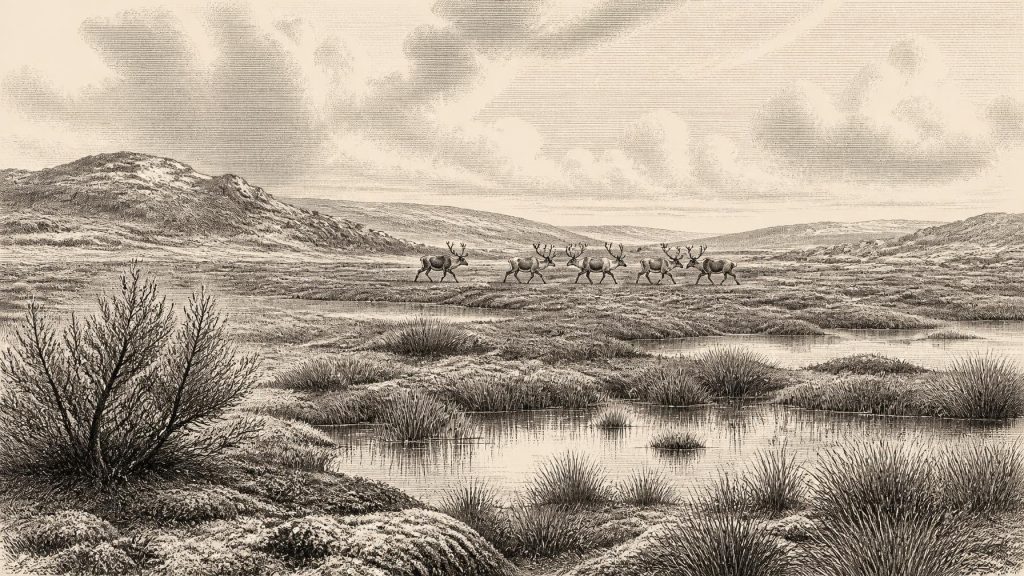
Its plant and animal traces nevertheless provide unusually direct evidence for the character of one Irish landscape. Pollen, seeds, mosses and beetle remains indicate open, treeless tundra or muskeg: a wet, cold mosaic of sedges, herbs, mossy ground and shallow freshwater pools. Plants associated with milder woodland should not be inferred from the few poorly preserved grains sometimes recovered in such deposits. The stronger signal is of sparse vegetation, prolonged winter cold and ground shaped by freezing and thawing. Derryvree was not modern green Ireland in miniature, but neither was it necessarily an empty white desert. It was a periglacial wetland able to sustain specialised plant and insect communities.
The deposit also gives an important warning about regional change. It lies between tills, demonstrating an ice-free interval at that location before later ice overran and sealed the wetland beneath glacial sediment. In south-west Ireland, speleothem records from Crag Cave likewise show episodic formation during warmer phases of MIS 3, when liquid water could circulate underground. Together, these archives support an interpretation of repeated climatic shifts rather than a simple, uninterrupted descent into maximum glaciation. They do not establish that Fermanagh and Kerry experienced identical weather, vegetation or ice cover at exactly the same time.
The Castlepook Faunal World
County Cork supplies the other principal body of evidence. Castlepook Cave, near Doneraile and also known as Mammoth Cave, produced an exceptionally important collection of Pleistocene animal remains during antiquarian excavations between 1904 and 1912, with further finds later. The wider cave assemblage includes reindeer, woolly mammoth, giant deer, brown bear, wolf, Arctic fox, mountain hare, lemmings and spotted hyaena. These animals were not necessarily all contemporaries, and their bones do not represent one intact food web. Cave deposits may combine material brought in by predators, water, natural deaths, collapse and excavation over many millennia.
Even with that caution, Castlepook establishes that Ireland formed part of the wider north-west European world of cold-adapted large mammals during the Late Pleistocene. Reindeer are particularly evocative because their presence is compatible with open country and seasonal movement across broad grazing landscapes. Mammoth and giant deer point to substantial herbivore resources, while hyaena and wolf remind us that people, if present, would not have held exclusive command over caves or carcasses. Caves could be dens, traps, shelters or repositories; they should not casually be called human homes.
Modern redating has also changed this evidence. Improved pretreatment and ultrafiltration techniques showed that several radiocarbon measurements obtained from Irish cave bones in the 1990s were too young. At Castlepook, some replacement determinations proved between roughly 5,000 and 12,000 radiocarbon years older than the earlier results. This is a major methodological lesson for any account of 31,143 BCE: dates are evidence produced by particular samples and methods, not permanent facts immune to revision. The faunal record is secure in its broad significance, but individual dates and associations require continual testing.
The Reindeer Femur Question
The most consequential possible human evidence for this broad period is a reindeer femur from Castlepook. It has been publicly presented as approximately 33,000 years old and as bearing a deep surface modification interpreted by zooarchaeologist Ruth Carden as a cut or chop made with a sharp stone implement while a carcass was processed. If that interpretation is confirmed, it would indicate human handling of a reindeer in Ireland during the Upper Palaeolithic, dramatically earlier than the securely documented post-glacial settlement record. It would be an important discovery, but it is not a licence to populate the island with imagined tribes.
The limits are as important as the possibility. The bone came from an old collection, not a modernly excavated occupation surface with a fully recorded stratigraphy. A radiocarbon determination dates the death of the animal, not automatically the moment when a mark was made, and recognising a stone-tool cut is a separate taphonomic judgement. No associated hearth, lithic assemblage, dwelling, burial, repeated camp sequence or securely contemporary human bone has established a resident community in Ireland at this date. The cautious conclusion is that the femur may preserve evidence of a brief human visit or episode of carcass processing; it does not prove a permanent population, a migration route or biological descent from any later Irish people.
What Cannot Be Recovered
There is no evidence from which to reconstruct political authorities, diplomacy, warfare, laws, language or named communities in Ireland around this point. Nor is there material support for attributing a religion, art style, monument tradition or system of formal learning to possible visitors. If people did reach the island, the most that can responsibly be inferred is a small, mobile group capable of using a sharp stone edge and exploiting animal resources in a difficult environment. Whether they hunted the reindeer, encountered an already dead animal, removed meat, hide, sinew or marrow, or transported the bone into the cave cannot be decided from the surviving object.
Economy and trade must be described with equal restraint. A mobile foraging economy is a reasonable conditional interpretation if the cutmark is human-made, but there is no evidence here for settled farming, exchange networks, seafaring technology or regular commerce. Ireland’s precise relationship to Britain and the continental landmass at this time was governed by changing sea levels, exposed shelves, ice and coastal geography, yet no demonstrated route can be attached to the femur. The archaeological record preserves neither a boat nor a crossing party.
What can be said is both modest and remarkable. Around the broad interval represented by 31,143 BCE, parts of Ireland contained cold, open habitats with freshwater wetlands and substantial Ice Age fauna. Derryvree records a periglacial ecological community later sealed by ice; Castlepook preserves a long, complicated animal archive and a potentially transformative sign of human action. The story is not one of kings, settlements or a dateable event. It is Ireland before recorded history, when climate, ice and animal movement shaped the available world, and when one marked reindeer bone raises a question that further excavation and scientific analysis may yet answer.
Primary Sources
- A Middle Midlandian Freshwater Series at Derryvree, Maguiresbridge, County Fermanagh, Northern Ireland
- A Reconsideration of the Radiocarbon Dating of the Marine Isotope Stage 3 Fauna from Southern Ireland
- The Irish Quaternary Fauna Project
- New Insights on the Fauna of Ireland's Younger Dryas and Early Holocene from Alice & Gwendoline Cave
- Phylogeographic, Ancient DNA, Fossil and Morphometric Analyses Reveal Ancient and Modern Introductions of a Large Mammal: The Complex Case of Red Deer (Cervus elaphus) in Ireland
- Late Pleistocene Chronostratigraphy and Ice Sheet Limits, Southern Ireland
- Dimensions and Chronology of the Last Ice Sheet in Western Ireland
- Trimlines, Blockfields and the Vertical Extent of the Last Ice Sheet in Southern Ireland
- Maximum Extent and Dynamic Behaviour of the Last British–Irish Ice Sheet West of Ireland
- The Deglaciation of the Western Sector of the Irish Ice Sheet from the Inner Continental Shelf to its Terrestrial Margin
- Timing and Pace of Ice-Sheet Withdrawal Across the Marine–Terrestrial Transition West of Ireland During the Last Glaciation
- Oscillating Retreat of the Last British-Irish Ice Sheet on the Continental Shelf Offshore Galway Bay, Western Ireland
- Growth and Retreat of the Last British–Irish Ice Sheet, 31,000 to 15,000 Years Ago: The BRITICE-CHRONO Reconstruction
- The Timing and Magnitude of the British–Irish Ice Sheet Between Marine Isotope Stages 5d and 2
- Episodic Speleothem Deposition Tracks the Terrestrial Impact of Millennial-Scale Last Glacial Climate Variability in SW Ireland
- The IntCal20 Northern Hemisphere Radiocarbon Age Calibration Curve (0–55 cal kBP)
- Radiocarbon Dates from the Oxford AMS System: Archaeometry Datelist 31
- Palaeoecology: Irish Quaternary Association Field Guide
- Late Quaternary Stratigraphy and Glacial History of Southern Ireland – INQUA Field Guide
- Heritage Artefacts of County Cork
- University of Birmingham Radiocarbon Dates XI