BIRM-166’s Arctic Pools31142 BCE
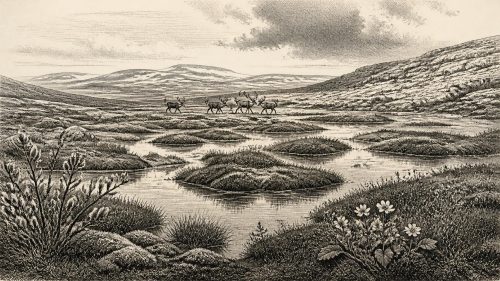
31,142 BCE is not archaeologically precise, but falls within MIS 3, a fluctuating Late Pleistocene phase. At Derryvree, County Fermanagh, organic freshwater sediments dated by BIRM-166 indicate a cold, periglacial wetland between ice advances, supporting grasses, sedges, juniper, mosses and shallow pools. Crag Cave evidence confirms climatic variability. Castlepook Cave, County Cork, preserves bones of mammoth, reindeer, giant deer, bear and hyaena, accumulated over extended periods. A possibly cut-marked reindeer femur suggests a transient Upper Palaeolithic human presence, but proves neither settlement nor culture. Ireland was a changing, largely treeless landscape repeatedly transformed by advancing ice with limited surviving evidence.
Dateline
Modern calendar-year precision is not available for Ireland in 31,142 BCE. No calendar, written source, settlement layer or identifiable event can be tied to that numbered year. It is best treated as a modern point within the Late Pleistocene, approximately 33,091 calendar years before AD 1950, during Marine Isotope Stage 3 (MIS 3), an unstable phase of the last glacial cycle. The nearest relevant Irish evidence is dated in broad ranges, not years. Most importantly, organic freshwater sediments at Derryvree near Maguiresbridge, County Fermanagh, produced the conventional radiocarbon determination BIRM-166: 30,500 +1,170/−1,030 radiocarbon years BP. With calibration, that is broadly about 36,900–31,700 calendar years BP. The requested date falls within that large range, but this does not mean that the deposit records a particular day, season or community in 31,142 BCE.
A Wetland Beneath a Drumlin
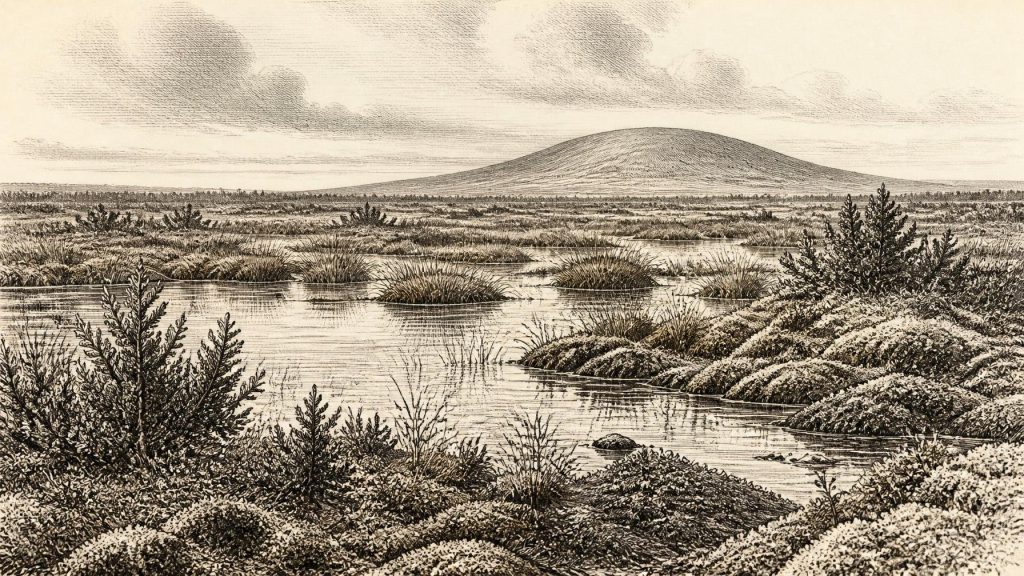
Derryvree was revealed by roadworks in 1969, when a cutting passed through a drumlin: a streamlined hill made largely of debris deposited by glacier ice. Beneath an upper till, and above an older till, investigators found fine sand, silt and organic-rich freshwater deposits. This sequence is the crucial fact. At least locally, ice had withdrawn or ceased to occupy the ground long enough for standing or slow-moving water, sediment and vegetation to accumulate. Ice later returned or expanded across the site, sealing the wetland below a new blanket of till.
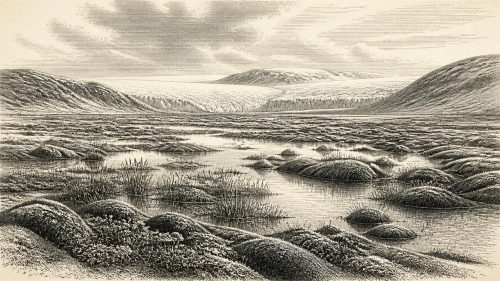
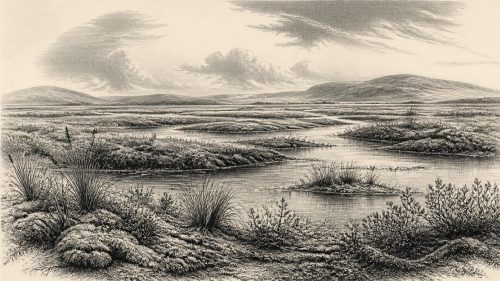
The Derryvree deposit is therefore neither a picture of a uniformly ice-free Ireland nor evidence for a mild interlude. It documents a cold, periglacial environment between glacial episodes in one part of Fermanagh. Its pollen, plant macrofossils, mosses and insect remains point to open, treeless ground and wetland habitats. Grasses, sedges, juniper and herbaceous plants occurred; moss-rich ground and shallow pools contained organic matter that could be preserved beneath later ice. The old term “muskeg”, used by the original investigators, conveys an uneven landscape of waterlogged vegetation, peat-like mud, pools and saturated ground rather than a modern bog.
This is exceptionally valuable evidence because the later British–Irish Ice Sheet eroded, displaced or buried so much older ground surface. Derryvree survived as a small environmental archive caught between tills. It permits a responsible reconstruction of a cold northern Irish wetland during the wider period, but it cannot establish the weather in the named year, the precise duration of the wetland, or whether comparable terrain covered every Irish region.
Cold Ground, Living Water
The landscape implied by Derryvree was severe but not lifeless. In the growing season, low plants could exploit brief thawed conditions around freshwater. Sedges and grasses offered cover and food; mosses colonised persistently damp surfaces; dwarf shrubs and scattered juniper marked better-drained patches. In winter, freezing conditions and snow would have sharply limited plant growth. The evidence is consistent with tundra-like, strongly seasonal country, not woodland, pasture or farmland.
South-west Ireland supplies a complementary, though differently dated, climatic record. Uranium-series dates from speleothems in Crag Cave, County Kerry, show that the last glacial period was interrupted by episodes in which liquid water again infiltrated shallow caves and calcite could grow. Such growth indicates intervals less persistently frozen than full stadial conditions. It does not date a Derryvree pool directly, but it confirms that Irish climates during MIS 3 could alter markedly on millennial scales. A single label such as “Ice Age” should not conceal that variability.
There were no cultivated fields, domesticated stock, roads, harbours or managed woodland. Nor can the Derryvree evidence reveal language, kinship, law or social rank. It does reveal the environmental foundations upon which any animal or human visitor would have depended: accessible water in some seasons, sparse vegetation, exposed ground and the hazards of frost, wind and changing ice margins.
Castlepook’s Uneven Faunal Record
At the opposite end of the island, Castlepook Cave near Doneraile in County Cork provides the principal animal archive relevant to this deep period. Early excavators recovered a large collection of bones from its limestone passages and chambers, giving the cave its alternative name, Mammoth Cave. Woolly mammoth, reindeer, giant deer, brown bear and spotted hyaena are among the animals represented. Together they show that Ireland was, at intervals before the Last Glacial Maximum, connected ecologically to the wider north-west European world sufficiently for large mammals and predators to reach it.
That conclusion needs careful limits. A cave bone collection is not a census of a single valley in a single year. Carnivores may drag carcass parts into dens; water, frost, collapse and early excavation can move material; and the remains accumulated over a long period. Modern radiocarbon work has demonstrated that several older Irish cave dates required revision, with some Castlepook animals proving substantially older than previously supposed. The fauna should therefore not be imagined as one perfectly contemporaneous herd pursued by one set of predators.
Nonetheless, reindeer are especially plausible inhabitants of open, cold country, while mammoth and hyaena underline how unfamiliar this ecology was beside the later Irish fauna. Their presence speaks of mobility across changing landscapes, not of an enduring local ecosystem unaffected by climate. As ice advanced and retreated, suitable habitats and movement corridors would have changed repeatedly. Some populations may have vanished locally long before the ice sheet attained its later maximum extent.
The Human Question
A reindeer femur from Castlepook is the most important, and most disputed in implication, artefact-like trace for this period. It has been reported as carrying a deep mark interpreted by zooarchaeologist Ruth Carden as an incision made with a sharp stone edge while fresh bone was being processed. Public heritage material dates the bone broadly to about 31,000 BC. If the mark is confirmed as human-made and related to the animal’s age, it would be evidence that people handled a reindeer in Ireland in the Upper Palaeolithic, vastly earlier than the formerly accepted archaeological record.
Even then, the conclusion must remain narrow. The dated bone records when the animal lived, not automatically the exact time at which it was cut. The original finds came from antiquarian excavation rather than a modern, undisturbed occupation surface. No securely associated hearth, stone-tool assemblage, built shelter, burial, ornament or repeated butchery floor has established a camp at Castlepook of this age. The bone cannot show whether people killed the animal, scavenged it, removed meat or sinew elsewhere, or whether a carnivore later carried the limb into the cave.
Accordingly, permanent settlement cannot responsibly be claimed for Ireland in 31,142 BCE. A transient visit by mobile hunter-gatherers is possible if the cut-mark interpretation stands; an established population, seasonal round, boat technology, clothing style or social identity cannot be recovered from this evidence. Upper Palaeolithic peoples elsewhere in Europe possessed sophisticated stone technologies, fire, tailored clothing and extensive social connections, but those comparisons describe possibilities, not demonstrated Irish facts.
No Polities, No Diplomacy
Political affairs, warfare, diplomacy, religion and formal learning lie beyond the evidence. There were no known Irish kingdoms, tribes, named leaders, shrines, monuments or institutions. Nor does a reindeer bone provide a religion, an ethnic label or a language. The appropriate history of this date is environmental and archaeological: ice, water, plants, animals and the faint possibility of a human action.
Sea levels were lower than today, and the surrounding shelves and routes between Ireland, Britain and continental Europe differed greatly from the modern map. Yet neither Derryvree nor Castlepook can specify a crossing route, season or mode of travel. The later expansion of the British–Irish Ice Sheet would further transform the terrain and destroy or conceal evidence. What survives is fragmentary precisely because these landscapes were repeatedly reshaped.
For 31,142 BCE, then, Ireland is not a stage for an annual chronicle. It is a cold and changing Late Pleistocene landmass, locally capable of supporting freshwater wetlands and cold-adapted mammals, with a possible but still limited human signal at Castlepook. BIRM-166 offers the clearest nearby evidence: not a calendar entry, but a buried record of living water and tundra vegetation before renewed ice closed over the ground.
Primary Sources
- A Middle Midlandian Freshwater Series at Derryvree, Maguiresbridge, County Fermanagh, Northern Ireland
- Palaeoecology: Middle Midlandian Palaeoenvironment of South Fermanagh
- Figure 6: The Subdivision of the Quaternary Period in Ireland
- A Reconsideration of the Radiocarbon Dating of the Marine Isotope Stage 3 Fauna from Southern Ireland
- Castlepook Cave: County Geological Site Report
- Heritage Artefacts of County Cork 2021
- New Insights on the Fauna of Ireland’s Younger Dryas
- Episodic Speleothem Deposition Tracks the Terrestrial Impact of Millennial-Scale Last Glacial Climate Variability in SW Ireland
- Trimlines, Blockfields and the Vertical Extent of the Last Ice Sheet in Southern Ireland
- Growth and Retreat of the Last British–Irish Ice Sheet, 31,000 to 15,000 Years Ago: the BRITICE-CHRONO Reconstruction
- BRITICE-CHRONO Maps and GIS Data of the Last British-Irish Ice Sheet 31 to 15 ka
- The IntCal20 Northern Hemisphere Radiocarbon Age Calibration Curve (0–55 cal kBP)
- IntCal Publications
- The Irish Quaternary Fauna Project
- The Colonization of Ireland: A Human Ecology Perspective
- Irish Pleistocene Biostratigraphy
- Pleistocene Vertebrates in the British Isles
- Early Midlandian–Middle Midlandian, Pleistocene, Northern Ireland
- Archaeological Excavation at Castlepook Cave, Co. Cork, 2022
- Timing, Pace and Controls on Ice Sheet Retreat: an Introduction to the BRITICE-CHRONO Transect Reconstructions of the British-Irish Ice Sheet