Castlepook Femur31091 BCE
Around 31,091 BCE, Ireland lay within fluctuating Marine Isotope Stage 3 conditions, not a precisely identifiable year. Derryvree, County Fermanagh, preserves freshwater sediments between glacial tills, dated broadly to 36,900–31,700 calibrated years before present. Their pollen, plants and insects indicate a treeless, cold, wet tundra landscape. Castlepook Cave, County Cork, contains diverse cold-stage fauna, including mammoth, reindeer, giant deer and hyaena, although cave deposits mix ages and origins. A marked reindeer femur may record stone-tool butchery, suggesting a brief human visit, but remains unconfirmed. Later advancing ice transformed or destroyed these landscapes, preceding the Last Glacial Maximum in subsequent millennia.
Dateline
The label 31,091 BCE is a modern chronological convenience, not a year that anyone in Ireland could have named or recorded. It falls roughly 33,040 years before AD 1950, the reference point conventionally used for radiocarbon chronologies, but neither radiocarbon dating nor archaeological stratigraphy can identify a particular Irish season, journey or individual at this precision. The responsible subject is therefore Ireland during the later part of Marine Isotope Stage 3, a fluctuating cold interval of the Late Pleistocene before the Last Glacial Maximum. The evidence is sparse, discontinuous and often reworked by later ice. Yet it offers an unusually vivid, if partial, picture: cold wetlands in Fermanagh, a varied Ice Age fauna in Cork, and one disputed-looking but potentially transformative trace of human activity.
A Date Within Ranges
The most relevant environmental sequence is at Derryvree, near Maguiresbridge in County Fermanagh. Road works in 1969 cut through a drumlin and exposed freshwater silts and fine sands sealed between two substantial layers of glacial till. The deposit was therefore formed during an interval when this part of Ireland was not covered by the ice that created the enclosing sediments. Its key radiocarbon determination, Birm-166, was reported as about 30,500 radiocarbon years before present; subsequent calibration has placed the deposit broadly around 36,900–31,700 calibrated years before present. The modern label 31,091 BCE falls within that very broad range, but it cannot be attached to a particular layer, plant, animal or event in the exposure.
This distinction matters. Derryvree is not a diary of one year; it is a compressed environmental archive built over time. The lower and upper tills show that glacier ice had occupied the area before the organic-rich freshwater phase and returned afterwards. The sequence disproves any simple picture of Late Pleistocene Ireland as uniformly and continuously ice-covered. It does not, however, prove that the entire island was ice-free at once, or establish how long conditions at Derryvree lasted. Ireland’s glaciers repeatedly advanced, stagnated, retreated and overwrote older deposits. Later ice destroyed much of the evidence that might otherwise settle local chronology.
Derryvree’s Cold Wetland
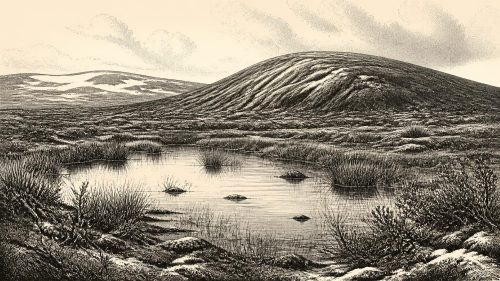
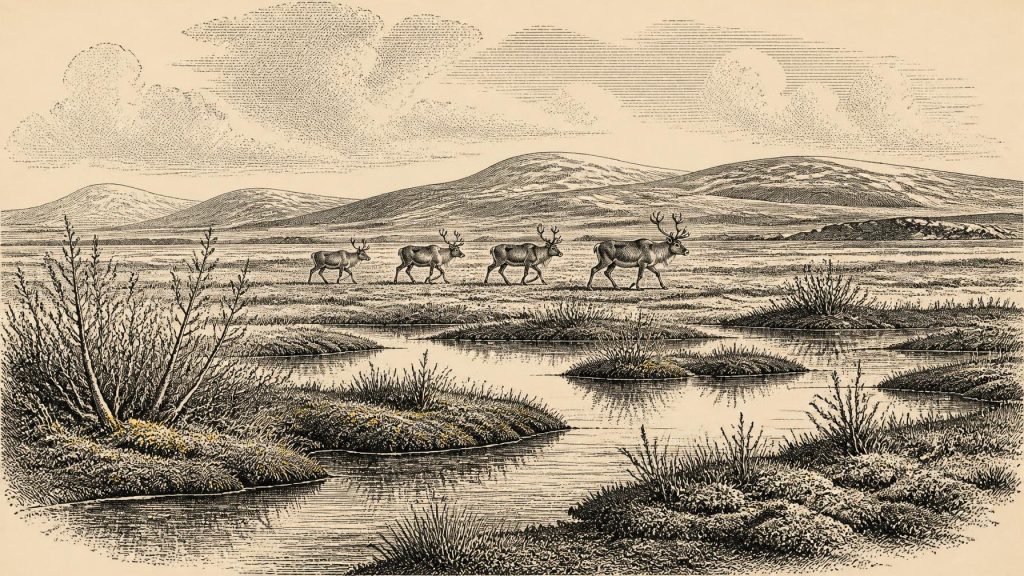
Pollen, plant macrofossils, mosses and insect remains from the Derryvree sediments point to a treeless, severe environment. Sedges, grasses, dwarf willow, juniper, mountain-avens, bogbean and other herbaceous plants indicate open ground with wet hollows, pools and mossy vegetation: a tundra-like or muskeg landscape rather than woodland. The insect evidence likewise suggests standing water rich in plant material, bordered by mosses and low vegetation. Winters were harsh, summers short, and ground conditions were shaped by frost, thaw and persistent moisture.
That was not an empty wasteland. Wetlands concentrated water, plants and invertebrate life, while open vegetation could support grazing animals. Nevertheless, the record does not justify imagining modern bogs, broad forests or a settled countryside. The Derryvree landscape was a dynamic periglacial mosaic, vulnerable to climatic shifts and eventually overwhelmed or buried by renewed glaciation. Its survival beneath a drumlin is an accident of geological preservation, not evidence that comparable wetlands are known throughout Ireland.
At the scale of the island, environmental change was the principal force shaping every possibility of life. Sea level was lower than today because much global water was held in ice sheets, but the exact routes available between Ireland, Britain and continental Europe changed through time and remain difficult to reconstruct for a particular moment. Animal movements into Ireland show that dispersal was possible during favourable phases; they do not demonstrate a permanent, easy land corridor or a stable human route.
Castlepook’s Animal World
South-western Ireland supplies another important archive. Castlepook Cave, also called Mammoth Cave, near Doneraile in County Cork, produced one of Ireland’s richest Pleistocene faunal assemblages during excavations in the early twentieth century and later investigations. Its bones include reindeer, woolly mammoth, giant deer, brown bear, wolf, Arctic fox, mountain hare, lemmings and spotted hyaena. Re-dating programmes have shown that some of the material belongs to Marine Isotope Stage 3, well before the Last Glacial Maximum. Published results include pre-maximum dates for mammoth, reindeer, brown bear and giant deer, while improved methods have also demonstrated that some earlier dates required revision.
The cave should not be treated as a photograph of one animal community or one moment. A cave can serve as a carnivore den, trap, shelter, drainage route and sediment store. Bones may be carried in by hyaenas, wolves or water; deposits may mix material of different ages; and nineteenth- and early twentieth-century excavation methods did not preserve the contextual detail expected today. The presence of mammoth and hyaena in the same cave system does not prove that every specimen lived beside every other specimen, much less that all were present in 31,091 BCE. It establishes something both firmer and more remarkable: Ireland sustained a much richer cold-stage mammal fauna than its later historical fauna.
Spotted hyaena is especially revealing. Far from its modern African range, the Late Pleistocene form occupied northern European environments and could accumulate bones in caves. At Castlepook, carnivore activity is a more secure explanation for much of the assemblage than human action. Reindeer and giant deer would have been important herbivores within open country, while mammoths were part of a broader north-west European cold-stage fauna. Predators, scavengers and grazing animals were linked by seasonal food availability, shelter and shifting access to land beyond the reach of advancing ice.
The Mark on a Reindeer Femur
For this approximate date, one object commands particular attention: a reindeer femur from Castlepook Cave, held in the National Museum of Ireland’s natural-history collections. It has been reported as about 33,000 years old and bears a deep mark interpreted by the palaeozoologist Ruth Carden as having been made with a sharp stone tool during butchery. County Cork’s heritage material presents it as evidence that Stone Age hunters processed a reindeer in the Doneraile area around 31,000 BCE. If that interpretation is confirmed, it would be Ireland’s earliest known evidence of people handling an animal, tens of millennia older than the securely established post-glacial settlement record.
Its importance demands restraint. The specimen was recovered from an old cave collection, not a modern excavation of an intact occupation floor. No securely associated hearth, stone-tool assemblage, dwelling, human burial or repeated butchery area of comparable age has yet been found at Castlepook. A radiocarbon measurement dates the animal’s death, not necessarily the precise act of cutting, the place where it was killed, or the duration of any human visit. Identifying a mark as anthropogenic is a specialist assessment that must be tested against damage caused by carnivores, sediment movement and excavation. The bone is consequently best understood as compelling potential evidence for a fleeting Palaeolithic visit, not proof of a resident population or a permanent settlement.
No Polities, No Recorded Diplomacy
There is no basis for describing Irish political affairs, diplomacy, named peoples, territories or warfare in this period. No writing existed, and no settlement plan, graveyard, monument or artefact assemblage can yet be securely assigned to Ireland in 31,091 BCE. Even if the Castlepook mark represents human butchery, it says nothing certain about language, identity, leadership, kinship or belief. Terms such as “Irish”, “Celtic” and “tribe” would impose far later categories on a deep prehistoric landscape.
What can be inferred, cautiously, concerns the practical demands of any visitors. Hunters or scavengers capable of reaching Ireland would have required knowledge of animal behaviour, stone-working and seasonal conditions. A reindeer carcass could provide meat, fat, hide, sinew and bone, but the Castlepook find alone cannot reveal how these materials were shared or used. Any group would probably have been small and mobile, but even that is an inference from wider Upper Palaeolithic lifeways, not a fact demonstrated by an Irish camp. There is no evidence for farming, trade networks, permanent villages, ritual monuments, formal learning institutions or organised exchange within Ireland at this date.
Iceward Change
The wider trajectory was towards greater glaciation. The Last Glacial Maximum lay in the future, with the British–Irish Ice Sheet reaching its greatest later extent roughly between 25,000 and 23,000 years ago in many reconstructions. Its growth was neither uniform nor instantaneous: individual sectors behaved differently, and the Irish Sea, western coast and uplands have their own complicated records. Still, the Derryvree sequence captures the central long-term reality. A freshwater wetland existed during a cold interval; renewed ice later buried it; and the landscape known to its plants and animals was transformed beyond recovery.
Thus the history of Ireland around 31,091 BCE is not one of kings, battles or towns. It is a history preserved in silt, pollen, moss fragments, insect remains and cave bone. Derryvree provides the strongest evidence for an exposed northern wetland within a broad calibrated range. Castlepook provides a southern faunal archive and an intriguing claim for human butchery. Together they show an island at Europe’s far north-western margin, intermittently habitable for cold-adapted animals and perhaps briefly visited by people, but standing on the threshold of a more extensive ice-bound world.
Primary Sources
- A Middle Midlandian Freshwater Series at Derryvree, Maguiresbridge, County Fermanagh, Northern Ireland
- Irish Pleistocene Biostratigraphy
- Figure 6.— The Subdivision of the Quaternary Period in Ireland
- The Irish Quaternary Fauna Project
- A Reconsideration of the Radiocarbon Dating of the Marine Isotope Stage 3 Fauna from Southern Ireland
- Occurrence of Mammalia Relicts at Site Castlepook Cave
- The Exploration of Castlepook Cave, County Cork
- Castlepook Caves
- Heritage Artefacts of County Cork
- Archaeological Heritage of County Cork
- Castlepook Cave, Co. Cork: 2022 Excavation Report
- Archaeology Research Excavation Grant 2022: Final Report
- Mammoth Cave
- Phylogeographic, Ancient DNA, Fossil and Morphometric Analyses Reveal Ancient and Modern Introductions of a Large Mammal: The Complex Case of Red Deer (Cervus elaphus) in Ireland
- New Insights on the Fauna of Ireland’s Younger Dryas
- Growth and Retreat of the Last British–Irish Ice Sheet, 31,000 to 15,000 Years Ago: The BRITICE-CHRONO Reconstruction
- Pattern and Timing of Retreat of the Last British-Irish Ice Sheet
- Stratigraphic and Palaeo-Geomorphological Evidence for the Glacial-Deglacial History of the Last British-Irish Ice Sheet in the North-Western Irish Sea
- Dimensions and Chronology of the Last Ice Sheet in Western Ireland
- Trimlines, Blockfields and the Vertical Extent of the Last Ice Sheet in Southern Ireland
- Prehistoric Details
- The Mesolithic in Ireland: When Was It?