

Castlepook’s Contested Reindeer30971 BCE
Around 32,900 cal BP, Ireland lay within the unstable Late Pleistocene climate of Marine Isotope Stage 3, before maximum glaciation. Derryvree deposits in County Fermanagh indicate cold, treeless wetlands supporting Arctic-alpine plants, insects and grazing animals. Castlepook Cave in County Cork preserves remains of mammoth, reindeer, giant deer, predators and smaller mammals, although its accumulated fossils do not form a single contemporary fauna. A modified reindeer femur may indicate Upper Palaeolithic butchery, but remains disputed because of its old, poorly contextualised collection. No secure evidence demonstrates settlement, society or continuous human occupation. Later ice-sheet expansion destroyed or obscured much evidence.
Dateline
30,971 BCE is a modern calendar label, not a date that can be recovered from Ireland’s prehistoric record. It corresponds approximately to 32,920 years before AD 1950, conventionally expressed as c. 32.9 thousand calibrated years before present (cal BP). No Irish site supplies evidence precise enough to say what occurred in that individual year, name a community, or reconstruct an annual sequence of events. The responsible history of this point in time is therefore a history of landscape, climate, animal remains and the limits of archaeological interpretation.
Ireland then belonged to the Late Pleistocene, within Marine Isotope Stage 3, a long and unstable phase of the last Ice Age. It stood before the fullest expansion of the British–Irish Ice Sheet during the Last Glacial Maximum, generally placed around 27,000–19,000 cal BP. Ice was advancing and retreating on a geological timescale, climates changed abruptly, and sea level was lower than today. Yet Ireland was not simply a featureless white wilderness. Evidence from buried sediments and cave deposits shows that, at different moments in this broader interval, open cold-country habitats supported a striking range of mammals.
A Year Beyond Calendar Precision
The dating language needs care. Radiocarbon measurements are reported in radiocarbon years before present, with “present” fixed at AD 1950; they are not identical to calendar years. At this depth of time, atmospheric radiocarbon changed significantly, and calibration produces probability ranges rather than an annual answer. The modern IntCal20 calibration curve extends to 55,000 cal BP, but the uncertainties remain substantial. Thus 30,971 BCE should be treated as a convenient point within a broad environmental horizon, not as a date to which a bone, plant seed or human action can securely be pinned.
The Derryvree deposits near Maguiresbridge, County Fermanagh, are especially important for understanding Ireland’s cold-stage environment. Roadworks exposed freshwater silts and fine sands lying between two tills: sediments left by ice at different stages. An organic deposit yielded a radiocarbon determination of 30,500 +1,170/−1,030 BP. On modern calibration, that result belongs broadly within the mid-30th millennium cal BP, rather than to one exact year. It may therefore be older than the nominal date used here, but it remains one of the best Irish windows onto the kind of treeless, cold landscape that preceded the island’s later, more extensive glaciation.
Derryvree’s Cold Wetlands
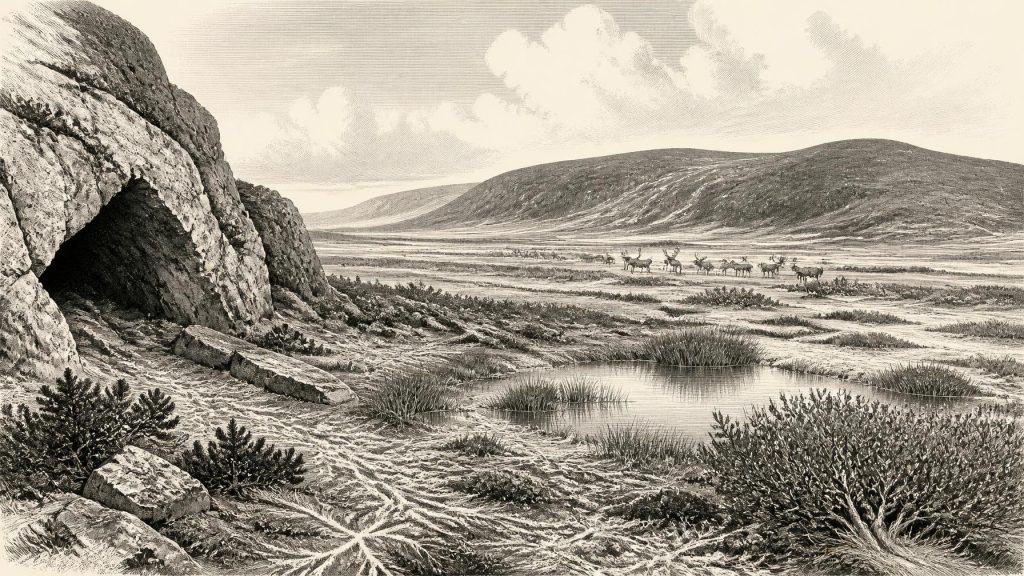
Derryvree does not reveal a settlement. It preserves a palaeoenvironment. Fossil pollen, plant macrofossils, mosses and insect remains indicate a wet, open terrain often described as tundra or muskeg: waterlogged ground with pools, sedges, grasses, mossy surfaces and low Arctic-alpine vegetation. Mountain avens, dwarf willow, juniper, clubmoss and bogbean are among the plants used to reconstruct these conditions. The combination suggests summer growth in exposed ground and shallow water, but harsh winters and an environment far too cold and unstable for woodland comparable with modern Ireland.
This was not a single uniform biome spread unchanged across the island. Local shelter, drainage, elevation and proximity to ice mattered. Fermanagh’s drumlin country preserves a wetland sequence because sediment was trapped and later sealed beneath glacial deposits. Elsewhere, especially on exposed uplands and coastal lowlands, evidence has often been eroded, reworked by later ice, submerged offshore or never deposited in the first place. Derryvree should therefore illuminate ecological possibilities, not be mistaken for a complete map of Ireland in 30,971 BCE.
The environment was nevertheless productive enough to sustain insects, aquatic plants and grazing animals during favourable intervals. Open ground allowed grasses and herbs to flourish; pools and sedge beds provided moisture and plant matter; snow, frost and seasonal thaw shaped every surface. The familiar Irish pattern of enclosed fields, hedgerows, farms and oak woodland lay tens of millennia in the future. In its place stood a changing mosaic of wet hollows, sparse vegetation, exposed mineral ground and, in some districts, looming ice margins.
Castlepook and the Animal Record
In north County Cork, Castlepook Cave near Doneraile—historically also called Mammoth Cave—provides the island’s most celebrated cold-stage faunal archive. Early twentieth-century excavations recovered remains attributed to woolly mammoth, reindeer, giant deer, brown bear, wolf, red and Arctic foxes, mountain hare, lemmings and spotted hyena. The National Museum of Ireland regards it as the country’s most important site for mammal remains of the last cold stage. The assemblage shows that Ireland had intermittent ecological connections with Britain and continental north-west Europe when geography and climate permitted animal movement.
It does not, however, demonstrate that all these species met one another in a single season, let alone in 30,971 BCE. Cave sediments accumulated over long periods; old excavations did not record every layer to modern standards; and fossils may have been disturbed by carnivores, water, collapse or later excavation. Modern redating has been particularly consequential. Improved pretreatment of bone samples showed that several Castlepook and southern Irish cave specimens were thousands of radiocarbon years older than earlier results suggested. The work places important elements of the fauna firmly in MIS 3 and indicates that animals such as spotted hyena and giant deer may have disappeared locally before the Last Glacial Maximum, around 40,000 cal BP.
That conclusion makes Castlepook simultaneously invaluable and difficult. Its mammals supply a powerful picture of the wider Pleistocene world relevant to the date, but not a securely contemporaneous census. At c. 32.9 ka cal BP, Ireland was approaching a period of growing glaciation; some of the best-known Cork bones may already have belonged to earlier phases. The appropriate conclusion is that open, cold-adapted animal communities had reached Ireland during this broad age, while the exact composition and distribution of fauna in any nominated year remain unknown.
The Reindeer Femur Question
One Castlepook reindeer femur has become central to the question of people in very early Ireland. Ruth Carden has identified a deep linear modification on the bone as a possible cut or chop made with a sharp stone tool during butchery. County Cork heritage publications have presented the specimen as dating to about 31,000 BC. If that interpretation is confirmed, it would be extraordinarily important: evidence that a person, or small group, handled a reindeer carcass in Ireland during the Upper Palaeolithic, far earlier than the island’s better contextualised terminal-Pleistocene evidence.
But the claim must be stated as proposed evidence, not settled fact. The femur came from an old cave collection rather than a newly excavated occupation floor with an intact sequence of associated artefacts. A radiocarbon result dates the death of the animal within a range; it does not automatically date the surface mark, prove where the animal was killed, or identify the person who made it. Likewise, distinguishing a stone-tool cut from carnivore damage, breakage or other modification depends on detailed taphonomic assessment. No securely associated hearth, stone-tool assemblage, dwelling, human bone, ornament or burial of comparable antiquity has yet been recovered in Ireland.
If the mark is human-made, the most that can responsibly be inferred is brief, mobile exploitation of a large animal. People may have hunted the reindeer, found a carcass, stripped meat, removed hide or sinew, or broken the limb in another place before carnivores carried bone into the cave. It does not establish a permanent settlement, an Irish population, a named culture or continuous occupation. Even the route by which people might have reached the island cannot be reconstructed from the bone alone. Lower sea levels altered coasts and routes, but changing channels, ice and sea ice made access contingent rather than predictable.
Society Without a Social Record
There is no evidence from Ireland at this date for political institutions, chiefs, warfare, diplomacy, law or territorial boundaries. Nor can historians responsibly describe religion, ceremony, language, music, art or formal learning. These subjects were certainly meaningful to any people who may have visited, but they leave no identified Irish trace around 32.9 ka cal BP. The absence is archaeological, not a judgement that Ice Age people elsewhere lacked complex social lives.
Economy and trade are equally elusive. There is no evidence for farming, livestock, pottery, metalworking, built houses or exchange networks in Ireland at this time. If the Castlepook modification was made by people, a stone cutting edge and animal processing are plausible elements of a short-term foraging economy; beyond that lies speculation. The best documented relationships are ecological rather than political: herbivores feeding in open country, carnivores and scavengers using caves, and plants and insects responding to cold, wet ground.
Approaching the Ice Maximum
Within several millennia, the Last Glacial Maximum would transform Ireland dramatically. The British–Irish Ice Sheet expanded across much of the island and its continental shelf, eroding landscapes and destroying or concealing many earlier deposits. That later ice helps explain the thinness of the surviving archive. Derryvree endured because a wetland layer was buried between tills; Castlepook endured because limestone caves protected bones, although not always their original contexts.
For 30,971 BCE, then, the central development is not a recorded event but a threshold. Ireland was a cold, environmentally variable place in which wetlands could briefly preserve delicate plants and insects, and where a wider Pleistocene fauna had left bones in Cork caves. A marked reindeer femur offers a tantalising possibility of human presence, but only further analysis and securely stratified discoveries can decide how far that possibility should carry the story of Ireland’s first people.
Primary Sources
- A reconsideration of the radiocarbon dating of the Marine Isotope Stage 3 fauna from southern Ireland
- The Irish Quaternary Fauna Project
- New insights on the fauna of Ireland’s Younger Dryas
- Palaeoecology
- Figure 6.— The subdivision of the Quaternary Period in Ireland
- Archaeological Heritage of County Cork
- Heritage Artefacts of County Cork
- 2022:564 – Castlepook Cave, Castlepook South, Cork
- Archaeology Research Excavation Grant 2022: Final Report
- Spotted Hyena Skull
- Exploring controls of the early and stepped deglaciation on the western margin of the British-Irish Ice Sheet
- Character of advance and retreat of the southwest sector of the British-Irish Ice Sheet during the last glaciation
- The timing and magnitude of the British–Irish Ice Sheet between Marine Isotope Stages 5d and 2
- Dimensions and chronology of the last ice sheet in Western Ireland
- Vertical dimensions and age of the Wicklow Mountains ice dome, Eastern Ireland, and implications for the extent of the last Irish Ice Sheet
- Trimlines, blockfields and the vertical extent of the last ice sheet in southern Ireland
- Anthropogenic changes to the Holocene nitrogen cycle in Ireland
- Ireland: Submerged Prehistoric Sites and Landscapes
- The IntCal20 Northern Hemisphere Radiocarbon Age Calibration Curve (0–55 cal kBP)
- IntCal
- Recent developments in calibration for archaeological and environmental samples
- Pleistocene vertebrates in the British Isles