Derryvree Habitat30903 BCE
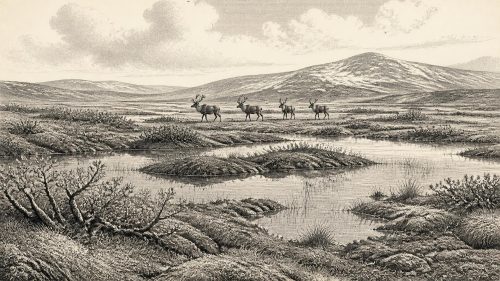
Labelled 30,903 BCE, this period cannot be dated in Ireland, but falls within climatically unstable Marine Isotope Stage 3. At Derryvree, County Fermanagh, organic sediments beneath glacial tills, dated by BIRM-166, record a freshwater wetland during an ice-free interval roughly 36,900–31,700 calibrated years BP. Plant and insect remains indicate cold, open tundra-like terrain. Cave faunas, notably Castlepook, attest to cold-adapted mammals including reindeer, mammoth and predators, though deposits span long periods. A marked reindeer bone may indicate early human butchery, but remains unconfirmed and cannot establish settlement. Evidence reveals environments, mobile fauna and possible human presence, not societies or history.
Dateline
“30,903 BCE” is a useful modern label, not a recoverable Irish date. Nobody in Ice Age Ireland used a calendar from which an individual year could be recorded, and no archaeological deposit can be assigned responsibly to that precise point. In calendar terms the label falls roughly 32,850 years before AD 1950, within Marine Isotope Stage 3 (MIS 3), a long and climatically unstable part of the Late Pleistocene. The best evidence relevant to this moment is therefore regional, dated in ranges, and environmental rather than historical in the conventional sense. It illuminates cold landscapes, animals, water, vegetation and perhaps a fleeting human encounter; it cannot supply a named community, ruler, battle, treaty or settlement.
The key Irish archive is Derryvree, near Maguiresbridge in County Fermanagh. Road works in 1969 cut through a drumlin and exposed organic freshwater silts and fine sands lying between tills. The sequence contained plant and insect remains and yielded the radiocarbon determination BIRM-166: 30,500 ± 1,100 radiocarbon years BP. A modern calibration converts such a measurement into a broad span rather than a single year; published modelling places the relevant Derryvree interval broadly within about 36,900–31,700 calibrated years BP. Thus the modern label 30,903 BCE lies near the late edge of a possible dating range, not at a pinpointed event horizon.
A Wetland Between Ice Advances
Derryvree is important because its organic layer proves that, at some point during this range, ground in south Fermanagh was not buried beneath glacier ice. Water collected in a shallow freshwater setting amid a cold, periglacial landscape. Later ice advances sealed that modest wetland beneath glacial deposits. This is an unusually fortunate survival: most landscapes available to us now were repeatedly reshaped by ice, meltwater, frost and erosion. The road cutting exposed a brief geological archive of conditions that would otherwise have remained hidden inside the drumlin.
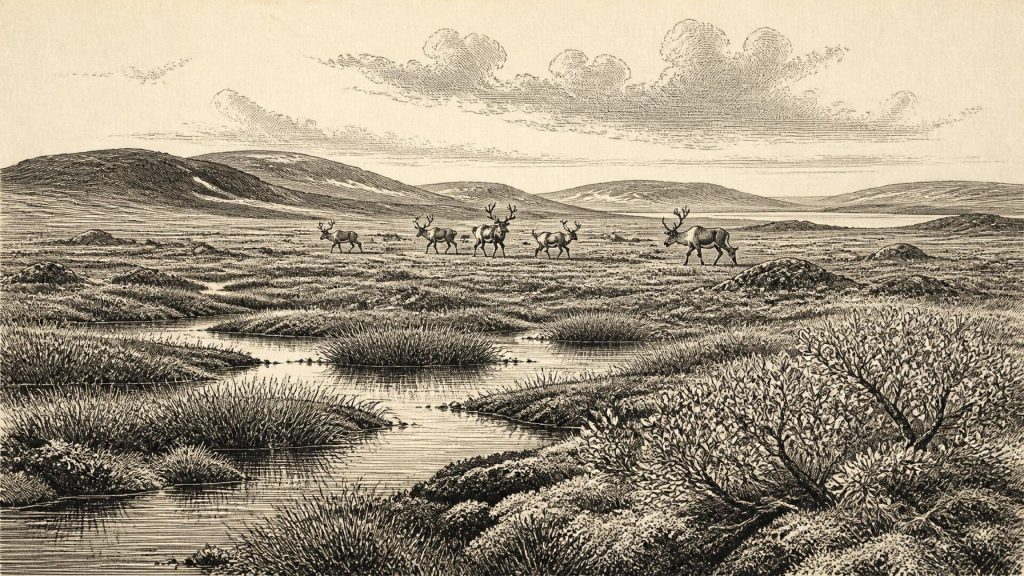
The evidence points to open, treeless or nearly treeless country, not to woodland. Pollen was poorly preserved, but plant macrofossils, mosses and insect remains indicate tundra-like vegetation and wet ground. Sedges, aquatic plants and bogbean (Menyanthes trifoliata) belonged to the local freshwater margin, while mountain-avens, dwarf willow, clubmosses and cold-tolerant mosses are consistent with sparse vegetation beyond it. Such finds do not permit a painted, metre-by-metre reconstruction of Fermanagh in one year. They do show that a small pool or marsh could support specialised plants despite severe cold, while the wider land had limited tree cover and a short growing season.
That distinction matters. The surviving Derryvree material records a locality and a span of deposition, not the whole island at once. Ireland’s topography, coasts, rainfall and ice margins would have varied markedly from region to region. At this stage, changing ice and low sea level made the island’s physical geography very different from that of today. Yet scholars remain cautious about exactly where ice lay across every Irish district at any particular moment before the Last Glacial Maximum. Firmer chronological evidence shows major expansion of the British–Irish Ice Sheet after this broad interval, with extensive Irish glaciation associated especially with the period after about 26,000 calibrated years BP.
Cold Country, Living Animals
The Derryvree wetland has to be read beside Ireland’s cave faunas, particularly those from Castlepook Cave near Doneraile in north Cork. The cave collections demonstrate that during parts of MIS 3 Ireland supported a richer large-mammal community than the island has known in recent millennia. Reindeer, woolly mammoth, giant deer, brown bear, wolf, Arctic fox, hare, lemmings and spotted hyaena are represented in Irish Pleistocene material. They should not, however, be turned into a single contemporary herd gathered at Castlepook or anywhere else. Cave deposits may combine bones accumulated over long periods through carnivore activity, natural death, water movement, disturbance and early excavation.
Even with that caution, the fauna gives the Fermanagh wetland a wider ecological setting. Reindeer and lemmings are strong indicators of cold, open habitats. Large grazers and browsers required seasonally available forage; wolves and hyaenas reveal a food web with substantial predators and scavengers. Mammoth remains evoke the broader north-west European mammoth-steppe world, but they do not prove that mammoths stood beside the Derryvree pool in the modern calendar year used here. The responsible conclusion is less dramatic but more secure: suitable phases of Late Pleistocene Ireland had connected ecological opportunities for cold-adapted mammals, whose ranges expanded and contracted with climate, ice and access to neighbouring lands.
These animals were not “Irish” in any modern national sense. Their populations moved through a changing north-west European landscape, and the sea crossings and land configurations that governed access were unlike those of the present. A lower global sea level enlarged continental shelves, but it does not justify an uncomplicated claim of a permanent land bridge, a fixed migration corridor or easy travel from Britain. Routes depended on local topography, ice, rivers, marine channels and season. Inferences about movement are therefore plausible ecological interpretations, not direct observations.
The Human Question at Castlepook
The most arresting possibility for this period comes from Castlepook: a reindeer femur, from an older cave collection, reported as bearing a deep mark interpreted by zoologist Ruth Carden as stone-tool damage made during butchery. County Cork heritage material has presented the specimen as dating to around 31,000 BC. If the mark is confirmed as anthropogenic and contemporary with the animal’s death, it would be evidence that one or more Upper Palaeolithic people handled a reindeer in Ireland tens of millennia earlier than the long-established evidence for post-glacial settlement.
Its importance is precisely why restraint is necessary. The dated bone is not an excavated village floor. It does not come with a securely associated hearth, stone-tool assemblage, shelter, burial, repeated butchered bone concentration or occupation sequence. A date on bone establishes an age range for the animal, not a calendar date for the incision. Nor can one modified object demonstrate a resident population, an annual migration route, family structure or continuous human presence. Recent reassessment has also shown that improved collagen treatment and ultrafiltration can substantially alter dates obtained from old Irish cave specimens, reinforcing the need to test claims rather than repeat them as settled fact.
If people did reach Ireland during an MIS 3 interval relevant to 30,903 BCE, they were most likely highly mobile hunter-gatherers rather than settlers in any later agricultural sense. A party capable of processing a large carcass would have needed cutting tools, practical knowledge of animal anatomy, co-operation and protection from cold. Those are reasonable inferences from Upper Palaeolithic lifeways elsewhere in Europe, but they remain inferences. Ireland has not yielded securely dated evidence here for houses, camps, clothing, ornament, art, ritual structures, graves, exchange networks or a sustained lithic industry. It would be wrong to populate the Fermanagh and Cork evidence with imagined clans, chiefs or ceremonies.
No Polities, No Diplomacy
Accordingly, there is no political history for Ireland at this point. Archaeology provides no basis for discussing kingship, territories, formal diplomacy, warfare, law or institutions. Conflict may have existed among animals competing for prey and shelter, and any visiting humans would have faced dangerous predators and environmental risk, but that is not evidence for human warfare. Likewise, there is no evidence for religion or formal learning. The absence is meaningful: it identifies the boundary between what the archaeological record supports and what later historical habits tempt us to invent.
Everyday life is equally elusive. Derryvree documents a wetland ecosystem, not a household. Castlepook offers an important but presently isolated indication of possible carcass processing, not a menu, seasonal round or social biography. There is no direct evidence for cultivation, animal husbandry, pottery, metallurgy, built settlement or trade in Ireland. “Economy” can only be used in the minimal ecological sense: animals obtained food from a patchy cold landscape, while any people present may have relied on opportunistic hunting, scavenging or butchery. Exchange and long-distance social ties, well documented among some contemporary Upper Palaeolithic societies elsewhere, cannot yet be demonstrated on the island.
What This Date Can Mean
The most historically valuable development around this projected year is therefore not a human event but an evidential window. Beneath a Fermanagh drumlin, BIRM-166 preserves the record of freshwater, mosses, sedges, insects and open cold-country vegetation during a pre-maximum glacial interval. In Cork, cave bones show that Ireland could sustain a varied Ice Age fauna, while one marked reindeer bone raises—without finally resolving—the prospect of a very early human visit. Together they overturn the older caricature of a uniformly empty, perpetually ice-covered Ireland before the final glacial retreat.
They do not reveal an inhabited country in the later historical sense. Around the modern label 30,903 BCE, Ireland’s recoverable story is one of climatic volatility, local ice-free refuges or intervals, wetland persistence, mobile animals and profound uncertainty. Future excavation of undisturbed cave deposits, direct dating with modern methods, microscopic study of bone surfaces and further palaeoenvironmental cores may refine that picture. For now, the Fermanagh pool remains the clearest guide: a small, cold freshwater world, preserved between tills, whose evidence is more compelling because it tells us exactly how much we do—and do not—know.

Primary Sources
- A Middle Midlandian Freshwater Series at Derryvree, Maguiresbridge, County Fermanagh, Northern Ireland
- Palaeoecology
- The Subdivision of the Quaternary Period in Ireland
- Exploring Controls of the Early and Stepped Deglaciation on the Western Margin of the British Irish Ice Sheet
- The Irish Quaternary Fauna Project
- A Reconsideration of the Radiocarbon Dating of the Marine Isotope Stage 3 Fauna from Southern Ireland
- New Insights on the Fauna of Ireland’s Younger Dryas and Early Holocene: Evidence from Alice and Gwendoline Cave, County Clare
- Late Pleistocene Chronostratigraphy and Ice Sheet Limits, Southern Ireland
- Reconstructing the Last Irish Ice Sheet 2: A Geomorphologically-Driven Model of Ice Sheet Growth, Retreat and Dynamics
- Last Glacial Maximum Cirque Glaciation in Ireland and Implications for Reconstructions of the Irish Ice Sheet
- Dimensions and Chronology of the Last Ice Sheet in Western Ireland
- Stratigraphic and Palaeo-Geomorphological Evidence for the Glacial-Deglacial History of the Last British-Irish Ice Sheet in the North-Western Irish Sea
- Character of Advance and Retreat of the Southwest Sector of the British-Irish Ice Sheet During the Last Glaciation
- Maximum Extent and Dynamic Behaviour of the Last British-Irish Ice Sheet West of Ireland
- Ice Sheet Extension to the Celtic Sea Shelf Edge at the Last Glacial Maximum
- Early Deglaciation of the British-Irish Ice Sheet on the Atlantic Shelf Northwest of Ireland Driven by Glacioisostatic Depression and High Relative Sea Level
- Heritage Artefacts of County Cork
- Archaeological Heritage of County Cork
- The Mesolithic in Ireland: When Was It?
- Ireland's Palaeolithic Archaeology – Fleeting Footprints in a Frozen Land