Maguirebridge Sedge-Moss Fen30788 BCE
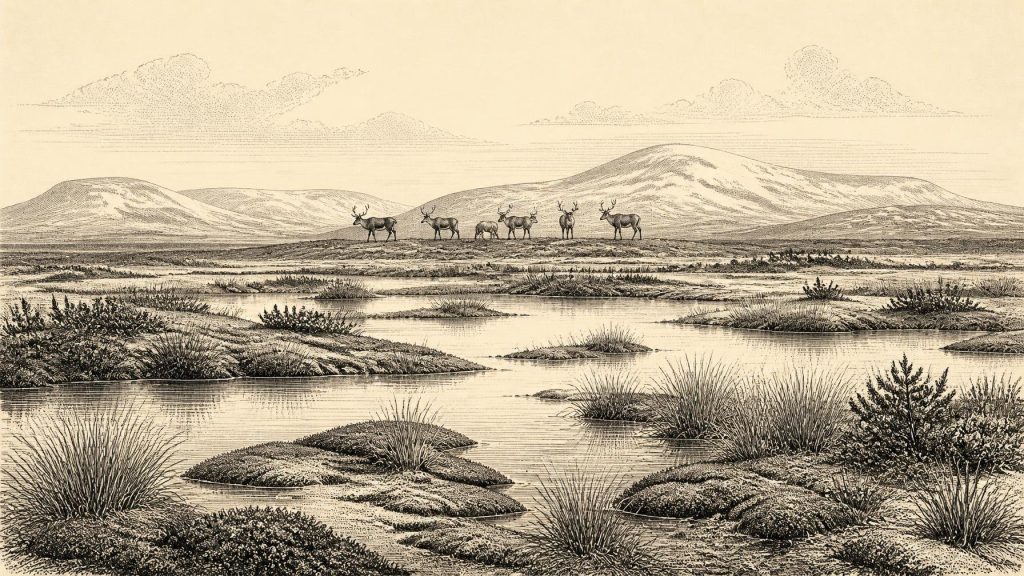
Although labelled 30,788 BCE, this period cannot be dated precisely and belongs broadly to MIS 3, roughly 35,000–30,000 BCE. At Derryvree, County Fermanagh, freshwater sediments between glacial tills record a wetland between ice advances, not an ice-free Ireland. Mosses, sedges, aquatic plants and insects indicate treeless, cold, periglacial ground with pools and productive local habitats. Castlepook Cave fauna, including mammoth, reindeer, giant deer, hyena and wolf, confirms diverse cold-stage animals, though not simultaneous occupation. No secure human settlement is known. A modified reindeer bone may suggest brief Upper Palaeolithic activity, but cannot prove permanent population. Environmental change is principal history.
Dateline
The modern label 30,788 BCE suggests a precision that the evidence cannot sustain. No Irish calendar, written record, named community or dated event can be assigned to this individual year. In archaeological terms it lies within the later part of the Pleistocene, during Marine Isotope Stage 3 (MIS 3), a long and climatically unstable phase of the last glacial cycle. The responsible history of Ireland at this point is therefore not a chronicle of rulers or battles, but an account of an extraordinarily altered landscape, reconstructed from sediments, plant remains, insects, animal bones and the changing record of ice.
Using the conventional archaeological ‘before present’ scale, whose present is 1950, 30,788 BCE is approximately 32,738 years ago. That conversion is a modern convention, not an ancient date. The closest important Irish environmental archive is a freshwater deposit found at Derryvree near Maguiresbridge, County Fermanagh. Its radiocarbon result, Birm-166, was reported as 30,500 radiocarbon years BP, with a substantial uncertainty of +1,170/−1,030 years. Radiocarbon years are not calendar years: calibration against atmospheric records produces broad probability ranges rather than an exact historical moment. The Derryvree evidence is consequently best placed broadly in the interval of roughly 35,000–30,000 BCE, not pinned to a particular season or generation.
A Wetland Between Ice Advances
Derryvree was exposed during road works in 1969, when a cut through a drumlin revealed a remarkable sequence. Beneath the familiar rounded hill lay one sheet of glacial till, then layers of fine sand, silt and organic material, and above them another thick till. Till is debris deposited directly by glacier ice: an unsorted mixture of clay, stones and larger fragments. The order of these layers establishes an important relative history. Ice occupied or strongly influenced the locality; a freshwater environment then developed long enough to accumulate sediments and preserve living things; later ice overran or approached the area again and sealed the deposit beneath the drumlin.
This does not demonstrate that all Ireland was ice-free in 30,788 BCE. The British–Irish Ice Sheet was not a single unchanging white cover, but a dynamic complex of expanding, thinning and shifting ice margins. Recent syntheses stress that the extent and timing of ice before the Last Glacial Maximum remain difficult to reconstruct. Local freedom from overriding ice in south Fermanagh need not mean ice-free coasts, mountains or lowlands elsewhere. Yet Derryvree decisively corrects any picture of an Ireland that was continuously frozen, lifeless and uniform.
Open Ground and Cold Water
The fossils in the Derryvree sediments point to a treeless, cold-climate wetland. Pollen was poorly preserved, so it must be treated cautiously; nevertheless, plant macrofossils and mosses are more informative. They include sedges, grasses and plants associated with open, damp ground, together with cold-tolerant moss communities. Bogbean, water-milfoil and other aquatic or wet-ground indicators show that standing or slow-moving freshwater existed. The resulting landscape was not a forested countryside awaiting settlement. It was a low-growing mosaic of wet hollows, mossy ground, shallow pools, sedge margins and exposed mineral soil.
Insect evidence reinforces that reading. The assemblage has been interpreted as one suited to a cold, northern, periglacial environment: ground subject to severe winter freezing but not necessarily buried under permanent glacier ice. The term ‘tundra’ is useful if used carefully. It describes the broad ecological character—open, treeless and cold-adapted—not a guarantee that every square kilometre resembled the modern Arctic. Shelter, water, slope, snow cover and season would have created small but important differences. Summer sunlight could support a brief burst of plant growth; winter conditions were harsh enough to govern the entire rhythm of life.
Derryvree’s organic layers are sometimes described as a muskeg-like environment. That comparison evokes waterlogged ground rich in mosses and decomposing vegetation, dotted with pools rather than a single clear lake. Such a place would have been biologically productive within a generally spare landscape. Plants fixed in the sediments, aquatic invertebrates, insects and wetland birds could exploit it; herbivores might have used its margins while avoiding its softer ground. But the evidence establishes a local ecological setting, not a complete food web or a detailed seasonal scene.
Animals on a Changing Island
The best-known animal evidence of this broad interval comes from Castlepook Cave, also called Mammoth Cave, near Doneraile in County Cork. Antiquarian excavations there recovered bones of mammoth, reindeer, giant deer, spotted hyena, wolf, bear, foxes, hares, lemmings and other animals. Later reassessment and improved radiocarbon methods have shown why the old cave dates must be handled critically: some earlier determinations were substantially too young. Even so, the cave assemblage demonstrates that Ireland was visited or inhabited by a richer cold-stage mammal fauna than the modern island possesses.
The coexistence of grazing animals and powerful carnivores does not mean that they all lived at Castlepook at the same instant. Caves accumulate material over long periods, and nineteenth- and early twentieth-century excavations did not always preserve the stratigraphic detail expected today. The cave may have served as a den, a shelter, a trap, a place into which bones were dragged, or several of these at different times. Mammoth and reindeer bones signal the wider availability of open-country habitats; hyena remains suggest carnivores capable of transporting and modifying carcasses. They do not create a neat, year-specific census of Cork wildlife.
Travel routes are equally uncertain. Lower global sea level altered the geography of the Irish Sea basin, while ice loading and local relative sea-level change complicated coastlines. Faunal movement from Britain or continental Europe was possible during suitable phases, but neither a simple dry land bridge nor a permanently impassable sea should be assumed for every part of MIS 3. Animals may have moved across exposed terrain, coastal plains, frozen or ice-connected areas, or changing chains of land and water. The evidence supports connectivity at times; it does not map a single route for 30,788 BCE.
The Human Question
There is no securely excavated settlement, hearth, stone-tool assemblage, burial or dwelling from Ireland that can be assigned to this date. Accordingly, there is no basis for describing households, kin groups, language, clothing, ritual, political authority, diplomacy, trade networks or warfare in year-specific terms. There were no states, kingdoms, towns, farms, written laws or institutions documented on the island. To supply them would be invention rather than history.
A reindeer femur from Castlepook has nonetheless made this period especially significant. It has been reported as about 33,000 years old and bears a deep modification interpreted by zooarchaeologist Ruth Carden as damage made by a sharp stone tool during carcass processing. If that interpretation and dating are confirmed by fuller contextual work, it would provide evidence that Upper Palaeolithic people handled a reindeer in Ireland within the broad chronological neighbourhood of this article. It would not prove a permanent population, identify a camp at the cave, or demonstrate activity in 30,788 BCE itself.
This distinction matters. A single modified bone may indicate a brief hunting or scavenging episode by a very small mobile group. It cannot reveal whether people arrived once, repeatedly or seasonally; whether they travelled over land, ice or water; or whether they endured locally through later climatic deterioration. The absence of tools and settlement debris may partly result from later glacial erosion and from the limited survival and investigation of suitable deposits. But absence of evidence is not positive evidence for a substantial occupation.
No Politics, but Powerful Change
For this date, environment is not merely background to human affairs: it is the principal historical subject. Ice advance could erase soils, rearrange river systems, transport rocks and bury former land surfaces. Periglacial frost could fracture exposed ground. The wetland at Derryvree survived precisely because a later glacial deposit sealed it, preserving a thin ecological archive while much surrounding evidence was removed, compressed or redeposited. Ireland’s later drumlin landscape owes much to these glacial processes, although the visible hills of the modern countryside should not be imagined as a settled prehistoric landscape.
Economy and trade can only be discussed in ecological, not social, terms. Plants converted the short growing season into food; herbivores converted vegetation into meat and movement across the landscape; carnivores and scavengers redistributed carcasses and nutrients. If people were present, they would have depended on such seasonal resources, probably with considerable mobility, but that is an inference from wider Upper Palaeolithic contexts rather than a fact demonstrated in Ireland. No Irish evidence of exchange, quarrying, long-distance tool circulation or organised hunting can responsibly be dated to this particular point.
Likewise, religion, art and learning leave no secure Irish trace at 30,788 BCE. The rich artistic and ritual record of Upper Palaeolithic Europe shows what human groups elsewhere could create, but it cannot be transferred automatically to Ireland. The soundest conclusion is more restrained, yet no less dramatic: during a cold and shifting phase of the Ice Age, freshwater plants, mosses, insects and large mammals occupied at least some locally hospitable Irish environments. Their remains preserve not an annual event, but a rare glimpse of life between advances of the ice.
Primary Sources
- A Middle Midlandian Freshwater Series at Derryvree, Maguiresbridge, County Fermanagh, Northern Ireland
- Early Midlandian–Middle Midlandian, Pleistocene, Northern Ireland
- Irish Pleistocene Biostratigraphy
- Cenozoic: Tertiary and Quaternary (until 11,700 years before 2000)
- Palaeoecology
- Figure 6—The Subdivision of the Quaternary Period in Ireland
- A Reconsideration of the Radiocarbon Dating of the Marine Isotope Stage 3 Fauna from Southern Ireland
- The Irish Quaternary Fauna Project
- Occurrence of Mammalia Relicts at Site Castlepook Cave
- The Exploration of Castlepook Cave, Co. Cork. With 3 Plates
- The Exploration of Castlepook Cave, County Cork
- Spotted Hyena Skull
- 2022:564 – Castlepook Cave, Castlepook South, Cork
- Heritage Artefacts of County Cork
- The Timing and Magnitude of the British–Irish Ice Sheet Between Marine Isotope Stages 5d and 2
- Growth and Retreat of the Last British–Irish Ice Sheet, 31,000 to 15,000 Years Ago: the BRITICE-CHRONO Reconstruction
- Pattern and Timing of Retreat of the Last British-Irish Ice Sheet
- The Problem of a Late Quaternary Landbridge Between Britain and Ireland
- The IntCal20 Northern Hemisphere Radiocarbon Age Calibration Curve (0–55 cal kBP)
- OxCal
- First Evidence of a Late Upper Palaeolithic Human Presence in Ireland
- Prehistoric Details