Derryvree’s Thawline30713 BCE
Thirty thousand seven hundred and thirteen BCE is not a meaningful precise Irish date, but broadly relates to later Marine Isotope Stage 3. At Derryvree, County Fermanagh, organic freshwater sediments between glacial tills demonstrate a local ice-free interval, preserving evidence of cold, treeless wet tundra with plants and insects. The BIRM-166 radiocarbon determination has wide calibration uncertainty. Ireland’s ice cover was dynamic before the Last Glacial Maximum. Castlepook Cave, County Cork, preserves remains of diverse Pleistocene mammals, including mammoth, giant deer and hyaena, though deposits span time. No evidence establishes human presence, society or activity in Ireland at this horizon.

Dateline
The label “30,713 BCE” gives a misleading impression of precision. No Irish event can be assigned to that calendar year, and no person, settlement or artefact is known from it. In conventional “before present” terms—where present is AD 1950—it lies about 32,662 years ago. At such depth of time, radiocarbon results carry wide statistical margins, calibration converts them into ranges rather than single years, and a sediment bed may represent centuries or longer. The responsible subject is therefore not an event in a year, but Ireland during the later part of Marine Isotope Stage 3, before the Last Glacial Maximum.
The most useful Irish evidence near this broad horizon comes from Derryvree, near Maguiresbridge in County Fermanagh. Road works in 1969 cut through a drumlin and exposed an unusual sequence: freshwater silts and fine sands, containing organic material, lay between two thick tills. Till is the unsorted mixture of clay, stones and debris deposited directly by glacier ice. The order of deposits is crucial. Ice had occupied the locality; afterwards, open water and wet ground allowed fine sediment and organic remains to accumulate; then a later ice advance sealed the freshwater layer beneath another till. This is firm stratigraphic evidence for an ice-free interval at Derryvree, not evidence that the whole island was simultaneously free of ice.
A Date Range, Not a Date
The Derryvree organic material produced the well-known determination BIRM-166, conventionally reported as about 30,500 ± 1,100 radiocarbon years BP. Its calendar equivalent has been expressed in differing broad ranges as calibration methods have improved; one glacial chronology gives approximately 35.9 ± 1.1 thousand calibrated years BP. The exact label 30,713 BCE is younger than the central estimate, though it falls close enough to the very wide chronological uncertainty sometimes attached to this environmental phase to make Derryvree relevant. It cannot, however, be used to say that the wetland existed in that precise year. Radiocarbon dates the death of once-living material, not a named historical moment; calibration curves themselves are revised as the underlying records improve.
For that reason, Derryvree should be understood as an archive of conditions during a cold-stage interval, rather than as a time capsule with a calendar date stamped upon it. Its importance is immense precisely because much of Ireland’s older Pleistocene surface record was eroded, buried or reworked by subsequent glaciers. A small body of preserved organic sediment, caught between two advances of ice, offers a rare glimpse of a landscape that normally has no surviving ground surface.
Wet Ground in a Treeless Land
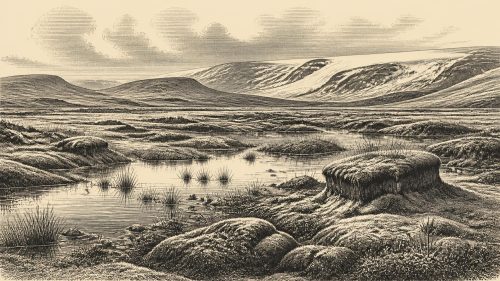
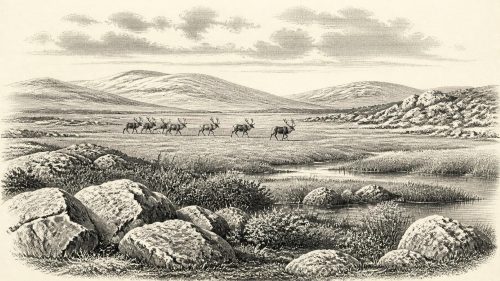
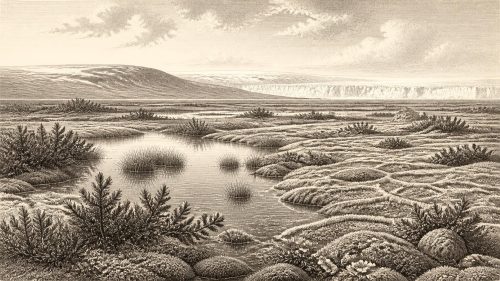
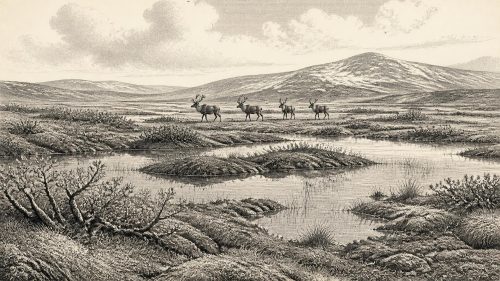
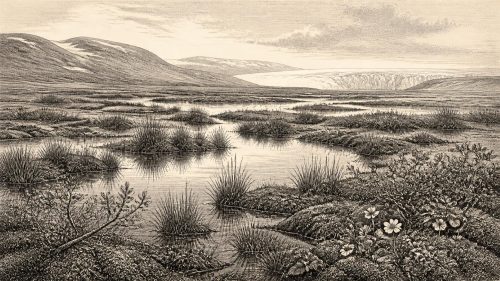
The flora and invertebrate evidence from Derryvree has been interpreted as indicating a cold, treeless muskeg or wet tundra environment. Mosses, sedges and aquatic or wetland plants point to shallow freshwater, saturated margins and biologically productive summer conditions. Northern, cold-adapted insects reinforce the picture of a severe climate. This was not the blanket bog, pasture or woodland of later Ireland. It was a shifting mosaic of pools, silty water, thawed margins, low vegetation and frost-affected ground.
“Treeless” does not mean lifeless. The freshwater deposit records plants growing, insects breeding and organic matter accumulating. In the warmer season, water moved slowly enough for fine sediments to settle; vegetation could take hold where the ground was not frozen. Winter was another matter. Frost, prolonged snow cover and a short growing season would have constrained every living thing. The evidence supports a landscape with sharp seasonal contrast, but it does not provide a single annual weather record, a precise shoreline or a complete list of species living across Ireland.
Such local variation matters. Fermanagh’s drumlin country was shaped by ice and meltwater, and the Derryvree basin had its own drainage, relief and shelter. A wetland beside Maguiresbridge cannot stand in for every Irish upland, coast or limestone plain. Still, it demonstrates that at least part of northern Ireland was not continuously entombed beneath glacier ice during the period represented by the organic beds.
Ice Was Building, Not Static
Ireland lay within the wider British–Irish ice-sheet system, whose growth and movement were neither simple nor synchronous. Research on the Irish Sea basin indicates major ice build-up in late MIS 3, with advancing ice margins and changing flow patterns before the eventual Last Glacial Maximum. The later maximum, broadly between about 27,500 and 19,000 years ago, was therefore still ahead. At the Derryvree horizon, an ice-free freshwater interval and nearby or later ice expansion were both possible parts of a dynamic system.
This is the main regional development that can responsibly be described for the period: environmental instability on a continental scale. Growing ice sheets altered drainage, sediment movement and accessible land. Falling sea levels during the wider glacial world exposed areas now submerged, but one should not imagine a simple, permanent land bridge or a familiar modern coastline. Glaciers, permafrost, rivers and sea level all changed through time. The later ice sheet heavily remodelled the evidence needed to reconstruct those earlier landscapes.
Castlepook and the Animal World
County Cork’s Castlepook Cave, near Doneraile, supplies a different kind of evidence: animal bones from a cave system on the limestone country north of the Blackwater. The assemblage includes woolly mammoth, giant deer, reindeer, brown bear, wolf, Arctic fox, mountain hare, lemmings and spotted hyaena. Radiocarbon work undertaken through the Irish Quaternary Fauna Project showed that a varied mammal fauna reached Ireland between at least about 45,000 and 20,000 years ago. Some Castlepook specimens date to MIS 3 and thus establish that Ireland was capable of supporting large mammals well before the later glacial maximum.
But Castlepook must not be made more precise than it is. The cave accumulated material over a long period, some deposits were disturbed by water and early excavation methods did not preserve the contextual detail expected today. Different bones need not belong to one contemporaneous herd, season or ecological community. A dated mammoth or giant-deer bone dates that animal’s death, not every creature found in the cave. The cave is therefore compelling evidence for a Pleistocene fauna in Ireland, but it cannot prove that mammoths, hyaenas and every other recorded species stood together outside the entrance in 30,713 BCE.
The presence of spotted hyaena is especially revealing. Hyaenas can carry and gnaw bones, and cave denning behaviour may explain part of the accumulation. Tooth marks and coprolites are evidence of animal activity, not automatically evidence of hunting by people. Castlepook’s fossil record speaks most securely of a food web in which large herbivores and predators used, crossed or occasionally occupied Irish landscapes. It does not yield a political map, a tribal territory or a human story.
People: What Cannot Be Claimed
There is no securely dated human skeleton, dwelling, hearth, stone-tool assemblage or artistic object from Ireland at this approximate horizon. Nor is there a demonstrated occupation at Derryvree. The National Museum of Ireland continues to state that clear evidence for human presence in Ireland during the Palaeolithic has not emerged. Recent discussion of possible very early human activity at cave sites is important to research, but it does not justify placing a community at Derryvree, Castlepook or anywhere else on the island in this particular notional year.
Accordingly, political affairs, diplomacy and warfare cannot be reconstructed. There are no known chiefs, states, alliances, battlefields or territorial boundaries. Equally, there is no evidence for households, social ranks, language, ritual places, burials, farming, trade networks or formal learning. To supply them would be invention. The most that can be said is conditional: if people ever visited Ireland in this phase, they would have encountered a cold and seasonally difficult landscape with freshwater patches and potentially large game; no direct Irish evidence presently demonstrates such visitors.
Economy, Culture and Connection
The economy visible in the evidence was ecological rather than human. Wetland plants fixed organic matter, insects occupied specialised habitats, and herbivores and carnivores moved through a landscape shaped by climate and ice. Reindeer and giant deer imply grazing opportunities; mammoths imply enough forage in at least some open-country settings; predators imply prey. These are reasonable ecological inferences, not a complete reconstruction of population size or migration routes.
Ireland was not isolated from north-west Europe in biological terms. Mammals had arrived during periods when routes across or around the Irish Sea region were available, and the island’s fauna belonged to a wider cold-stage world. Yet the mechanisms, timings and frequency of each dispersal remain uncertain. The record is patchy because caves preserve bones selectively, lowlands were glaciated repeatedly and much former coastal landscape is now underwater. Derryvree’s freshwater silts and Castlepook’s bone deposits are therefore complementary fragments, not chapters of a continuous narrative.
For Ireland around this point in deep time, the responsible history is a history of evidence. A Fermanagh wetland briefly accumulated life between glacial advances. Cork caves retained traces of mammals that ranged across a far colder island than today. Their survival in the geological record allows us to see not a calendar year of Irish society, but an unstable Pleistocene environment in which ice, water, vegetation and animals repeatedly remade the possibilities of life.
Primary Sources
- A Middle Midlandian Freshwater Series at Derryvree, Maguiresbridge, County Fermanagh, Northern Ireland
- The IntCal20 Northern Hemisphere Radiocarbon Age Calibration Curve (0–55 cal kBP)
- The Irish Quaternary Fauna Project
- Castlepook Cave, County Cork Geological Site Report
- Occurrence of Mammalia Relicts at Site Castlepook Cave
- The Exploration of Castlepook Cave, County Cork
- Irish Pleistocene Biostratigraphy
- Figure 6—The Subdivision of the Quaternary Period in Ireland
- Section 1: Introduction, Irish Association for Quaternary Research Guide
- The Evolution of the Terrestrial-Terminating Irish Sea Glacier During the Last Glaciation
- A Critical Review and Re-Investigation of the Pleistocene Deposits Between Cranfield Point and Kilkeel, Northern Ireland
- Stratigraphic and Palaeo-Geomorphological Evidence for the Glacial-Deglacial History of the Last British-Irish Ice Sheet in the North-Western Irish Sea
- Landform Modification by Palaeo-Ice Streams in East-Central Ireland
- Short Notes: Directions of Ice Movement in the Southern Irish Sea Basin During the Last Major Glaciation
- Pleistocene Vertebrates in the British Isles
- Prehistoric Details: Stone Age Collections
- The Antiquity of Man in Ireland
- Palaeolithic Archaeology of Ireland
- Castlepook Cave, County Cork, 2022 Excavation Report
- Ireland: Submerged Prehistoric Sites and Landscapes
- Range of Ages and Sources Used to Infer Mid-Devensian Ice-Sheet Build-Up
- The Last Scottish Ice Sheet