Derryvree Radiocarbon30708 BCE
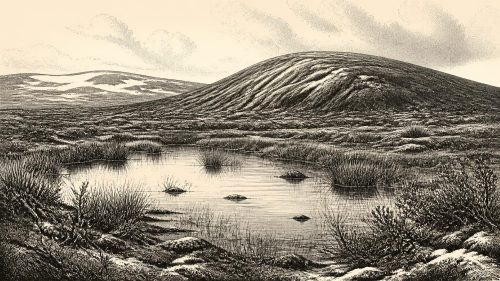
The label 30,708 BCE cannot identify a recoverable Irish year, but falls within a broad MIS 3 climatic interval. At Derryvree, County Fermanagh, freshwater sediments between glacial tills, including radiocarbon sample BIRM-166, indicate an ice-free episode around 33,500 calendar years BP. Plant and insect remains reveal cold, open, boggy tundra wetland. Later ice buried the site, while the Last Glacial Maximum followed millennia afterwards. Castlepook Cave, County Cork, preserves diverse cold-stage fauna, including mammoth and reindeer. A cut-marked reindeer bone may suggest human butchery, but cannot establish settlement. Together, the fragmentary evidence supports cautious environmental reconstruction, not annual social history.
Dateline
30,708 BCE is a modern calendar label, not a year that can be recovered from Ireland’s Late Pleistocene record. No Irish written calendar, settlement sequence or dated human lifetime can be fixed to it. In conventional archaeological terms, it lies about 32,657 years before AD 1950, within the unstable climatic span known as Marine Isotope Stage 3 (MIS 3), during the Midlandian glaciation. The evidence available is measured in broad radiocarbon and calibrated ranges, often with substantial uncertainty. It can illuminate the kinds of landscapes, plants and animals that existed in parts of Ireland around this remote point, but it cannot furnish an annual chronicle.
A Wetland Beneath a Drumlin
The most informative Irish evidence close to this broad period comes from Derryvree, near Maguiresbridge in County Fermanagh. Roadworks in 1969 sliced through a drumlin, exposing a remarkable sequence: freshwater silts and fine sands lay between two thick sheets of till, the unsorted debris left by glacier ice. The order of the layers is more secure than any attempt to assign them to a particular year. An earlier ice advance had deposited the lower till; thereafter, water, plants, insects and sediment accumulated at the site; finally, another advance buried the wetland beneath fresh glacial material.
Organic matter from this freshwater series, catalogued as BIRM-166, produced a conventional radiocarbon age of 30,500 BP, with an uncertainty of +1,170 and −1,030 years. Later chronological work treats it cautiously: old radiocarbon determinations have limits, and calibration turns one laboratory measurement into a probability range rather than a calendar anniversary. A published model places the deposit broadly around 33,500 ± 1,200 calendar years BP. The nominal date of 30,708 BCE falls within that wide range, but the deposit accumulated over time. It is therefore evidence for an interval of environmental conditions, not proof that a particular plant or pool existed in this precise numbered year.
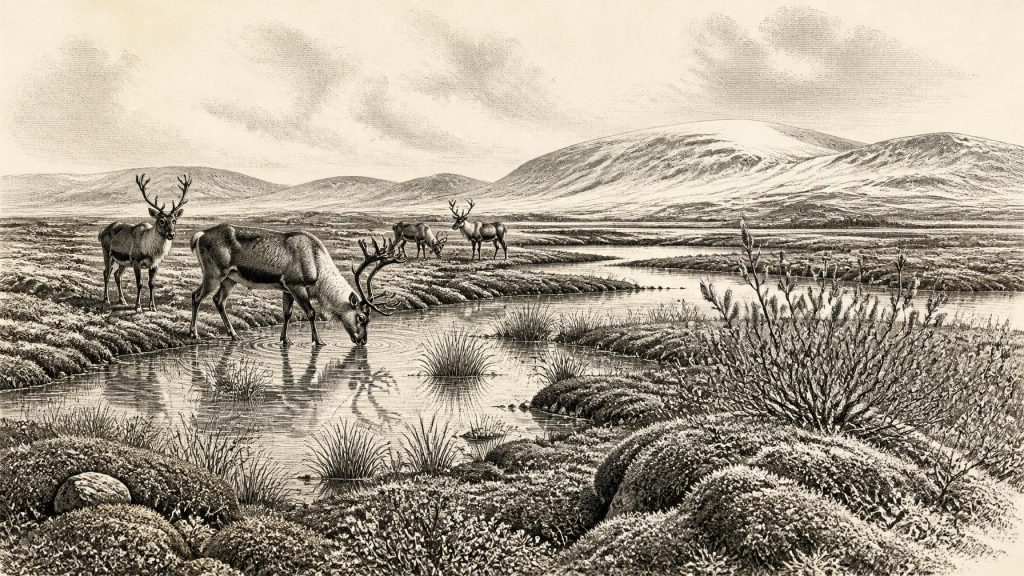
The original investigators found a flora and fauna of full-glacial aspect. Pollen was poorly preserved, but plant macrofossils, mosses and insect remains indicated open, treeless tundra or muskeg: a wet, cold, boggy landscape with shallow or sluggish freshwater, sedge-rich margins and sparse vegetation beyond the waterlogged ground. Bogbean and water-milfoil point to standing or slow-moving fresh water; mountain-avens, lesser clubmoss and dwarf willow belong to cold, exposed settings. The scene was not an unbroken white desert. It was a functioning but severe wetland ecosystem, likely changing sharply with season, frost, snow cover and meltwater.
Ice, Water and Uneven Country
Derryvree corrects any simple picture of Ireland as either wholly frozen or uniformly habitable during the last Ice Age. Its freshwater sediments show that this locality in Fermanagh was free of glacier ice long enough for organic deposits to form. They do not prove that the whole island was ice-free at the same moment. Ice margins, upland glaciers, river systems and exposed lowlands shifted over long periods, while later ice repeatedly eroded, buried and rearranged older deposits. Much of the record has consequently been lost.
The main historical development was environmental rather than political. At some stage after the Derryvree wetland formed, ice returned to cover the locality. The much larger expansion associated with the Last Glacial Maximum still lay ahead: current reconstructions broadly place its principal Irish phase later, from about 26,500 to 19,000 calendar years ago. Around 30,708 BCE, Ireland was thus part of a changing north Atlantic world in which cold phases, brief ameliorations, ice growth and retreat altered the ground available to plants, animals and any passing people.
Lower global sea levels also meant that the outlines of coasts and continental shelves differed greatly from those of modern Ireland. Yet this fact must not be converted into an imagined highway from Britain or continental Europe. The relevant shorelines, channels, ice barriers and exposed lands changed through time; the available evidence cannot identify a reliable route, season of crossing or means of travel for this date. Geography created possibilities and obstacles, but archaeology cannot turn them into a documented journey.
Mammals in the Southern Caves
Far from Fermanagh, Castlepook Cave near Doneraile in north County Cork—also called Mammoth Cave—provides an important, though differently dated, window onto Ireland’s wider MIS 3 fauna. Antiquarian excavations recovered a rich and complicated bone assemblage. Subsequent study and radiocarbon dating have identified remains including woolly mammoth, reindeer, giant deer, brown bear, wolf, Arctic fox, hare, lemmings and spotted hyaena. These animals did not necessarily share one moment, one habitat or one local food web: cave deposits can be assembled by carnivores, water movement, natural deaths and human excavation as well as by people.
Nevertheless, the fauna establishes that Ireland supported, or was reached by, cold-stage mammals during portions of the Late Pleistocene. Reindeer and mammoth evoke open grazing country; hyaenas and wolves indicate predators able to exploit animal carcasses and den sites. Castlepook should not be treated as a photographic image of Derryvree, much less of all Ireland in 30,708 BCE. It instead reinforces the broader conclusion that the island’s late-glacial environments were dynamic mosaics, capable at different times and places of sustaining large herbivores, small mammals and carnivores.
A Possible Human Trace
Castlepook also contains the most consequential and uncertain evidence relevant to people in Ireland at this depth of time. A reindeer femur, assigned by County Cork’s heritage publication to about 31,000 BC, bears a deep mark interpreted by palaeozoologist Ruth Carden as having been made by a sharp stone tool during butchery. If that interpretation is sustained, it would be an exceptionally early indication that Upper Palaeolithic people handled an animal in Ireland—far earlier than the long-established record of post-glacial settlement.
Its significance requires restraint. The marked femur is a single bone from an old, complex cave collection, not a sealed campsite. No securely associated stone-tool assemblage, hearth, dwelling floor, burial, food store or extensive concentration of butchered remains of comparable age has been recovered. The bone cannot show whether hunters killed the reindeer, scavenged it, removed meat or sinew elsewhere, or whether a carnivore later carried the limb into the cave. It cannot establish the size, identity, language or duration of a human presence. A possible human action is not evidence for a permanent population.
What Society Leaves Unsaid
For this reason, political affairs, diplomacy and warfare cannot responsibly be described. There are no known Irish kingdoms, named leaders, tribal territories, meeting places or treaties. Nor is there evidence for farming, livestock, fields, pottery, metalworking, monuments, shrines, art or formal exchange networks. Religion, learning and culture are equally beyond direct recovery. Assigning beliefs or institutions to hypothetical visitors would substitute familiar stories for evidence.
If people did reach Ireland during this phase, comparison with Upper Palaeolithic communities elsewhere suggests that survival would have depended on close knowledge of animals, weather, fuel, stone and shelter. Such a statement is an inference, however, not a demonstrated Irish social history. The Irish record does not yet reveal camps, seasonal rounds, clothing, boats, kinship or trade. The only sound economic observation is negative: there is no evidence here for the agricultural and settled ways of life that would emerge tens of millennia later.
An Archive, Not an Anniversary
The Ireland of this notional year was neither the wooded, farmed island of later prehistory nor a blank landscape without life. At Derryvree, cold freshwater and wet ground supported specialised plants and insects during an ice-free interval. At Castlepook, cave deposits preserve traces of an Ice Age animal world, while one marked reindeer bone raises a serious but unresolved question about human activity. Renewed glaciation would reshape the island and conceal much of what preceded it.
That fragmentary survival is the central lesson. BIRM-166 is not a record of 30,708 BCE, and Mammoth Cave does not provide a lost Irish community. Together, they show why the earliest history of Ireland must be written as a careful reconstruction from sediment, bone, stratigraphy and calibrated ranges: an account of possibility bounded by what the evidence can actually bear.
Primary Sources
- A Middle Midlandian Freshwater Series at Derryvree, Maguiresbridge, County Fermanagh, Northern Ireland
- Palaeoecology: Irish Quaternary Association Field Guide 16
- Exploring Controls of the Early and Stepped Deglaciation on the Western Margin of the British-Irish Ice Sheet
- Exploring Controls of the Early and Stepped Deglaciation on the Western Margin of the British-Irish Ice Sheet
- A Reconsideration of the Radiocarbon Dating of the Marine Isotope Stage 3 Fauna from Southern Ireland
- New Insights on the Fauna of Ireland's Younger Dryas and Early Holocene from Alice & Gwendoline Cave
- New Insights on the Fauna of Ireland's Younger Dryas and Early Holocene from Alice & Gwendoline Cave
- Heritage Artefacts of County Cork
- Ireland's Palaeolithic Archaeology – Fleeting Footprints in a Frozen Land
- The Mesolithic in Ireland: When Was It?
- Guide to the National Museum of Ireland – Natural History
- Exhibition Galleries: National Museum of Ireland – Natural History
- Outreach and Education Resources
- Publications
- Postglacial Colonisation Conference Proceedings
- Dimensions and Chronology of the Last Ice Sheet in Western Ireland
- New Data for the Last Glacial Maximum in Great Britain and Ireland
- The Geology of Ireland: Cenozoic, Tertiary and Quaternary
- Irish Pleistocene Biostratigraphy
- The Irish Quaternary Fauna Project
- Landscapes and Environments of the Last Glacial-Interglacial Transition: A Time of Amazingly Rapid Change in Ireland
- Irish Quaternary Association