
Derryvree Silts30661 BCE
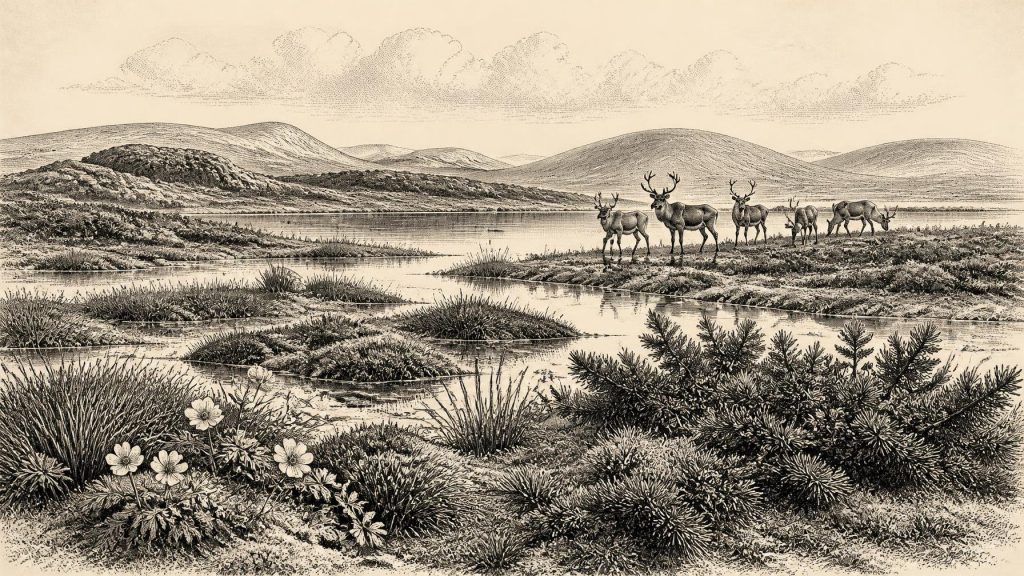
Around 30,661 BCE, Ireland cannot be described through annual history, but Late Pleistocene evidence outlines a changing, cold environment. At Derryvree, County Fermanagh, organic freshwater sediments between glacial tills, dated broadly to 34,950–29,750 BCE, record an ice-free wetland with tundra vegetation, pools and periglacial conditions. Castlepook Cave, County Cork, preserves a mixed fauna including mammoth, reindeer, giant deer and predators, demonstrating ecological opportunity rather than a single contemporary community. A cut-marked reindeer femur may indicate early human activity, but no secure settlement exists. Ice, sea levels and coastlines fluctuated; later glaciation destroyed or buried much evidence. Ireland’s evidence remains fragmentary.
Dateline
The label 30,661 BCE gives a modern calendar name to a time that cannot be reconstructed year by year. No Irish calendar, written record, named community or event survives from this depth of the past. In archaeological terms, the point is about 32,610 years before AD 1950, the conventional “present” used in radiocarbon science. It falls in the Late Pleistocene, broadly within Marine Isotope Stage 3, long before the Last Glacial Maximum reached its later, more extensive expression around Ireland.
Modern calendar-year precision is not available. A radiocarbon result is a measurement with an error range, and atmospheric carbon levels changed through time; it must therefore be calibrated before it is compared with calendar years. At more than 30,000 years ago, calibrated ranges can span millennia. The responsible task is not to invent an occurrence in 30,661 BCE, but to ask what dated deposits, fossil animals and glacial landforms can illuminate about Ireland during the broad interval into which that notional year falls.
A Wetland Beneath the Tills
The closest Irish environmental anchor is Derryvree, near Maguiresbridge in County Fermanagh. Roadworks exposed a drumlin section there in 1969. Beneath the familiar smooth hill’s surface lay a remarkable sequence: a lower body of glacial till, then freshwater silts and fine sands rich in organic material, and finally an upper till. The order matters more than any attempt to assign a particular season to the sediment. Ice had occupied the locality; subsequently, water and organic mud accumulated in an ice-free hollow; later ice or glacial sediment sealed the deposit again.
Organic material from that freshwater bed, laboratory sample BIRM-166, produced a conventional radiocarbon age of 30,500 years BP, with a substantial uncertainty of +1,170 and −1,030 years. Using modern calibration, published discussions place its broad probability range at approximately 36,900–31,700 calibrated years BP, roughly 34,950–29,750 BCE. Thus 30,661 BCE lies within the wide range relevant to the deposit, not at a securely identifiable point within it. Nor does one Fermanagh wetland provide a precise climate record for every coast, mountain and inland basin of Ireland.
Nevertheless, Derryvree is unusually eloquent evidence. Plant macrofossils, pollen, mosses and insect remains indicate treeless, open ground with wet, mossy margins and shallow pools: a tundra or muskeg-like landscape rather than the wooded island of later millennia. Grasses, sedges, juniper and herbs are represented, alongside cold-tolerant plants including mountain avens, bogbean and lesser clubmoss. Aquatic and wet-ground species show that this was not merely wind-blown gravel beside an ice front. Freshwater stood long enough for plants, invertebrates and fine sediment to form a biological archive.
Cold Does Not Mean Unchanging
The Derryvree evidence points to severe winters, short growing seasons and periglacial conditions: repeated freezing and thawing affecting soil and water beyond the direct edge of a glacier. It does not prove that every square mile of Ireland was bare, equally cold or ice-free at once. Marine and terrestrial studies increasingly show that the British–Irish Ice Sheet fluctuated considerably during the last glacial cycle. Ice was present in some Irish sectors during Marine Isotope Stage 3, while the Derryvree sequence demonstrates that this Fermanagh locality experienced an interval free of glacier ice before a later advance.
At 30,661 BCE, Ireland’s coastline was also unlike that of today. Much global water was locked in ice, lowering sea level and exposing parts of the continental shelf. Yet no evidence permits a confident map of the shoreline, a fixed land bridge or a single route into Ireland for this particular year. Sea level, local ice loading, changing channels and the shifting edges of ice all mattered. It is safer to say that Ireland belonged to a physically changing north-west European zone than to picture it as either permanently isolated or continuously joined to Britain.
Landscape change had a long afterlife. Later ice sheets eroded, buried and redistributed older deposits. That process helps explain why an inhabited surface, if one ever existed, is exceptionally unlikely to have survived openly across the Irish lowlands. Derryvree survived because organic sediment happened to be sealed between tills. Such preservation is a geological accident as much as a historical record.
Castlepook’s Animal Archive
County Cork provides a contrasting source of evidence. Castlepook Cave, near Doneraile, became known as Mammoth Cave after excavations in the early twentieth century produced a rich collection of animal bones. Work on the Irish Quaternary fauna and subsequent radiocarbon reassessment has shown that southern Ireland supported, or at least received, a varied Late Pleistocene fauna during parts of Marine Isotope Stage 3. The wider assemblage includes woolly mammoth, reindeer, giant deer, red deer, brown bear, wolf, fox, hare, lemmings and spotted hyaena.
That list should not be treated as a snapshot. Cave deposits can accumulate over long intervals. Carnivores carry carcass parts inside; animals die in or near caves; water, frost, excavation and earlier disturbance can mix layers. Direct dates have also revised older assumptions about individual specimens. Mammoth and hyaena bones once helped place part of the Castlepook fauna in a roughly 35,000–34,000 radiocarbon-year-old world, but a bone’s age, the date it entered a cave and the date another animal disturbed it are not necessarily the same thing.
Even with that caution, the fauna is historically important. Reindeer and lemmings support the picture of open, cold habitats. Mammoth, giant deer and large carnivores show that Ireland was not biologically empty during every phase before the later ice maximum. The cave is evidence for animal movements and ecological opportunity across the wider region, not proof that all listed species grazed together outside its entrance in 30,661 BCE.
The Narrow Human Question
One Castlepook object has renewed the question of whether people reached Ireland in this earlier Ice Age world: a reindeer femur reported as about 33,000 years old and bearing a deep mark interpreted by zooarchaeologist Ruth Carden as made by a sharp stone tool during carcass processing. If the interpretation and association are sustained by further work, it is potentially Ireland’s earliest evidence for human activity: a brief Upper Palaeolithic encounter with a reindeer carcass.
Its importance requires restraint, not embellishment. The femur derives from an old cave collection, rather than a modernly excavated, tightly recorded occupation surface. A radiocarbon date measures when the animal lived, not automatically when a mark was made; recognising a cut mark is a separate taphonomic judgement. No securely associated hearth, stone-tool assemblage, house floor, burial, human skeleton, cave art or repeated camp sequence has yet been published for Ireland around this date. Recent work at Castlepook is seeking undisturbed deposits precisely because these questions remain open.
Accordingly, it is not possible to name an Irish people, assign them a language, or attach a continental archaeological culture securely to the island in 30,661 BCE. Upper Palaeolithic communities elsewhere in western Europe made sophisticated stone and bone tools, travelled across large territories and, in some regions, produced art and formal burials. Those are useful comparisons for the human world near Ireland, but they cannot be imported as facts about Ireland without Irish finds. A possible visit, hunt or carcass-processing episode is not evidence for permanent settlement or descent into later populations.
No Polities, No Trade Network
There is no basis for political history here. No rulers, territories, diplomacy, warfare or institutions can be identified. Equally, there is no evidence in Ireland for farming, herding, cereal cultivation, metalworking, pottery, monuments, market exchange or long-distance trade at this time. The economy visible in the evidence is ecological rather than social: wild animals moved through cold environments, carnivores used caves, and plants occupied the limited productive ground available around water.
If people did enter Ireland, they would have depended on mobile foraging and on practical knowledge of weather, animals, stone and routes. That is an inference from Upper Palaeolithic lifeways elsewhere, not a demonstrated Irish social system. No object from Ireland around 30,661 BCE reveals religious practice, storytelling, music, education, kinship arrangements or a gendered division of labour. Absence of evidence does not prove absence of such human practices; it does mean that responsible history must leave them unknown.
An Island Recorded in Fragments
The most defensible picture of Ireland around 30,661 BCE is therefore environmental and provisional. In Fermanagh, an ice-free interval at some point within a wide dated range allowed a cold freshwater wetland to form between glacial advances. In Cork, cave collections preserve the remains of animals adapted to, or able to exploit, an open Late Pleistocene landscape. A marked reindeer bone raises the serious possibility of a human presence, but does not yet furnish a settlement narrative.
This is not an empty chapter of Irish history. It is a chapter written in silt, moss, seeds, insect fragments, bone and till, and it is valuable precisely because it defines the limits of knowledge. The evidence reveals a changing Ice Age Ireland, not an annual chronicle: wet tundra at Derryvree, a diverse animal world at Castlepook, and the possibility that people briefly reached the island before later glaciation erased or buried much of what they left behind.
Primary Sources
- A Middle Midlandian Freshwater Series at Derryvree, Maguiresbridge, County Fermanagh, Northern Ireland
- Exploring the controls on the Late Pleistocene dynamics of the British-Irish Ice Sheet
- The Irish Quaternary Fauna Project
- A reconsideration of the radiocarbon dating of the Marine Isotope Stage 3 fauna from southern Ireland
- Next-generation phylogeography resolves post-glacial colonization patterns in red deer
- Radiocarbon constraints on the history of the western Irish ice sheet prior to the Last Glacial Maximum
- The timing and magnitude of the British–Irish Ice Sheet between Marine Isotope Stages 5d and 2
- British–Irish Ice Sheet and polar front history of the Goban Spur, offshore southwest Ireland over the last 250,000 years
- Timing and pace of ice-sheet withdrawal across the marine–terrestrial transition west of Ireland during the last glaciation
- New Data for the Last Glacial Maximum in Great Britain and Ireland
- The IntCal20 Northern Hemisphere Radiocarbon Age Calibration Curve (0–55 cal kBP)
- The IntCal20 Northern Hemisphere Radiocarbon Age Calibration Curve (0–55 cal kBP)
- Figure 6: The Subdivision of the Quaternary Period in Ireland
- Irish Pleistocene Biostratigraphy
- Menyanthes trifoliata
- Dryas octopetala
- Selaginella selaginoides
- Archaeology Research Excavation Grant 2022: Final Report
- Castlepook Cave, Co. Cork: Excavations 2022
- Heritage Artefacts of County Cork 2021
- First Evidence of a Late Upper Palaeolithic Human Presence in Ireland
- The Colonization of Ireland: A Human Ecology Perspective
- New Insights on the Fauna of Ireland’s Younger Dryas and Early Holocene from Alice and Gwendoline Cave
- Geology of Ireland
- The Ice Age in Ireland


