Derryvree’s Periglacial Herbarium30548 BCE
Around 30,548 BCE, Ireland’s history is reconstructed from environmental evidence rather than recorded events. At Derryvree, County Fermanagh, organic sediments between glacial tills preserve a cold, treeless wetland of sedges, mosses, dwarf willow and aquatic plants, demonstrating an ice-free interval locally, not across Ireland. Climatic conditions changed rapidly as ice expanded regionally and sea levels remained low. Castlepook Cave, County Cork, records a diverse, chronologically mixed Ice-Age fauna including mammoth, reindeer and hyaena. No secure evidence establishes human settlement. A possibly butchered reindeer bone may suggest brief human contact, but cannot demonstrate occupation. These archives reveal Ireland’s changing Ice-Age environments.
Dateline
The label 30,548 BCE gives a useful point on a modern timeline, but it must not be mistaken for a date at which an event in Ireland can be pinpointed. There were no written records, calendar systems or securely dated settlements from this age. In archaeological terms, the nominal year falls at roughly 32,500 calendar years before present, within the Late Pleistocene and Marine Isotope Stage 3. Radiocarbon and environmental records can illuminate broad spans of time, usually with sizeable uncertainty ranges; they cannot tell us what happened in Ireland in one particular year.
The strongest Irish evidence relevant to this moment comes not from a village or a grave, but from a buried wetland at Derryvree, near Maguiresbridge in County Fermanagh. There, roadworks exposed organic silts and fine sands sealed between two distinct layers of glacial till. The deposit is one of the rare surviving records of an interval when part of Ireland was not buried beneath moving ice. Its conventional radiocarbon determination, BIRM-166, was 30,500 radiocarbon years before present, with a substantial margin of error. Later calibration places the material broadly around 36,900–31,700 calibrated years before present. The nominal year belongs within that wide window, but it cannot be assigned to a particular layer, plant, animal or season.
A Wetland Between Ice Advances
Derryvree’s importance lies in its position between tills. Till is debris left directly by glacier ice: clay, sand, stones and boulders mixed and pressed into a dense deposit. At Derryvree, an earlier ice advance laid down one till; afterwards, water, silt and organic matter accumulated in a cold landscape; later ice covered and protected that record beneath another till. This sequence demonstrates an ice-free interval in this part of Fermanagh before the growth of the final, more extensive British–Irish Ice Sheet. It does not prove that all of Ireland was clear of ice at once. The island’s conditions were regionally varied, and the extent of early ice remains debated.
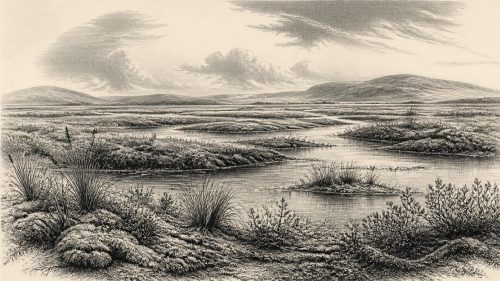
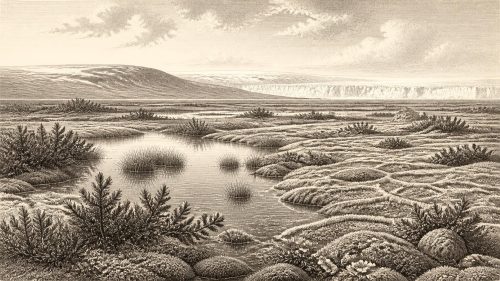
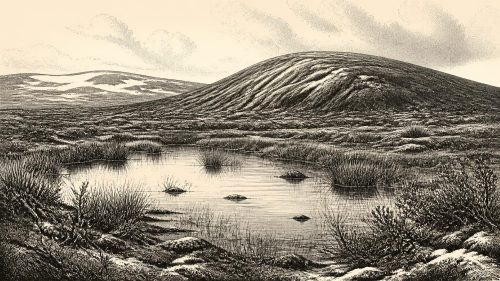
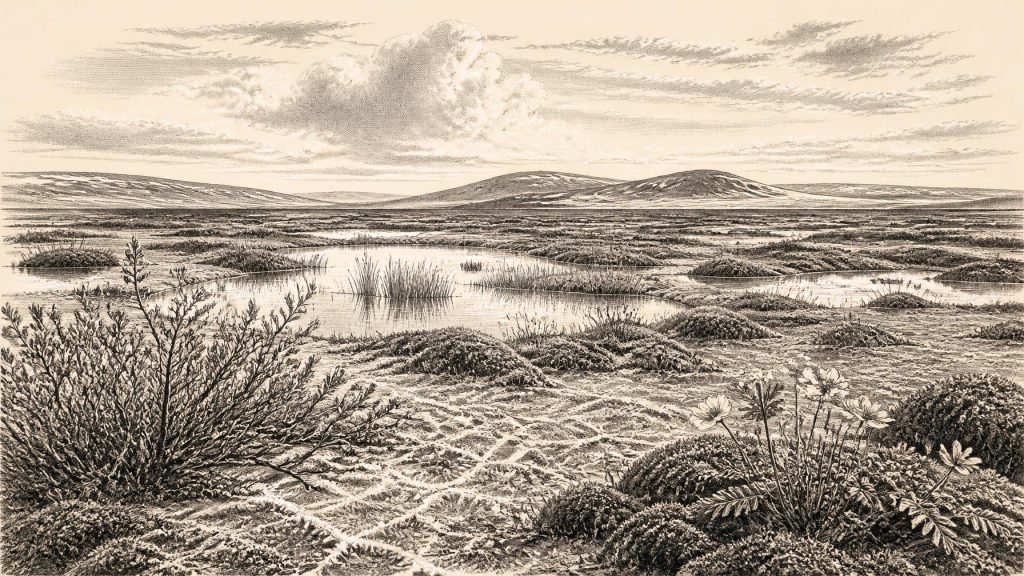
The organic bed preserves the traces of a treeless, periglacial wetland rather than a familiar green Irish countryside. Plant remains include sedges, mosses, dwarf willow, mountain avens, bogbean and aquatic plants such as water-milfoil. Together they indicate shallow freshwater, saturated ground and open vegetation capable of surviving harsh cold. The assemblage has often been described as tundra or muskeg: a mosaic of wet hollows, sedgy margins, low shrubs and exposed mineral ground. Such terms are interpretative ecological shorthand, not proof that Derryvree precisely matched any modern Arctic landscape.
This was a demanding environment, yet not necessarily a lifeless one. Short summers could support plant growth around ponds and watercourses, while severe winters, frost action and sparse woody cover shaped the land. Insects and other small remains from the deposit add to the impression of cold freshwater conditions. The detailed mix of organisms is direct evidence for local habitats around the wetland; it should not be stretched into a complete map of Fermanagh, still less a claim that the entire island had one uniform climate.
Climate at a Northern Edge
The broader North Atlantic climate was unstable. Greenland ice-core records divide this period into abrupt cold and relatively milder episodes, known as stadials and interstadials. Around 32,500 years before present, the relevant comparison is Greenland Interstadial 5, though aligning a single Irish deposit with an ice-core phase carries chronological uncertainty. Speleothem records from south-west Ireland nevertheless show that cave formation responded episodically to these millennial-scale climatic shifts during Marine Isotope Stage 3. Ireland was part of a rapidly changing north-west European world, not an isolated climatic refuge.
Ice was becoming increasingly important in the Irish Sea region. Modern reconstructions of the British–Irish Ice Sheet show major expansion during the later part of Marine Isotope Stage 3 and towards the Last Glacial Maximum, which followed considerably later. The final maximum ice extent belongs broadly to about 27,000–23,000 years before present in many reconstructions, not to the nominal year considered here. Thus it would be inaccurate to picture Ireland at this point as wholly entombed beneath the vast ice sheet of the maximum. Equally, it would be inaccurate to portray it as securely ice-free. Derryvree records one open sector during a cold interval within a landscape vulnerable to renewed glaciation.
Sea level was far below its present position because immense volumes of water were held in global ice sheets. The coastline and shallow seas around Ireland were therefore very different, with parts of today’s continental shelf exposed, submerged beneath ice, or affected by changing marine margins. That altered geography may have created intermittent routes for animals across the wider Irish Sea region. It does not establish a simple, permanent land bridge from Britain or continental Europe, and it provides no evidence that human communities regularly travelled such routes.
Animals Recorded in Cork Caves
South Munster supplies the other principal body of evidence. Castlepook Cave, also known as Mammoth Cave, near Doneraile in County Cork, yielded Ireland’s most famous Pleistocene animal assemblage. Excavations in its limestone passages, including areas traditionally called Hyaena Hall and Elephant Hall, recovered remains attributed to woolly mammoth, reindeer, giant deer, brown bear, wolf, Arctic fox, stoat, mountain hare, lemmings and spotted hyaena. These finds overturn any simple vision of prehistoric Ireland as devoid of large mammals.
But Castlepook is not a snapshot. Cave deposits can gather bones through carnivore activity, deaths within or near the cave, water movement, disturbance and excavation practices that pre-dated modern recording standards. Radiocarbon re-dating has shown that several Castlepook specimens were significantly older than previously thought, and that some species, including giant deer and spotted hyaena, may have disappeared locally before about 40,000 calibrated years ago. The cave therefore documents a long and changing faunal history through Marine Isotope Stage 3, rather than a single herd or community living together in 30,548 BCE.
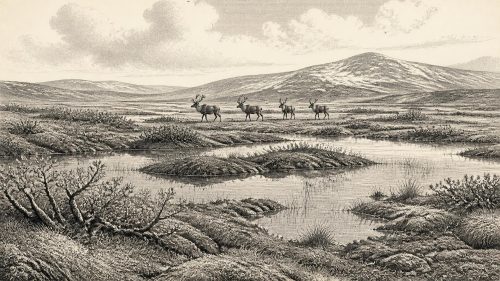
Reindeer are especially relevant to an open, cold setting, though their bones do not demonstrate their precise range in the nominal year. Mammoth remains similarly indicate that these animals reached Irish Ice-Age landscapes at some point, not that mammoths stood beside Derryvree’s pools. The responsible picture is one of shifting habitats and episodic animal movement. Open ground, wetland vegetation and low sea levels may have offered opportunities for colonisation, while advancing ice, changing coastlines and severe winters repeatedly restricted them.
The Unsettled Human Question
There is no securely excavated house, hearth, occupation surface, stone-tool workshop or burial in Ireland dated to this broad period. There is consequently no sound basis for describing a resident population, an Irish Upper Palaeolithic society or continuous occupation. Later glaciers eroded landscapes and buried or destroyed potential sites; rising seas also removed evidence from former coastal plains. Absence of evidence is not proof that no person ever entered Ireland, but it sets firm limits on what can be asserted.
A reindeer femur from Castlepook, held in the National Museum of Ireland’s natural-history collections, has been publicly interpreted as bearing a deep mark made during butchery with a stone tool and has been associated with an age of about 33,000 years ago. If that interpretation and chronology withstand continued scrutiny, it may indicate a brief encounter between people and a reindeer carcass in Ireland during this wider interval. It would still not prove settlement, population size, repeated seasonal visits or an identifiable cultural tradition. The bone derives from an old cave collection, not a modern excavation with a tightly recorded archaeological context.
Comparisons with Upper Palaeolithic groups elsewhere in north-west Europe can help define what a human visitor might have needed: warm clothing, fire, portable equipment, knowledge of animal behaviour and social networks capable of managing risk. Such comparisons are not evidence that any of these things were present in Ireland. No Irish material from this period identifies language, ancestry, kin groups, leadership, territory, diplomacy, warfare, ritual, art or religious belief. Nor can archaeology demonstrate trade. A passing group might have carried stone, food or other supplies, but no exchange network is attested.
History Before Society
Political affairs and conflict cannot responsibly be narrated for Ireland at this date. There were no known polities, borders, chiefs or treaties, and animal predation must not be recast as human warfare. Society and everyday life are likewise recoverable only in the most cautious conditional sense: if people visited, they would have faced a mobile, seasonal and dangerous environment. For the island itself, the clear evidence concerns ecology and geological change rather than institutions or communities.
That does not make the period insignificant. Derryvree’s buried flora preserves a rare record of cold-water life in an open Fermanagh landscape before later ice sealed it away. Castlepook preserves the deeper history of animals that entered and sometimes flourished in Irish landscapes very unlike those of today. Together with cave calcite, marine records and glacial landforms, they show an Ireland continually remade by climate, ice, water and changing connections to neighbouring lands. Around the nominal date, Ireland’s history is best understood not as an annal of named people and events, but as a fragile environmental archive at the edge of Ice-Age Europe.
Primary Sources
- A Middle Midlandian Freshwater Series at Derryvree, Maguiresbridge, County Fermanagh, Northern Ireland
- The Irish Quaternary Fauna Project
- A Reconsideration of the Radiocarbon Dating of the Marine Isotope Stage 3 Fauna from Southern Ireland
- Episodic Speleothem Deposition Tracks the Terrestrial Impact of Millennial-Scale Last Glacial Climate Variability in SW Ireland
- Growth and Retreat of the Last British–Irish Ice Sheet, 31,000 to 15,000 Years Ago: The BRITICE-CHRONO Reconstruction
- The Timing and Magnitude of the British–Irish Ice Sheet Between Marine Isotope Stages 5d and 2: Implications for Glacio-Isostatic Adjustment, High Relative Sea Levels and ‘Giant Erratic’ Emplacement
- The Evolution of the Terrestrial-Terminating Irish Sea Glacier During the Last Glaciation
- Trimlines, Blockfields and the Last Ice Sheet, S Ireland
- Timing and Pace of Ice-Sheet Withdrawal Across the Marine–Terrestrial Transition West of Ireland During the Last Glaciation
- Character of Advance and Retreat of the Southwest Sector of the British-Irish Ice Sheet During the Last Glaciation
- Stratigraphic and Palaeo-Geomorphological Evidence for the Glacial-Deglacial History of the Last British-Irish Ice Sheet in the North-Western Irish Sea
- A 10Be-Dated Record of Glacial Retreat in Connemara, Ireland, Following the Last Glacial Maximum and Implications for Regional Climate
- The IntCal20 Northern Hemisphere Radiocarbon Age Calibration Curve (0–55 cal kBP)
- A 60 000 Year Greenland Stratigraphic Ice Core Chronology
- A New Greenland Ice Core Chronology for the Last Glacial Termination
- The Subdivision of the Quaternary Period in Ireland
- Heritage Artefacts of County Cork
- Occurrence of Mammalia Relicts at Site Castlepook Cave
- New Insights on the Fauna of Ireland’s Younger Dryas and Early Holocene from Alice & Gwendoline Cave
- Palaeolithic Ireland – New Evidence Emerges from the Emerald Isle