Castlepook’s Stone-Tool Question30547 BCE
30,547 BCE is not a datable Irish event but an editorial point within unstable Marine Isotope Stage 3. Derryvree, County Fermanagh, preserves freshwater sediments between glacial tills, demonstrating an ice-free tundra wetland during a broad cold interval. Castlepook Cave, County Cork, contains diverse cold-adapted fauna accumulated over millennia. A marked reindeer femur may record stone-tool butchery and thus an early human visit, but lacks supporting tools, hearths or secure contexts. Ireland was environmentally varied, with ice, open ground, wetlands and large mammals, rather than uniformly frozen. Evidence permits possible intermittent human presence, not settlement, society or year-specific history in Ireland.
Dateline
30,547 BCE is a useful modern label for a point deep in the Late Pleistocene, not a date at which an event in Ireland can be placed. No calendar, written record, named individual, settlement or political episode can be assigned to this year. The responsible chronological language is therefore broad: this notional year falls within Marine Isotope Stage 3, a climatically unstable part of the last glacial cycle, and within the wide calibrated range associated with the Derryvree freshwater deposits in County Fermanagh. The latter produced a conventional radiocarbon result of 30,500 +1,170/−1,030 BP; calibrated ranges cited in later scholarship span roughly 36,900–31,700 calendar years BP. Such ranges are measured in centuries and millennia, not individual years.
A Date Without a Chronicle
The conversion of an ancient radiocarbon measurement into BCE dates needs particular care. ‘Before Present’ conventionally counts backwards from AD 1950, while radiocarbon years are not the same as calendar years because atmospheric carbon-14 levels have varied. Modern calibration curves, including IntCal20, extend to this period but produce probability ranges rather than a pinpoint calendar placement. Accordingly, 30,547 BCE should be read as an editorial waypoint within a long environmental interval. It cannot identify a particular season, animal migration, human visit or glacial advance. Even the relationship of Irish deposits to abrupt Greenland climate oscillations is usually approximate, because local sedimentary records are incomplete and their dates have uncertainties.
At this scale, the central historical question is not what happened in one year, but what kind of Ireland could have existed around it. The answer is an island repeatedly transformed by cold climate, fluctuating ice margins, low sea levels and an open, often treeless landscape. Ireland was not the green, wooded island familiar today. Its habitats altered sharply as temperature, moisture, snow cover and glacier extent changed. Some areas were ice-covered; others supported periglacial ground, wetlands, ponds and tundra vegetation. The geographical outlines of the island and its connections across the Irish Sea were also unlike those of the modern world. This was a shifting north-west European frontier, not an isolated and stable land.
Derryvree’s Buried Wetland
The most direct Irish environmental evidence relevant to this broad period comes from Derryvree near Maguiresbridge, County Fermanagh. Road works in 1969 cut through a drumlin and revealed organic silts and fine sands trapped between two distinct tills. Till is the unsorted debris laid down by glacier ice. The sequence matters because it establishes relative order: local ice had deposited the lower till; freshwater and organic sediment then accumulated during an ice-free interval; later ice overrode or approached the locality again, leaving the upper till. The deposit is therefore a rare record of an exposed, functioning landscape surviving between episodes of glaciation.
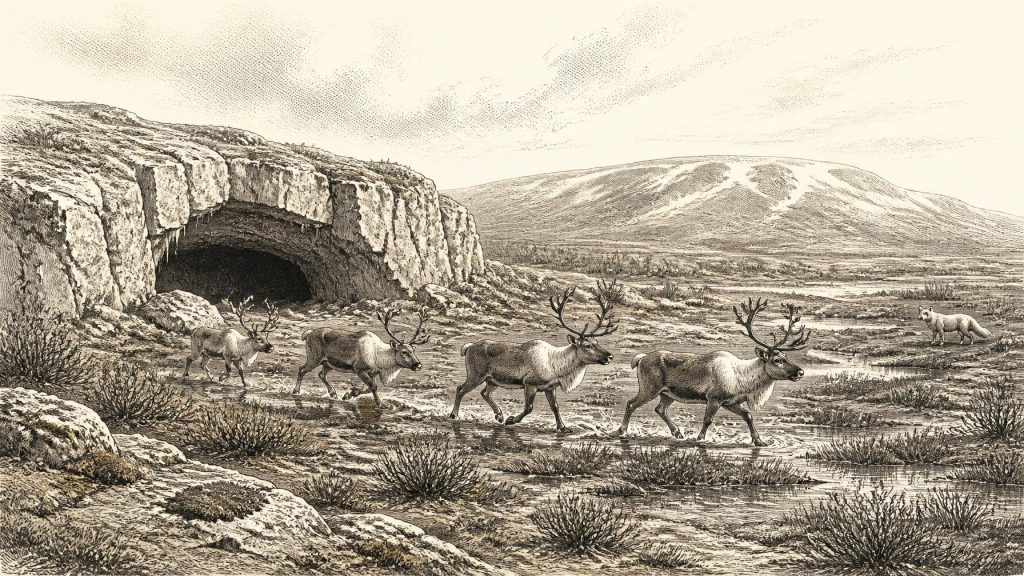
Plant and animal remains in the Derryvree sediments point to open tundra and a periglacial regime. They do not recreate every hill and valley across Ireland, but they give unusually tangible evidence for one northern landscape: wet ground and freshwater, with vegetation adapted to severe cold rather than closed forest. Earlier descriptions of the assemblage include sedges, mosses and cold-tolerant herbs, alongside aquatic or wetland plants. The lesson is important. ‘Ice Age’ did not mean that all Ireland was a featureless sheet of ice at all times. In suitable ice-free pockets, shallow water, saturated ground and short growing seasons could sustain distinctive communities of plants and small animals.
That evidence also sets limits on interpretation. Pollen, seeds, moss fragments, beetle remains and sediment layers reveal environments, but not human intentions. They cannot demonstrate a camp, a hunting route, language, kinship or belief. Nor does a freshwater bed beneath a drumlin prove that people lived beside it. It documents the ecological stage upon which human or animal movement might have occurred. The later burial of this evidence beneath glacial deposits is one reason the Irish record for this period is so fragmentary: many former ground surfaces were eroded, reworked or sealed by ice.
Castlepook and the Reindeer Bone
The archaeological possibility nearest to this date lies far to the south, at Castlepook Cave near Doneraile in north County Cork, also known as Mammoth Cave. Excavations there in the early twentieth century recovered more than 2,000 bones from a complicated cave system. The cave fauna includes woolly mammoth, giant deer, reindeer, brown bear and spotted hyaena, while other remains include wolf, Arctic fox and lemmings. Individual radiocarbon determinations show that the cave received animal remains over a long span, broadly from before 45,000 to about 20,000 BP. It is Ireland’s richest known archive for vertebrate life before the Last Glacial Maximum.
A reindeer femur from Castlepook has attracted exceptional attention because its deep linear mark has been interpreted by zooarchaeologist Ruth Carden as a cut made by a sharp stone tool during carcass processing. County Cork heritage publications place the specimen broadly at about 31,000 BCE, while public reporting has described its radiocarbon age as about 33,000 years. If the mark is correctly identified and contemporary with the bone, it is potentially the earliest evidence for people handling an animal in Ireland. It would suggest a brief Upper Palaeolithic human presence long before the well-established post-glacial settlement of the island.
But ‘potentially’ is essential. Castlepook does not yet provide a securely excavated stone-tool assemblage, hearth, dwelling floor, human burial or occupation layer of this age. Its deposits were excavated long before modern recording standards, and the cave accumulated bones through several processes: carnivores could have carried in prey or scavenged remains; animals may have died nearby; water disturbed deposits; and material from different moments can become mixed. Subsequent work has also stressed that some older radiocarbon dates from the site merit reassessment in light of improved pretreatment methods. The femur is a significant clue, not a licence to invent an established colony of hunters.
Animals, Landscapes and Risk
The Castlepook fauna nonetheless makes the Irish world of this interval more vivid. Reindeer and mammoth indicate open, cold-stage habitats capable of supporting large grazing animals; giant deer occupied parts of this wider faunal mosaic; predators and scavengers included wolf and spotted hyaena. Caves could serve as dens, traps, shelters or repositories for bones rather than as human homes. A reindeer limb found in a cave does not mean the animal was killed there. Indeed, the published interpretation of the cut-marked femur allows that a carcass may have been processed elsewhere and the discarded bone later transported into the cave by carnivores.
For any people who did reach Ireland, life would have demanded mobility, ecological knowledge and careful risk management. That is an inference from the climate and the wider Upper Palaeolithic world, not a description of a documented Irish community. Reindeer offered meat, fat, hide, sinew and bone; stone edges could help separate flesh and tendon. Yet no Irish evidence from around this point establishes the size of a party, the duration of a visit, whether people crossed from Britain or continental Europe, or whether they returned. The sea and ice geography of the Irish Sea basin varied greatly during glacial conditions, but changing physical accessibility is not evidence that a particular crossing took place.
No Polities, No Trade Network
There is no evidence for political institutions, diplomacy, organised warfare, named territories or leaders in Ireland around 30,547 BCE. Equally, no demonstrable Irish trade network, exchange system, ritual site, art tradition or formal learning can be attached to this date. The absence is archaeological as well as historical: a lone modified bone, even if accepted as humanly cut, cannot carry such conclusions. It would be misleading to project later prehistoric societies backwards into a period separated from the first sustained settlement of Ireland by many millennia.
Religion and culture are similarly beyond recovery here. People in Upper Palaeolithic Europe elsewhere made images, ornaments, burials and complex stone technologies, but those wider achievements cannot be transferred automatically to Ireland. No comparable Irish material is securely associated with Castlepook’s possible human trace. The appropriate conclusion is modest: Ireland may have been visited by people during a harsh but biologically varied stage of the last glacial cycle; whether that contact was isolated, repeated or sustained remains unresolved.
An Archive Still Being Tested
The importance of this notional year lies in its uncertainty. Derryvree demonstrates that ice-free tundra wetland existed in at least one Irish locality during a broad late MIS 3 interval. Castlepook demonstrates that cold-adapted mammals ranged through southern Ireland over a long period, and its reindeer femur raises the possibility of human butchery. Together, the sites replace an older image of wholly empty, uniformly frozen Ireland with a more dynamic landscape of ice advances, exposed ground, freshwater habitats, migrating animals and perhaps occasional people. They do not yet provide a year-by-year narrative.
Future work may refine the picture through renewed cave excavation, microscopic study of bone surface modification, improved radiocarbon pretreatment, ancient biomolecular techniques and tighter correlation between Irish sediments and North Atlantic climate records. For now, 30,547 BCE is best understood not as the date of an Irish event, but as a point within a deep and changing Pleistocene past: a world preserved in a Fermanagh wetland beneath glacier deposits and in the bones of animals accumulated in a Cork limestone cave.
Primary Sources
- A Middle Midlandian Freshwater Series at Derryvree, Maguiresbridge, County Fermanagh, Northern Ireland
- A Reconsideration of the Radiocarbon Dating of the Marine Isotope Stage 3 Fauna from Southern Ireland
- The Irish Quaternary Fauna Project
- Castlepook Cave: Cork County Geological Site Report
- Heritage Artefacts of County Cork
- The Archaeological Heritage of County Cork
- Castlepook Cave, Co. Cork: Excavation Report 2022
- First Evidence of a Late Upper Palaeolithic Human Presence in Ireland
- New Insights on the Fauna of Ireland's Younger Dryas and Early Holocene from Alice & Gwendoline Cave
- The Evolution of the Terrestrial-Terminating Irish Sea Glacier During the Last Glaciation
- Pattern, Style and Timing of British–Irish Ice Sheet Advance and Retreat Over the Last 45,000 Years
- A Stratigraphic Framework for Abrupt Climatic Changes During the Last Glacial Period Based on Three Synchronized Greenland Ice-Core Records
- The IntCal20 Northern Hemisphere Radiocarbon Age Calibration Curve (0–55 cal kBP)
- The IntCal20 Approach to Radiocarbon Calibration Curve Construction: A New Methodology Using Bayesian Splines and Errors-in-Variables
- Recent Developments in Calibration for Archaeological and Environmental Samples
- Irish Pleistocene Biostratigraphy
- Freshwater Organic Deposits and Stratified Sediments Between Early and Late Midlandian (Devensian) Till Sheets, at Aghnadarragh, County Antrim, Northern Ireland
- Landscapes and Environments of the Last Glacial-Interglacial Transition: A Time of Amazingly Rapid Change in Ireland
- Pleistocene Vertebrates in the British Isles
- The Exploration of Castlepook Cave, County Cork
- Figure 6: The Subdivision of the Quaternary Period in Ireland
- Soils of County Waterford
- The Stratigraphic Position and Age of the Gortian