BIRM-166’s Buried Wetland30299 BCE
30,299 BCE is a modern label within Marine Isotope Stage 3, not a recoverable Irish historical year. At Derryvree, Fermanagh, organic silts between glacial tills, dated BIRM-166, record an ice-free freshwater wetland during separate glacial phases. Fossils indicate cold, treeless tundra mosaics of pools, sedges, grasses and Arctic-alpine plants. Castlepook Cave, Cork, preserves a mixed faunal record including mammoth, reindeer, giant deer, carnivores and lemmings, demonstrating varied cold-stage habitats but not a simultaneous fauna. A reindeer bone may suggest human activity, though evidence remains inconclusive. Ice-age Ireland was ecologically active, regionally diverse and repeatedly reshaped, then obscured, by advancing ice.
Dateline
30,299 BCE is a modern chronological label, not a recoverable year in Ireland’s own past. No Irish calendar, written record, named community or securely dated human action can be assigned to it. In radiocarbon terms it falls about 32,248 years before AD 1950, the conventional “present” used in dating science, but that arithmetic is not a scientific date. The responsible frame is a much broader Late Pleistocene interval within Marine Isotope Stage 3, when climates, ice margins and habitats changed over centuries and millennia. Evidence relevant to this nominal year comes chiefly from calibrated ranges, stratified sediments and fossil assemblages—not from an annal of events.
A Wetland Beneath the Drumlins
The most informative Irish archive close to this point lies at Derryvree, near Maguiresbridge in County Fermanagh. Roadworks in 1969 exposed a remarkable section through a drumlin: glacial till at the base, then fine sands and organic freshwater silts, capped by a further thick till. Till is unsorted debris laid down directly by glacier ice. The order of these layers is decisive evidence. Ice had occupied the site; a later interval allowed water, sediment, plants and small animals to accumulate; then ice returned or expanded and buried the wetland beneath another glacial deposit.
Organic material from that intervening layer produced the conventional radiocarbon determination BIRM-166, 30,500 radiocarbon years BP, with a sizeable uncertainty of +1,170 and −1,030 years. Radiocarbon years are not identical to calendar years because atmospheric carbon-14 has varied through time. Calibration using modern curves gives a broad calendar range, published approximately as 36,900–31,700 calibrated years BP, or about 34,950–29,750 BCE. Thus 30,299 BCE belongs near the younger part of the long interval illuminated by Derryvree, but cannot be identified with a particular season, pond edge, plant or generation.
This distinction matters. The BIRM-166 sample does not date all of Ireland, still less a single historical year. It dates carbon within a deposit that formed over an extended period and was subsequently protected by ice. Yet it establishes something important: in part of present-day Fermanagh, an ice-free freshwater environment existed between separate phases of glaciation during the last Ice Age.
Cold Water and Open Ground
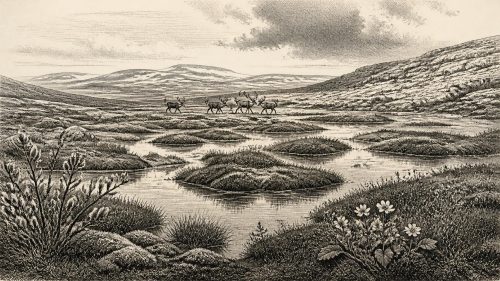
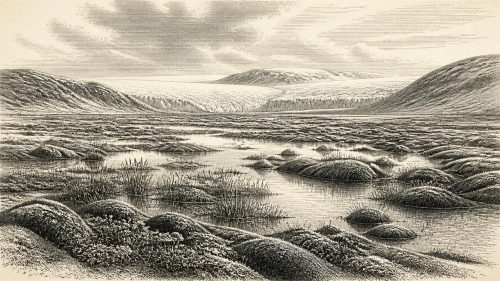
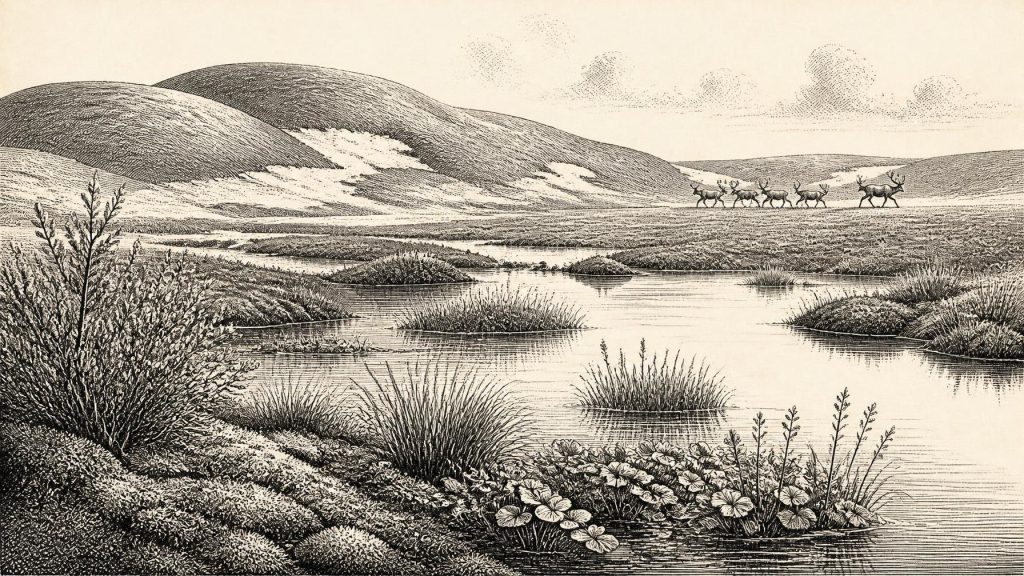
The fossils preserved in the Derryvree silts indicate a cold, treeless and varied landscape. Plant macrofossils, pollen, mosses and insects point to open tundra-like vegetation under a periglacial regime. Sedges, grasses, dwarf willow, juniper and Arctic-alpine herbs formed parts of this mosaic. Mountain avens, lesser clubmoss and bogbean are among the plants reported from the sequence; aquatic remains, including water-milfoil, show that shallow fresh water was available. Mossy wet margins and pools could be locally productive even where exposed ground was thinly vegetated and severe winter cold restricted growth.
“Tundra” should not conjure a level, unchanging snowfield. Derryvree’s setting probably comprised wet hollows, sedge margins, shallow pools, frost-disturbed surfaces and channels fed by seasonal meltwater. Freezing and thawing would have reshaped soils and drainage repeatedly. The environmental evidence supports a harsh but living wetland; it does not support a precise reconstruction of temperature or weather on any day in 30,299 BCE. Nor can one Fermanagh deposit provide a national map. Conditions differed between lowlands, uplands, cave country, coastal margins and districts nearer active ice.
The enclosing tills also make Derryvree a reminder that the Irish landscape was unstable in the geological sense. Ice was not simply retreating towards a warmer future. During the wider Middle to Late Midlandian, glaciers and ice caps could advance, stagnate, thin or reorganise, while cold-stage ecosystems occupied available ground. Later growth of the British–Irish Ice Sheet would become much more extensive: the Last Glacial Maximum is generally placed around 26,500–19,000 years BP. That later ice scoured, buried or disturbed much of the older terrestrial record, helping to explain why evidence from this earlier interval is exceptionally fragmentary.
Cave Bones in North Cork
Castlepook Cave, also called Mammoth Cave, near Doneraile in north County Cork, supplies the principal faunal counterpart to Derryvree. It is Ireland’s richest known cave archive for vertebrate life in the long period leading towards the Last Glacial Maximum. More than 2,000 bones have been recovered from its chambers and passages. Direct dates from individual specimens span a very long interval, approximately 45,700 to 19,950 radiocarbon years BP. This is a strength, because it demonstrates repeated animal use of southern Ireland; it is also a limitation, because the collection cannot be treated as one simultaneous local menagerie.
Its Ice-Age fauna includes woolly mammoth, reindeer, large deer conventionally identified as giant deer, brown bear, wolf, Arctic fox, hare, lemmings and spotted hyaena. These animals signal a cold-stage world with open habitats, seasonal resources and mobile populations. Hyaenas are particularly instructive. Castlepook was not simply a place where animals died naturally: carnivores could transport or gnaw carcass parts, while water and old excavation methods could move bones from their original positions. The cave accumulated remains through several processes and across many thousands of years.
Accordingly, it would be wrong to place every listed species together beside the same pool in 30,299 BCE. The evidence establishes broad ecological possibilities rather than a single scene. Mammoth and reindeer are consistent with open, cold environments; foxes and lemmings reinforce the picture of northern conditions; bears, wolves and hyaenas show that Ireland’s Pleistocene fauna was more diverse than that of the later historic island. But specimens have individual histories, and some species may have entered, disappeared and reappeared as climate, terrain and access routes changed.
The Human Question
Castlepook has also altered discussion of Ireland’s earliest people. A reindeer femur in the old cave collections has been reported as carrying a deep surface mark interpreted as damage made by a stone tool during carcass processing. If that diagnosis is sustained by further microscopic and contextual work, it would be important evidence for a human visit to Ireland in the Upper Palaeolithic, long before the much better documented settlement of the post-glacial period.
For now, however, the claim must remain carefully bounded. A radiocarbon date on an animal bone establishes the age of the animal, not automatically the date or cause of every mark on it. Cave deposits can be mixed; carnivore activity, sediment abrasion and damage during recovery may mimic or obscure traces of cutting. No securely associated stone-tool assemblage, hearth, dwelling surface, human burial or settlement has yet demonstrated a resident Irish Upper Palaeolithic population at this time. Recent work at Castlepook is valuable precisely because it seeks undisturbed deposits and better dated associations rather than treating old discoveries as conclusive.
Upper Palaeolithic communities elsewhere in north-west Europe used stone tools, fire, clothing, shelters and far-reaching social contacts to survive demanding seasonal conditions. Such comparison can indicate the skills a hypothetical visitor to Ireland might have required. It cannot supply an Irish language, identity, religion, artistic tradition or political organisation for which no local evidence exists. There is likewise no responsible basis for claims about tribes, leaders, territorial boundaries, warfare, diplomacy, exchange networks or formal learning in Ireland in 30,299 BCE.
No Politics, but a Deep History
Society and economy can therefore be described only negatively. There was no farming, field system, metalworking, pottery production, town or monument known from Ireland at this date. There is no evidence for domesticated animals, regular maritime trade or enduring settlement. If people crossed into the island during a favourable interval, they may have been small, highly mobile hunter-gatherer parties exploiting animal carcasses and seasonal terrain; that is an interpretation drawn from wider European archaeology, not a demonstrated Irish social system.
Connections with Britain and continental Europe were themselves changing questions. Sea levels were substantially lower than today during the last glacial period, and the geography of the Irish Sea basin differed greatly from the modern map. Yet the presence, continuity and practical traversability of routes depended on changing water, ice, coastlines and terrain. The evidence does not justify imagining an easy land bridge or a settled corridor at this specific date. Ireland stood at the north-western edge of Europe, and its accessibility could have varied sharply between climatic phases.
The central development around 30,299 BCE is therefore environmental. Derryvree records a cold freshwater wetland between glacial episodes; Castlepook preserves the long, mixed record of animals inhabiting or passing through southern Ireland; and one disputed reindeer bone raises the possibility of a fleeting human encounter with that world. The past here is written in silt, pollen, plant remains, cave bone, isotopes and ice-laid sediment. It is not an empty past, but it is not an annual history either. Its most secure lesson is that Ice-Age Ireland was regionally diverse, ecologically active and repeatedly remade by climate before later ice concealed so much of its evidence.
Primary Sources
- A Middle Midlandian Freshwater Series at Derryvree, Maguiresbridge, County Fermanagh, Northern Ireland
- A Reconsideration of the Radiocarbon Dating of the Marine Isotope Stage 3 Fauna from Southern Ireland
- The Irish Quaternary Fauna Project
- Castlepook Cave: County Geological Site Report
- 2022:564 – Castlepook Cave, Castlepook South, Cork
- Castlepook Caves
- Growth and Retreat of the Last British–Irish Ice Sheet, 31,000 to 15,000 Years Ago: The BRITICE-CHRONO Reconstruction
- The Timing and Magnitude of the British–Irish Ice Sheet Between Marine Isotope Stages 5d and 2: Implications for Glacio-Isostatic Adjustment, High Relative Sea Levels and ‘Giant Erratic’ Emplacement
- The Deglaciation of the Western Sector of the Irish Ice Sheet from the Inner Continental Shelf to Its Terrestrial Margin
- Late Pleistocene Chronostratigraphy and Ice Sheet Limits, Southern Ireland
- Trimlines, Blockfields and the Vertical Extent of the Last Ice Sheet in Southern Ireland
- Timing and Pace of Ice-Sheet Withdrawal Across the Marine–Terrestrial Transition West of Ireland During the Last Glaciation
- Sedimentology and Chronology of the Advance and Retreat of the Last British-Irish Ice Sheet on the Continental Shelf West of Ireland
- Oscillating Retreat of the Last British-Irish Ice Sheet on the Continental Shelf Offshore Galway Bay, Western Ireland
- The IntCal20 Northern Hemisphere Radiocarbon Age Calibration Curve (0–55 cal kBP)
- IntCal Publications
- A Stratigraphic Framework for Abrupt Climatic Changes During the Last Glacial Period Based on Three Synchronized Greenland Ice-Core Records: Refining and Extending the INTIMATE Event Stratigraphy
- New Insights on the Fauna of Ireland’s Younger Dryas and Early Holocene from Alice & Gwendoline Cave
- Investigating Seasonal Mobility in Irish Giant Deer (Megaloceros giganteus Blumenbach)
- Heritage Artefacts of County Cork
- Ireland’s Palaeolithic Archaeology – Fleeting Footprints in a Frozen Land
- Pleistocene to Holocene Extinction Dynamics in Giant Deer and Woolly Mammoth