
Castlepook’s Fresh-Bone Reindeer30168 BCE
Around 30,168 BCE, Ireland lay in a climatically unstable Late Pleistocene world as the British–Irish Ice Sheet expanded. Conditions varied regionally; exposed ground supported patches of cold, open habitat and mobile fauna, including reindeer, horse, mammoth and predators. Castlepook Cave preserves animal remains and a reindeer femur bearing a possible stone-tool cut mark. This may indicate brief human carcass processing roughly 33,000 years ago, but does not prove settlement. No securely documented Palaeolithic habitation, polity, economy or culture is known. The period’s history is reconstructed from uncertain radiocarbon ranges, cave deposits, fauna and glacial evidence, leaving Castlepook an unresolved clue.
Dateline
Modern calendar-year precision is not available for Ireland in 30,168 BCE. The number is useful as a point of orientation, but it cannot identify a dated event, ruler, settlement or generation. In archaeological terms it falls roughly 32,100 calendar years before 1950, within the Late Pleistocene and Marine Isotope Stage 3, a long and climatically unstable part of the last Ice Age. Evidence from this depth of time is dated in ranges, not ancient calendar years: radiocarbon determinations require calibration and carry statistical uncertainties, while cave deposits and glacial sediments often record processes unfolding over centuries or millennia.
A responsible account of Ireland at this point therefore begins with a limitation. There are no contemporary written records, named peoples, political communities, monuments or securely dated habitation sites. Nor can historians recover an Irish ‘year’ in the ordinary sense. What can be examined is the changing relationship between ice, sea, exposed land, animals and, perhaps, occasional human visitors. The evidence is substantial enough to show that Ireland formed part of a dynamic north-west European Ice Age world, but too incomplete to turn that world into a conventional narrative of events.
An Island in an Expanding Ice World
About 30,168 BCE, Ireland was approaching, rather than standing at, the best-known peak of the last glaciation. The Last Glacial Maximum is generally placed later, broadly between about 26,000 and 19,000 years ago, although the growth, thickness and limits of the British–Irish Ice Sheet varied sharply by region. Recent reconstructions emphasise that its advance was asynchronous: some sectors expanded early, others later, and the precise condition of every part of Ireland at any one moment remains unresolved.
This matters because older summaries can make the Ice Age sound like a single, uniform freeze. It was not. Geological evidence indicates substantial Irish ice before the later maximum, and research on the western seaboard suggests major ice-sheet loading over a wide interval between about 40,000 and 19,000 calibrated years ago. Other work identifies the build-up of ice in the Irish Sea Basin from around 30,000 years ago, followed by stronger advance into the Celtic Sea. Yet these regional records do not license a simple claim that every valley, hilltop and coast was continuously buried at 30,168 BCE. The extent and thickness of ice, particularly before the maximum, remain active questions in Quaternary science.
Accordingly, the Ireland of this article was neither necessarily a wholly ice-covered blank nor a hospitable version of the modern island. It was a cold, exposed and shifting region at the edge of expanding ice masses. Where ground stood free of glacier ice, frost action, sparse vegetation, seasonal meltwater and powerful winds would have shaped it. Ice and meltwater were already preparing many of the sediments and landforms that later glaciations would further remodel: tills, streamlined ground, channels and basins. However, the familiar drumlin fields, eskers and lake-studded landscapes visible today are cumulative products of repeated glacial processes, not a map of one moment in 30,168 BCE.
Open Ground and Mobile Animals
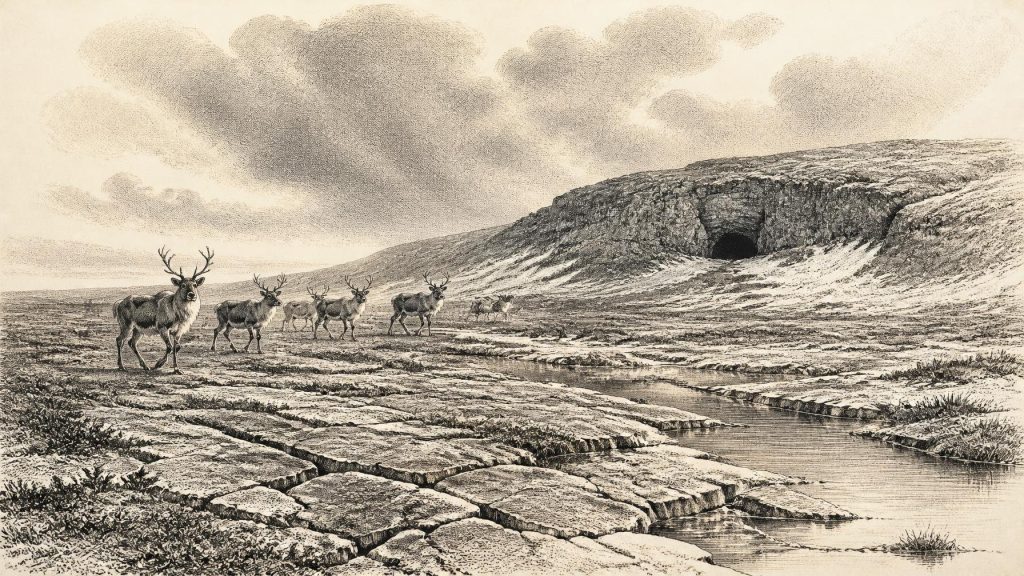
The most direct testimony to Ireland’s living environment comes from animal bones, especially those recovered from caves. The Irish Quaternary Fauna Project demonstrated that a varied mammalian fauna reached Ireland at intervals between at least about 45,000 and 20,000 years ago. Castlepook Cave, near Doneraile in north County Cork, is particularly important because antiquarian excavations there produced remains attributed to animals associated with cold or open environments, including reindeer, horse, mountain hare, lemmings, arctic fox, wolf, brown bear, spotted hyaena, giant deer and woolly mammoth.
That list must be read carefully. It is an assemblage accumulated in a cave over a long span, not a census of creatures seen together on a single day. Caves can serve as carnivore dens, shelters, traps, drainage routes and sediment stores. Bones may be chewed, moved, redeposited or recovered without the stratigraphic control expected of modern fieldwork. Direct radiocarbon dates have greatly improved the chronology, but individual specimens still represent particular animals, not an automatically continuous local ecosystem.
Even so, the fauna supports a broad environmental interpretation. At least during favourable windows within this cold stage, parts of Ireland sustained large herbivores and their predators. Reindeer are especially informative because they fit an open, cold-country setting rather than closed woodland. Mammoth and horse point in the same general direction, though neither should be used to claim a permanent, island-wide ‘mammoth steppe’ without qualification. The available evidence is geographically uneven, concentrated in a small number of caves and finds, and does not supply a detailed vegetation map for this exact date. It is safer to envisage a mosaic of exposed ground, herb-rich or shrubby patches, wet places and glacial or periglacial terrain where local conditions permitted, rather than a single uniform landscape.
The Castlepook Problem
Castlepook has an additional significance. A reindeer femur from the cave has been reported as bearing a deep linear mark interpreted by zooarchaeologist Ruth Carden as damage made with a sharp stone tool while fresh bone was being processed. Public discussion has associated the specimen with an age of roughly 33,000 years ago, making it relevant to the broad era around 30,168 BCE. If the mark is confirmed as anthropogenic and is contemporary with the animal’s death, it would indicate that people handled or butchered a reindeer in Ireland far earlier than the firmly established post-glacial settlement record.
That is a striking possibility, not a licence to write a settled Palaeolithic population into Ireland. The National Museum of Ireland continues to state that no clear evidence has yet demonstrated human presence in Ireland during the Palaeolithic. The caution is justified. Castlepook’s key material derives from early twentieth-century excavation and does not come with the securely documented occupation surfaces, associated tool assemblages, hearths, structures or human remains required to demonstrate a camp or a sustained community. A radiocarbon date on bone dates the animal’s death, not automatically the cutting action, the location of killing or the duration of a human visit.
The distinction between evidence and interpretation is therefore crucial. Evidence: Ireland had reindeer and other Ice Age mammals in the wider period, and one reindeer femur carries a mark that has been interpreted as a tool incision. Interpretation: a human or humans may have processed that carcass. What cannot responsibly be asserted is a named hunting people, a resident population, a route of migration, a seasonal camp at Castlepook, or an uninterrupted human presence on the island. The bone is best understood as an important and unresolved clue.
No Polity, No Proven Settlement
For political affairs, conflict and diplomacy, the answer is absence of evidence in the strictest sense. No state, chiefdom, territory, leader, alliance or war can be identified in Ireland around this time. Nor is there evidence for farming, herding, pottery, metalworking, formal religion, literacy or long-distance trade operating from an Irish settlement. These are not omissions in the record of an otherwise known society; they are categories for which the surviving Irish evidence offers no secure foundation.
If people did reach Ireland, their economy would have been one of immediate survival rather than agriculture: movement through a severe landscape, the use of perishable materials that rarely survive, and perhaps the exploitation of animal carcasses or game. But even this is conditional. The Castlepook mark may eventually strengthen the case for a brief Palaeolithic visit; it cannot by itself reveal whether meat was shared, whether hides or sinews were taken, how many people were present, or whether the visitors travelled on from elsewhere. Sea levels were lower than today and the geography of the Irish Sea differed, but ice, water and rapidly changing coastal settings made access complex. It would be misleading to describe a straightforward land bridge or a known migration corridor for this particular date.
Religion and culture likewise remain beyond recovery. A cave bone cannot disclose language, belief, kinship or ritual. It is possible that any human visitors possessed rich traditions, social rules and technical knowledge, as Upper Palaeolithic groups elsewhere in Europe certainly did, but importing those practices into Ireland without Irish evidence would be speculation. The responsible conclusion is not that people of this era lacked culture; it is that no securely Irish cultural expression has yet been demonstrated for 30,168 BCE.
What This Date Can Mean
The most meaningful history of this notional year is environmental and evidential. Ireland lay within a fluctuating cold-stage world as the British–Irish Ice Sheet grew towards its later maximum. In some places, ice or its effects dominated the landscape; in others, animal remains show that exposed terrain could support mobile Pleistocene fauna. Castlepook Cave preserves the most provocative Irish clue to possible human activity, but its promise rests on an interpretation that requires continuing scrutiny.
That uncertainty is itself historically important. It explains why the history of Ireland this far back cannot be made from kings, battles or settlements. It must be assembled from a reindeer femur, cave sediments, radiocarbon ranges, glacial landforms and the limits of each method. Around 30,168 BCE, the island’s story was not yet one of documented human communities. It was a story of climate, ice, animals and the tantalising possibility of a very fleeting human encounter in a changing Ice Age landscape.
Primary Sources
- Prehistoric Details: Mell Flint Flake
- Quaternary
- Ireland through geological time
- The Irish Quaternary Fauna Project
- The timing and magnitude of the British–Irish Ice Sheet between Marine Isotope Stages 5d and 2: implications for glacio-isostatic adjustment, high relative sea levels and ‘giant erratic’ emplacement
- Pattern and timing of retreat of the last British-Irish Ice Sheet
- Growth and retreat of the last British–Irish Ice Sheet, 31,000 to 15,000 years ago: the BRITICE-CHRONO reconstruction
- Timing, pace and controls on ice sheet retreat: an introduction to the BRITICE-CHRONO transect reconstructions of the British-Irish Ice Sheet
- Radiocarbon constraints on the history of the western Irish ice sheet prior to the Last Glacial Maximum
- Radiocarbon constraints on the age of the maximum advance of the British–Irish Ice Sheet in the Celtic Sea
- Maximum extent and readvance dynamics of the Irish Sea Ice Stream and Irish Sea Glacier since the Last Glacial Maximum
- Maximum extent and dynamic behaviour of the last British–Irish Ice Sheet west of Ireland
- Last Glacial Maximum cirque glaciation in Ireland and implications for reconstructions of the Irish Ice Sheet
- Trimlines, blockfields and the vertical extent of the last ice sheet in southern Ireland
- Early deglaciation of the British-Irish Ice Sheet on the Atlantic shelf northwest of Ireland driven by glacioisostatic depression and high relative sea level
- The deglaciation of the western sector of the Irish Ice Sheet from the inner continental shelf to its terrestrial margin
- New age constraints for the maximum extent of the last British-Irish Ice Sheet (NW sector)
- The IntCal20 Northern Hemisphere radiocarbon age calibration curve (0–55 cal kBP)
- Phylogeographic, ancient DNA, fossil and morphometric analyses reveal ancient and modern introductions of a large mammal: The complex case of red deer (Cervus elaphus) in Ireland
- New insights on the fauna of Ireland's Younger Dryas and Early Holocene from Alice & Gwendoline Cave
- Archaeology Research Excavation Grant 2022: Final Report