Thomond Park’s Twelve Points1978 CE
In 1978, Jack Lynch’s Fianna Fáil government pursued expansionary policies, abolishing domestic rates while increasing borrowing amid unemployment and inflation. Its dismissal of Garda Commissioner Edmund Garvey was ruled invalid, raising concerns about policing and due process. Ireland chose to join the European Monetary System, loosening its automatic link with sterling. Northern Ireland endured violence, including the La Mon bombing, while the Maze dirty protest intensified and Ireland won a human-rights case against Britain. RTÉ 2 began broadcasting, John Treacy won the World Cross Country Championship, and Munster’s 12–0 victory over the All Blacks provided a lasting symbol of confidence.
Dateline
In 1978, Ireland lived with sharply contrasting measures of confidence and anxiety. In the Republic, Jack Lynch’s large Fianna Fáil majority pursued an expansionary programme intended to ease the economic difficulties of the mid-1970s. Across the border, the Troubles continued to bring civilian deaths, coercive security policy and a deepening prison confrontation. Yet the year also supplied institutions and occasions through which people imagined a wider, more modern country: a second national television channel began broadcasting, a Waterford runner became world champion, and Munster defeated the All Blacks at Thomond Park. None of these events cancelled the island’s political divisions. Together, however, they show how public life in 1978 extended beyond the crisis that dominated headlines.
Government, Policing and Public Confidence
Lynch remained Taoiseach throughout 1978, leading the Fifteenth Government and working with George Colley as Tánaiste and Minister for Finance. Fianna Fáil had entered office after its emphatic 1977 election victory, with enough Dáil seats to govern alone. That strength allowed it to act on conspicuous election commitments, but it also made its judgement highly visible. From 1 January, the old office of parliamentary secretary was replaced by that of minister of state, a small but meaningful reorganisation of the machinery of government.
A more damaging controversy began on 19 January, when the Government dismissed Garda Commissioner Edmund Garvey. Garvey had been Commissioner since 1975 and his tenure had unfolded amid intense pressure on An Garda Síochána over republican violence, intelligence-gathering and allegations of misconduct. The Government said it had lost confidence in him, but gave no detailed public explanation. Patrick McLaughlin, the deputy commissioner, replaced him. Garvey challenged the dismissal in the courts during the year. The episode raised an awkward constitutional question: how far could a government remove the head of an unarmed national police force without stated reasons or fair procedures? The High Court judgment delivered in October held the dismissal invalid, although the litigation did not finally conclude until 1979. In 1978 itself, the affair unsettled confidence in the relationship between political authority, policing and the rule of law.
Relief Now, Borrowing Later
The Republic’s domestic politics were closely tied to household costs and employment. The February budget was deliberately expansionary. Contemporary OECD analysis recorded a sharp real increase in planned public expenditure, while revenue growth slowed. Ministers defended this course as a way to sustain demand and create jobs after recession. It was not a painless recovery: the CSO’s later historical series places unemployment in 1978 at 8.2 per cent, or about 99,000 people under its comparable measure. Inflation had eased considerably from the worst of the previous years, but prices, rents, credit and job security still shaped everyday calculations.
The Government’s abolition of domestic rates was one of its most tangible popular measures. The Local Government (Financial Provisions) Act 1978 provided an allowance equal to the rates due on domestic property, mixed property, farm buildings, secondary schools and community halls; the provision was deemed to operate from 1 January. For householders it removed a direct local charge. For local authorities, however, it meant that a source of locally raised revenue was replaced by central funding and administrative adjustment. The relief was real, but it belonged to a larger fiscal strategy that relied heavily on borrowing. An OECD assessment published in May anticipated that the public-sector borrowing requirement could approach 13 per cent of GNP in 1978. Thus a year remembered for tax and rate relief also contained the accumulating financial strain that would burden the State in the following decade.
European integration framed these choices. Ireland had been in the European Economic Community since 1973, and questions of agricultural support, regional development and currency stability were now domestic as well as diplomatic concerns. During 1978 the Government decided to participate in the developing European Monetary System, while the United Kingdom chose not to do so. The new arrangement took practical effect in 1979, but the decision in 1978 already pointed towards a significant change: the Irish pound would no longer be held automatically in step with sterling. For a country whose trade, migration and financial connections with Britain remained exceptionally close, that was an important assertion of a more European economic direction.
The Northern Conflict
Northern Ireland remained the gravest matter connecting the two jurisdictions. Violence was relentless and devastating. In February an IRA incendiary bomb at the La Mon House Hotel near Belfast killed twelve Protestant civilians attending a dinner dance and injured many more. The atrocity underlined the indiscriminate human cost of the conflict and intensified fear in communities already divided by security, segregation and political allegiance. Other shootings and bomb attacks through the year demonstrated that neither British military policy nor policing had brought stability.
Prisons became a central theatre of the conflict. The background was the British Government’s withdrawal, from March 1976, of special category status for people convicted of scheduled offences. Republican prisoners in the Maze, or Long Kesh, had responded with the blanket protest, refusing prison uniforms and demanding recognition as political rather than ordinary criminal prisoners. In March 1978 the protest escalated into what became known as the dirty protest, as prisoners refused to leave cells under the prevailing prison regime. The phrase is necessarily uncomfortable, but it matters because it names a protest that would shape Irish politics in the years ahead. By the middle of 1978, hundreds of prisoners were involved.
On 30 July, Cardinal Tomás Ó Fiaich, Catholic Primate of All Ireland, visited republican prisoners in the Maze. The following day he publicly described the conditions as inhuman. His intervention did not settle the dispute: the British Government continued to reject any restoration of special category status. But it gave the prison issue greater moral and political prominence across Ireland. It is important not to read the later hunger strikes back into 1978 as though they had already happened. They had not. What 1978 witnessed was the hardening of the prison confrontation from which the hunger strikes of 1980 and 1981 would emerge.
Law, Diplomacy and Borders
On 18 January, the European Court of Human Rights delivered its judgment in Ireland v United Kingdom, a case brought by the Irish Government over detention and interrogation practices in Northern Ireland in 1971. The Court found that the use of the so-called five techniques amounted to inhuman and degrading treatment contrary to Article 3 of the European Convention, while distinguishing them from torture under its interpretation at the time. The ruling concerned earlier events, rather than a practice newly begun in 1978, but its delivery that year was a major Irish legal and diplomatic event. It showed Dublin using an international human-rights forum to challenge British conduct in Northern Ireland.
Relations between Lynch and British Prime Minister James Callaghan combined friction with practical contact. Lynch’s January call for Britain to declare an intention ultimately to withdraw from Northern Ireland angered London and was interpreted by critics as a call for haste rather than a negotiated settlement. Nevertheless, both governments continued discussions on security and on economic co-operation in deprived border areas. The contrast was stark: constitutional disagreement remained profound, while officials still sought limited ways to reduce the economic damage created by the border and conflict.
Economic hope was also invoked in Northern Ireland itself. In August, Secretary of State Roy Mason announced that the DeLorean sports-car project would establish a factory in west Belfast, promising 2,000 jobs. At the moment of announcement it represented an effort to bring American-backed manufacturing employment to an area of severe deprivation. Later failure should not obscure what the proposal meant in 1978: a highly public attempt to answer insecurity and unemployment with industrial investment.
A Second Screen
On 2 November, RTÉ 2 began broadcasting, launched by Lynch from Cork Opera House. Its opening-night gala included The Chieftains, Maureen Potter, Val Doonican, Colm C. T. Wilkinson and the RTÉ Concert Orchestra. The channel offered Irish-made programmes alongside material acquired from British and other broadcasters, including programmes that many viewers had previously received only unevenly from across the Irish Sea. It was a substantial cultural and technical enlargement of the national broadcaster’s service.
The new channel did not reach every household in identical fashion. RTÉ’s test broadcasts had warned viewers without cable that they might require a suitable aerial, and some areas needed additional equipment to avoid interference. The television licence also rose in December: a colour licence increased to £38 and a black-and-white licence to £23. Even so, RTÉ 2 represented increased choice for viewers and a recognition that television had become central to family leisure, news, entertainment and cultural exchange.
Running and Rugby
Sport supplied two unusually durable moments of shared celebration. On 25 March, John Treacy of Villierstown, County Waterford, won the World Cross Country Championship in Glasgow. His victory made a young Irish athlete world champion in an event that demanded endurance rather than glamour, and Waterford welcomed him home with civic pride. It also anticipated his successful defence of the title when the championship came to Limerick in 1979.
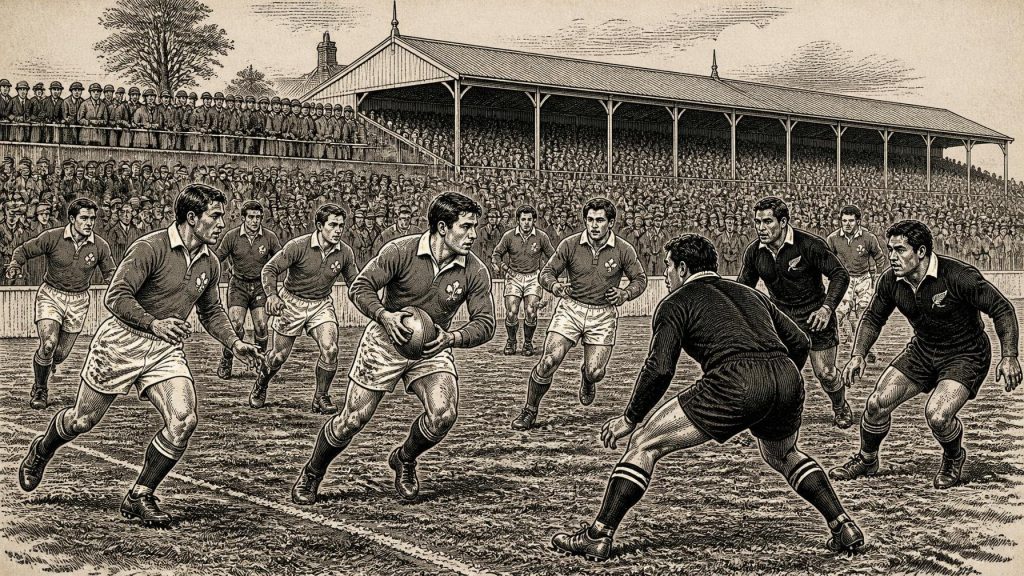
Then, on Tuesday 31 October, Munster defeated New Zealand 12–0 at Thomond Park. The All Blacks were the pre-eminent touring side in world rugby, and Munster’s victory quickly passed into sporting legend. It was achieved by a provincial team rather than the Irish international side, which made the occasion especially resonant: local clubs, workplaces and parishes could see their own rugby culture reflected in the result. The score became a compact piece of collective memory, recalled long after the final whistle.
That triumph did not resolve the year’s political or economic troubles. It did, however, close 1978 with a vivid image of Irish capability and communal confidence. Between strained public finances, contested policing, Northern violence and the beginnings of a prison crisis, the twelve points at Thomond Park offered a rare and uncomplicated reason for people to gather, cheer and remember.
Primary Sources
- Twenty-First Dáil
- Garvey, Edmund
- Garvey v Ireland
- Garda Commissioners since 1922
- Commissioners' Reports
- Ireland v. the United Kingdom Judgment
- OECD Economic Surveys: Ireland 1978
- OECD Economic Surveys: Ireland 1978 (PDF)
- Labour Market: Ireland and the EU at 50
- Local Government (Financial Provisions) Act, 1978, Section 3
- Finance Act, 1978
- Irish Statute Book: Statutory Instruments 1978
- Vow to End Domestic Rates Honoured
- CAIN: Chronology of the Conflict 1978
- CAIN: Chronology of Major Violent Incidents, 1969–1998
- The Billy Wright Inquiry – Report HC 431
- RTÉ Archives: Dirty Protest Ends, Hunger Strike Begins
- RTÉ Archives: RTÉ 2 Opening Night 1978
- RTÉ Archives: RTÉ 2 Testing 1978
- RTÉ Archives: New TV Licence Rates 1978
- Munster Rugby: 1978
- Irish Rugby: Munster’s Historic Day
- Athletics Ireland: History
- RTÉ Archives: John Treacy World Champion
- Leaders' Warmth Ruffled by Political Impasse
- Commons Chamber, 11 May 1978