O’Malley’s School Promise1966 CE
During 1966, Ireland marked the Easter Rising’s fiftieth anniversary with major ceremonies, the Garden of Remembrance’s opening, and the destruction of Nelson’s Pillar. A census recorded population growth and continuing urbanisation, while the Anglo-Irish Free Trade Area signalled export-oriented economic policy despite farmers’ protests over low incomes. Education Minister Donogh O’Malley promised free post-primary schooling and transport from 1967. Seán Lemass resigned as Taoiseach and Jack Lynch succeeded him. De Valera began another presidential term. In Northern Ireland, competing commemorations, UVF violence, sectarian murders and political tensions foreshadowed the coming conflict, underscoring Ireland’s unresolved division amid social and economic change.
Dateline
In 1966, the Republic of Ireland publicly revisited the revolutionary inheritance from which it had emerged while taking conspicuous steps towards a more modern, outward-looking society. The fiftieth anniversary of the Easter Rising dominated the ceremonial calendar, but the year was not simply an exercise in commemoration. It brought a census that registered renewed population growth, the coming into force of a far-reaching free-trade arrangement with Britain, a major farmers’ protest, a dramatic promise of free post-primary education, and a change of Taoiseach from Seán Lemass to Jack Lynch. Across the border, anniversary politics and loyalist violence exposed tensions that would soon become much more dangerous.
A Jubilee of 1916
The central public event was the fiftieth anniversary of the Easter Rising. The State had long honoured 1916, but the jubilee gave exceptional scale and official force to remembrance. It also placed Éamon de Valera, President since 1959 and one of the best-known surviving leaders of the revolutionary generation, at the centre of a narrative linking rebellion, independence and the institutions of the modern State.
On 8 March, before the principal official ceremonies, a bomb destroyed the upper part of Nelson’s Pillar in O’Connell Street. The monument, erected in honour of Horatio Nelson, had stood over one of Dublin’s principal thoroughfares since the early nineteenth century. Its destruction was an unauthorised and dangerous act, rather than an event organised by the Government, yet its symbolism was inescapable in a year devoted to independence. The vacant and damaged site sharpened public arguments about history, national identity and the appearance of the capital. It should not, however, be taken as proof that Irish people shared one view either of the monument or of the past.
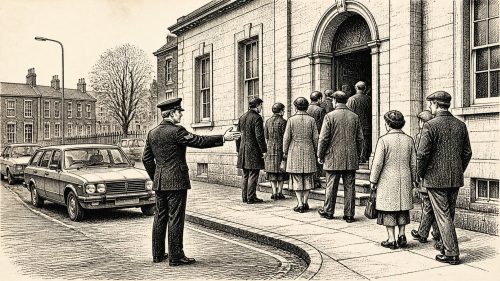
Official commemoration reached its height over Easter. On Sunday 10 April, de Valera took the salute at a major Dublin parade involving veterans, the Defence Forces and public ceremonial around the General Post Office, headquarters of the 1916 insurgents. The following day, Easter Monday, he formally opened the Garden of Remembrance at Parnell Square. Designed by Dáithí Hanly and dedicated to those who had given their lives in the cause of Irish freedom, the garden established a permanent civic space for commemoration. Archbishop John Charles McQuaid blessed it, an indication of the close public presence of Catholic ritual in the overwhelmingly Catholic Republic.
The ceremonies did more than look backwards. They presented the independent State as the fulfilment of sacrifice and encouraged a shared national story across schools, military institutions, broadcasting and public space. Yet the jubilee also revealed limits to that story. Ireland remained divided, and the fiftieth anniversary of the Battle of the Somme was equally meaningful for many unionists in Northern Ireland. The island contained competing memories of 1916, empire, war and allegiance; the anniversary year made those differences more visible rather than resolving them.
Counting a Changing State
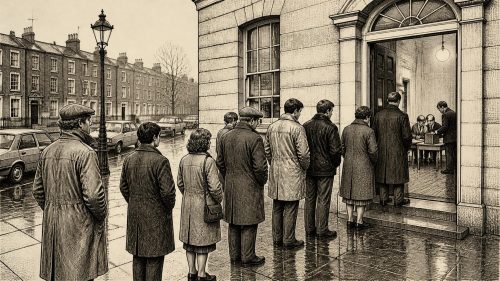
One week after the principal Dublin ceremonies, on Sunday 17 April, the Central Statistics Office conducted the census of population. The final count was 2,884,002 people, an increase of 65,661 from 1961. This was significant because the previous census had recorded the lowest population of the State since independence, after decades in which emigration had drained rural districts and small towns. Population growth did not mean that emigration or regional inequality had disappeared, but it suggested that the economic changes begun in the late 1950s were affecting demographic fortunes.
The census was also an unusually detailed picture of ordinary life. It asked adults about occupation and employment, agricultural landholding, the age at which full-time education ended and the schools or colleges attended; householders were asked about rooms in the dwelling. Enumerators recorded a country in transition. Almost half of the population, 49.2 per cent, lived in the census’s aggregate town areas, defined as towns of 1,500 inhabitants or more. Dublin and other urban centres drew people and services, while many western and border counties continued to lose population. The statistical return therefore captured both recovery after the severe out-migration of the 1950s and an ongoing shift from dispersed rural life towards towns.
Trade Opens, Farmers March
On 1 July the Anglo-Irish Free Trade Area Agreement, signed the previous December, came into force. The agreement created a timetable for reducing tariffs between Ireland and the United Kingdom, still by far the Republic’s most important trading partner. It was a practical expression of the Lemass Government’s departure from the protectionism of earlier decades. Ministers believed that Irish industry needed export markets, scale and competition if it was to provide work at home and prepare the country for eventual participation in a wider European market.
The policy carried obvious risks. In Dáil debate early in the year, opponents warned that exposing protected firms to British competition could cost jobs and worsen emigration. Contemporary economic assessments similarly stressed that many sectors would need reorganisation to meet freer trade. Those effects should not be projected backwards too simply: the agreement began in 1966, but tariff reductions were phased, and its full industrial consequences belonged to later years. What was clear in 1966 was the direction of travel: economic policy was becoming more export-oriented, more closely bound to Britain, and increasingly concerned with European integration.
Rural discontent supplied a sharp counterpoint to that optimism. During 1966 the National Farmers’ Association mounted its Farmers’ Rights Campaign, protesting low farm incomes, rates and the insecure position of farm families. In October, its president Rickard Deasy led a march from Bantry towards Dublin; farmers from other areas joined as it progressed. A sit-in outside Government Buildings followed when Agriculture Minister Charles Haughey would not meet the protesters. The campaign demonstrated that economic expansion was unevenly experienced. For many small farmers, the language of modernisation and trade could sound remote beside immediate worries about prices, debts and local charges.
A Promise Beyond Primary School
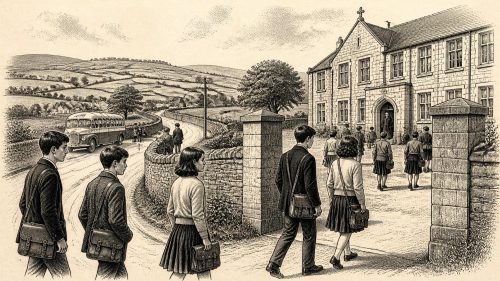
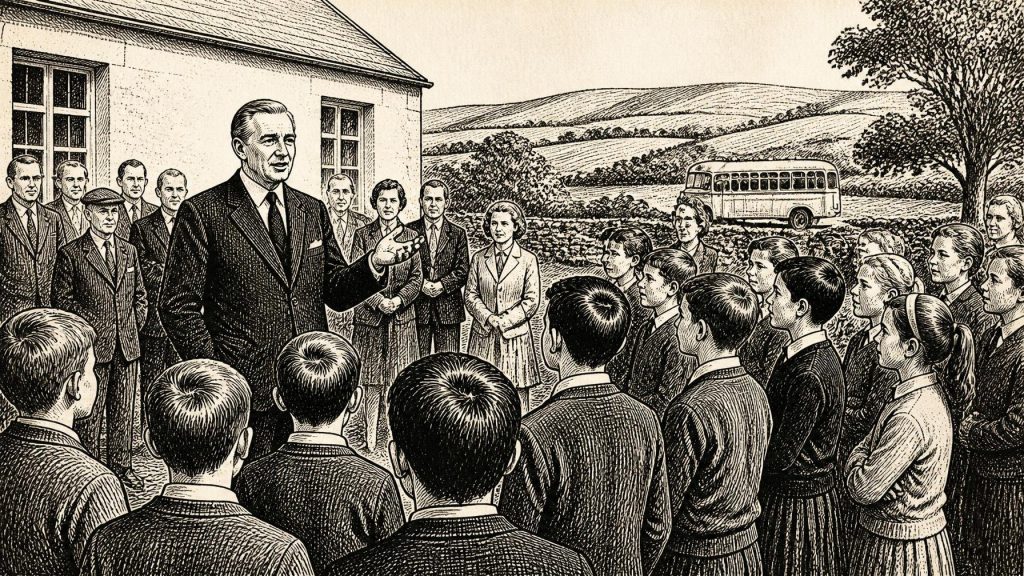
The year’s most consequential domestic announcement came on 10 September. Donogh O’Malley, recently appointed Minister for Education, declared that post-primary education would become free up to Intermediate Certificate level, with free transport intended to make attendance possible for rural children. His announcement was striking not only for its ambition but for its timing: it was made before the machinery, buildings, staffing and funding needed for a national scheme had been fully arranged.
In 1966 this remained a promise rather than a completed transformation. The formal free post-primary scheme was set to take effect from September 1967. Even so, O’Malley changed the terms of public debate at once. Secondary education had commonly been constrained by fees, distance and family resources. His proposal treated education beyond primary school as a public entitlement and as an economic necessity for a country seeking industrial employment. It also spoke directly to the evidence being collected in the April census about early school-leaving and educational attainment.
The proposal was contested. Critics questioned its cost and the Government’s preparedness; others argued that it did not go far enough. Yet its importance in 1966 lay in the political commitment itself. It offered families a credible prospect that children who would previously have left school at fourteen might continue into secondary or vocational education. In a year saturated with the memory of national liberation, free education became a powerful statement about the kind of republic the State hoped to build.
Lemass Gives Way to Lynch
Political leadership changed abruptly in November. On 8 November, Seán Lemass announced that he intended to resign as Taoiseach. Lemass had led Fianna Fáil and the Government since 1959, presiding over the turn towards economic planning, foreign investment, freer trade and a less isolated relationship with Northern Ireland and Britain. His departure therefore marked the end of a distinctive phase in the Republic’s post-war development.
Fianna Fáil’s parliamentary party chose Jack Lynch as leader on 9 November, defeating George Colley by 52 votes to 19. The Dáil elected Lynch Taoiseach on 10 November. A Corkman celebrated both as a former hurler and as an able, unassuming minister, Lynch inherited a Government with a working majority but no settled answer to every question raised by rapid change: education, farm incomes, industrial adjustment and the constitutional future of the island. He was not elected by the public in a general election that year; the transfer followed Lemass’s resignation within the existing Dáil.
De Valera, meanwhile, began a second presidential term on 25 June. The presence of both de Valera and Lemass in the year’s public life gave 1966 an unusually strong connection with the revolutionary generation. By its close, however, Lynch and O’Malley represented a younger political cohort whose defining tasks were less likely to be military independence than education, economic opportunity and social development.
Northern Warning Signs
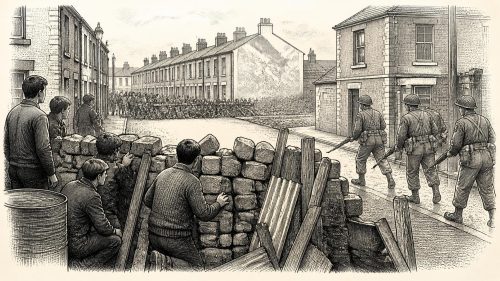
Developments in Northern Ireland gave the anniversary year a darker edge. A modern Ulster Volunteer Force emerged in 1966 and issued threats against alleged republicans. In May and June, UVF attacks in Belfast killed Matilda Gould, a Protestant woman fatally injured when an intended attack on a Catholic-owned premises went wrong; John Scullion, a Catholic civilian who later died of wounds; and Peter Ward, an eighteen-year-old Catholic civilian. These were grave sectarian acts, not simply commemorative disorder. On 28 June, the Northern Ireland Government declared the UVF illegal.
Prime Minister Terence O’Neill was pursuing a cautious programme of economic development and limited reform, but he faced pressure from hard-line unionism as well as deep nationalist and Catholic grievances about housing, voting, employment and local government. The British Prime Minister Harold Wilson met O’Neill on 5 August, evidence that London was attentive to the growing strain. It would be wrong to portray 1966 as the full conflict that erupted later; the major civil-rights confrontations lay ahead. But the murders and political intimidation of this year showed that violence could already be mobilised around identity and constitutional fear.
Thus 1966 joined commemoration with transition. The Republic honoured its founding revolt in ceremonies of confidence, counted a population beginning to rise, and announced reforms that would widen educational horizons. At the same time, farmers challenged the unequal rewards of change, freer trade posed hard adjustments, and violence in Belfast warned that the island’s unresolved division could not be contained by ceremony alone.
Primary Sources
- Eighteenth Dáil
- Lemass, Seán
- Lynch, John Mary (‘Jack’)
- Timeline of events, 1919–69
- Jack Lynch Appointed Taoiseach
- Inauguration Address by President Éamon de Valera, 26 June 1966
- The President: Interactive Timeline
- Garden of Remembrance
- Garden of Remembrance Opened
- #OnThisDay 1966: Nelson’s Pillar Destroyed
- Census Through History
- Census 1966 Volume 1: Population
- Census of Population, 1966: Explanatory Notes
- Census of Population, 1966: Commentary
- Agreement Between the Government of Ireland and the Government of the United Kingdom Establishing a Free Trade Area
- Irish Treaty Series: No. 10 of 1966
- Agreements Between the Government of Ireland and the Government of the United Kingdom
- OECD Economic Surveys: Ireland 1966
- The Irish Economy in 1966
- Farmers Released
- Free Secondary Education
- Provision of Free Post Primary Education
- Background: Chronology of Key Events 1800 to 1967
- O’Neill, Terence Marne
- The National Archives, Kew: Records on the CAIN Web Site