Campile Bombing1940 CE
In 1940, neutral Éire faced danger as German victories transformed its strategic position. De Valera defended neutrality, expanded emergency powers and rejected Britain’s unity proposal, judging it insecure and incompatible with sovereignty. The government suppressed IRA activity, while Seán Russell died during an abortive German-backed mission. On 26 August, German bombs killed three women at Campile creamery, Ireland’s first fatal Luftwaffe raid. Shortages prompted censorship, restrictions and compulsory tillage to strengthen food security. Northern Ireland mobilised for Britain, with Belfast industry expanding and John Miller Andrews succeeding Craigavon. The Bell appeared, while in December John Charles McQuaid became Dublin’s archbishop.
Dateline
A Neutral Island in a Dangerous Summer
In 1940 the war that the Irish state had hoped to hold at arm’s length became harder to regard as a distant continental struggle. Éire, as the state was named in the 1937 Constitution, remained neutral and its government called the wartime condition simply the Emergency. Yet Germany’s victories in the Low Countries and France during May and June transformed Ireland’s strategic position. The coast of occupied France now faced Ireland across the Celtic Sea; Britain feared an Atlantic invasion route and wanted the former treaty ports back in service; Dublin feared that surrendering neutrality would compromise sovereignty, inflame old divisions and expose an inadequately equipped country to attack.
Éamon de Valera was Taoiseach and also Minister for External Affairs. His government had emergency powers inherited from the crisis of September 1939, but the Emergency Powers (Amendment) Act, enacted on 5 January 1940, sharpened the state’s capacity to deal with internal security. The political argument was immediate and serious: ministers said extraordinary powers were essential to preserve public safety in wartime, while opponents warned of detention without trial and a grave reduction in ordinary legal safeguards. The Emergency was therefore never merely a foreign-policy posture. It gave the state a far wider hand in communications, supplies, policing and public order.
Neutrality did not mean indifference to aggression. On 12 May, after Germany had invaded Belgium and the Netherlands, de Valera publicly protested. But he resisted pressure to take Ireland into the British war effort. The central calculation was that a formally independent, neutral state could best avoid becoming a battlefield while retaining authority over its own territory. This did not produce isolation in any simple sense: trade, shipping, intelligence concerns and defence arrangements linked Ireland closely to Britain. It did, however, require a carefully maintained public neutrality at a moment when military defeat seemed possible for Britain itself.
The Unity Proposal
The collapse of France also generated one of the most striking, but least settled, diplomatic episodes of the year. In June British representatives raised the prospect that Britain might accept the principle of Irish unity if Ireland entered the war on the Allied side. The initiative was tied to immediate British anxieties about defence, the use of Irish facilities and the security of the Atlantic approaches. It was not a completed constitutional settlement: its terms envisaged procedures and negotiations rather than a guaranteed, instant transfer of Northern Ireland.
De Valera’s reply made the obstacle plain. A commitment to the war would mean abandoning neutrality at once, while the proposed route to unity offered no dependable assurance of an agreed all-Ireland outcome. It also left the wishes of Northern Ireland’s unionist majority unresolved. On 4 July he formally rejected the proposal. The episode is sometimes compressed into the misleading claim that Ireland simply ‘turned down unity’. In fact, it exposed the collision of several realities in 1940: partition, British wartime need, Irish sovereignty, and the likelihood that unity imposed amid war would be neither peaceful nor secure.
Security, the IRA and the State
For Dublin, neutrality also depended on preventing Irish territory from becoming a base for anybody’s war. The Irish Republican Army’s bombing campaign in Britain, begun in 1939, had already endangered relations with London and intensified the government’s security response. On 7 February 1940 Peter Barnes and James McCormack were hanged at Winson Green Prison in Birmingham for their part in the 1939 Coventry bombing. De Valera had made unsuccessful representations for clemency. Their execution was a powerful republican grievance, but it did not dislodge the government’s determination to suppress an organisation whose actions threatened the state’s policy and international position.
In late May, as the military crisis in Europe worsened, the government established the Local Security Force under Garda supervision. It invited civilians into organised local service for duties connected with security and emergency preparedness. The force was not an army substitute; rather, it reflected the recognition that a small state with limited military resources required local organisation, observation and assistance if invasion, sabotage or air attack came. Daniel McKenna became Chief of Staff of the Irish Army during the year, another sign that defence administration was being recast for a far more threatening environment.
The year also brought a dramatic failure to turn German-IRA contacts into action in Ireland. Seán Russell, a veteran republican and former IRA chief of staff, had travelled to Germany seeking assistance. On 8 August he and Frank Ryan left Germany aboard the German submarine U-65, bound on a mission intended to return Russell to Ireland. Russell became gravely ill and died at sea on 14 August; the operation was abandoned. His death did not end official anxiety about republican contacts with Germany, but it removed a figure associated with the disastrous bombing campaign and illustrated the dangerous international entanglements into which a minority of republicans had entered.
Bombs at Campile
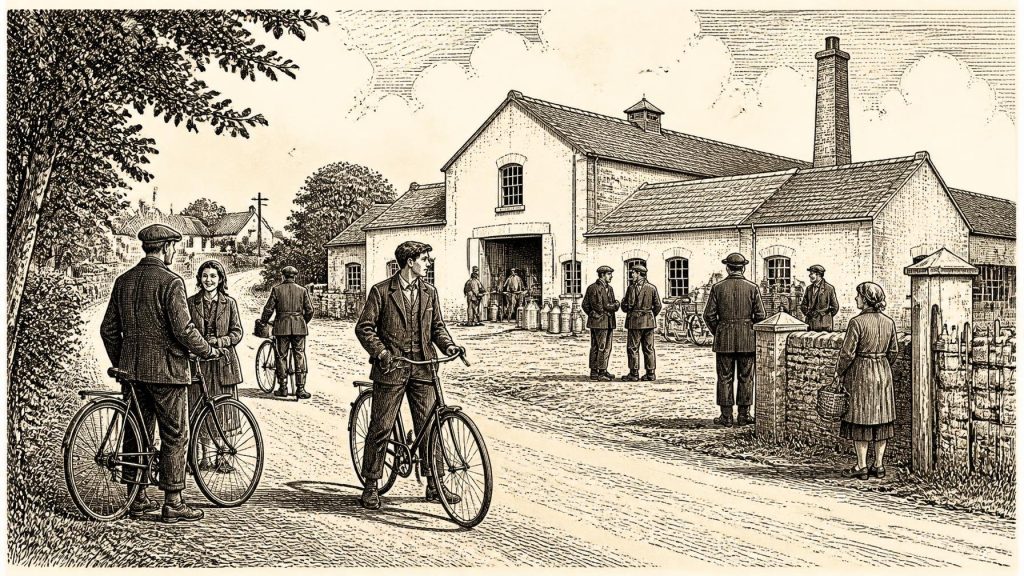
On 26 August the war reached the south-east in the most direct and fatal way yet experienced by the neutral state. A German air raid struck the Shelbourne Co-operative Creamery at Campile, County Wexford, killing three women. Other bombs fell in the locality. The precise purpose of the raid has remained uncertain in historical discussion, and it should not be presented as proof that the creamery itself was deliberately selected. What is firmly established is the date, place and human cost: Campile became the site of the first fatal Luftwaffe bombing in Ireland during the Second World War.
The attack made neutrality tangible in an ordinary working community. Campile was not a battlefield and the people killed were civilians at a creamery, an institution embedded in the rural economy of south Wexford. The event exposed the limits of geography and legal status: a neutral country could be endangered by navigational error, reconnaissance, coercion or violence directed elsewhere. It also lent urgency to air-raid precautions, blackouts and local emergency organisation, measures that had often seemed abstract to people outside the main cities and ports.
Food, Fuel and the Farm
The Emergency remade daily life above all through scarcity. Ireland depended heavily on imported coal, petrol, fertilisers, machinery, feeding stuffs and food. War at sea made every cargo vulnerable and Britain, itself under severe pressure, could not meet Irish needs as before. Government controls, licences, duties and quotas multiplied. The public encountered the results in restricted goods, altered diets, reduced transport and constant concern about fuel. Emergency censorship also shaped what people heard and read: Radio Éireann’s news relied on official material, weather broadcasts were prohibited, and its transmitters were synchronised partly to limit their usefulness for aircraft direction-finding.
Agriculture was the essential response. The compulsory tillage scheme applied for the 1940 growing season, requiring occupiers of ten or more statute acres of arable land to cultivate at least one-eighth of it. The aim was to replace vulnerable imports with Irish-grown cereals, particularly wheat. It was an exceptionally forceful intervention in a countryside where many holdings were oriented towards grass, livestock and dairying rather than ploughing. Inspectors, registers and maps made the policy visible at farm level. Farmers faced more labour, machinery and seed demands just when inputs were difficult to obtain, but the state considered greater tillage indispensable to food security.
Northern Ireland’s Different War
Partition meant that the island contained two sharply different wartime systems. Northern Ireland was part of the United Kingdom and fully mobilised for war. Belfast’s shipbuilding, engineering, rope-making, linen and aircraft industries became increasingly important to British production. Recovery from the depression was uneven and older problems of unemployment, sectarian competition and uneven opportunity did not disappear. Still, war contracts began to draw workers into factories and yards, with major expansion in engineering and shipbuilding already under way in 1940. The city’s industrial significance also made it an obvious future target, though the Belfast Blitz lay in 1941, not 1940.
Political transition came at Stormont when Lord Craigavon, Northern Ireland’s first prime minister, died in November after leading the government since 1921. John Miller Andrews succeeded him. This was more than a change of personnel: the new premier inherited wartime mobilisation, difficult relations with Westminster and a political order built on unionist dominance. In Dublin, the June unity discussions had confirmed that partition remained central to every question of defence. In Belfast, the same crisis reinforced the strategic and political connection with Britain.
Church and Culture Under Constraint
Two developments late in the year point to the institutions that continued to shape Irish life despite emergency controls. In October, Seán Ó Faoláin launched The Bell in Dublin. Its first issue announced a new monthly forum for fiction, criticism and reflection on Irish society. The magazine’s arrival mattered precisely because cultural debate took place amid censorship, restricted paper and a narrowing public sphere. It offered writers and readers a space to examine the Ireland of its day rather than merely celebrate an idealised national past.
In December John Charles McQuaid became Roman Catholic archbishop of Dublin, aged forty-five. His appointment was noteworthy both for his relative youth and because he came from a religious order, an uncommon route to the office. McQuaid’s long archiepiscopate would profoundly influence Catholic education, welfare and public morality in later decades; that larger legacy should not be projected wholesale back onto 1940. What can securely be said of this year is that his elevation marked the arrival in Dublin of a formidable church administrator at a time when Catholic institutions were deeply woven into everyday social life.
By the close of 1940, Ireland had not entered the war, but it had been changed by it. Campile’s dead, the pressure on farms and households, the suppression of violent republicanism, the heightened defence measures and the failed June diplomacy all showed that neutrality was neither effortless nor detached. It was an active, restrictive and precarious policy pursued on an island divided between a neutral state and a region mobilised for Britain’s war.
Primary Sources
- Emergency Powers Act, 1939
- Emergency Powers (Amendment) Act, 1940
- Emergency Powers (Amendment) Bill, 1940—Second Stage
- Éamon de Valera Papers: Descriptive Catalogue
- Discussions with the Irish Government Relating to the Purchase of Arms by Ireland and the Use of Irish Ports by the United Kingdom
- The British Offer to End Partition, June 1940
- Farming Since the Famine: Irish Agriculture 1847–2007
- Tillage & Fertiliser Schemes
- Till or Go to Jail: When Irish Farmers Were Forced to Grow Crops
- RTÉ 1940s
- Office of the Controller of Censorship
- This Is Your Magazine, an Editorial on the Founding of The Bell
- Sean O’Faoláin, The Bell and the Voice of Irish Dissent
- August 27th, 1940: From The Archives
- The Other German Bombing – Transcript
- The Defence Forces in 1940
- Russell, Seán
- A Collection of Letters and Circulars Relating to the Barnes and McCormack Appeal Committee
- James Craig MP, 1st Viscount Craigavon (1871–1940)
- Andrews, John Miller
- The War for Industrial Production
- Harland and Wolff Shipyard, Queen’s Road, Belfast
- Why Belfast Was Targeted
- McQuaid, John Charles
- Consecration of Dr. John Charles McQuaid as Archbishop of Dublin in St. Mary’s Pro-Cathedral