Thurles, Tenure and Survival1850 CE
In 1850, Ireland remained scarred by famine despite a less destructive, uneven potato blight. Workhouses, poor-law debt, eviction, emigration and a shrinking rural labour market continued to shape survival. Land insecurity intensified as the Encumbered Estates Court facilitated sales of indebted properties. The Dublin Tenant-Right Conference formed the Irish Tenant League, uniting diverse reformers behind fair rents, secure tenure and free sale of tenants’ interests. The Synod of Thurles, led by Paul Cullen, strengthened Catholic discipline, episcopal authority and Roman alignment, while opposing the Queen’s Colleges. These initiatives made 1850 a hinge between catastrophe and political, social and religious change.
Dateline
In 1850 Ireland remained a country in emergency, although the character of the emergency was changing. The catastrophic years of mass hunger and epidemic disease were not simply over when harvest prospects improved. Families had been broken by death, departure and eviction; poor-law institutions remained crowded and costly; and the rural economy had lost much of the labouring population on which its old pattern depended. Yet the year also produced two organised responses with long consequences: a national Tenant-Right Conference in Dublin and the Catholic Synod of Thurles. One addressed security on the land, the other authority in the Church and the education of Catholics. Both emerged from a society altered by famine.
A fragile harvest
The potato was still the immediate measure by which many people judged their prospects. Blight had returned in 1849, prolonging distress after the worst mortality of 1846–47. In 1850 it appeared again, though far less destructively and unevenly. Contemporary reporting during the late summer registered damp weather and disease in potatoes, while an official report on the year’s crop was issued in September. It would be misleading, however, to present the harvest as either a complete failure or a clean recovery. The scale of planting had collapsed from its pre-famine level, seed supplies and household reserves were weak, and a modest disease incidence could still terrify communities whose subsistence had so recently disintegrated.
That distinction mattered in everyday life. The apparent easing of blight did not restore the people who had died, return those already abroad, rebuild cabins that had disappeared, or replenish the savings of tenants and small farmers. In the west and south-west especially, the Famine’s effects were visible in reduced settlement, abandoned holdings and dependence on relief. Across the island, labourers who had formerly exchanged seasonal work for a cabin and potato ground faced a contracting and uncertain rural labour market. Better harvest conditions could reduce immediate hunger; they could not by themselves settle the questions of rent, employment, medical care and possession that now pressed upon rural households.
Poor relief after catastrophe
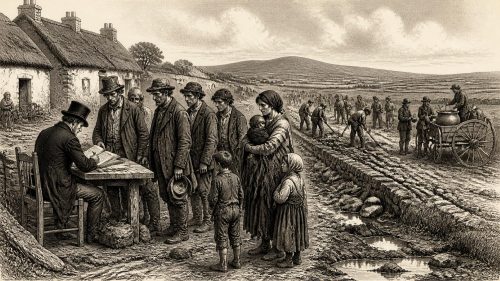
The poor-law system remained at the centre of this strained social landscape. Ireland’s 130 poor-law unions, each organised around a workhouse, had been designed before the Famine for a far smaller proportion of the population than they had been forced to accommodate. Workhouse life separated families into wards and imposed an institutional routine upon people who had often entered only after every household resource had gone. Fever, dysentery and other diseases had exposed the cruel inadequacy of buildings conceived as deterrents to destitution rather than hospitals for a national calamity.
By 1850 the direct Famine relief apparatus was receding, but the costs of survival had been transferred heavily to local rates. Poor-law expenditure and debt sharpened conflict between ratepayers, landlords, guardians and tenants. This was not an abstract fiscal dispute. A high rate could undermine an indebted estate; a landlord’s inability or refusal to meet obligations could endanger labourers and cottiers; and a union board’s decisions governed admission, food, clothing and relief for people with few alternatives. Parliamentary discussion of Irish agricultural distress in February showed that claims of improvement were contested. The contrast between official optimism and the experiences reported from distressed districts remained politically potent.
Emigration continued as both a family strategy and a public controversy. Passage required money, connections or assistance, and departure could be a desperate calculation rather than an escape freely chosen. In May, Westminster debated assisted emigration for orphan children, a debate that placed Ireland within a wider imperial argument about labour, colonial settlement and public responsibility. Such schemes accounted for only part of the outward movement. Far more broadly, letters, remittances and earlier migrants created routes from Irish ports and inland parishes to Britain, North America and the colonies. The departures of 1850 belonged to a demographic transformation whose full extent would be measured only by the census taken in March 1851.
Land, debt and tenant right
Land was the year’s foremost political question because it connected poverty, social status and power. Famine had exposed the precarity of holdings rented at will, particularly where families had invested labour in cabins, drainage, fences or cultivation but possessed no secure legal interest to sell or defend. Falling agricultural prices after 1849 added pressure to rent demands. At the same time, many landlords faced mortgages, family charges and arrears accumulated before and during the crisis.
The Encumbered Estates legislation of 1848 had created a mechanism through which heavily indebted Irish properties could be sold with a clear parliamentary title. Its court was operating in Dublin by 1850. The process promised creditors a route to settlement and purchasers a safer title, but it also accelerated a profound reordering of ownership. An estate sale did not automatically mean eviction or improvement; its local effects depended on the buyer, the tenants, the state of the property and the obligations inherited in practice. Nonetheless, it encouraged the replacement of financially compromised proprietors by purchasers expected to manage estates on commercial lines. For many occupiers, the possibility of sale made the absence of enforceable tenant protection feel more immediate.
That anxiety gave force to the Tenant-Right Conference held in Dublin from 6 to 9 August. It assembled reformers from different religious and regional backgrounds and culminated in the formation of the Irish Tenant League. Charles Gavan Duffy, the former Young Ireland editor, and Frederick Lucas were leading organisers; crucial northern support came from the Presbyterian journalist James MacKnight and allies such as William Sharman Crawford. The alliance was notable precisely because it attempted to join Catholic tenant societies in the south with Ulster Presbyterian advocates of the local tenant custom.
The conference stated its programme with unusual clarity. It sought a fair valuation of rent, security of tenure while rent was paid, and free sale of the tenant’s interest: the principles later remembered as the Three Fs. These were not yet law, nor did they resolve every rural grievance. Labourers without land had interests that could differ from those of substantial tenant farmers, and tenant right itself varied greatly between Ulster and other provinces. But the League made land reform a national political language. It proposed legal and parliamentary action rather than rebellion, and it tested whether a cross-confessional Irish movement could be built around shared economic security.
Thurles and Catholic authority
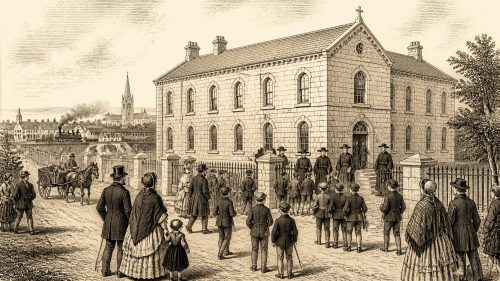
Less than a fortnight after the conference began, another national gathering opened at Thurles, County Tipperary. The Synod of Thurles sat from 22 August to 10 September under Archbishop Paul Cullen of Armagh, papal delegate and a recently returned Roman-trained churchman. It was the first national Catholic synod in Ireland since the seventeenth century. Its setting, amid the consequences of famine, was significant: the Church was ministering to a wounded population while also seeking a more coherent institutional presence in parishes, schools and public life.
Cullen’s purpose was not merely ceremonial. The synod addressed clerical discipline, parish administration, devotional practice, property and education. Its decrees pointed towards greater regularity, stronger episcopal oversight and closer alignment with Rome. The later phrase “devotional revolution” should not obscure the fact that this was a process, not an overnight conversion of Irish habits. Local religious customs, family devotions and patterns of attendance could not be remade by decree alone. Still, the synod supplied a programme and an authority for changes that would shape Catholic organisation over subsequent decades.
Education proved the most public issue. The three Queen’s Colleges at Belfast, Cork and Galway had opened in 1849 as non-denominational institutions, and on 3 September 1850 a royal charter established the Queen’s University in Ireland to award their degrees. Advocates viewed the arrangement as wider access to modern higher education in arts, law and medicine. Catholic critics feared that mixed, non-residential teaching separated intellectual formation from religious supervision. At Thurles, the bishops condemned the Queen’s Colleges for Catholics and supported the principle of a Catholic university. The decision did not erase all disagreement within the hierarchy, but it set a durable conflict between denominational authority and state-supported university education.
A year of beginnings amid loss
Political administration in Ireland still lay within the United Kingdom, and no single measure in 1850 repaired the devastation of the Famine. The Tenant League had only begun its attempt to convert tenant demands into parliamentary strength. The Synod’s decrees still required Roman approval before their formal promulgation in 1851. The Encumbered Estates Court was only beginning the long sequence of transfers that would alter the map of ownership. Even the comparatively improved potato season offered no guarantee against further disease or hardship.
Yet 1850 deserves attention not as a postscript to disaster but as a hinge year. Survival remained the immediate fact of life for countless Irish people, marked by workhouse discipline, migration and insecurity. At the same time, Dublin’s tenant-right organisers made the tenant’s claim to the fruits of labour a national issue, while Thurles gave the Catholic hierarchy a new instrument for directing institutional and religious life. Ireland was still grieving and dispersing. It was also creating the arguments, organisations and divisions that would govern much of its later nineteenth-century history.
Primary Sources
- Poor Law Records
- Famine Records: Distress Papers and the Relief Commission
- Sources in the National Archives for Researching the Great Famine 1845–1850
- An Act to facilitate the Sale of Incumbered Estates in Ireland
- Land and Politics
- Agricultural Distress—Adjourned Debate
- Emigration of Orphan Children
- Report on the Potato Crop in Ireland for the Year 1850
- Census 1851
- Farming Since the Famine: Irish Agriculture 1850–1940, Appendices
- The Great Hunger 1845–1850
- Ireland's Great Famine
- Duffy, Sir Charles Gavan
- MacKnight (McKnight), James
- Lucas, Frederick
- Resolutions Adopted at the Tenant-Right Conference
- Cullen, Paul
- Thurlesianum / Thurles: Plenary Council; 1850
- Decreta synodi plenariæ episcoporum Hiberniæ apud Thurles habitæ, anno 1850
- Historical Timeline for UCC
- The Foundation and Early Development of Queen's College Belfast, 1845–1850
- The Queen's College
- Aula Maxima
- The Tenant Right Conference in Dublin
- Address from the Synod of Thurles to the Roman Catholics of Ireland