The Penny Rent1824 CE
In 1824, Ireland saw organisational developments rather than decisive settlement or revolt. Daniel O’Connell’s Catholic Association introduced the penny Catholic Rent, linking parish subscriptions, clerical networks and constitutional agitation for emancipation. Tithe commutation and applotment sharpened rural grievances, amid official concern about agrarian secret societies. Parliament authorised a uniform survey and valuation, initiating the Ordnance Survey’s mapping. Economic and administrative modernisation included Belfast’s joint-stock Northern Banking Company, Donaghadee harbour planning, and standardised weights and measures. Belfast’s Academical Institution, Croker’s Irish travel and folklore publication, and Bishop Kernan’s succession illustrated expanding educational, cultural and Catholic institutional life, despite inequality and exclusion.
Dateline
In 1824 Ireland did not witness a single constitutional settlement or a decisive rebellion. Its importance lies instead in the way several quieter developments enlarged the machinery through which the island would be argued over, measured and governed. Daniel O’Connell’s Catholic Association found a practical means of reaching far beyond Dublin’s lawyers and merchants. Parliament set in motion the survey that would map Ireland in unprecedented detail. The year also left traces of commercial change, religious organisation and intellectual life in Dublin, Belfast and the countryside. These were not yet solutions to Ireland’s inequalities; rather, they made them more visible and more politically organised.
A Penny for Political Membership
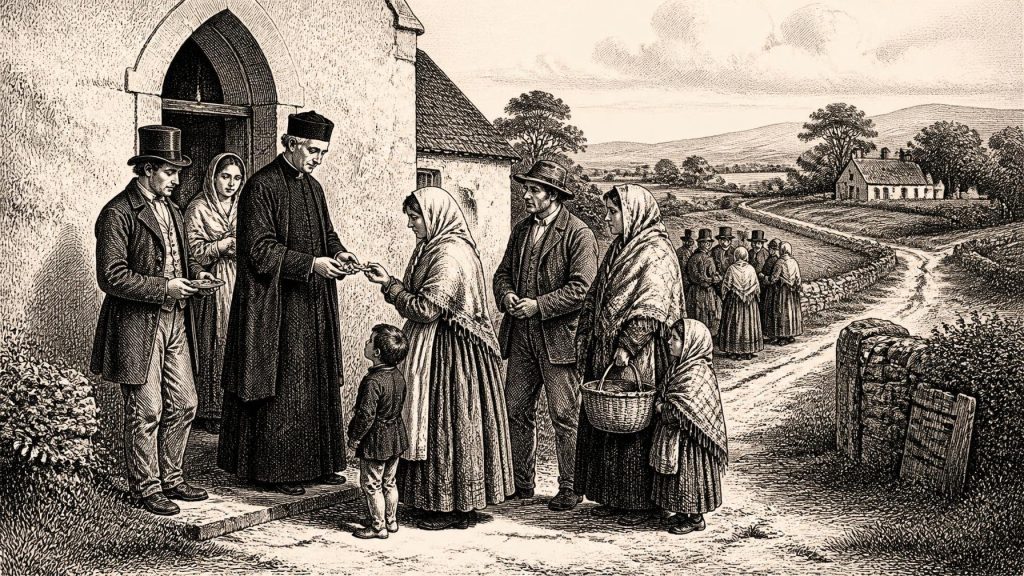
The firmest political turning point of the year came in the Catholic Association’s adoption of what became known as the Catholic Rent. O’Connell had helped found the Association in 1823 to pursue Catholic emancipation: the removal of remaining legal disabilities that excluded Roman Catholics from parliament and important offices. Early in 1824 he advanced a deliberately modest subscription: a penny a month, or a shilling a year, could make a contributor an associate member. The smallness of the payment was the point. It enabled a national political body to draw support from people who could never have afforded the guinea subscription expected of full members.
This was not democracy in the modern electoral sense. Many poor Catholics had no vote, while Catholics who met the property qualification could vote but remained barred from sitting at Westminster. Nor did every penny-payer become an active political participant. Yet the Rent created a regular connection between local communities and a Dublin organisation. It provided funds for petitions, publicity, legal activity and the practical business of campaigning. More significantly, it treated the Catholic population not simply as a religious majority to be governed, but as a constituency capable of contributing, accounting and acting collectively.
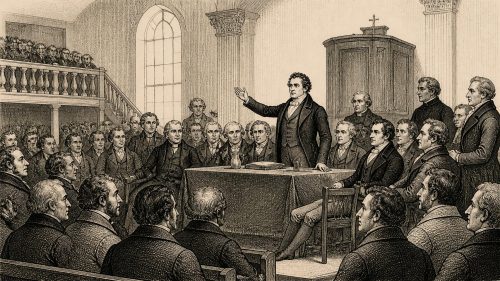
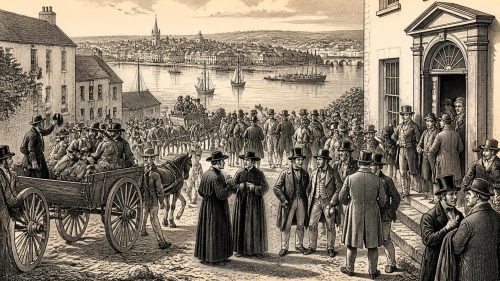
Records kept for Dublin Castle show both the scope of the ambition and the authorities’ close attention to it. At an Association meeting on 28 February, O’Connell pressed for parish-by-parish organisation. Clergy were to act as inspectors of collections; collectors unacceptable to local priests were not to be appointed; accounts and collectors’ names were to be publicly known. Such arrangements mattered. The parish priest was often the most educated and influential resident accessible to small farmers, labourers and tradespeople. The plan therefore joined urban lawyers and public speakers to local clerical networks without making every priest a political agent in the same fashion.
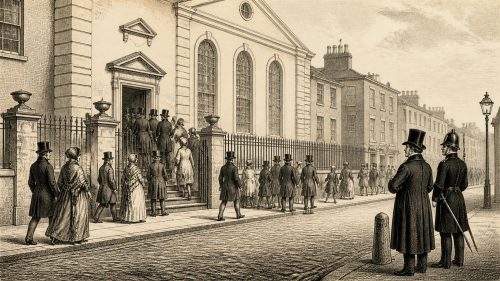
The Association’s language was constitutional but pointed. At a dinner for O’Connell in the Corn Exchange on 3 June, he declared loyalty to crown and constitution while condemning the exclusion of most Irish people from constitutional privileges. Richard Lalor Sheil and John Lawless, among others, gave the occasion a sharper reforming tone. The event illustrates the Association’s method: public dinners, meetings, speeches, printed resolutions and petitions rather than secret drilling or armed rising. That method did not make the movement uncontroversial. Dublin Castle received eyewitness accounts of its proceedings, and opponents feared that a mass Catholic organisation could unsettle the political order. But in 1824 its striking achievement was organisational: it made peaceful national agitation financially sustainable.
Land, Tithes and the State’s New Map
The Rent’s appeal was especially potent because political exclusion existed beside pressing material grievances. Most Irish people lived in rural communities, where access to land, rents, local authority and religious payments shaped everyday security. The Tithe Composition Act of 1823 had begun converting tithes from payments in agricultural produce into cash charges. In the years from 1823 to 1837, officials compiled applotment books for thousands of parishes, recording occupiers and holdings in order to assess liability. This process was under way in 1824; it was not yet the Tithe War of the 1830s. Nevertheless, cash assessment made the claims of the established Church of Ireland more immediate and more legible to occupiers, the great majority of whom were Catholic.
It is important not to flatten the countryside into a single story of rebellion. Conditions varied sharply between regions, estates and households. Still, official papers from 1824 contain reports of Ribbon activity near Trim, while correspondence also recalled prosecutions for nocturnal robberies of arms in the north-west. Such material shows an administration alert to clandestine agrarian association and violence. It cannot, by itself, measure the views of whole counties. It does indicate the tense background against which O’Connell insisted on legal, public mobilisation and against which land, church dues and policing were debated.
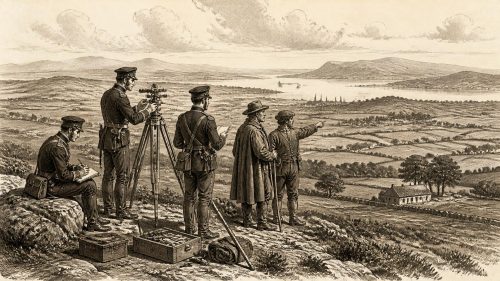
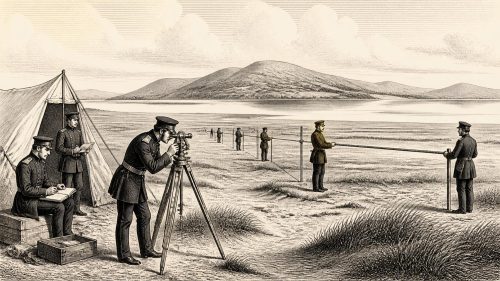
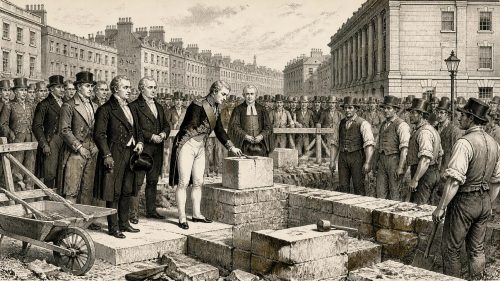
Another major undertaking addressed land through measurement. In April, a parliamentary select committee chaired by the Limerick MP Thomas Spring Rice was established to consider a uniform Irish survey and valuation for taxation. Its report, laid before parliament on 21 June, argued that reliable maps had to precede a fair valuation. The resulting Ordnance Survey Office in Ireland was placed under the Board of Ordnance and based initially at Mountjoy House in Phoenix Park, Dublin. Field survey work commenced in June.
The project was born from a practical fiscal problem. County cess and other local charges rested on old, inconsistent measurements, while Ireland’s dense pattern of townlands required much finer work than a broad national sketch could offer. Under the direction of Colonel Thomas Colby, surveyors would use triangulation and a six-inch-to-the-mile scale to establish a common spatial framework. In 1824 this was a beginning, not a completed map: the precise Lough Foyle baseline belonged to 1827–28, printed sheets came later, and the first complete six-inch survey was finished only in 1846. Yet the decision of 1824 was consequential. It began an official description of boundaries, roads, settlements and land that would profoundly shape later valuation, administration and historical understanding.
Commerce, Measures and Urban Change
Economic change in 1824 was equally uneven. In Ulster, the Northern Bank of Belfast was converted into the joint-stock Northern Banking Company. This did not mean that banking transformed the life of every rural household. It did, however, signal the growing importance of more durable corporate finance to merchants, manufacturers and traders in a region deeply connected to linen production, ports and British markets. A joint-stock structure could assemble capital more broadly than a small private partnership, although banking remained a world far removed from many tenants and labourers.
Ports and communications were also matters of public concern. In May and June, the commissioners improving Donaghadee harbour corresponded with Dublin Castle and the Treasury about a proposed north pier. The papers record an application and planning process, not a finished harbour transformation. Even so, they point to the practical importance of the short sea route between County Down and Scotland, and to the dependence of local improvement on official permissions and finance.
Parliament’s Weights and Measures Act received royal assent on 17 June. It aimed to establish uniform standards throughout the United Kingdom of Great Britain and Ireland, where differing measures were presented as a source of confusion and fraud. Its main standards were to take effect from 1 May 1825, so it would be wrong to describe 1824 itself as the year when every Irish market immediately changed its practice. The Act nonetheless marks a contemporary drive towards common commercial rules, paralleling the new survey’s pursuit of standardised land measurement.
Dublin’s urban economy acquired a lasting landmark when Martin Burke established the Shelbourne hotel enterprise beside St Stephen’s Green. Its later fame should not obscure its modest relevance in 1824: it was one sign of a capital serving travellers, visiting elites and commercial life within the Union, rather than evidence that prosperity was evenly shared across Ireland.
Learning, Print and Religious Life
Public life was not confined to parliamentary grievances. In Belfast, the ninth session of the Belfast Academical Institution was reported on 4 May. Its prize lists covered natural philosophy, mathematics, moral philosophy and metaphysics, logic and belles lettres, Greek, Latin, Hebrew and elocution. The institution’s mixed curriculum reveals an urban culture invested in classical learning, science and public speaking. Its president, the physician and naturalist James Lawson Drummond, belonged to a wider Belfast world of medical, scientific and educational societies. Such activity cannot be treated as representative of all Ireland, but it demonstrates that intellectual institutions outside Dublin were developing substantial civic importance.
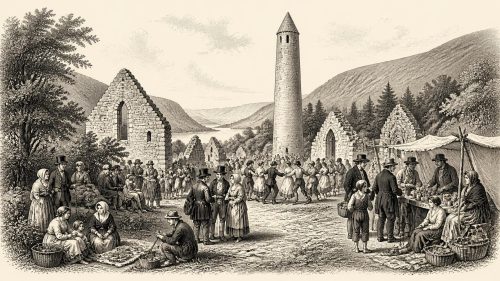
In print, Cork-born antiquary Thomas Crofton Croker published Researches in the South of Ireland. The book presented scenery, architectural remains, popular customs and stories gathered during journeys made between 1812 and 1822. It is therefore not a diary of 1824. It is, however, a revealing publication of that year: Irish folklore and rural life were being packaged for a reading public through the perspectives of an educated antiquary and illustrated travel writing. Croker’s work preserved material of cultural value while also filtering it through the assumptions of its author and intended audience.
Religious structures continued to matter at every level. On 19 November Edward Kernan succeeded James Murphy as Roman Catholic bishop of Clogher. The succession was a local diocesan event, not a national political breakthrough. But it belongs to a period in which Catholic bishops and clergy were becoming increasingly important organisers of communal life, education and political communication. Their significance helps explain why the Catholic Rent’s parish machinery could operate so effectively.
A More Organised Ireland
What joins these developments is organisation. The Catholic Rent counted small subscriptions and converted them into political pressure. Tithe applotment and the new survey counted land, occupiers and boundaries. Banks gathered capital; harbour commissioners pursued infrastructure; schools, books and dioceses cultivated authority and knowledge. None erased the divisions of property, denomination or power. In 1824, Catholic emancipation was still five years away, the great maps had barely begun, and rural hardship remained acute. But Ireland was becoming more systematically connected—by parish collection, official measurement, print and institutions—and that change would shape the conflicts and reforms of the decades ahead.
Primary Sources
- The Registered Papers of the Chief Secretary’s Office: Catholic Association records, 1824
- The Registered Papers of the Chief Secretary’s Office: 1824 records
- Letter from Daniel O’Connell to his wife Mary
- O’Connell, Daniel
- The Life and Speeches of Daniel O’Connell, M.P.
- Selected English Speeches: Catholic Emancipation, Daniel O’Connell, 24 February 1824
- Our History
- Survey of Ireland, House of Lords debate, 12 March 1824
- Ordnance Estimates, House of Commons debate, 27 February 1824
- The Origin of Ireland’s Ordnance Survey
- OS History
- The Tithe Applotment Books, 1823–37
- Family History Sources: Tithe Applotment and Valuation Records
- Wildcat Bankers or Political Failure? The Irish Financial Pantomime, 1797–1826
- Weights and Measures Act 1824
- Our History
- Researches in the South of Ireland
- Croker, Thomas Crofton
- Drummond, James Lawson
- Kernan, Edward
- Bishops of Clogher
- The Office of the Chief Secretary of Ireland: Chronology