Wellesley’s Bottle Riot1822 CE
In 1822, Ireland endured agrarian unrest, food scarcity and emergency government. Lord Lieutenant Richard Wellesley inherited Rockite violence, chiefly in Munster, where the Insurrection Act, habeas corpus suspension, troops and special commissions produced prosecutions, transportation and executions. Poor harvests caused severe regional distress, especially in the west and south-west. Government coordinated charity and funded public works, employing labourers on roads, piers and harbours under engineers including Alexander Nimmo and Richard Griffith. Political divisions persisted over Catholic exclusion and the established Church. A new constabulary law encouraged organised policing. December’s Bottle Riot, when a jar was thrown at Wellesley, symbolised conflict.
Dateline
In 1822 Ireland was governed through emergency law while parts of the country faced acute hunger. The year brought no single national turning point, but its crises exposed the pressures bearing on a rapidly growing, overwhelmingly rural society: insecure livelihoods, high food prices after a poor harvest, unequal religious and political rights, and deep distrust of local authority. Violence associated with the Rockite movement convulsed parts of Munster; severe scarcity struck districts in the west and south-west; and the Dublin administration responded with troops, special courts, coercive legislation and relief works. By December, a jar thrown at the Lord Lieutenant in a Dublin theatre showed that political conflict was not confined to remote townlands.
A Viceroy Facing Crisis
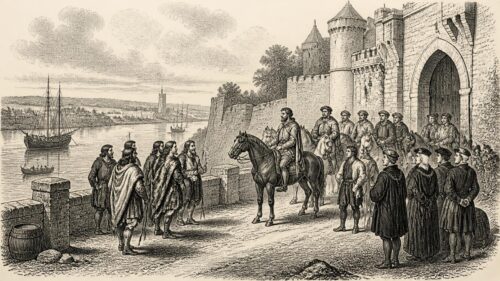
Richard Wellesley, Marquess Wellesley, began his Irish viceroyalty amid considerable expectation. His appointment had been welcomed in addresses from Dublin, Belfast, Cork, Drogheda and Trim during the opening months of 1822. He was a prominent figure, and his reputation for favouring a more conciliatory approach to Catholic claims encouraged hopes among some Catholics and liberal Protestants. Yet Wellesley inherited an administration whose immediate priority was restoring order in a countryside already troubled by organised nocturnal violence.
Ireland had been part of the United Kingdom since 1801, but the main executive machinery of government remained concentrated in Dublin Castle under the Lord Lieutenant and Chief Secretary, Henry Goulburn. Westminster legislated for Ireland, while daily administration relied heavily on magistrates, grand juries, landlords, clergy, soldiers and a patchy local policing system. That structure was especially strained in 1822. Parliamentary discussion described the inability of existing police arrangements to protect peaceful inhabitants in disturbed counties. The state’s answer was therefore both centralising and coercive.
Rockites and Emergency Government
On 11 February Parliament passed an Irish Insurrection Act, initially to remain in force only until 1 August. It was directed against insurrections said to be sustained through unlawful oaths and secret association. The Act enabled a county’s magistrates to seek proclamation as disturbed, after which severe restrictions could be imposed. Alongside it came a suspension of habeas corpus in Ireland, permitting detention on suspicion. These measures were not ordinary criminal-law remedies: they indicated that government treated the situation in sections of the country as an exceptional security emergency.
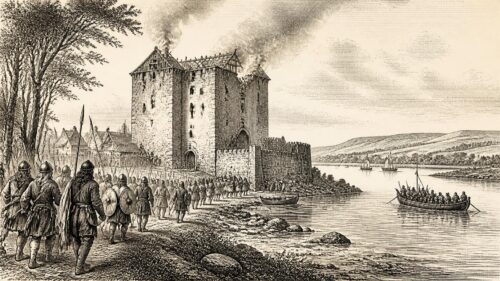
The immediate setting was the Rockite movement, strongest in County Cork but connected to a wider repertoire of agrarian protest. Contemporaries applied several labels—Whiteboys, Rockites and other names—to secret, often oath-bound groups acting at night. Their targets could include people or property associated with rent, landholding, evictions, tithes, labour arrangements or local authority. Such movements were neither a coherent national rebellion nor simply criminal gangs. They grew from sharply local disputes, but their methods—threatening notices, attacks, arms seizures and incendiarism—could make whole districts ungovernable.
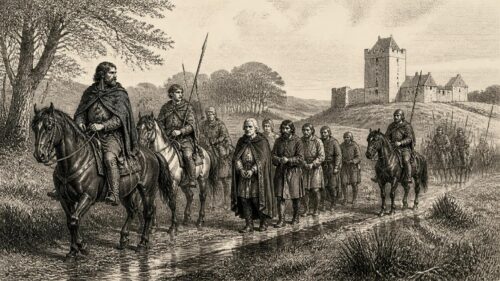
In Munster the scale of the repression was formidable. Five army regiments were sent from Britain, and special commissions were appointed in February to try alleged Rockites in Cork. Modern research based on official returns records more than 1,500 men tried under the Insurrection Act in Munster during its first year, with more than 200 transported after conviction. Thirty-six men convicted at the Cork special commissions received capital sentences. These figures convey the reach of the state, but also require care: they measure prosecutions and punishments, not a simple count of active insurgents or popular support.
For ordinary rural households, the consequences were immediate. Night movement could attract suspicion; the presence of soldiers altered village life; and the court system became an instrument of exemplary punishment. The response also revealed the limits of the old local order. Landlords and magistrates could command influence, but Dublin Castle sought more dependable means of surveillance and enforcement than the scattered parish constable or occasional military patrol.
Scarcity in the West
At the same time, many families confronted a subsistence crisis. The poor harvest of 1821 had reduced supplies of grain and potatoes, and hardship in 1822 was particularly grave in Mayo, Galway, Connemara and other western districts, while distress also extended into parts of the south. It would be misleading to call this a repetition of the Great Famine of the 1840s; it was a regional and severe pre-Famine food crisis. But contemporary reports leave no doubt about its urgency. Power Le Poer Trench, Church of Ireland Archbishop of Tuam, reported hunger in Mayo and Galway in terms so stark that government officials treated the alarm as a demand for immediate intervention.
The crisis exposed the fragility of an economy in which labourers and small occupiers depended upon a narrow food margin. A household without cash could not readily buy meal when its own crop failed or was exhausted. In isolated districts, inadequate roads and harbours made the physical movement of provisions expensive and slow. Hunger was therefore not merely a question of total food supply: it was also a question of wages, purchasing power, credit, transport and access to markets. By June, MPs were debating the scarcity of provisions in Ireland and questioning whether private charity and sums already voted could meet the need.
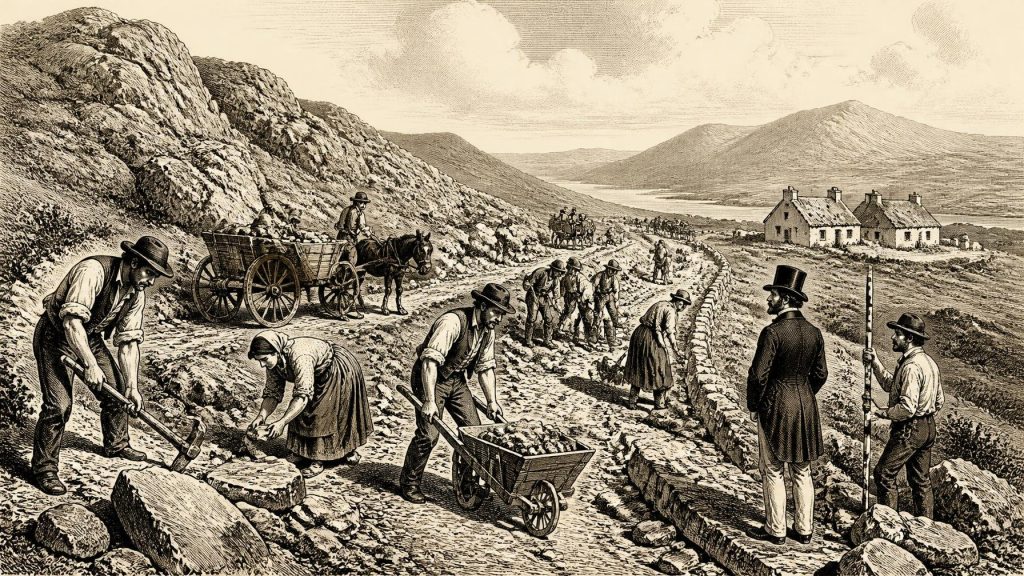
Government relief combined charitable coordination with employment. A Dublin committee, established on the Lord Lieutenant’s direction, communicated with the most distressed localities. Parliament made a further £50,000 available for public works, supplementing money already associated with the earlier Poor Employment legislation. The object was to provide wages as well as to construct useful infrastructure, rather than simply distribute food. It was an important choice, though one that could not by itself meet every urgent need of people who were already weak, ill-fed or far from a work site.
Roads as Relief
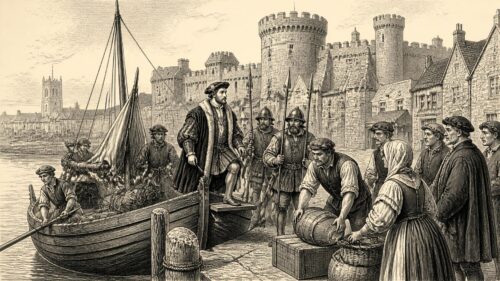
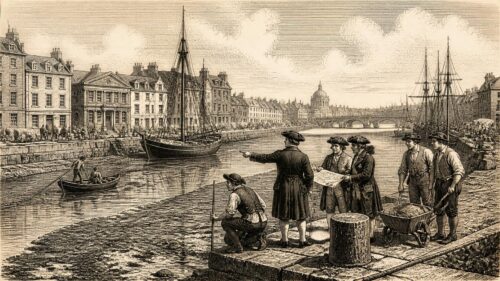
Three engineers became central to this practical response: Alexander Nimmo in the western district, John Killaly in the middle district and Richard Griffith in the southern district. Their remit linked distress relief to roads, piers, harbours and other improvements. Nimmo assessed schemes in Mayo and Galway, including proposals intended to open coastal and interior communications. Griffith directed road-building relief in Cork, Kerry and Limerick. In July he reported more than 10,000 people employed in County Limerick alone, chiefly on road construction, excluding ordinary farm labourers.
The works were not simply benevolence in earth and stone. Officials hoped a road would allow food, fish, turf and farm produce to travel more cheaply, connect isolated places to market towns, and give employers and labourers a more regular commercial relationship. In the short term, however, relief work could be arduous, seasonal and unevenly distributed. Its funding depended on local applications, engineering inspections and grand-jury presentments. The great demand for employment also placed opportunities for favouritism and mismanagement beside genuine local initiative. Still, 1822 established a significant pre-Famine precedent: central government could use engineers, surveys and public employment to address a social emergency.
Religion, Representation and Police
The religious settlement remained at the heart of political division. Most Irish people were Catholic, while the established Church of Ireland retained state support and Catholics remained excluded from Parliament by the oath required of members. In May and June, Parliament considered George Canning’s Roman Catholic Peers Bill, a limited proposal to remove the exclusion of Catholic peers from the House of Lords. The debate showed both the persistence of anti-Catholic constitutional argument and the failure of modest concession to settle the wider question. Opponents in the Lords stressed that the measure would not directly benefit ordinary Irish Catholics; supporters and critics alike treated Ireland’s condition as inseparable from the issue. Full Catholic emancipation still lay seven years ahead.
Another lasting development came on 5 August with the Appointment of Constables, etc. (Ireland) Act. It authorised the Lord Lieutenant to establish a more systematic baronial police: chief constables, constables and sub-constables, appointed through a combination of central direction and local magistrates. It did not instantly create the later Royal Irish Constabulary, and its operation depended on county-by-county implementation. Nevertheless, it marked a deliberate move away from ad hoc policing towards a more organised force, shaped by the experience of the year’s disturbances.
The Theatre Jar
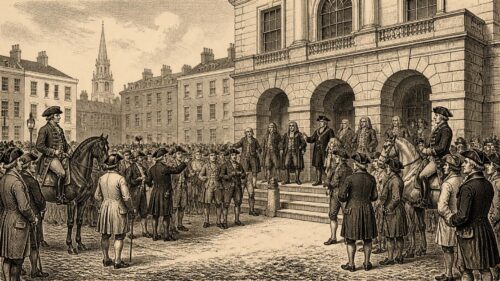
On 14 December, Wellesley attended Dublin’s Theatre Royal in Hawkins Street. During a disturbance, an earthen jar was thrown into his box. The incident became known as the Bottle Riot. It was a minor physical attack compared with the violence and hunger elsewhere, but politically it mattered. The Lord Lieutenant was visibly challenged in the capital, where questions of Protestant ascendancy, Catholic relief and official authority could generate intense public feeling.
Thus 1822 closed without resolution. Emergency legislation and military force had checked major rural disorder, but did not remove its social causes. Relief works had offered wages and left tangible improvements, but scarcity had displayed the vulnerability of the western seaboard and the dependence of poor households on precarious crops and labour. Wellesley’s administration had begun to combine conciliation in tone with a more forceful and centralised state. The contradictions of that approach—reform promised, coercion applied—would continue to shape Ireland through the 1820s.
Primary Sources
- Historical Commentaries for 1822
- An Act to suppress Insurrections and prevent Disturbance of the Public Peace in Ireland, until the First Day of August One thousand eight hundred and twenty-two
- State of Ireland, House of Commons debate, 7 February 1822
- State of Ireland, House of Commons debate, 22 April 1822
- Irish Insurrection Bill, House of Commons debate, 8 July 1822
- Scarcity of Provisions in Ireland, House of Commons debate, 17 June 1822
- Roman Catholic Peers Bill, House of Commons debate, 10 May 1822
- Roman Catholic Peer’s Bill, House of Lords debate, 21 June 1822
- Tithes, and the Church Establishment in Ireland, House of Commons debate, 19 June 1822
- Appointment of Constables, etc. (Ireland) Act 1822
- The Registered Papers of the Chief Secretary’s Office: 1822
- The Registered Papers of the Chief Secretary’s Office: 1822
- The Registered Papers of the Chief Secretary’s Office: 1822
- Chief Secretary’s Registered Papers, 1818–1922
- The Rockite Movement in County Cork in the Early 1820s
- ‘Wholesome regulation and unlimited freedom’: governing market space in southern Ireland before the Famine
- Alexander Nimmo
- Richard John Griffith
- Add MS 13914 B
- Pre-Famine Relief Committees, 1817–42
- Identifying Public Works in County Mayo in 1822