American War1776 CE
In 1776, Ireland, though a separate kingdom, was deeply affected by Britain’s war with the American colonies. An embargo on provisions exposed dependence on imperial trade, while the Tumultuous Risings Act targeted Whiteboy rural unrest rooted in land, tithe and tenancy grievances. Newspapers expanded political debate: Finn’s Leinster Journal printed the Declaration of Independence in August, and the Hibernian Magazine cautiously reproduced Paine’s Common Sense. Arthur Young’s travels recorded ports, linen districts and farms alongside poor roads, insecure smallholders and poverty. The year intensified awareness of inequality, constitutional constraint and economic vulnerability, foreshadowing campaigns for free trade and legislative independence.
Dateline
An Island Drawn into War
In 1776 Ireland was not a bystander to the American Revolution. It was a separate kingdom with its own parliament in Dublin, but it remained bound tightly to the British imperial system: by constitutional restraints, commercial regulations, the authority of the Crown’s Dublin Castle administration, and the sea routes that carried Irish food, linen, people and news across the Atlantic. When the war with the American colonies intensified, its consequences arrived in Ireland not chiefly as distant battle reports but as restrictions on trade, demands upon resources, political argument and anxious talk in ports, markets and print shops.
The most immediate officially dated development came on 3 February, when a proclamation imposed an embargo on the export of provisions from Ireland. Britain needed food for forces engaged in the American war, and Lord North’s ministry looked to Irish supplies. The word “provisions” embraced commodities central to the southern and western export economy: cattle, salted beef and pork, butter and other victualling goods. For merchants and producers, particularly around Cork, the measure was a sharp reminder that Ireland’s commerce could be redirected by imperial military necessity.
The embargo did not mean that Ireland ceased to feed itself, nor should it be mistaken for a single uniform experience across the island. Its effects varied by region, commodity and access to market. But it made a general political problem tangible. Irish exporters already worked within a restrictive mercantilist system that channelled much trade through Britain and limited direct access to colonial markets. Wartime controls made the imbalance more conspicuous. Proclamations in November modified, removed and renewed particular restraints in quick succession, showing how closely food, shipping, naval supply and public policy had become entangled.
Order in the Countryside
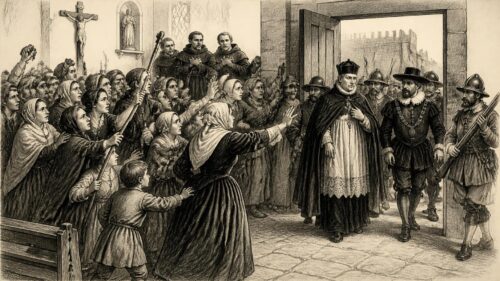
Government alarm also reached beyond the quays. The Whiteboys—rural secret societies whose members often appeared in white shirts or smocks—had emerged in the 1760s amid disputes over rents, enclosures, tithes, pasture and local authority. Their methods could include threatening letters, nocturnal assemblies, attacks on property and attempts to regulate practices regarded as oppressive. They were neither a national political organisation nor a simple expression of all poor people’s interests. Yet their persistence exposed the strain within a countryside of unequal landholding, insecure tenures and competing claims on agricultural produce.
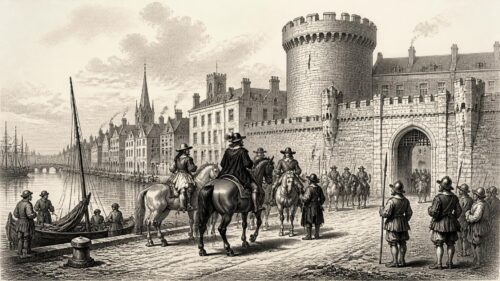
A stringent statute passed late in 1775, the Tumultuous Risings Act, took effect from 1 March 1776. Its preamble explicitly named “White Boys” and described attacks on persons and property, coercive oaths, threats, the taking of horses and arms, and interference with the movement or export of grain. The language is revealing even where it cannot prove every allegation in every locality: the state feared collective rural action that challenged landlords, clergy, merchants and the circulation of food. On 4 April a further proclamation offered pardon in return for information connected with Whiteboy disturbances. The calendar matters here. The principal Act was not newly passed in April 1776; it was a 1775 measure whose new provisions began operating that spring.
Such coercive legislation belonged to a wider structure of authority. The Irish parliament was dominated by Protestant property holders, while most Catholics remained excluded from parliamentary political power and lived under a penal-law system that still restricted property, education, office and religious life, despite cautious concessions in the previous decade. The Church of Ireland was established and supported by tithes. Presbyterians, especially numerous in Ulster, occupied a different legal and social position from Catholics but also had reasons to resent aspects of the established order. These divisions shaped everyday obligations as much as high politics.
Dublin, Print and American News
War also enlarged Ireland’s political reading public. The Freeman’s Journal, published in Dublin since 1763 and associated in its early years with the parliamentary patriot interest, was among the newspapers carrying transatlantic news and argument. Across the Irish Sea, the conflict raised searching questions about representation, taxation and the rights of legislatures. In Ireland those questions could not be copied directly from the American case: the island’s confessional inequalities, land system and constitutional relationship with Britain were distinctive. Still, American events supplied a powerful vocabulary through which Irish grievances could be discussed.
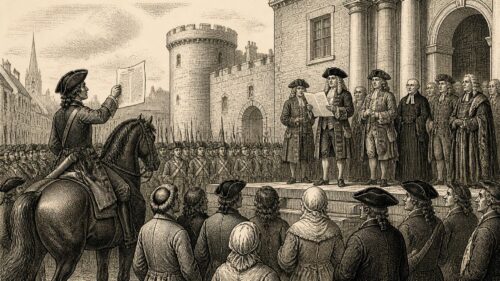
The Declaration of Independence, adopted in Philadelphia on 4 July 1776, reached Irish readers with notable speed. In August, Finn’s Leinster Journal, published at Kilkenny, became the first Irish newspaper known to have printed it. That was a concrete act of transmission, not evidence that all readers approved its claims or favoured separation from Britain. Its importance lies in making a revolutionary document available in an Irish provincial town, where it could be read alongside advertisements, local notices, commodity prices and reports of war.
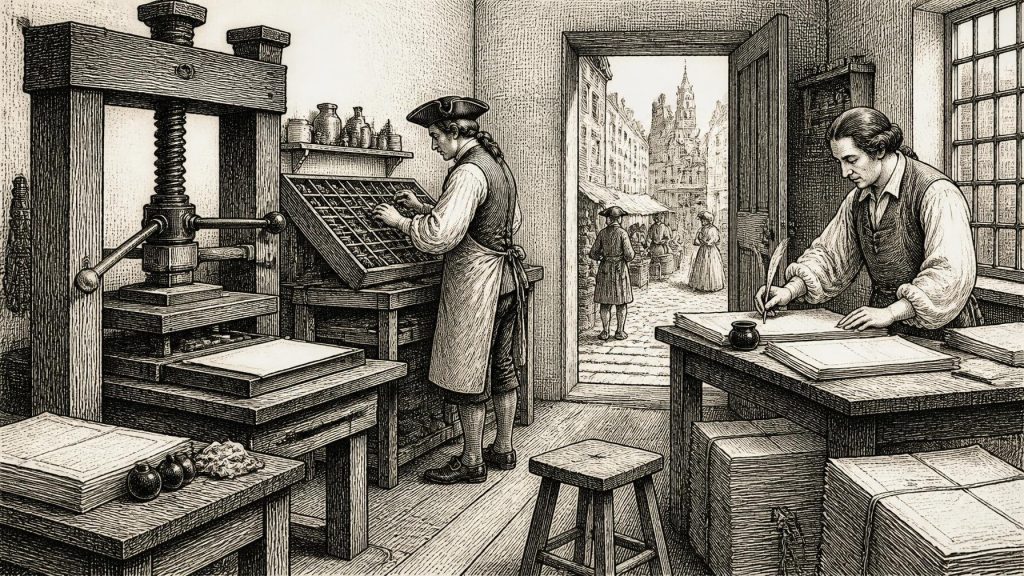
American polemic circulated too. The Hibernian Magazine published Thomas Paine’s Common Sense during 1776, though its most vehement attacks on hereditary monarchy were toned down. The editorial caution is as significant as the reprinting. Dublin printers and readers could engage with a case for American independence, but publication operated within laws of libel and a political culture in which open republicanism was risky. Print fostered comparison and debate; it did not automatically create a revolutionary movement.
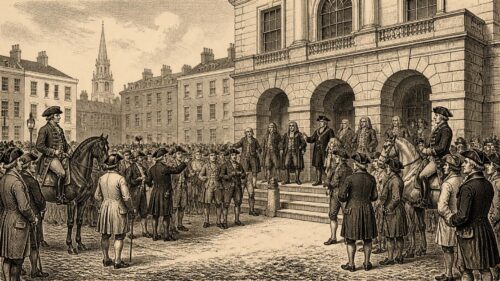
Dublin itself displayed another side of eighteenth-century Ireland. Arthur Young, the English agricultural writer, arrived from Holyhead on 20 June and found a city whose public buildings and planned streets impressed him. He saw Lord Harcourt, the lord lieutenant, prorogue parliament with the customary ceremony. Parliament met in the grand building on College Green, while Trinity College stood nearby as a centre of Protestant higher learning. The scene projected refinement and institutional confidence. Yet it was the capital of a polity whose legislature was constrained by Britain and whose franchise and public offices were closed to the great majority of inhabitants.
Arthur Young’s Ireland
Young’s arrival began one of the year’s most valuable surviving observations of Ireland. He travelled for 122 days, from 20 June to 19 October, through much of the island: from Dublin and the midlands to Kilkenny and Wexford, through Ulster, then across Donegal, Fermanagh, Connacht, Munster and back towards Waterford. His later Tour in Ireland was published in 1780, but its notes and itinerary preserve encounters made in 1776 itself. They offer unusually rich evidence of roads, farming, rents, manufactures, markets and landscapes.
Young was no neutral witness. Armed with letters of introduction, he stayed frequently with landlords, clergy and improving gentlemen; his conversations and statistics often came from men with property or official influence. He could be impatient with practices unlike those he admired in England, and his broad judgements should not be treated as a complete census of Irish life. Modern scholarship has also cautioned against accepting his bleakest comparisons at face value. Nevertheless, his local observations reveal real contrasts in productivity, wealth and social security.
He encountered productive grain land, improving estates and commercial towns, but also extensive rough ground, weak communications and acute rural poverty. Around Coleraine he found linen manufacture widely spread; flax cultivation, spinning, weaving and bleaching linked households to merchants and distant markets. In the north-east, linen was the great rural-industrial system, drawing on the labour of small farmers and cottiers as well as urban traders. At Drogheda, on a crowded market day in July, Young noted the abundance of people and grain brought together by the Boyne’s trading connection. These were not signs of an isolated subsistence island.
Elsewhere his evidence points to a more precarious balance. In coastal districts of the west, informants described households living for much of the year on potatoes and herrings, supplemented by oat bread and milk, with little meat. Small holdings might combine potatoes, oats, flax, a cow’s grass and a pig or two. Such patterns supplied calories and some resilience, but they left families exposed to changes in rent, employment, harvest or market access. Young repeatedly recorded the centrality of potatoes, cattle, turf, fishing and seasonal labour. Ireland’s economy was diversified, but its benefits were very unevenly distributed.
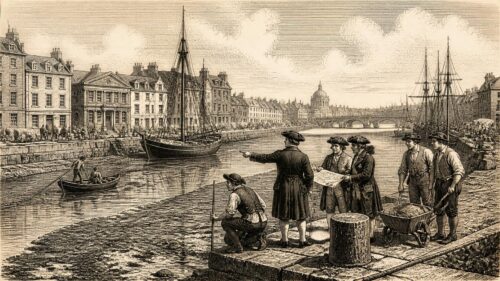
The landscape he described also had an economic history. Woodlands and planted demesnes clustered around elite houses, while large tracts appeared comparatively treeless to him. Harbours and rivers mattered enormously because moving bulky goods by water was usually cheaper than carrying them over poor roads. Cork was the principal provisioning port, with merchants who owned dozens of ships in 1776; Belfast and Derry were linked to linen and Atlantic commerce; smaller ports served local coastal traffic. The American war therefore touched communities far from Dublin, because cargoes, seafarers, emigrants and credit connected Irish regions to an unsettled ocean.
A Year Before the Volunteer Moment
It is tempting to see 1776 simply as a prelude to later Irish constitutional agitation. That would flatten the year. Henry Grattan and other patriot politicians were already associated with demands for a more independent Irish legislature and freer trade, but the decisive free-trade campaign lay ahead in 1779, and legislative independence would be secured only in 1782. Likewise, the Irish Volunteer movement did not yet exist as the famous nationwide force of later years; it developed after 1778, when war with France and the withdrawal of regular troops created fears for Ireland’s defence.
What 1776 did provide was the pressure from which those later developments grew. An imperial war made Irish provisions strategically valuable, exposed trade restrictions, carried radical and constitutional arguments into the press, and sharpened concern over security and public order. Young’s journey, meanwhile, set down a detailed portrait of the kingdom at precisely that moment: a country of handsome public buildings and crowded markets, linen districts and busy ports, great estates and small cabins, expanding information networks and profound inequalities. Finn’s Leinster Journal printing the American Declaration in August captured the year’s central tension. A document announcing independence was being read in a kingdom whose own place within the empire was becoming harder to accept as fixed.
Primary Sources
- Tumultuous Risings Act 1775
- Statute Law Revision Act 2015
- A Tour in Ireland, Made in the Years 1776, 1777, and 1778
- Arthur Young: 1st to 10th August 1776: Antrim, Londonderry and Donegal
- A Tour in Ireland, with General Observations on the Present State of that Kingdom, 1776–78
- Young, Arthur
- A Tour in Ireland [Young]
- On the Road Again with Arthur Young: English, Irish, and French Agriculture During the Industrial Revolution
- The Embargo on the Export of Irish Provisions, 1776-9
- History of the Commercial and Financial Relations between England and Ireland from the Period of the Restoration
- Irish Sea and Coastal Trade
- Ecclesiastical Politics and the Dismantling of the Penal Laws in Ireland, 1774–82
- The Public Register or Freeman
- The Freeman’s Journal
- Preserving History: The America250 Collection at the NLI
- Thomas Paine, Ireland and the Irish Ghost
- Ireland and the Making of America
- Divided Loyalties: Ireland and the American War of Independence
- Irish Immigrants in the American Revolution
- Irish Artisans and Radical Politics, 1776–1820: Apprenticeship to Revolution