Pill Lane1744 CE
Ireland in 1744 combined political control, social vulnerability and tentative institutional improvement. With the Anglican parliament prorogued, Dublin Castle governed through proclamations addressing foreign military recruitment, disorder, crime, war with France and maritime quarantine. In February, a house collapsed during Catholic Mass in Dublin’s Pill Lane, killing priest and nine worshippers, exposing hazards intensified by penal restrictions. Dublin also founded the Physico-Historical Society and Hospital for Incurables, while cultural life included Spranger Barry’s theatre debut and developing drawing instruction. Arthur Price became archbishop of Cashel. A wet, cold autumn damaged northern oats and potatoes, reviving fears after the 1740–41 famine.
Dateline
Ireland in 1744 was neither quiet nor defined by a single national turning point. It was a year in which the ordinary vulnerabilities of life—unsafe housing, illness, bad weather and insecure food—were sharply visible, while the institutions of Protestant government continued to police a predominantly Catholic population. In Dublin, charitable and learned associations tried to order, relieve and investigate the world around them. In the north, a wet and cold autumn threatened staple crops. Across the island, events were shaped by the recent memory of the catastrophic famine of 1740–41, remembered in Irish as Bliain an Áir, the Year of the Slaughter.
Government Without Parliament
George II was king, but Ireland’s political system was narrow and highly managed. The Irish parliament, composed exclusively of Anglican members, was not sitting in 1744. Official proclamations recorded repeated prorogations: on 28 February its meeting was deferred, and in June it was postponed again until February 1745. Government therefore proceeded through Dublin Castle, the lord lieutenant’s administration, privy councillors, judges, grand juries and local magistrates rather than through parliamentary debate.
The record of proclamations gives an unusually direct view of official anxieties. On 20 February, rewards were offered for information leading to the apprehension of people recruiting soldiers for foreign armies. On 5 March army officers were ordered to be ready for service. A proclamation of 13 March invoked the law against unlawful assemblies and combinations. In July, men described by the authorities as “tories, robbers and rapparees”, who had been presented by grand juries in Kerry, Wicklow and Queen’s County, were ordered to surrender. These measures should not be read as proof of a single co-ordinated rebellion. Rather, they show a state alert to military recruitment, rural crime and collective disorder during a European war.
The international setting became still more immediate in April. France had declared war on Britain in March during the wider War of the Austrian Succession, and on 5 April the Irish administration published George II’s declaration of war against France. Ireland was not a battlefield in 1744, but its ports, garrisons, taxes and manpower belonged to a British and Atlantic war effort. The August proclamation imposing quarantine on ships arriving from the western coast likewise reminds us that maritime connections brought perceived dangers as well as trade and news. It cannot, by itself, demonstrate an epidemic in Ireland; it does demonstrate official caution at a time when disease was feared and communication by sea was indispensable.
A Mass in Pill Lane
The most starkly dated Dublin event occurred on 26 February. A house in Pill Lane, near the Four Courts, collapsed while Roman Catholic Mass was being celebrated inside. The priest and nine members of the congregation were killed, while others were injured. The disaster was at once a human tragedy and a revealing glimpse of religious life under the penal system. Catholic worship persisted through networks of clergy and lay congregations, but it did so without the public security, endowments and civic standing enjoyed by the established Church of Ireland.
That context was reinforced only two days later. On 28 February the authorities ordered enforcement of laws against Catholic ecclesiastics and regular clergy. It would be misleading to treat every Catholic service as equally clandestine, or to suppose that the laws were enforced uniformly in every county. Local practice varied, and Catholic priests continued to minister. Yet the sequence of the Pill Lane deaths and the official proclamation makes clear how precarious Catholic public worship could be. A crowded gathering in a poor or ageing urban building involved physical danger; the surrounding law added political and religious insecurity.
Knowledge as Improvement
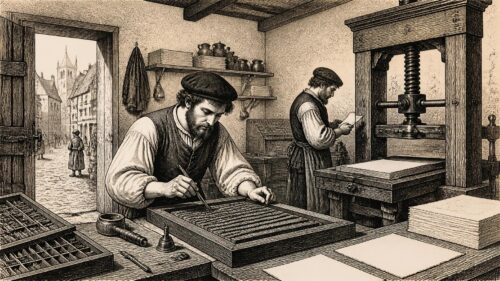
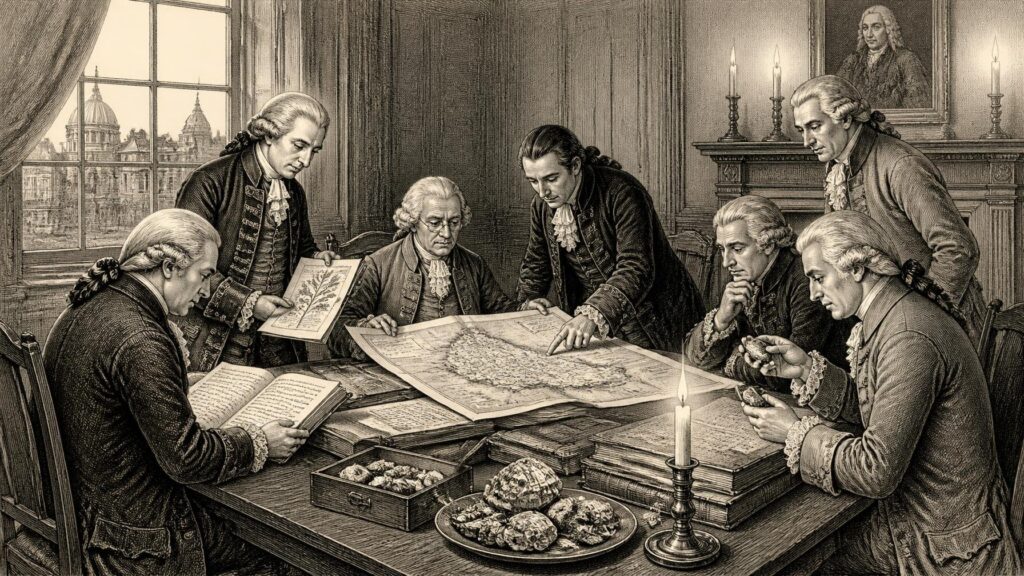
On 14 April, about twenty men met in the Lords’ committee room in Dublin’s Parliament House to establish the Physico-Historical Society of Ireland. Its title joined two interests that modern readers often separate: the natural features of the country and its human, antiquarian and civil history. The society sought information about Ireland’s counties, including manuscripts, rare printed books, antiquities and natural curiosities. A surviving minute book begins in April 1744, and contemporary notices appealed to gentlemen in different parts of the kingdom to send such material to the society’s officers.
This was an early expression of the eighteenth-century language of “improvement”. Its members hoped that better knowledge of soils, resources, manufactures, local history and population could strengthen Ireland’s wealth and reputation. The enterprise was socially restricted: it drew heavily on Anglican clergy, landowners, Trinity College men and figures connected with the Dublin Society. Nevertheless, it treated Ireland itself as a subject demanding systematic description rather than merely a territory to be administered from Dublin or London. Walter Harris and Charles Smith’s Antient and Present State of the County of Down, published in 1744, illustrated the kind of county-based research that this milieu valued.
The society’s ambitions were larger than its achievements, and its active life was relatively brief. That later limitation should not obscure the significance of its foundation year. In 1744, collecting a local manuscript, recording a mineral specimen or compiling a county account could be presented as public work: a contribution both to learning and to economic development.
Charity, Medicine and Civic Display
Dublin’s growing culture of organised benevolence produced another firmly dated development on 23 May. The Hospital for Incurables opened in a rented house in Fleet Street. It was supported by the charitable activities of the Musical Society, whose subscribers had first used concert income for more occasional relief. Their decision to maintain people with conditions judged beyond cure marked a shift towards a permanent institution with governors, medical attendance, nursing and regular fundraising.
The language of “incurable” was harsh by modern standards, and the hospital did not offer the forms of treatment, diagnosis or patient rights now expected. Yet its opening recognised a need that families, parishes and casual almsgiving often could not meet: long-term care for people living with severe chronic illness or disability. Music, sociability and philanthropy were closely joined in eighteenth-century Dublin. Public entertainments could generate funds, while charitable institutions gave elite subscribers a visible civic role. The new hospital therefore belongs both to the history of medicine and to the social world of Georgian associational life.
Church of Ireland patronage remained central to that public world. Arthur Price, formerly bishop of Meath, was translated to the archbishopric of Cashel in April; letters patent followed on 7 May. Price’s career, aided by powerful Whig connections, shows how senior ecclesiastical office functioned as part of the governing order. The established church was a religious body, a major landholder and an element in the political constitution. Its contrast with the position of Catholic clergy was one of the defining inequalities of the year.
Stages, Drawing and Public Culture
Not all of Dublin’s cultural energy belonged to government or philanthropy. On 5 February Spranger Barry, a Dublin-born silversmith’s son, made his first recorded appearance at the Theatre Royal in Smock Alley. He would become one of the leading actors of the century. His debut is a small event in itself, but it points to the city’s active commercial theatre, where performance could offer a route from trade into celebrity.
Drawing instruction was also taking firmer shape. Robert West had established a private drawing school in George’s Lane in the late 1730s, and biographical evidence places the Dublin Society’s employment of him to teach selected boys at about 1744. The chronology is important: the society’s formal plans and financial support for a drawing academy are more securely associated with 1746, not with a neatly datable foundation in 1744. What can responsibly be said is that, by this year, practical training in drawing was being connected to manufacture, design and the cultivation of Irish artistic skill. It was an early stage in a longer institutional story, not yet the fully developed Dublin Society schools of later decades.
The Northern “Rot Year”
By about October, a wet and cold season had spoiled oats and potatoes in northern districts. Later chronologies call 1744 the “rot year”. The phrase should not be confused with the potato blight of the nineteenth century, and the surviving evidence does not warrant claiming that all Ireland suffered an equal harvest failure or that a new island-wide famine followed. It does, however, identify a serious regional check to two foods central to poorer households and small farms.
The timing mattered. Only three years had passed since the extraordinary famine of 1740–41, when frost, drought, crop failure and disease had inflicted devastating mortality. Survivors in 1744 did not need a historian’s hindsight to understand the danger in spoiled oats or rotting potatoes. Food was grown, stored, bought and consumed locally, but bad weather could quickly move through rents, prices, labour, household diet and begging. The year’s colder, wetter close therefore cast a shadow over the confidence represented by Dublin’s new societies and charities.
That tension is the clearest theme of 1744. In one year, Ireland saw the loss of worshippers in a collapsing city house, renewed coercive proclamations, new institutions for care and inquiry, and a troubling harvest in the north. The record is fragmentary, but it reveals a society in which improvement and insecurity advanced side by side.

Primary Sources
- Statute Law Revision Act 2015 (Schedule 2: proclamations and orders for 1744)
- Price, Arthur — Dictionary of Irish Biography
- Minute book of the Physico-Historical Society, Dublin, April 1744 to March 1752
- The Making of Irish Geography, IV: The Physico-Historical Society of Ireland, 1744–1752
- Charles Smith: Pioneer of Irish Topography
- A History of the Royal Dublin Society
- West, Robert — Dictionary of Irish Biography
- The Dublin Society Drawing Schools: Student and Award Winners (1746–1876)
- Down to a Fine Art: The RDS Art Collection
- Further Hospital Histories
- Hospitals and Medical Institutions
- Social Life in Eighteenth-Century Dublin
- The Physico-Historical Society and Irish County History
- A Chronology of Ireland
- The Cambridge History of Irish Literature: Chronology
- The 1841 Census—Do the Numbers Add Up?
- Penal Law
- Parnell: History of the Penal Laws
- The Dublin Society
- The Training of Irish Artists and Exhibitions
- A History of England in the Eighteenth Century, Volume II
- The Eighteenth Century: Ballinasloe Town and Parish
- The Eighteenth Century: Limerick