Antrim Presbytery1725 CE
In 1725, Ireland’s significance lay in institutional and political tensions rather than a single decisive event. Lord Carteret suspended William Wood’s contested halfpence patent, demonstrating the force of opposition mobilised by Jonathan Swift while leaving Ireland subordinate to Westminster. His administration exposed a treasury deficit and renewed reliance on parliamentary patronage. The Synod of Ulster created the Presbytery of Antrim for non-subscribing ministers, deepening Presbyterian divisions over conscience and confessional authority. Dublin’s first surviving Grand Lodge meeting recorded freemasonry’s organisation. These developments unfolded within a rural, unequal Protestant state, where Catholics and Presbyterians faced disabilities and economic life remained vulnerable.
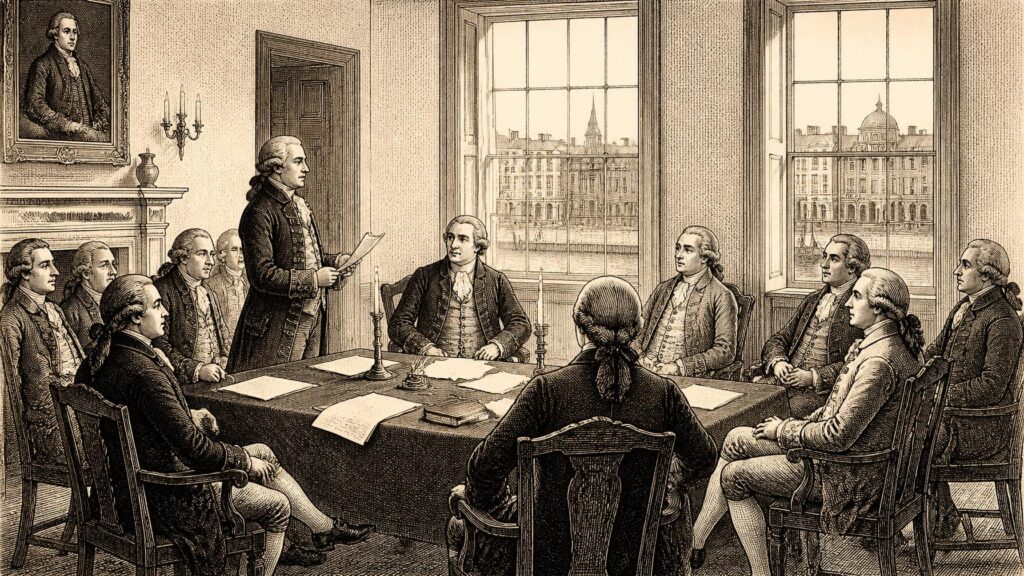
Dateline
In 1725, Ireland produced no single battle, rebellion or statute that neatly defines the year. Its importance lies instead in several well-attested developments that expose the workings of the early Georgian kingdom: a political retreat over an unpopular coinage scheme, a hardening division within Ulster Presbyterianism, and the first surviving record of a Grand Lodge meeting in Dublin. These were events of very different scale, but together they reveal an Ireland governed through a narrow Protestant political establishment, linked tightly to Britain, yet full of institutions and arguments that were distinctly local in character.
Care is needed with the calendar. Ireland still used the old legal dating convention in which the year began on 25 March, while modern historians commonly render dates in the modern calendar. The securely dated events discussed here are therefore best understood through the dates supplied by the contemporary or archival records, rather than as evidence for a uniform modern timetable. Much else in this account is wider context: the social and economic conditions in which the events of 1725 occurred, not claims that every feature began in that year.
Wood’s Halfpence Suspended
The principal political issue carried into 1725 was the furious controversy over William Wood’s patent to supply Ireland with copper halfpence. Granted in 1722, the patent had prompted Jonathan Swift’s Drapier’s Letters, which presented the coinage as a threat to Ireland’s prosperity and constitutional standing. The dispute was never only about small change. It gave merchants, landowners, clergy and Dublin crowds a common language of suspicion towards decision-making in London, particularly after the British Declaratory Act of 1720 had asserted Westminster’s right to legislate for Ireland and hear Irish appeals.
John, Lord Carteret, lord lieutenant since 1724, inherited this volatile affair. He was expected to uphold royal authority but encountered unusually broad resistance. The controversy strained the usual methods by which Dublin Castle managed the Irish parliament through office-holders, patrons and leading MPs. Carteret prorogued parliament from 24 March to 6 August 1725, an admission that a stable governmental majority could not simply be assumed. In April, Alan Brodrick, Viscount Midleton, resigned the lord chancellorship, removing one of the great rivals for influence in Irish public life.
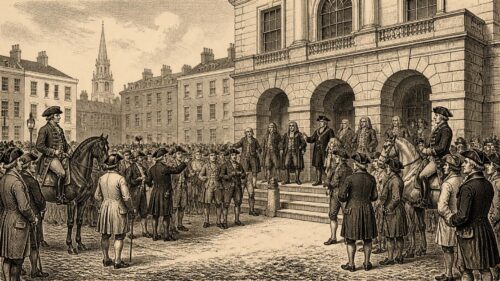
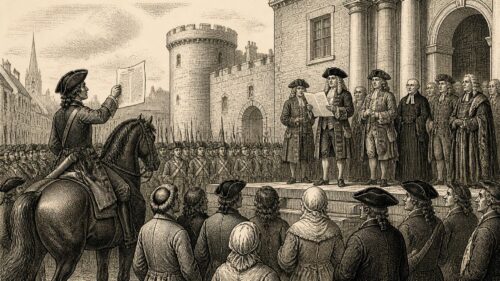
The decisive development came on 21 September, when Carteret announced the suspension of Wood’s patent. That announcement answered a crisis rather than resolving the constitutional grievance behind it. Ireland remained subordinate to British parliamentary power, and its own parliament was not a representative national assembly in the modern sense. Yet the climbdown mattered. It demonstrated that public resistance, sharpened by Swift’s print campaign and political manoeuvring in Dublin, could make an imperial policy practically unworkable. The celebrated victory was consequently both material and symbolic: a dispute over copper had enlarged ideas of Irish interest and public opinion.
Finance, Patronage and Parliament
In the same year Carteret’s investigation of the Dublin administration uncovered a treasury deficit reported at £80,000. In June he had the deputy vice-treasurer, John Pratt, arrested. This was a concrete sign that the lord lieutenant intended to scrutinise the revenue system, though it also fuelled rumours and factional anxieties among those whose wealth and influence depended upon government office. Public finance was inseparable from politics. Revenue supplied the civil and military establishment, while offices offered patronage to the landowning elite who dominated parliament.
William Conolly, speaker of the Irish House of Commons and a commissioner of revenue, stood at the centre of that elite. A former lawyer whose fortune rested on land, office and political connections, he had become the foremost parliamentary ‘undertaker’: a man expected to bring votes and interests into alignment with the Castle. The halfpence crisis had made his position awkward because opposition to the patent was near universal among politically active Protestants. Carteret initially tried to govern without relying on Conolly’s machinery, but the poor opening of the 1725 parliamentary session forced a more practical accommodation. By the year’s later stages, the speaker and the king’s ‘hearty friends’ were again essential to managing the Commons.
This was not democracy, nor was it mere personal intrigue. It was the operating system of the Irish Protestant state. The Church of Ireland was established; parliamentary power and major public offices were confined to those within the political nation; and the great estates shaped electoral influence. Catholics, who formed the large majority of the population, lived under the accumulated restrictions of the penal code. Presbyterians, especially numerous in much of Ulster, were also outside the established church and subject to disabilities. These were continuing conditions in 1725, not new measures enacted that year.
Antrim’s New Presbytery
Religion supplied the year’s other major institutional turning point. At the Synod of Ulster in June 1725, ministers who resisted compulsory subscription to the Westminster Confession of Faith were placed together in the newly arranged Presbytery of Antrim. The step did not yet make them entirely separate from the synod; formal exclusion followed in 1726. Nevertheless, the creation of the Antrim body marked a clear line in the long dispute.
The disagreement was not a simple contest between belief and unbelief. The so-called New Light or non-subscribing ministers insisted that scripture and individual conscience should outweigh obligatory assent to a humanly composed confession. Their opponents believed that subscription protected congregations from doctrinal error and defended the inherited Calvinist character of Presbyterianism. John Abernethy, formerly minister at Antrim and an important intellectual influence, had argued that church decisions could bind conscience only where people were convinced by them. James Kirkpatrick and Samuel Haliday were among the Belfast ministers associated with the non-subscribing cause.
The issue mattered beyond clerical meetings. Presbyterian congregations were sustained by householders, elders, collections, meeting houses and networks crossing Ulster, Scotland and Dublin. Arguments over the Trinity, predestination, scriptural authority and church discipline entered local loyalties and family religious life. The reorganisation of 1725 thus shows that Ireland’s Protestant population was far from uniform. In Ulster, where Presbyterians were numerous, an internal quarrel about theological authority created an enduring institutional inheritance eventually associated with the Non-Subscribing Presbyterian tradition.
Dublin’s Recorded Grand Lodge
On 24 June 1725, Dublin supplied another landmark in associational life: the first recorded communication of the Grand Lodge of Ireland. The wording matters. It is the earliest surviving record of a Grand Lodge meeting, not firm proof that Irish freemasonry or every lodge began on that day. Lodges and Masonic practices existed before a central body was documented. But the record establishes that, by midsummer 1725, Dublin freemasons had an organised Grand Lodge capable of conducting a public installation and giving structure to a wider fraternity.
Freemasonry belonged to the expanding culture of voluntary association: formal gatherings, ceremonial offices, shared rules, dining and sociability among men who could meet outside parish vestries and official government. Its later influence should not be projected backwards without caution. The 1725 record does not tell us that it transformed Irish politics overnight, nor that it represented all classes or denominations. It does, however, offer unusually precise evidence of Dublin’s capacity to generate durable institutions and networks alongside the official structures of Castle, church and parliament.
Life Beyond the Recorded Events
For most people, the year was shaped more by tenancy, work, worship and local exchange than by parliamentary manoeuvres. Ireland remained overwhelmingly rural. Cattle, dairying and provisions for export were central to many regions, while flax cultivation, spinning and linen production were becoming increasingly important, particularly in Ulster. Towns and ports connected these activities to markets in Britain, continental Europe and the Atlantic world. English restrictions on the export of Irish woollens to foreign markets still formed part of the economic background, encouraging adaptation but also limiting opportunity.
None of this permits a claim that 1725 brought a sudden general boom or a nationwide subsistence disaster. The serious sequence of poor harvests and near-famine conditions identified by historians belongs chiefly to 1726–28, not to 1725. The absence of a securely year-specific environmental crisis is itself worth preserving. A responsible account should not turn every difficult early eighteenth-century year into famine. What can be said is that rural households were vulnerable to harvest variation, rents, tithes, changing market prices and the unequal distribution of land.
Religious difference also touched daily life. Catholic worship and education continued despite restrictive laws and uneven enforcement; Catholic priests, lay patrons and informal teachers sustained communities that the political order sought to subordinate. Anglican parish life, meanwhile, was woven into local administration and tithe collection. Presbyterian meeting houses in the north provided an alternative religious and communal centre. The Antrim dispute makes clear that even within dissent, religious practice was negotiated rather than static.
A Year of Institutional Boundaries
1725 therefore stands out less for a single national transformation than for the boundaries it exposed. Carteret’s suspension of Wood’s halfpence showed the limits of imposing policy in the face of organised Irish opposition. The Presbytery of Antrim showed that Protestant dissent contained rival understandings of conscience and authority. Dublin’s recorded Grand Lodge meeting showed new forms of association acquiring a lasting framework. Beneath these events lay a society in which political privilege, religious status and economic security were distributed profoundly unevenly. The year’s surviving records illuminate that structure with unusual clarity.

Primary Sources
- Carteret, John
- Conolly, William
- Abernethy, John
- Tercentenary 1725–2025
- About Grand Lodge
- His Excellency John Lord Carteret lord lieutenant general and general governor of Ireland, his speech to both Houses of Parliament, at Dublin: on Tuesday the eighth day of March, 1725. Published by authority
- Presbyterianism in the Eighteenth Century
- The First Subscription Controversy
- Constitutional differences
- Acts and Statutes made in a parliament, begun at Dublin … 12 Nov. 1715, etc. First Session. B.L.
- Statute Law Revision Act 2015
- The making of a penal law (2 Anne, c.6), 1703–4
- Penal Law
- The Exchange Business of the Irish Banks in the Eighteenth Century
- Irish History Online – 1725
- The construction of political theology in Ireland, 1710–1725
- Church authority and non-subscription controversies in early eighteenth-century Presbyterianism
- Background: Chronology of Key Events 1169 to 1799
- History of Parliament in Ireland
- 17th and 18th Century Hedge Schools
- Irish Political Writings after 1725
- William III