Dublin Common1664 CE
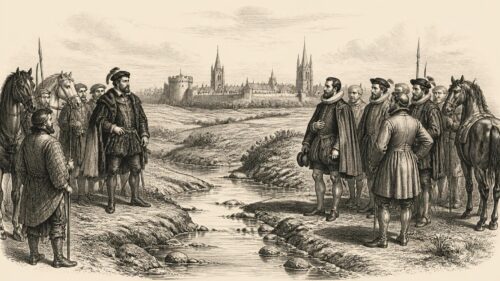
In 1664, Restoration Ireland was reshaped through administrative and cultural initiatives rather than decisive events. Dublin Corporation divided the marshy St Stephen’s Green common into ninety-six building plots, retaining a reduced central green to generate revenue. Land settlement negotiations continued without resolution, as Ormond and rival claimants sought to reconcile confiscated estates; legislation followed in 1665. Londonderry Corporation gained responsibility for its Foyle port, while Portmore Castle symbolised elite estate improvement in Antrim. Sir James Ware published Latin annals of Ireland, and Roger Boyle’s plays reached London. These developments strengthened corporate and proprietary control amid Protestant ascendancy and Catholic exclusion.
Dateline
Ireland in 1664 did not witness a decisive battle, a new Irish parliament, or a final settlement of the upheavals that had transformed the country since 1641. Its importance lies instead in smaller but consequential acts of administration, building and cultural production. In Dublin, municipal government began converting a wet common used for grazing into a planned residential quarter. In London and Dublin, the Crown and the duke of Ormond continued the laborious work of reconciling rival claims to land confiscated during the Cromwellian conquest. On the River Foyle, a charter placed the port under the responsibility of Londonderry Corporation. These developments were separate in place and scale, yet each showed Restoration government working through property, corporate privilege and controlled improvement.
Measured Ground in Dublin
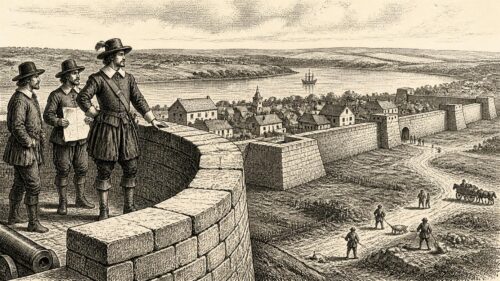
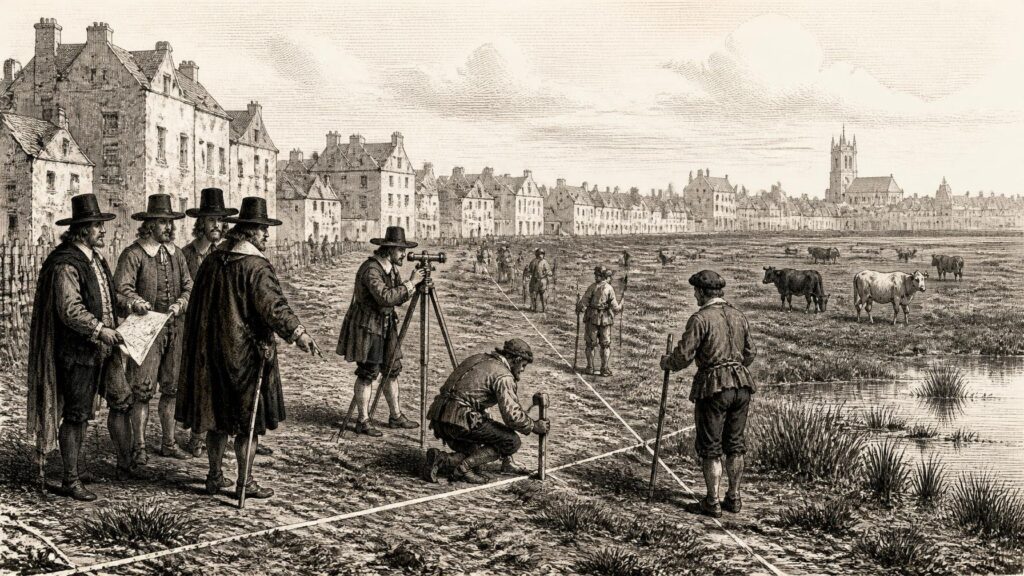
The most visible development associated with 1664 was at St Stephen’s Green, then on Dublin’s southern edge. This was not the leafy Victorian park familiar today, nor yet a completed square of fashionable townhouses. It had been a broad, low-lying common, marshy in places and used for pasture. Dublin Corporation had decided in 1663 to turn the land into a source of revenue. During 1664, the scheme moved into its practical, marketable phase: the ground was divided into ninety-six plots around a much reduced central green.
The numbers reveal the character of the decision. About sixty acres of commonage had previously served the city; roughly twenty-seven acres were retained as a central open space while the surrounding land was laid out for building. The Corporation was not creating a public park in the modern sense. It was making an urban investment: a regular setting in which leases, plots and future houses might yield income. Surveying, allotting and marking boundaries converted land whose value had been shared through customary use into an ordered commodity controlled by civic authority.
It is important not to force the later appearance of St Stephen’s Green back into 1664. The housing did not rise all at once, and the evidence for the enclosing wall belongs to the following years; archaeological and heritage studies place the perimeter enclosure in 1669. What can securely be attached to 1664 is the laying-out and disposal of building ground. The change was nonetheless significant. It brought Dublin into the wider seventeenth-century fashion for planned residential squares, while retaining an Irish particularity: a corporation under financial pressure using a former common to raise money.
For ordinary residents, this was a change in the geography of daily life before it was a change in architecture. Grazing, crossing open ground, collecting fodder and living beside a semi-rural margin of the city were all affected by the conversion of a common into building plots. For prospective tenants, craftsmen and suppliers, meanwhile, the scheme promised work and opportunity, though slowly rather than spectacularly. The Green’s eventual social prestige should not obscure its initial condition: it began as a speculative municipal project on difficult, damp ground.
Settlement Without Settlement
The larger political fact of 1664 was that the Restoration land settlement remained unfinished. Charles II had restored James Butler, duke of Ormond, to the lord lieutenancy in 1662, but neither royal favour nor the Act of Settlement of that year could reconcile every claimant. The Court of Claims had heard cases in 1663 under rules intended to distinguish the “innocent” from those held responsible for rebellion. Its work, however, made the underlying arithmetic more rather than less pressing. There was not enough land to restore dispossessed Catholic proprietors, reward loyal royalists and satisfy the Cromwellian soldiers, adventurers and purchasers already in possession.
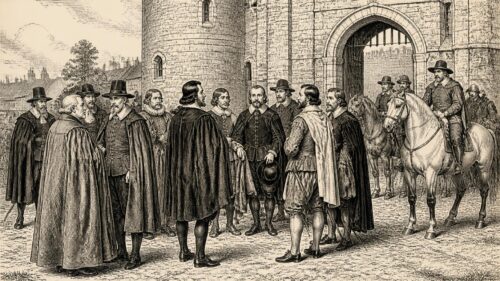
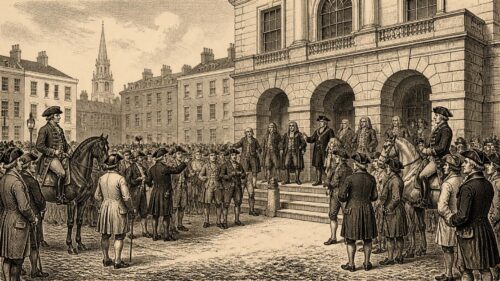
In 1664 the argument therefore shifted into intensive negotiation. Ormond was in England for much of the period, working on the proposed explanatory measure that would eventually become law in 1665. Catholic agents, including Nicholas Plunkett and Richard Talbot, pressed cases for former owners; Protestant settlers and purchasers defended titles made under the Commonwealth; officials sought a formula that would preserve the Crown’s authority without provoking a fresh crisis. The opposing interests were not simple ethnic blocs. Religion, wartime allegiance, family influence, military service, purchase, debt and tenancy all shaped a person’s claim. Yet the broad outcome being prepared would confirm a profound transfer of landholding and political power towards a Protestant proprietorial order.
Surviving records convey the everyday density of the problem. A royal letter to Ormond dated 25 March 1664 concerned a grant of forfeited houses and lands in Dublin, Kildare, Meath, Roscommon and Galway to Sir James Shaen. Such a document was one transaction among many, but it demonstrates why a settlement could not be merely theoretical. Each grant could involve occupiers, old proprietors, creditors, leases, rents, improvements and local influence. The question was not only who possessed an estate on paper, but who would farm it, collect from it, live upon it and exercise local authority.
By August, Ormond had been directed to bring together the Irish privy council and the commissioners charged with carrying out the Act of Settlement to consider the developing proposals. That instruction belongs firmly to 1664; the resulting Act of Explanation does not. The distinction matters. This was a year of drafts, delegations, petitions and bargaining, not of final resolution. It also explains the guarded mood of Restoration politics in Ireland. Peace had returned after the wars, but property remained unsettled, and property was inseparable from security, status and religion.
Ports and Demesnes
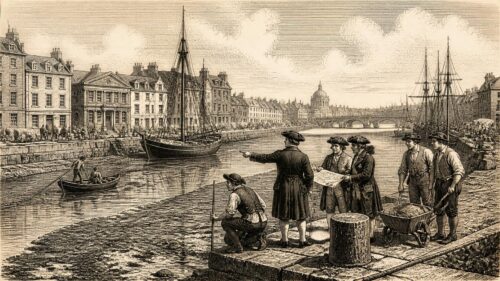
In the north-west, Charles II granted Londonderry Corporation responsibility for the port in 1664. The River Foyle had long connected the city to coastal and overseas traffic, but the charter gave the corporation a defined role in regulation and upkeep. This was an administrative development rather than a sudden creation of commerce. It mattered because quays, markets, ferries, tolls and shipping were not incidental features of an early modern town: they were sources of income, authority and strategic importance. Later municipal records show the corporation managing such assets, though the earliest surviving minute book begins only in 1673.
The charter also belonged to the continuing consolidation of plantation-era urban power in Ulster. Londonderry was a walled, corporate town whose civic structure had been reasserted after the Restoration. Giving its corporation responsibility for the port tied the town’s government still more closely to the movement of goods and people on the Foyle. It did not eliminate older Gaelic, Scottish and English connections across the river valley and Lough Foyle, but it strengthened a chartered urban institution through which those connections could be regulated.
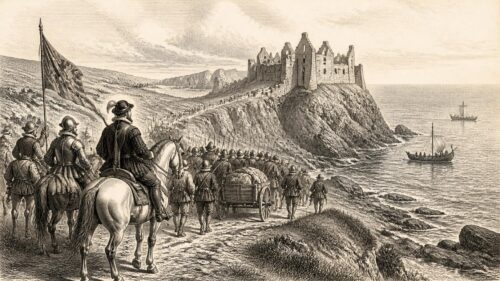
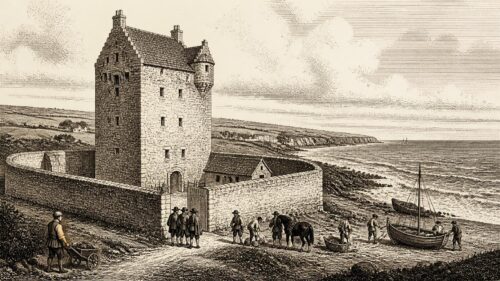
County Antrim offers a more private version of Restoration improvement. Portmore Castle, near Portmore Lough on the edge of Lough Neagh, is conventionally dated to 1664 and associated with Edward Conway, third Viscount Conway. The building rose on the site of an earlier Ó Néill stronghold. Its construction should not be mistaken for a military necessity in a newly pacified kingdom. It was a great-house project, expressing landed rank, security and the capacity to reshape a landscape. The neighbouring deer park was enclosed across the later 1660s, with deer introduced in 1665. Together, house and park signalled the transformation of land into a managed elite demesne.
These northern developments should be set beside, not confused with, the Dublin scheme. A municipal corporation subdivided common ground for urban revenue; a landed magnate built a residence and fashioned a sporting estate; a chartered city received responsibility for its port. All were forms of control over land and resources. They also depended upon labour: surveyors and masons, carpenters and carriers, boatmen, tenants, servants, park workers and those supplying timber, stone, food and animals. The surviving record privileges corporations and proprietors, but their projects rested on many less visible hands.
Books, Stages and Confessional Limits
1664 also produced an important work of Irish historical scholarship. Sir James Ware’s Rerum Hibernicarum Annales, a Latin history of Ireland from 1485 to 1558, appeared in Dublin. Ware was a Protestant civil servant, antiquary and collector of manuscripts whose career had been disrupted by the wars but revived after the Restoration. His annals assembled political and ecclesiastical material into a learned account of the Tudor past. Written in Latin and aimed at educated readers, the book was not popular history. It nevertheless represented a serious attempt to preserve and organise Irish evidence at a moment when the ownership of archives, lands and memories remained politically charged.
The year also connected Ireland to the Restoration stage through Roger Boyle, earl of Orrery. Boyle was a Munster magnate and a central political figure in Restoration Ireland. His heroic drama Henry the Fifth was first performed in London on 13 August 1664, and The Generall followed there in September. These were metropolitan performances, not evidence of a Dublin theatrical season. Their relevance lies in Boyle’s Irish political and social world: an Irish landholder and former governor of Munster was helping shape the new courtly drama of the Restoration. Cultural authority, like landed authority, moved between Ireland and England rather than remaining within one kingdom.
Religious life formed the background to all these developments. The Church of Ireland had been re-established after the Restoration, and officeholding, municipal power and the language of political loyalty were strongly Protestant. Roman Catholic worship and clerical organisation endured, but Catholics seeking public restitution encountered a state settlement that treated the memory of rebellion and the security of Protestant possession as fundamental concerns. No general religious settlement was enacted in Ireland in 1664. Rather, the year exposed how land, public office and confessional identity had become entangled after two decades of war and confiscation.
A Year of Foundations
Seen closely, 1664 was a year of foundations rather than conclusions. Dublin’s former common was measured into lots, but would take generations to acquire its famous architectural character. Ormond’s negotiations advanced a land settlement, but did not complete it until the following year’s legislation. Londonderry’s port received corporate supervision, while Portmore projected aristocratic control over an Antrim landscape. Ware’s book gave shape to an Irish past, even as contemporaries disputed the ownership of the present. The year’s significance lies precisely in that unfinished quality: Ireland was being reordered through surveys, charters, grants, buildings and books, one administrative act at a time.

Primary Sources
- The King to Ormond, Whitehall: 25 March 1664
- State Papers Ireland 1509–1782: government papers on Irish affairs
- Act of Settlement [1662] and Act of Explanation [1665]
- The Irish Court of Claims of 1663
- Butler, James
- BUTLER, James (1610–88)
- Talbot, Richard
- Plunkett, Nicholas
- St Stephen’s Green and Archaeological Heritage
- MetroLink Environmental Impact Assessment Report: Archaeology & Cultural Heritage
- Dublin South City: An Introduction to the Architectural Heritage
- History
- Londonderry Corporation Minute Books
- Merchant Trade Records: Port Books 1565–1799
- Register of Parks, Gardens and Demesnes of Special Historic Interest: Northern Ireland
- History of Deer Management in Ireland
- Lisburn’s Castle and Cathedral
- Rerum Hibernicarum Annales, 1485–1558
- Rerum Hibernicarum annales, 1664 edition
- Ware, Sir James
- Roger Boyle, First Earl of Orrery
- Roger Boyle, Baron Broghill and Earl of Orrery: Catalogue of English Literary Manuscripts
- London Stage Event: 28 September 1664
- The General, The
- Ormond Family Papers