Ludlow’s Command1659 CE
In 1659, the collapse of Richard Cromwell’s Protectorate transformed Irish government. Henry Cromwell resigned, and parliamentary commissioners assumed control in Dublin. Edmund Ludlow, a regicide and committed republican, reorganised the Irish army, tested officers’ loyalties and sent troops to England amid constitutional crisis. Meanwhile, completion of William Petty’s Down Survey provided maps and records enabling confiscated land to be redistributed among soldiers, adventurers and officials. The approximate 1659 census documented settlements and leading occupiers, though imperfectly. Political instability culminated in opponents seizing Dublin Castle in December. Despite changing regimes, the administrative framework for Protestant landholding and long-term social transformation endured.
Dateline
In 1659 Ireland stood at a political turning-point, although not one marked by a single great battle or parliamentary settlement on Irish soil. The decisive shocks came from London, where the Protectorate created by Oliver Cromwell unravelled after his death. Their consequences were immediate in Dublin: Henry Cromwell, Oliver’s younger son and the effective governor of Ireland, relinquished office; a new republican administration replaced him; and Edmund Ludlow arrived to take command of the army. Meanwhile, the immense work of measuring, allocating and recording confiscated land reached a defining stage. Ireland was being made legible to its rulers in maps, lists and official categories, even as the regime ordering that work became increasingly unstable.
The Protectorate Collapses
Richard Cromwell had succeeded his father as lord protector in September 1658. He was formally lord protector of England, Scotland and Ireland, but the arrangement depended upon the cooperation of an army whose officers distrusted civilian parliaments and resented the uncertain constitutional direction of the new regime. In Ireland, Henry Cromwell had supplied much of the practical strength that Richard lacked. He had governed with relative competence and had won the confidence of many Protestant settlers and officials, while remaining committed to the Cromwellian settlement.
The crisis in England broke openly in the spring of 1659. Richard dissolved the Third Protectorate Parliament on 22 April under army pressure, and the old Rump Parliament returned in May. On 25 May he resigned the protectorship. That date mattered profoundly in Ireland, not because power changed hands at once in every town or garrison, but because the constitutional authority under which Henry Cromwell ruled had disappeared. Dublin Castle was again required to take its direction from a shifting parliamentary and military politics across the Irish Sea.
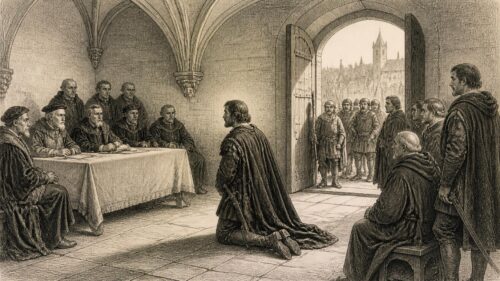
Henry did not attempt to preserve his brother’s position by force. The restored Rump Parliament resolved on 7 June that the government of Ireland should be placed in the hands of commissioners appointed by parliament and ordered Henry to return to England. On 15 June he submitted his resignation as lord lieutenant and commander-in-chief. His decision helped prevent an immediate armed struggle within Ireland’s substantial English army, but it did not answer the larger question: whether the Commonwealth could command lasting obedience after abandoning the Protectorate.
Commissioners at Dublin Castle
Authority was transferred to a group of parliamentary commissioners: John Jones, William Steele, Robert Goodwin, Miles Corbet and Matthew Thomlinson. They were men of the Commonwealth rather than representatives of an Irish electorate. Their task was formidable. They had to keep the army supplied and disciplined, administer justice and revenue, uphold the confiscatory land settlement of the 1650s, and maintain order in a country still marked by the destruction and displacement of the preceding wars.
The change was more than a replacement of names at the top of government. Henry Cromwell’s departure removed a governor who had been able to mediate between officers, civilian administrators and the Protestant landed interest. The commissioners instead embodied the revived claim that parliament, rather than a protector or a single military governor, should direct the three kingdoms. Ireland was therefore drawn directly into the constitutional argument that was convulsing the Commonwealth.
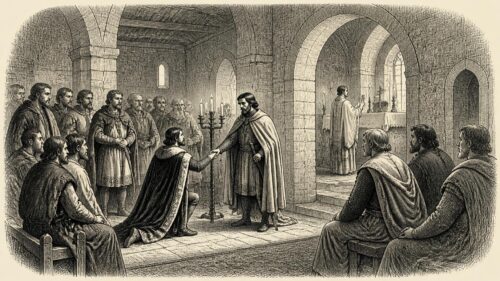
On 9 and 12 July parliament issued warrants appointing Edmund Ludlow commander-in-chief of the forces in Ireland and lieutenant-general of horse, instructing him to proceed there without delay. Ludlow was an experienced parliamentarian soldier, a regicide, and an uncompromising republican who had previously served in Ireland during the conquest. His appointment signalled a deliberate effort to make the Irish army answerable to the revived parliamentary regime rather than to Cromwellian personal authority.
Ludlow and the Army
Ludlow reached Ireland towards the end of July. His immediate work was military and political at once: to reorganise the army, scrutinise its officers and favour men judged reliable supporters of the Commonwealth. This was not a quiet administrative adjustment. Commissions determined control of garrisons, access to arrears and land grants, and influence over local government. An officer dismissed from command lost more than rank; he could lose the place from which he had exercised power within the new settler order.
Parliament’s wider needs also made Ireland’s army a resource to be managed from Westminster. On 30 July Ludlow was ordered to send 1,000 foot soldiers and 500 horse to England. The order illustrates both the strategic importance of the Irish establishment and the weakness of the central government: England’s political crisis demanded troops, while Ireland required enough armed force to protect a settlement founded on recent conquest. No major nationwide rising defined 1659 in Ireland, but the state depended visibly upon garrisons and officers whose loyalties could not be assumed.
Ludlow’s programme sharpened divisions rather than removing them. Men associated with the Cromwellian Protectorate could see the republican reorganisation as a threat, while radical parliamentarians regarded an independent military interest as the danger most likely to destroy civil government. The same tension had overthrown Richard Cromwell. It now reached barracks and fortified places throughout Ireland.
The Country on Paper
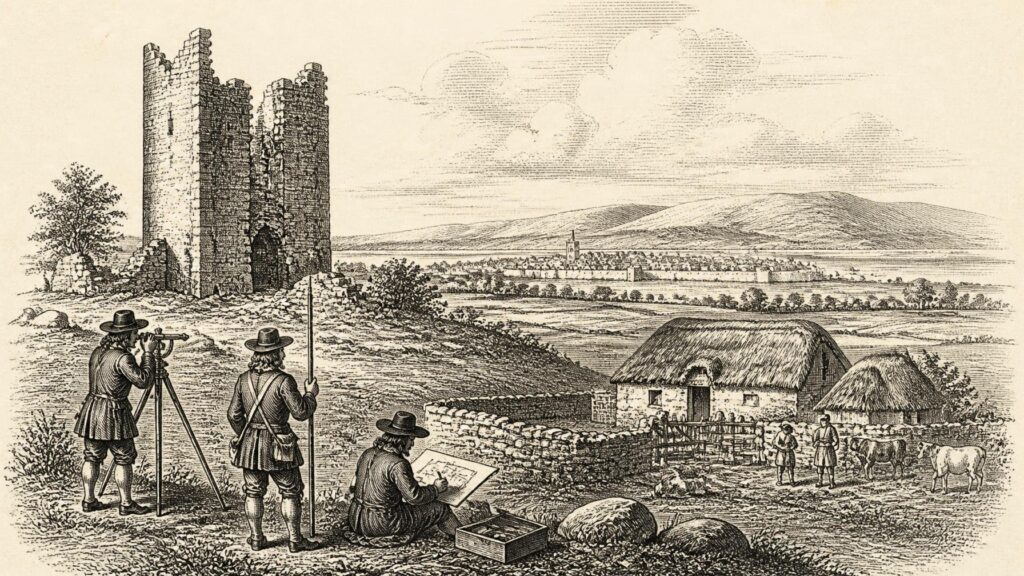
At the same moment, another form of power was being consolidated: the mapping and calculation of land. The Down Survey, undertaken principally between 1656 and 1658 under William Petty’s direction, was the first detailed national land survey of its kind. Its purpose was not antiquarian. It identified land forfeited after the wars so that it could be distributed to soldiers owed pay, Merchant Adventurers who had financed conquest, and other creditors of the Commonwealth.
The survey was completed in 1659 and its materials were kept in Dublin under the care of the surveyor-general, Vincent Gookin. Its county, barony and parish maps reduced an immense and varied landscape to measured territories capable of allocation. They recorded townlands, boundaries, acreage, profitable land and former ownership. In practice, a map could become an instrument by which a family’s inherited estate was transformed into a soldier’s arrears, an investor’s security or a new Protestant proprietor’s title.
This did not mean that every claim had been settled or every boundary became uncontentious. The Cromwellian land transfer was crowded with competing demands, dubious assignments of debt and arguments over value. Yet the completion of the survey gave the settlement an administrative solidity that political instability could not easily erase. The official landscape of 1659 was a landscape prepared for redistribution.
Counting Settlement, Not Simply People
The record conventionally called the Census of Ireland, circa 1659 belongs to this same world of official enumeration. It is an exceptionally important source, but its title can mislead. The surviving manuscript is dated only approximately, its precise purpose remains uncertain, and it was not a modern census of every named individual. It lists parishes, townlands and places; totals of people; leading occupiers described as “tituladoes”; and figures categorised as Irish and English or Scots.
Its limitations are substantial. Returns are missing for Cavan, Galway, Mayo, Tyrone and Wicklow, as well as for several baronies elsewhere. The categories were created by officials and cannot be treated as simple measures of ancestry, language, religion or political loyalty. Nor do the named “tituladoes” offer a social cross-section: they identify people with standing or title, not the countless labourers, servants, tenants, widows and children whose lives were only summarised numerically.
Even so, the compilation offers a close view of post-war Ireland. It shows Irish names enduring across the country, alongside English and Scottish settlers concentrated unevenly in particular places. It reveals that the new order was not a blank replacement of one population by another. Instead, communities lived through an unequal and changing coexistence: old inhabitants remained numerous, while control of land, offices, fortified towns and the established Protestant interest increasingly rested with newcomers and their allies.
Land, Religion and Daily Security
For ordinary households, high politics was inseparable from material security. A transfer of landownership could alter rents, tenancies, access to pasture, obligations of labour and the identity of the local authority. The recent wars had damaged buildings, disrupted markets and reduced population. The Cromwellian state’s response was not chiefly a programme of social repair; it was a programme of security, revenue and Protestant plantation. Catholic landholding had been severely curtailed, while the land settlement favoured the soldiers, adventurers and officials on whom the regime relied.
Religion was embedded in that distribution of power. The established Protestant interest was strengthened through possession of estates and offices, while Catholic communities continued under a government suspicious of their political allegiance and determined to prevent a return of the pre-war landed order. Yet the surviving 1659 materials chiefly expose administration rather than private belief. They can show who was recorded, where people lived and which properties were claimed; they cannot fully recover the worship, family strategies and local negotiations through which people endured the new regime.
An Unfinished Republican Year
By October the instability in England again changed Ireland’s outlook. Ludlow returned there after completing much of his reorganisation, intending to help mediate between parliament and the army. On 13 October the army expelled the Rump Parliament once more. Dublin’s commissioners nevertheless issued instructions to Ludlow on 17 October to represent Irish affairs to the committee in London, a small but telling sign of officials trying to preserve a chain of command while the centre was breaking apart.
During December, opponents of Ludlow and the parliamentary commissioners moved against them in Dublin, seizing Dublin Castle and creating a council of officers. The action did not yet restore Charles II; that lay in the future. But it demonstrated how swiftly authority in Ireland could be remade by control of a fortified administrative centre and the troops around it.
Thus 1659 was a year of transition without resolution. The Protectorate ended; Henry Cromwell departed; Ludlow briefly imposed a republican military order; and the Down Survey and the so-called census supplied a durable paper framework for a transformed country. Governments would fall again before the Restoration of 1660, but the mapped estates, recorded townlands and redistributed lands of 1659 would shape Irish society for generations.

Primary Sources
- Cromwell, Henry
- Ludlow, Edmund
- Down Survey of Ireland: About
- PETTY PAPERS. VOL. XXVII. ‘Census’ of Ireland
- A Census of Ireland circa 1659
- Census of Ireland c.1659
- 1659 Census of Clare
- Transcript of the Census of Ireland for the County and City of Kilkenny, made, probably for Sir William Petty, 1659
- Warrant from Parliament appointing Edmund Ludlow to be commander in chief of the army in Ireland and ordering him to proceed there, July 12, 1659
- Stowe MS 185
- Add MS 4165
- Memoirs of Edmund Ludlow, Lieutenant-General of the Horse in the Army of the Commonwealth of England, 1625–1672
- Catalogue of the Stowe Manuscripts in the British Museum
- The Government in Dublin, Cromwellian Ireland: English Government and Reform in Ireland 1649–1660
- A Month in Politics: The Fall of Protector Richard Cromwell, 1659
- The Protectorate Timeline
- 1659 Timeline
- Edmund Ludlow
- From Cromwell to the Boyne
- The Irish Court of Claims of 1663
- A Census of Ireland, Circa 1659: With Essential Materials from the Poll Money Ordinances 1660–1661
- The 1659 Census
- Materials for History
- Ireland under the Commonwealth: Being a Selection of Documents Relating to the Government of Ireland from 1651 to 1659