

Docwra’s Foyle Bridgehead1600 CE
In 1600, the Nine Years’ War shifted strategically without decisive resolution. Lord Mountjoy and Sir George Carew restored English military organisation and recovered much of Munster through garrisons, raiding and coercion, while Ormond’s capture exposed continuing instability. Hugh O’Neill’s southern expedition demonstrated confederate reach but cost him Hugh Maguire and intensified internal disputes. Sir Henry Docwra’s landing at Lough Foyle created a vulnerable but enduring northern bridgehead, strengthened by Niall Garbh O’Donnell’s defection. At Moyry Pass, O’Neill blocked Mountjoy’s advance into Ulster. By year’s end, pressure on the confederacy had grown, making Spanish intervention at Kinsale increasingly urgent in 1601.
Dateline
In 1600, Ireland stood at a turning point in the Nine Years’ War. Hugh O’Neill, earl of Tyrone, and Hugh Roe O’Donnell had brought the English administration close to collapse after the crown’s disasters of 1598 and 1599. Yet the year did not produce a decisive battle or settlement. Instead, it changed the geography of the conflict. The crown placed more capable commanders in office, recovered much of Munster, established an exposed but consequential foothold on Lough Foyle, and tested O’Neill’s elaborate northern defences. The Irish confederacy remained formidable at year’s end, but its leaders now had to defend several threatened regions at once.
A New Deputy and a Southern Offensive
Elizabeth I replaced the discredited earl of Essex with Charles Blount, Lord Mountjoy, who arrived in Ireland late in February as lord deputy. His arrival was accompanied by that of Sir George Carew, appointed president of Munster. Both inherited a costly war, an army afflicted by poor supply, sickness and weak discipline, and a government whose authority beyond defended towns and garrisons was sharply limited. Mountjoy’s eventual reputation can make his appointment seem like an instant solution; in 1600, however, success was still uncertain. His initial task was to restore the army’s effectiveness while preventing the war from spreading further.
O’Neill had tried to seize the initiative before the new administration could settle. Early in the year he led a major expedition south through the midlands and into Munster, seeking to consolidate alliances, compel doubtful lords to choose sides and prepare the ground for the Spanish intervention on which the confederate leadership increasingly relied. He reached the Cork region in February, received submissions from important local figures and oversaw Florence MacCarthy’s inauguration as MacCarthy Mór. The campaign displayed O’Neill’s reach, but it also exposed the strain involved in sustaining a large travelling army far from Ulster.
The loss of Hugh Maguire, lord of Fermanagh, during the Munster expedition was a severe blow. A leading commander since the opening of the war, Maguire had helped make the alliance militarily dangerous in Ulster and Connacht. Contemporary and later Irish accounts stressed the demoralising effect of his death, and O’Neill withdrew north sooner than he may have intended. A succession dispute in Fermanagh then added friction within the wider confederacy: O’Neill favoured Maguire’s son Conor, while O’Donnell backed Maguire’s brother Cú Chonnacht. These were not merely personal quarrels. They concerned the command of men, territory, clients and supplies at a moment when unity was vital.
Munster Recovered, at Great Cost
Carew reached Cork in April and began a determined campaign against the Munster rising associated with James fitz Thomas Fitzgerald, the so-called Sugan Earl of Desmond, and his allies. His position was initially precarious. Although he nominally commanded several thousand foot soldiers and cavalry, many were tied to garrison duty; the province contained rebel-held districts, wooded refuges and powerful lordships whose loyalty could not be assumed. The crown nevertheless possessed important advantages: the ports and walled towns, waterways useful for movement and supply, and a network of allies willing to bargain for protection or advantage.
Carew’s method was not simply to seek pitched battles. Garrisons were planted or strengthened around key districts in north Kerry and the wooded country of Connello in Limerick. Crown troops seized livestock, disrupted food stores and threatened crops, while commanders encouraged local submissions. Such operations made ordinary rural life hazardous. Cattle, grain and labour were the basis of household survival as well as military provision; their removal or destruction could force communities into submission without a formal siege. By the end of summer, the main organised forces of the Sugan Earl had been checked, and by December the insurgents held no castle in Munster. That assessment should not be mistaken for peace: it described a military position maintained through garrisons, raids and coercion.
Political authority in the province was also contested. In April, Thomas Butler, tenth earl of Ormond, Carew and the earl of Thomond attended a parley near Kilkenny with Owny O’More. The meeting became a trap: Ormond was seized, while Carew and Thomond escaped. Ormond’s captivity threatened the balance of power in Kilkenny and showed how unsafe negotiation could be amid a war conducted through rival lordships and local alliances. Carew stationed troops in the area before proceeding south. Later in the year he held court sessions at Limerick, Clonmel and Cashel, a deliberate display that royal law and administration were being reasserted.
The recovery of Munster had a wider diplomatic importance. Spain was expected to send aid to Ireland, and Munster’s harbours made it the likeliest landing ground. Carew’s campaign therefore aimed not only to defeat local opponents but to deny a future Spanish force a secure provincial base. O’Neill’s commitment to the Catholic Spanish connection remained clear: in April he sent his son Henry as a hostage to Spain. Religion provided a language of common cause against a Protestant crown, but the alliance was also practical, dependent on ships, arms, money, provisions and the choice of a usable harbour.
The Foyle Landing
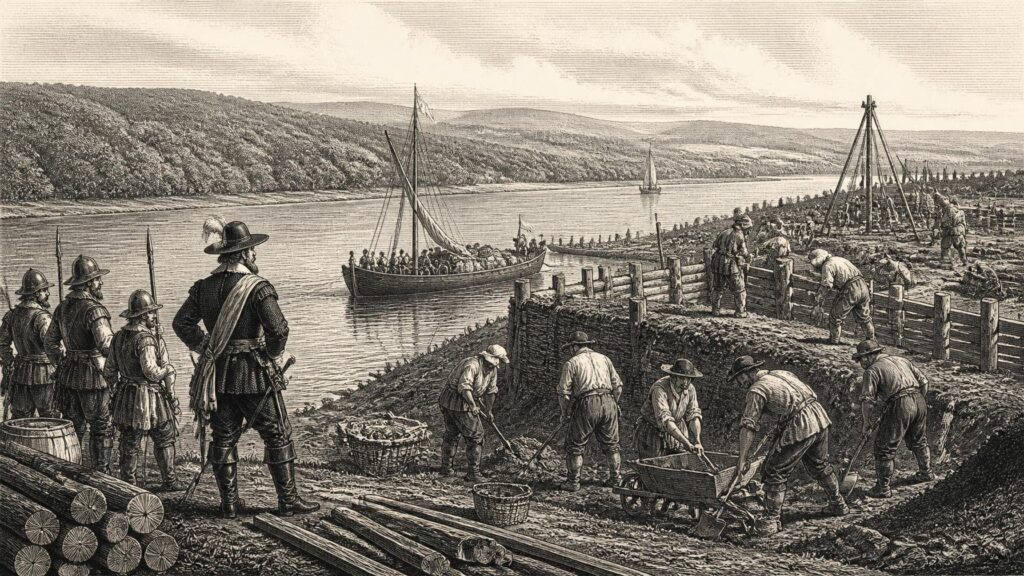
The most consequential operation of 1600 occurred in the north-west. In May Sir Henry Docwra landed an expedition on Lough Foyle and occupied positions at Culmore and Derry. His force was large enough to be threatening but not sufficient to conquer Ulster outright. It had to build and hold works, find food, keep open communications by sea and recruit Irish allies while surrounded by hostile territory. Derry was not yet the later walled plantation city. It was an old ecclesiastical site and strategic river position whose occupation gave the crown a bridgehead at the edge of Tyrconnell and within striking distance of Tír Eoghain.
Docwra’s presence changed the war’s strategic map. The crown could now threaten the confederacy from the Foyle while Arthur Chichester’s forces operated from Carrickfergus in the east and Mountjoy pressed from the south. Yet the immediate campaign was difficult. Irish forces contained the garrison, attacked its movements and prevented an easy advance. The English-held posts depended heavily on shipments and on labouring soldiers who dug earthworks, repaired defences and carried provisions as well as fighting.
Internal rivalry in Tyrconnell became crucial. Niall Garbh O’Donnell, a kinsman and rival of Hugh Roe O’Donnell, had reasons of inheritance and political ambition to resent the existing leadership. During 1600 he entered the crown’s orbit. His eventual open alignment with Docwra, and the fall of Lifford late in the year, gave the English a local partner with intimate knowledge of terrain and kinship politics. It was a serious setback for Hugh Roe, though it did not end resistance. The episode also demonstrates that the war cannot be reduced to two uniform national sides: Gaelic lordships, Old English magnates, townspeople and crown officers made choices shaped by faith, survival, land and family power.
The Gate into Ulster
Mountjoy’s principal land offensive came in the autumn at the Moyry Pass, the narrow and difficult route between Dundalk and Newry. O’Neill had prepared the ground with trenches, earthworks and defended obstacles in woodland, boggy ground and narrow approaches. From late September into early October, Mountjoy’s army attempted to force its way through. The encounter is often called the Battle of Moyry Pass, but it was better understood as a prolonged campaign of probing attacks, engineering, skirmishing and attrition rather than a single neat clash.
The crown’s troops eventually got beyond parts of the defences and established a short-lived position at Mountnorris, but they could not sustain a secure advance deep into Ulster. Casualty figures in official reports are uncertain, and should not be treated as exact. What is firm is that illness, difficult terrain and determined defence imposed heavy costs, while O’Neill showed that the approaches to his heartland remained dangerous. Mountjoy retired towards Dundalk. The campaign was therefore neither a simple English victory nor an Irish rout. It revealed the limits of both sides: O’Neill could obstruct an invasion, but could not remove the growing pressure from Foyle and Carrickfergus; Mountjoy could field a major army, but could not yet break into Tyrone at will.
War, Work and Uncertainty
For most inhabitants, 1600 was experienced less through high policy than through movement, requisition and insecurity. Army columns required grain, cattle, carts, horses, timber, labour and shelter. Garrisons altered local markets, sometimes creating demand for supplies but more often absorbing them by force or through compulsory payment. Town corporations in Munster complained about the burden of quartering soldiers and financing fortifications. Carew’s campaign restored crown authority in important places, yet that authority rested on an expensive military presence and could be resented by communities that did not support rebellion.
Religion remained central but did not dictate every allegiance. O’Neill and O’Donnell presented their resistance in Catholic terms and sought Spanish assistance, while the crown’s commanders served a Protestant monarch. Still, Munster’s Catholic towns did not automatically join the insurgency, and Carew recognised the political danger of treating all Catholics as rebels. The year’s conflict was simultaneously a struggle over royal sovereignty, local lordship, land, military survival and religious legitimacy.
By December, the crown had regained a large measure of control in Munster and had planted an enduring military problem on the Foyle. O’Neill’s defences at Moyry had prevented the decisive penetration of Ulster, but the confederacy had lost Maguire, faced dissension in Fermanagh and Tyrconnell, and could no longer concentrate its attention in one theatre. Nothing in 1600 made the eventual outcome inevitable. It did, however, create the conditions in which the next year’s Spanish landing at Kinsale would become both possible and urgent: a gamble intended to reverse a war whose balance was beginning to shift.
Primary Sources
- Annals of the Four Masters: English Translation
- Annals of the Four Masters: Irish Text
- Beatha Aodha Ruaidh Uí Dhomhnaill
- Docwra’s Derry: A Narration of Events in North-west Ulster 1600–1604
- Sir Henry Docwra, 1564–1631
- Docwra (Dowkra, Dockwra, Dockwraye, Dockquerye, Docura), Sir Henry
- O’Neill, Hugh
- Maguire, Hugh
- O’Donnell, Sir Niall Garvach
- Carew, Sir George
- Wilmot, Sir Charles
- FitzGibbon, Edmond fitzJohn
- FitzMaurice, Thomas
- Fitzgerald, James
- Newce, William
- A Kingdom Near Lost: English Military Recovery in Ireland, 1600–03
- Political Discourse and the Nine Years’ War in Late Elizabethan Ireland, c.1593–1603
- Mountjoy in Ireland, 1600
- The Nine Years War, 1593–1603: O’Neill, Mountjoy and the Military Revolution
- Calendar of the Carew Manuscripts: 1589–1600
- Pacata Hibernia: Or, A History of the Wars in Ireland During the Reign of Queen Elizabeth
- State Papers Ireland 1509–1782: Government Papers on Irish Affairs
- The Taking of the Earl of Ormond April 10 1600
- Irish History Online: The Defence of the Moyry Pass, 1600