MacMahon’s Execution1590 CE
In 1590, Hugh Roe MacMahon’s execution after a manipulated Monaghan trial signalled the Tudor government’s determination to replace Gaelic lordship with courts, garrisons and Crown-controlled landholding. Sir Richard Bingham’s campaigns in Connacht and Breifne secured hostages, devastated O’Rourke territory and established a strategic fort, though resistance revived. In Tyrconnell, Donnell O’Donnell’s death at Doire Leathan strengthened Hugh Roe’s eventual claim while he remained imprisoned. Sorley Boy MacDonnell died, prompting renewed territorial conflict, and Hugh O’Neill eliminated a dynastic rival. Despite warfare, learned culture and commercial development persisted. Ireland remained politically fragmented, as Crown expansion encountered resilient local powers across Ireland.
Dateline
In 1590 the most consequential Irish event was not a large pitched battle but an execution at Monaghan. Hugh Roe MacMahon, head of a Gaelic lordship in Airgíalla, was tried and put to death under the authority of Sir William Fitzwilliam, Elizabeth I’s lord deputy. The exact day is not securely established, but the execution belongs firmly to the autumn. It made a powerful statement about how the Tudor administration intended to rule in Ulster: not simply through alliances with local dynasties, but through sheriffs, courts, garrisons and a new understanding of landholding. Elsewhere, campaigns in Connacht and Breifne, a dynastic battle in Tyrconnell, and a change of leadership on the Antrim coast showed that authority in Ireland remained intensely local, mobile and contested.
A Lordship Brought Before the Law
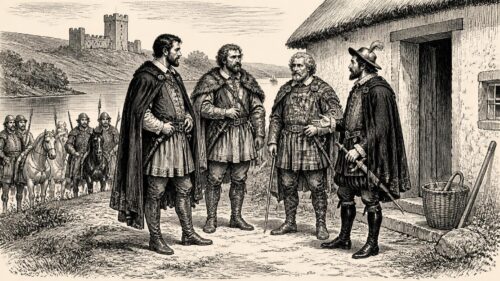
The MacMahons ruled much of what is now County Monaghan. Their lordship lay in a strategically exposed position between the Pale, the English-administered districts around Dundalk and Newry, and the great northern power of Hugh O’Neill, earl of Tyrone. It was also a society in which Gaelic customary law, kinship, clientship and military service still shaped political life. A lord’s position depended on the support of related branches of his kindred, on rights over land and cattle, and on his ability to levy the food-rents and military exactions needed to sustain followers.
Hugh Roe MacMahon had emerged from a disputed succession in 1589, initially with Fitzwilliam’s support. The relationship then collapsed. Government accounts represented MacMahon as having unlawfully imposed traditional Gaelic exactions on people whom the Crown regarded as the queen’s subjects. Yet those practices had long been part of lordship in the region, and previous administrations had often tolerated them. The issue was therefore larger than an isolated breach of order: it was whether a Gaelic ruler could retain powers that royal officials increasingly treated as incompatible with shire government.
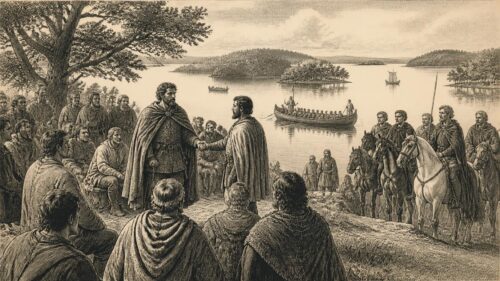
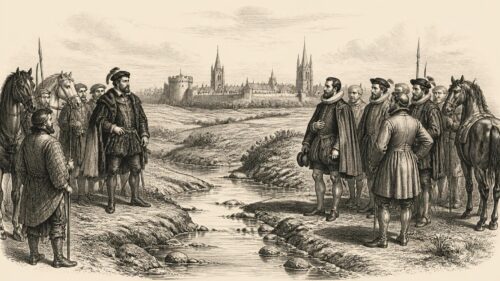
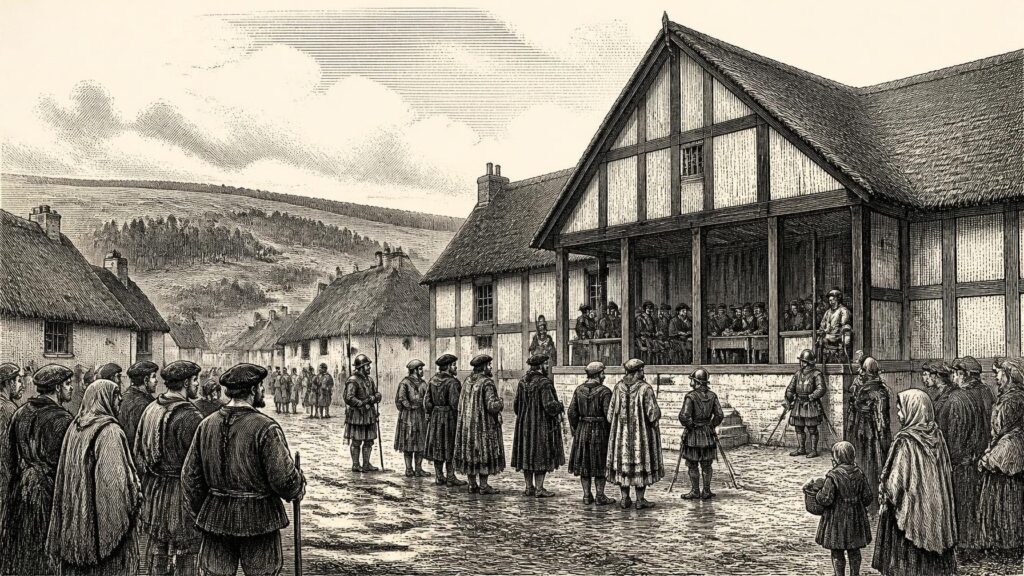
In the autumn, MacMahon was brought before judicial sessions at Monaghan and executed. Later assessments of the proceedings have been exceptionally severe, describing them as manipulated or rigged; the evidence also indicates that Fitzwilliam had personal and political reasons to silence a man connected to allegations of official corruption. It is safest to say that the trial occurred under the outward form of law but was inseparable from the deputy’s drive to remake local power. MacMahon’s death ended his own lordship, while the Crown took control of the territory’s future disposition.
The full land settlement followed in 1591 and should not be misplaced into 1590. Nevertheless, the direction was already unmistakable in the year of the execution. The later arrangement divided the MacMahon country among lesser landholders and Crown favourites, placed church lands in new hands, established a garrison in Monaghan town and extended common-law administration. For Gaelic lords throughout Ulster, the warning was plain. A chief who lost royal favour could face not merely punishment, but the dismantling of the political community from which his authority sprang.
Connacht Under Arms
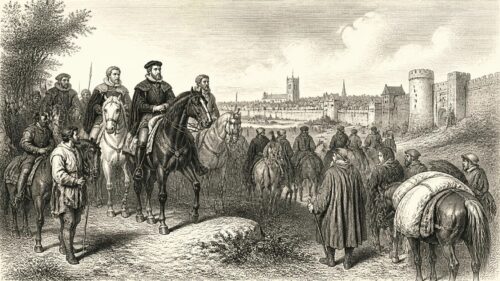
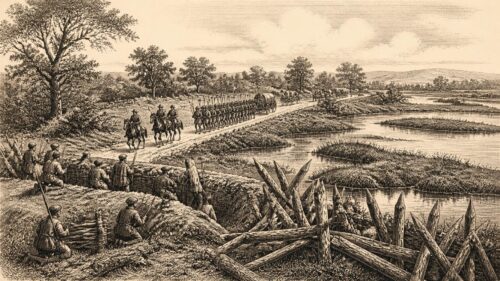
While Monaghan exposed a constitutional struggle in Ulster, western Ireland experienced the more immediate hardships of campaigning. In January, Sir Richard Bingham, president of Connacht, and Donough O’Brien, earl of Thomond, led forces against the Lower Burkes and their allies. The Annals of the Four Masters place their camp at Cong, beside the route between Lough Mask and Lough Corrib. Opposing forces faced one another for about a fortnight, while talks took place without producing an agreement. The government troops then moved through difficult passes towards Tirawley and Erris, areas in north Mayo where control depended upon roads, provisions and the willingness of local communities to cooperate.
The annals record a subsequent reconciliation: hostages were handed to Bingham and the Connacht forces dispersed. Hostages were not a ceremonial detail. They were a practical guarantee of obedience, usually drawn from prominent families, and their removal could bind a district to an agreement as surely as a written bond. For ordinary households, however, the passing of an army could mean requisitioned food, disrupted grazing, labour demanded for transport and the insecurity caused by armed companies moving through narrow routes and settlements.
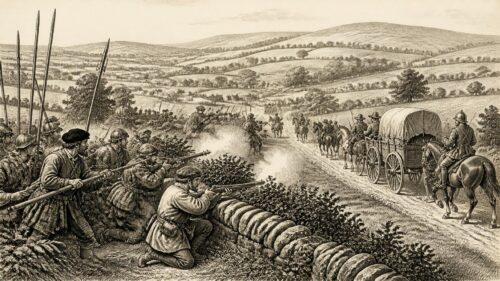
In March Bingham turned against Brian Ballach O’Rourke of West Breifne. The annalistic account is emphatic about the scale of the operation: parties moved through the country burning, destroying and killing, before converging again. O’Rourke was driven from his territory and sought refuge with Owen Óg MacSweeney in the Tuatha, in north-west Donegal. Many inhabitants submitted to the governor rather than go into exile. Yet conquest was neither clean nor complete. By Michaelmas, branches of the O’Rourke kindred and their local allies had returned, and raiding against English interests continued to the end of the year.
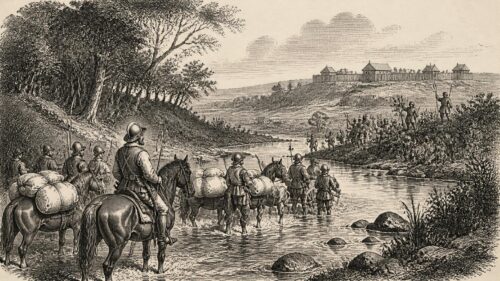
A substantial fort was built between Lough Key and Lough Arrow, in the strategic country linking Roscommon, Sligo and Breifne. Such a work was an instrument of permanent pressure rather than a temporary camp. It offered soldiers shelter, secured communications and made it easier to collect rents, protect collaborators and launch patrols. It also altered the landscape of power: a route once governed through the influence of local lordships was now watched from a fortified Crown position.
Tyrconnell’s Succession Battle
On 14 September, a firmly dated battle at Doire Leathan, near Teelin harbour in south-west Donegal, settled an urgent phase of the O’Donnell succession crisis. Sir Hugh O’Donnell was old and infirm. His younger son, Hugh Roe, the likely heir of his second marriage, remained a prisoner in Dublin Castle after his seizure in 1587. In his absence, an elder half-brother, Donnell O’Donnell, had gained control in parts of Tyrconnell, including Boylagh and Tirhugh.
Hugh Roe’s mother, Iníon Dubh MacDonnell, mobilised a coalition against Donnell. The forces named in the annals included O’Doherty, the MacSweeneys of Fanad and of the Tuatha, and a sizeable Scottish contingent. Donnell had supporters of his own, among them MacSweeney Banagh, men of the Munster MacSweeneys and O’Boyle. The encounter at Doire Leathan was thus not a simple clash between Irish and outsiders, but a struggle among interconnected Gaelic families whose politics crossed the North Channel.
The annals say Scottish archers wounded Donnell, after which he was killed; they record around two hundred further deaths, a figure that should be treated as a chronicle’s estimate rather than a modern casualty count. The result mattered greatly. It removed the strongest immediate rival to Hugh Roe’s eventual succession and preserved the influence of Iníon Dubh’s Scottish-MacDonnell connection. Hugh Roe himself was still captive in Dublin throughout 1590; his first attempted escape belongs to January 1591, not this year. His imprisonment nevertheless shaped every calculation in Tyrconnell during 1590.
Deaths and Shifting Regional Power
Early in the year, probably in late January or early February, Sorley Boy MacDonnell died at Dunanynie in County Antrim. For decades he had helped establish the MacDonnells in the Route and the Glens, linking north-east Ulster to the western Scottish islands through kinship, mercenary service and seaborne movement. His son James succeeded to leadership in the Route and part of the Glens. Almost at once, the displaced MacQuillans pressed their claims, making clear that succession could reopen old territorial disputes even where a dynasty appeared secure.
Another internal Ulster episode involved Hugh Geimhleach, a member of the MacShane branch of the O’Neill family. He was hanged on Hugh O’Neill’s orders in 1590. The act underlines the hard edge of O’Neill’s authority before the Nine Years’ War began openly in 1594. O’Neill was still formally an earl within Elizabeth’s political order, but he was also strengthening his position among competing branches of his own dynasty. Government pressure in Monaghan and military intervention in Breifne gave such calculations an ever wider significance.
Learning, Labour and the Texture of the Year
The record for 1590 is overwhelmingly political and military, but it offers flashes of wider social life. The annals mourned Thomas Fitzmaurice, MacMaurice of Kerry, as a notable purchaser of wine, horses and literary works. This is a valuable reminder that Gaelic and lordly households participated in trade and maintained learned culture even amid conflict. Imported wine and horses signalled status; books and manuscripts depended upon scribes, teachers, poets and ecclesiastical networks. Warfare did not extinguish these connections, although captivity, raids and shifting lordships put them at risk.
In south-east Ireland, development on Sir Henry Wallop’s Wexford estate was beginning around this period. English woodcutters were employed to fell timber, and a sawmill at Enniscorthy converted logs into planks moved down the Slaney to Wexford for export. The evidence dates this enterprise broadly to 1590–92, rather than securely to a particular month of 1590. It nonetheless reveals another Ireland alongside the marches and forts: one in which woodland, river transport, wage labour and overseas markets were becoming more closely organised for commercial gain.
By year’s end, no single authority controlled Ireland in a modern sense. Dublin Castle could execute a lord at Monaghan and Bingham could drive O’Rourke from Breifne, yet resistance resumed after armies withdrew. In Tyrconnell, a mother’s alliance of kindreds and Scottish soldiers had decided a succession while the intended heir sat in a government prison. The year’s decisive feature was therefore not inevitable conquest, but the escalating collision between Crown institutions and the resilient, adaptive politics of Irish lordships.

Primary Sources
- Annals of the Four Masters, Annal M1590
- CELT: Annals of the Four Masters
- Calendar of the State Papers Relating to Ireland, Vol. 4: August 1588–September 1592
- State Papers Ireland 1509–1782: Government Papers on Irish Affairs
- Fitzwilliam, Sir William
- O'Neill, Hugh
- O'Donnell, ‘Red’ Hugh (Ó Domhnaill, Aodh Ruadh)
- O'Rourke (Ó Ruairc), Brian Ballach
- Bingham (Byngham), Sir George
- MacDonnell, Sorley Boy
- MacDonnell, Sir James MacSorley
- O'Byrne, Fiach MacHugh
- Wallop, Sir Henry
- Shane (Seaán) O'Neill
- Select Documents XL: An Address to Aodh Ruadh Ó Domhnaill in Captivity, 1590
- The Mac Mahons of Monaghan (1500–1593)
- The Legal Murder of Aodh Rua McMahon, 1590
- National Library of Ireland Catalogue: Allotment and Division of Lands in County Monaghan on the Attainder of Hugh Roe Mac Mahon
- Calendar of the Patent and Close Rolls of Chancery in Ireland, Vol. 1
- Texts Beginning with the Letter C: Irish History and Literature Sources