Waterford’s Eleven-Day Defence1495 CE
In 1495, Sir Edward Poynings sought to strengthen Henry VII’s authority in Ireland through the Drogheda parliament, whose measures restricted Irish legislative initiative, while arresting the eighth earl of Kildare; his attainder was reversed later that year. Perkin Warbeck, backed by Desmond and Cork interests, failed after Waterford’s eleven-day land-and-sea defence, preserving a loyal harbour. Elsewhere, Aodh Ruadh Ó Domhnaill’s Scottish alliance and warfare around Sligo, conflicts in Breifne, and lordly rivalries demonstrated fragmented power. Church councils, monasteries, guesthouses, learned families and physicians reveal institutions supporting society. The year exposed Tudor ambitions but confirmed fragmented Irish power across the island.

Dateline
In 1495 Ireland stood at the meeting point of a Tudor succession crisis, local lordship and maritime warfare. The year is most clearly remembered for the attempted capture of Waterford by Perkin Warbeck, the Yorkist pretender who claimed to be Richard, duke of York, the younger son of Edward IV. Yet the same calendar year also brought the removal of the powerful eighth earl of Kildare, a decisive phase in the parliament convened at Drogheda by Sir Edward Poynings, a Scottish journey by Aodh Ruadh Ó Domhnaill of Tír Chonaill, and hard fighting from Breifne to Sligo. Ireland was not a single political arena. The king’s government held strongest in and around the Pale and a handful of towns, while Gaelic and Gaelicised lordships maintained their own alliances, rivalries and systems of rule.
Drogheda, Dublin and Kildare’s Arrest
Sir Edward Poynings had arrived as Henry VII’s deputy late in 1494, carrying soldiers, money and unusually forceful instructions. The immediate concern was Yorkist conspiracy. Ireland had supported Lambert Simnel’s unsuccessful invasion of England in 1487, and Warbeck had first found encouragement in Cork in 1491. To Henry VII, the lordship of Ireland seemed dangerously open to a fresh challenge. Poynings’s administration therefore combined military pressure with an attempt to reshape government.
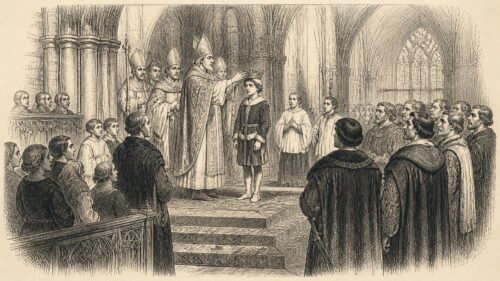
The parliament summoned at Drogheda in December 1494 continued into 1495. Its legislation is conventionally associated with the plural phrase ‘Poynings’ Law’, though two measures require distinction. One required the Irish deputy and council to send proposed legislation to the king and council in England before an Irish parliament could be summoned to enact it. Another confirmed the application in Ireland of English public statutes then regarded as relevant. These were major constitutional restraints upon the initiative of the Irish political community represented in parliament. They did not, however, create effective royal control across the island overnight. They were instruments designed for an English lordship whose reach remained uneven and contested.
The parliament’s programme was broader than constitutional procedure. It addressed office-holding, private war, military service, payments and provisions extracted by magnates, and the defence of the Pale. Such statutes reveal the practical anxieties of government: armed followings, lordly exactions, insecure borders and the difficulty of obtaining obedience from men whom the crown called subjects but could not reliably command. Measures reasserting aspects of the older Statutes of Kilkenny likewise show an official wish to distinguish the English lordship from neighbouring Irish polities, even though personal, familial and commercial connections continually crossed that supposed divide.
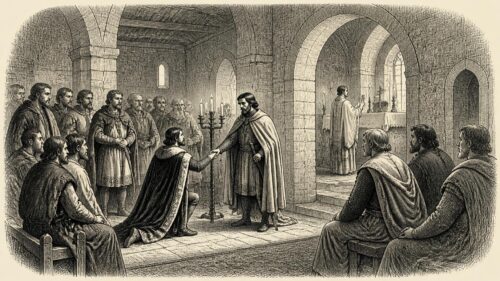
Its most dramatic victim was Gerald FitzGerald, eighth earl of Kildare, long the dominant magnate in the lordship and himself formerly deputy. The Annals of Ulster give a precise date: on Friday, 27 February, the ‘Saxon Justiciary’ arrested Kildare in Dublin. The following Thursday he was put aboard ship at Drogheda for England. The allegations later aired against him were formidable: plotting against Poynings, dealings with Irish lords and foreign enemies, and involvement in rebellion. His brother James’s seizure of Carlow Castle soon demonstrated both Geraldine capacity for resistance and the limits of government without Kildare’s co-operation. Kildare’s attainder was enacted during the Drogheda parliament, but his fall would prove temporary: Henry VII reversed it in October 1495. That reversal belongs firmly to the year, though Kildare’s eventual return to the deputyship came only in 1496.
Warbeck Before Waterford
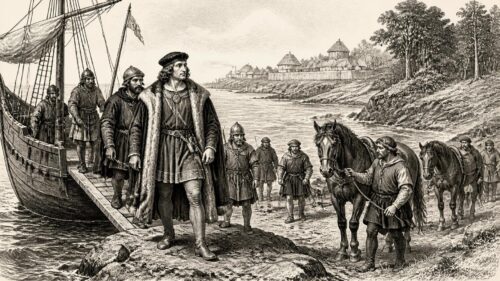
The summer brought the threat Poynings had been sent to contain. After a failed landing in Kent in July, Perkin Warbeck sailed again for Ireland. He possessed no secure kingdom or army of his own; his strength lay in the willingness of powerful people to treat his claim as useful. Maurice FitzGerald, tenth earl of Desmond, supported him, as did Lord Barry and Cork. Waterford, by contrast, had remained conspicuously loyal to Henry VII during the Simnel rising and became the key obstacle to Warbeck in the south-east.
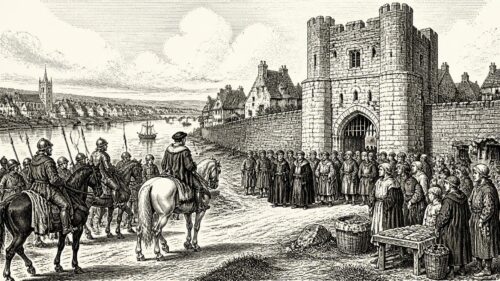
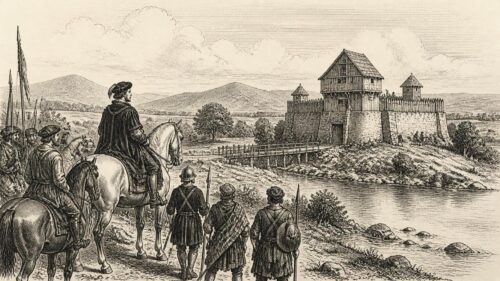
Warbeck and Desmond besieged Waterford by land and water. Later narratives give the attacking force as 2,400 men and the fleet as eleven vessels; those figures should be treated as traditional rather than as a surviving muster. The length of the siege—eleven days—is more consistently reported. Its character is nevertheless clear: this was an attack on a walled port where control of the River Suir, approaches through the suburbs and the city’s civic organisation mattered as much as field forces.
Waterford’s defence was conducted by its mayor, citizens and garrison, with Poynings moving to oppose the invaders. Accounts associate the defence with artillery mounted at Reginald’s Tower and with a tactical use of the waters around St John’s Pill. The defenders checked the southern attackers’ approach, made sorties and struck at the fleet. One of Warbeck’s vessels was reportedly sunk by the town’s guns. The episode is an important early illustration of how cannon, ships, river channels, walls and organised urban manpower could work together in late medieval Ireland. It also cautions against imagining towns merely as outposts of an English state: Waterford defended privileges, trade and civic survival as well as Tudor allegiance.
The siege failed. Warbeck withdrew through the south-west and then travelled to Scotland, where James IV received him with conspicuous honour. Waterford’s survival denied him a major harbour and a durable southern base. For Henry VII, it also confirmed the political value of a loyal port capable of acting independently of the great magnates who dominated much of the countryside.
Scotland, Sligo and the Northern Sea
Warbeck’s flight points to a wider Irish Sea world, one in which rulers, ships and information moved readily between Ireland, Scotland and England. The annals record that Aodh Ruadh Ó Domhnaill, lord of Tír Chonaill, went to the Scottish king’s court about a month before Lammas, or early August. The Annals of the Four Masters say that the two made a compact to assist one another. This was not a marginal diplomatic excursion. Tír Chonaill faced the western seaways, had long-standing links with Gaelic Scotland, and its ruler was an important force in Ulster and north Connacht. It would be unsafe to present the annalistic notice itself as proof that Ó Domhnaill joined Warbeck’s Waterford enterprise; it does, however, securely place high-level Irish-Scottish diplomacy in the same moment as the pretender’s Scottish turn.
Before and after the Scottish journey, Ó Domhnaill’s power was expressed in war around Sligo. His son Conn besieged the town or castle of Sligo around Lammas. A relief host from Lower Connacht advanced, but Aodh Ruadh returned from Scotland on the Friday after Lammas and moved against it the next day. The annals describe the defeat of the relief force and name leading casualties, including Brian Caech Ó Conchobair and Eogan Caech Ó Dubhda; they count seventy people killed, captured or drowned. Numbers in annalistic battle reports need not be read as modern casualty returns, but the named dead and captives show the seriousness of the encounter.
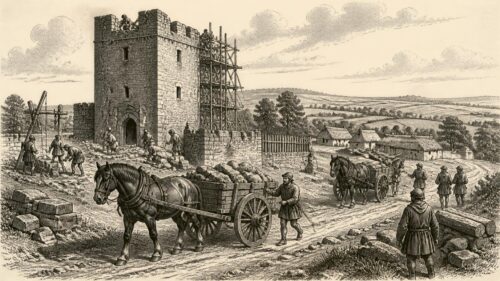
The struggle did not settle Sligo. Uilleag Burke, Mac William of Clanricarde, then entered Lower Connacht and devastated what Ó Domhnaill’s men had not already ruined. Warfare was inseparable from subsistence. Armies sought cattle, burned settlements, disrupted crops and destroyed fortified residences. At a castle of the sons of Aodh Mac Donnchadha, the annals report that fifteen people, men and women, died from smoke after the building was burned. Such notices expose the human cost behind accounts framed around lordly rivalry.
Breifne and Local Lordship
Elsewhere, power changed hands with similar speed. On 27 May, conflict within the Uí Raghallaigh of east Breifne killed Toirdelbach and Aodh Uí Raghallaigh, while their opponent Cú Chonnacht was himself killed by a javelin cast. Within a fortnight John Ua Raghallaigh captured Tullach Mongáin castle and opponents submitted their cattle to him. This compact sequence of violence, seizure and submission demonstrates how a castle and livestock could be political assets as well as material resources.
In north-west Breifne, Feidhlimidh Mag Samradhain drowned at the lake of the crannóg of Coill an Mhuilinn, and his brother Domnall succeeded as chief. The crannóg—an island or artificial island residence—was not an archaic curiosity but part of a living landscape of lordship and security. Succession was often decided amid danger, through election or recognition within a ruling lineage, rather than by an automatic rule of primogeniture.
Church, Learning and Everyday Institutions
The year’s annals also preserve quieter evidence of institutions serving communities. Cormac Mac Carthaigh, founder of the monastery at Cill Chreidhe in Muskerry, was killed by his brother early in the year. Later annalists praised him as a supporter of the church who had ordered observance of Sunday in his territory. Whether that description reflects an idealising memorial as much as an enforceable ordinance, it signals the close entanglement of lordship, religious patronage and moral order.
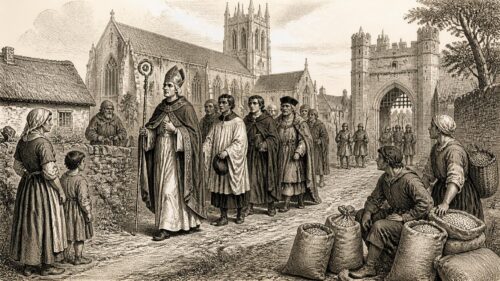
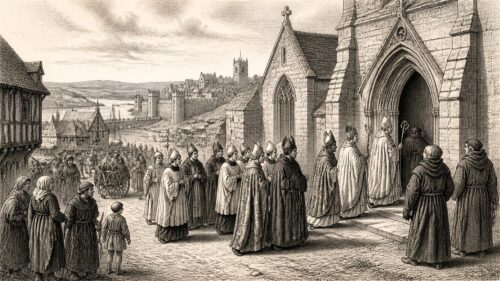
In Dublin, Archbishop Walter FitzSimons held a provincial council at the end of April. Bishops, cathedral chapters and other prelates were summoned; several absentees were declared contumacious, and the council resolved on a visitation of the province. This was a church still governed through ecclesiastical courts, councils, cathedral institutions and visitation, not simply through royal statutes. In Fermanagh, the annals noted the death of a parson and erenagh who kept a general guest-house, while the death of Dubthach Ó Duibhgeannáin of Kilronan was recorded in Connacht with the description ‘eminent historian’ and keeper of an open guest-house. Hospitality, learning and clerical or hereditary learned families remained essential features of social life.
The death of William ‘the Green’ Ó Caiside, praised as a successful physician attached to Philip Maguire and his sons, offers another glimpse of specialised expertise sustained by a lordly household. Such brief notices are not a survey of ordinary life, but they show that 1495 was not only a year of parliaments and sieges. It was also a year in which monasteries, guest-houses, physicians, historians, castles and towns structured the daily lives and obligations of people across Ireland.
A Year of Uneven Power
By the end of 1495, Poynings had demonstrated that Henry VII could send an army, arrest Ireland’s strongest Anglo-Irish earl and impose consequential legislation. Waterford had shown that a chartered town could repel a transmarine threat. Yet Ó Domhnaill’s Scottish alliance, the struggle for Sligo and the conflicts of Breifne show why neither achievement amounted to conquest. The island remained a mosaic of jurisdictions. What made 1495 exceptional was not that Tudor authority replaced that mosaic, but that constitutional reform, urban artillery and Irish Sea diplomacy exposed how urgently the crown wished to manage it.
Primary Sources
- The Annals of Ulster, Year U1495
- Annála Connacht, Annal 1495
- Annals of the Four Masters, Annal M1495
- CELT: The Annals of Ulster
- CELT: Annála Connacht
- CELT: Annals of the Four Masters
- FitzGerald, Gerald (Gearóid Mór), Dictionary of Irish Biography
- Poynings, Sir Edward, Dictionary of Irish Biography
- Warbeck, Perkin, Dictionary of Irish Biography
- Poynings’ Law, UK Parliament
- Poynings’ Law 1495, legislation.gov.uk
- Statute Law Revision Act 2007, Schedule 2, Irish Statute Book
- The Hegemony of the Earls of Kildare, 1494–1520
- Documents Relating to Perkin Warbeck, with Remarks on His History
- Henry VII’s Relations with Scotland and Ireland 1485–1498
- Ireland under the Tudors, Volume I
- Liber Primus Kilkenniensis: The Earliest of the Books of the Corporation of Kilkenny Now Extant
- Registrum Diocesis Dublinensis: A Sixteenth-Century Dublin Precedent Book
- Decies 57
- Decies 61
- A Short History of County Waterford
- Patentee Officers and High Sheriffs in Ireland, 1173–1826