Glasdromainn’s Rival O’Neills1493 CE
In 1493, Conn Ó Néill’s treacherous killing by his brother Henry Óg triggered a contested succession in Tír Eóghain. Backed respectively by Ó Domhnaill and by Uí Chatháin and Uí Mhealláin, Domhnall Clárach and Henry Óg fought at Glasdromainn, where Henry prevailed, though instability continued. Ó Domhnaill’s later Ulster hosting ravaged territories but won no settlement. Across Ireland, killings, raids, burnings and changes of lordship affected Leinster, Offaly, Breifne and Connacht. Gerald FitzGerald, earl of Kildare, visited Henry VII amid political scrutiny. Annals also recorded deaths of clerics, poets and aristocratic women, revealing cultural ties and piety during the year.

Dateline
The most consequential Irish events securely assigned to 1493 unfolded in Ulster, where the killing of Conn Ó Néill fractured the leading dynasty of Tír Eóghain. What followed was not a simple change of ruler but a contested succession involving brothers, collateral kindreds, hostages, professional soldiers and the intervention of Aodh Ruadh Ó Domhnaill of Tír Chonaill. A firmly dated battle at Glasdromainn on 28 June showed how quickly a family dispute could turn into a regional war. Elsewhere, raids, assassinations and changes of lordship ran from Kildare and Offaly to Breifne and Connacht, while Gerald FitzGerald, eighth earl of Kildare, prepared to cross the Irish Sea for the court of Henry VII.
A Killing in Tír Eóghain
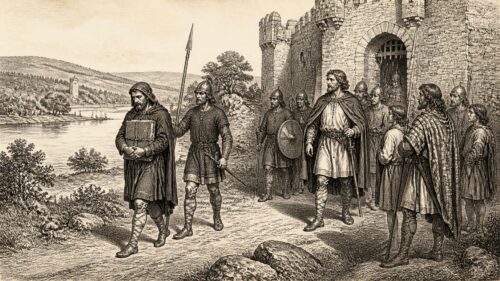
The Annals of Ulster date Conn Ó Néill’s death precisely to 8 January 1493. Conn, son of Henry and lord of Tír Eóghain, was killed treacherously by his younger brother Henry Óg. Colla Mac Domhnaill, a member of a family with deep connections to the Hebrides and to Irish military service, died in the same encounter. The annalists’ emphasis on treachery was not neutral description: it signals an act regarded as an especially grave breach within a ruling kin-group. Conn’s death also deprived Tír Eóghain of a lord whose authority had been repeatedly tested by neighbouring powers and by rival branches of his own extensive dynasty.
Modern readers should not imagine that the title Ó Néill passed automatically to the nearest son. Gaelic lordship relied upon descent, seniority, political support and military capacity; more than one eligible kinsman might make a plausible claim. In 1493 Henry Óg took the lordship after killing Conn, but his position was immediately contested by his elder brother Domhnall Clárach. The annals identify another important division: Domhnall was recognised by Aodh Ruadh Ó Domhnaill, while Henry Óg was made Ó Néill by the support of Uí Chatháin and Uí Mhealláin. These were not merely witnesses to a ceremony. Their backing represented armed followings, local influence and control over parts of the political landscape of north Ulster.
Hostages lay at the centre of this contest. The Annals of the Four Masters say that Ó Domhnaill entered Tír Eóghain at Domhnall’s request, had Domhnall proclaimed Ó Néill, and took hostages from the country, apart from those held by Uí Chatháin and Uí Mhealláin. Such hostages were normally high-status people whose custody guaranteed agreements and obedience. Their removal was therefore a practical assertion of authority as well as a public declaration that Ó Domhnaill could intervene in the affairs of his great eastern rival. Yet the exceptions mattered: the refusal or ability of Uí Chatháin and Uí Mhealláin to withhold hostages demonstrated the limits of Domhnall’s and Ó Domhnaill’s immediate reach.
The Battle of Glasdromainn
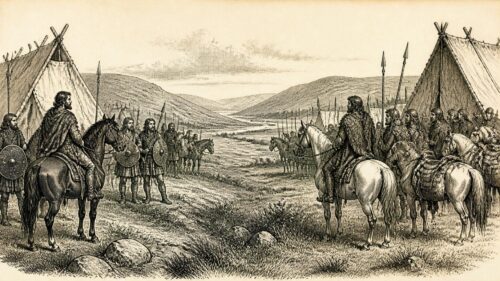
The contest reached a documented military climax at Glasdromainn on 28 June, the vigil of the feast of St Peter. Domhnall and Henry Óg met in battle, and Domhnall’s side was defeated. The detailed casualty list preserved by the Annals of Ulster gives the encounter unusual clarity. Ragnall Mac Domhnaill, described as constable of the Ó Néill galloglasses, fell with three sons; other members of Mac Domhnaill families, the Muintir Aodha and Ó Néill kindreds were killed, while several prominent men were captured. The Annals of the Four Masters likewise name prisoners, including Niall, son of John Buidhe Ó Néill, and a son of Domhnall.
The loss of the galloglass constable and his sons is particularly revealing. Galloglasses were heavily armed professional infantry, many descended from Hebridean and west Highland families who had become integral to warfare in Ireland. Their service bound military households to lords through pay, maintenance and political allegiance. Their presence on the field, and the annalists’ care in naming them, show that the struggle for Tír Eóghain was fought with forces extending beyond a single family’s immediate tenants. It was a contest in which the Irish Sea world still mattered: Mac Domhnaill soldiers and connections linked Ulster politics to Scotland’s western seaboard.
Glasdromainn did not settle the succession. Henry Óg’s victory gave him the immediate advantage, but the competing claims and alliances endured. Nor was violence confined to the principal rivals. The annals record the killing of Domhnall, a descendant of Niall Óg Ó Néill, by men associated with Art, son of Conn; Niall, son of John Buidhe Ó Néill, died in captivity. Later in the year a night attack killed Henry, son of Brian Ó Néill, his wife and several attackers. These notices should not be read as proof that every part of Ulster was in continuous warfare. They do show, however, that lordship was being contested through targeted killings, custody of prisoners, raids and the mobilisation of kin.
Ó Domhnaill’s Harvest Hosting
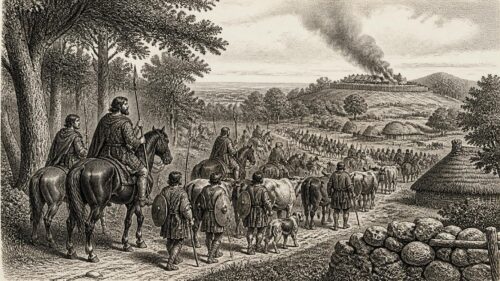
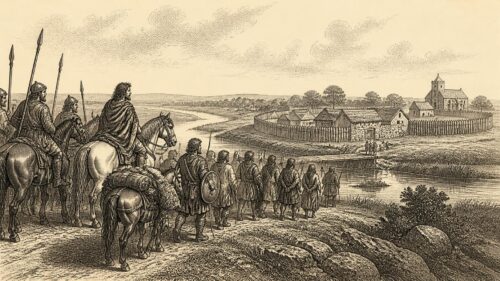
In the harvest season, Aodh Ruadh Ó Domhnaill mounted a major expedition eastward. The Annals of Ulster state that leading men of Lower Connacht joined him, including Domhnall Ó Conchobair and members of the Ó Ruairc leadership of Breifne. The route brought the host through Trian Conghail, Clann Aodha Buidhe, Lecale, Iveagh, Orior and Uí Eachach: a wide sweep through what is now much of eastern Ulster. This was a display of coalition politics as much as a raid. A lord able to assemble allies from Tír Chonaill, Connacht and Breifne could impose serious costs on adversaries far from his own base.
Henry Óg gathered a counter-host with Aodh Óg Mac Mathghamhna and Aodh Mag Aonghusa. The opposing armies confronted one another around Beanna Boirche, the Mourne region. Both major annalistic accounts agree that Ó Domhnaill brought his force safely through the dangerous pass and that his opponents were repulsed. The fuller Ulster account is notably restrained about the result: it says thirteen men were killed by Ó Domhnaill’s force and that darkness prevented a more crushing defeat; crucially, Ó Domhnaill returned home without securing peace, truce or submission. That qualification is important. A victorious raid could enhance prestige, gather plunder and punish resistance, but it did not necessarily create durable control.
For communities along the route, the consequences were more immediate than the high politics of succession. The annals say that hostile territories were ravaged and plundered. Such language encompassed the seizure of cattle, food and movable goods, the destruction of crops or settlements, and the disruption of seasonal work. The harvest reference is therefore more than a chronological marker. An army moving at this time threatened stores, animals and labour at a moment when households depended upon successful collection and protection of the year’s produce. We cannot reconstruct the experience of any named ordinary household in 1493, but the recorded pattern makes clear that warfare reached well beyond battlefields.
Leinster Under Pressure
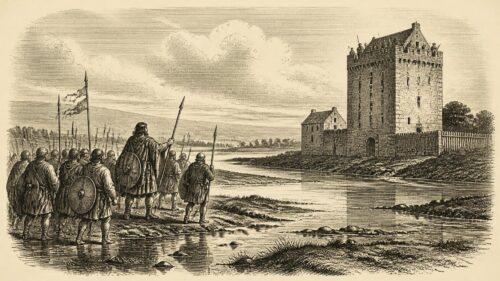
Conflict also marked the lands nearest the English lordship. Conall Ó Mórdha was killed at the castle of Baile na mBachlach, in Críoch Bhuíbhleach, by men of the earl of Kildare; Niall, son of Domhnall, then became Ó Mórdha. The notice captures the mixture of castle-based power, local succession and magnate intervention characteristic of late medieval Leinster. It should not be mistaken for a straightforward clash of ‘English’ against ‘Irish’: Kildare’s forces served a powerful Anglo-Irish earl whose authority depended on alliances, feuds and negotiations with Gaelic as well as Old English neighbours.
The rivalry could cut both ways. In the same year the annals report that the county of Kildare and Kildare town were burned by the son of the earl of Ormond. The entry does not safely allow a precise date, route or scale of destruction, but it records a serious blow within the political heartland of Kildare’s power. In Offaly, Cahir Ó Conchobair Fhailí was defeated by James Mac Eochagáin; prisoners and eighty horses were taken. Two rival Ó Conchobair figures were subsequently hanged by Cahir. Horses were both valuable property and essential military resources, so their capture represented economic loss, prestige and a reduction in an opponent’s capacity to move and fight.
Kildare and the King
After 1 November, Gerald FitzGerald sailed to the court of Henry VII with what the Annals of Ulster calls great retinue and splendour. This is firmly placed in 1493, although the surviving notice gives no day of departure or account of every purpose of the journey. The context is clearer. Kildare had long dominated the Dublin administration while retaining extensive personal connections across Ireland. Henry VII, still alert to Yorkist challenges after the earlier Lambert Simnel episode and to the wider danger posed by Perkin Warbeck, had strong reasons to require the loyalty of so powerful an Irish magnate. In autumn 1493 Kildare and others also entered bonds to uphold council ordinances aimed at law and order.
The journey was therefore both ceremonial and political. A magnificent retinue advertised Kildare’s rank, resources and usefulness; appearing before the king also acknowledged that his authority existed within the English crown’s lordship of Ireland. Neither side was fully secure. Kildare needed royal favour to sustain his position, while the king required a figure capable of governing, negotiating and fighting in Ireland. The tension was not resolved in 1493. Within the next two years Edward Poynings would arrive with an English army and administration, and Kildare himself would be arrested. Those later developments should not be projected backwards as inevitable, but the journey of late 1493 shows the relationship already under close scrutiny.
Learning, Piety and Loss
The year’s obituary notices provide brief but valuable glimpses of cultural and religious life. Eogan Ó Luchairén, described as an exemplary cleric, died. Tadhg Mac Con Midhe, an eminent poet and teacher, was killed at the port of Rosgabraidh on Inis Ceithleann by a man of his own people; the killer was then hanged by John Mag Uidhir. The episode records both the vulnerability of a learned professional and a lord’s determination to punish his killer. Poets, teachers, lawyers and clerics preserved and transmitted learning across lordships, and their standing is reflected in the annalists’ decision to name and characterise them.
Women also appear, though usually through family relationships and obituary praise. Finnghuala, daughter of Calbhach Ó Conchobair Fhailí and widow of both an Ó Domhnaill and an Ó Néill, died on 25 July according to the Annals of the Four Masters; another annal places her death in the early harvest. The compilers commend her charity, piety and long widowhood. Catherine Mac Mathghamhna, wife of Toirdhealbhach Ó Raighilligh, also died. Such entries do not reveal the whole lives of these women, but they show marriage as a means of connecting ruling families across territorial boundaries, and they preserve ideals of religious and social reputation valued by the chroniclers.
There is no reliable annalistic evidence for a nationwide famine, epidemic, weather emergency or major commercial transformation in this calendar year, and none should be invented. What 1493 does show is a political geography made mobile by armed hostings, kinship alliances and sea crossings. In Tír Eóghain, the murder of Conn Ó Néill unleashed a succession crisis whose battles and retaliations destabilised Ulster. In Leinster, burning and local killings exposed the fragility even of Kildare’s heartland. And as Kildare sailed to Henry VII, the relationship between Ireland’s strongest magnate and the Tudor monarchy entered a more searching phase.
Primary Sources
- The Annals of Ulster: Year U1493
- Annals of the Four Masters: Annal M1493
- Annals of Loch Cé: Annal LC1493
- Annals of Loch Cé: Original Irish Text, Annal LC1493
- Annála Connacht
- FitzGerald, Gerald (Gearóid Mór)
- O'Neill (Ó Néill), Conn
- O'Neill (Ó Néill), Conn ‘Bacach’
- Poynings, Sir Edward
- English Lordship of Ireland and the Irish Sea World: Re-assessing the Origins of the Kildare Ascendancy, c.1390–c.1513
- The English Lordship of Ireland and the Irish Sea World: Re-assessing the Origins of the Kildare Ascendancy, c.1390–c.1513
- The Galloglass Project
- Gaelic Ireland: Land, Lordship and Settlement, c.1250-c.1650
- The Resurgence of Gaelic Power in Ireland and Scotland and Its Wider Impact, c.1350–1513
- Law, Poetry and Medicine: The Literate Professionals in Autonomous Gaelic Ireland, c.1250–c.1630
- Exploring the Irish Annals
- CELT: The Online Resource for Irish History, Literature and Politics
- List of Published Texts at CELT
- The Later Middle Ages
- Moymlough