Edgecombe’s Dublin Oath1488 CE
In 1488 Sir Richard Edgecombe secured renewed allegiance to Henry VII after Ireland’s leaders had supported Lambert Simnel. At Kinsale, Waterford, Dublin, Drogheda and Trim, towns and magnates received pardons and swore fealty. Gerald FitzGerald, earl of Kildare, negotiated rather than submitted unconditionally, taking a solemn oath at St Thomas’s while retaining his regional power; royal control was reinforced through Dublin Castle. Beyond the Pale, warfare, succession disputes, hostage-taking and alliances shaped Gaelic and Anglo-Irish lordships. Religious reform flourished at Donegal, while deaths from smallpox, losses among learned figures and destructive weather exposed insecurity. The settlement restored cooperation, not rule.
Dateline
In 1488, Ireland felt the aftershock of a failed attempt to alter the English succession. The previous year, leading figures of the English lordship in Ireland had backed Lambert Simnel, the Yorkist pretender crowned in Dublin as Edward VI. His cause was destroyed at the battle of Stoke on 16 June 1487, where many Irish soldiers fought and Gerald FitzGerald, eighth earl of Kildare’s brother Thomas was killed. Yet the settlement of 1488 was not simply a punishment imposed from England. It was a negotiated restoration of allegiance, conducted in churches, guild halls, monasteries and lordly residences, while conflict, lordship and religious life continued across the island on their own regional terms.
A Royal Commissioner Arrives
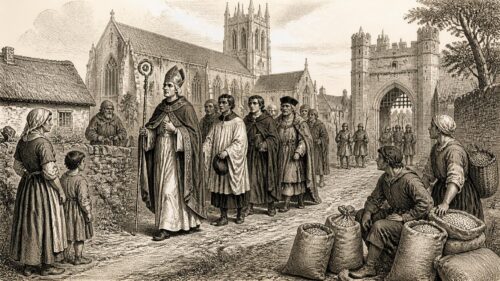
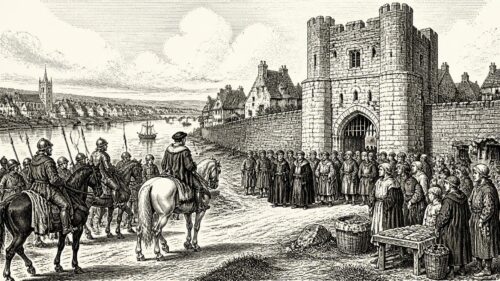
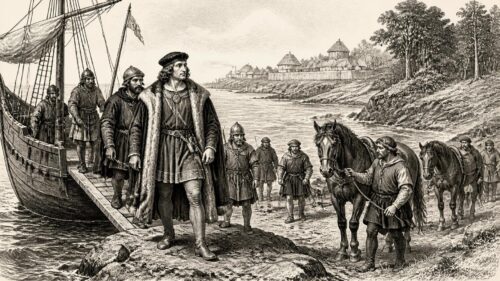
Henry VII sent Sir Richard Edgecombe to Ireland with royal pardons and authority to receive new oaths of loyalty. His surviving travel account gives an unusually close view of the political geography of the lordship. Edgecombe reached Kinsale in late June. There Lord Barry, Lord Courcy, the town’s portreeve and its leading inhabitants submitted to the king. The keys of Kinsale were ceremonially delivered to the commissioner and returned in the king’s name, an action which made royal sovereignty visible while leaving local government in place.
From Kinsale, Edgecombe proceeded by sea to Waterford. The citizens received him honourably, showed him their walls and repairs, and then made an urgent political case in the guild hall. Waterford’s leaders described Kildare as their enemy and feared that a royal pardon would restore his ability to harm their city. They asked to hold directly of the king and to be exempt from the jurisdiction of Kildare or any other Irish lord who might govern the land. Their request reveals an important limit to easy descriptions of a united ‘English Ireland’. A walled port could be intensely loyal to the Tudor king precisely because royal intervention offered protection against a powerful neighbouring magnate.
Adverse winds made the voyage to Dublin hazardous. Edgecombe’s ship reached Lambay, off the Dublin coast, before he landed at Malahide and was brought into Dublin by the bishop of Meath and civic representatives. He lodged with the Black Friars while awaiting Kildare. The delay was itself political. Kildare was reported to be on pilgrimage, and the commissioner waited for several days before the earl appeared with a substantial mounted following at St Thomas’s Court outside the city walls. The encounter was courteous in form but guarded in substance: Edgecombe delivered Henry’s letters without making the conventional reverence to Kildare or the assembled lords.
Submission at St Thomas’s
The negotiations that followed show both the reach and the weakness of Tudor authority. Kildare and the Irish council did not simply accept every demand. They expressed willingness to become the king’s true subjects and to offer sureties for their future conduct, but resisted a proposed bond. In Edgecombe’s account, they declared that they would rather “become Irish” than accept it. The phrase should not be treated as a simple ethnic declaration. It was a forceful assertion that the magnates would not submit their political position to an unfamiliar and onerous English legal instrument. Their power depended on local affinities, lands, armed followers and agreements which could not be reduced easily to royal paperwork.
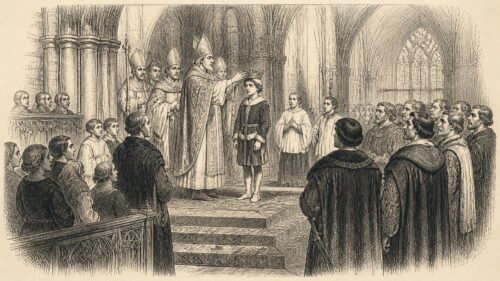
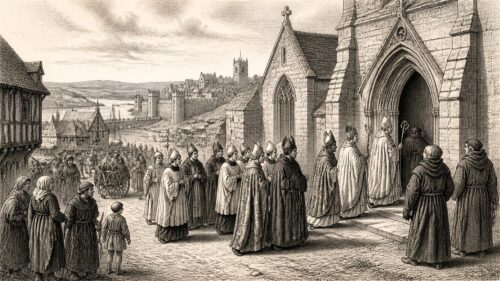
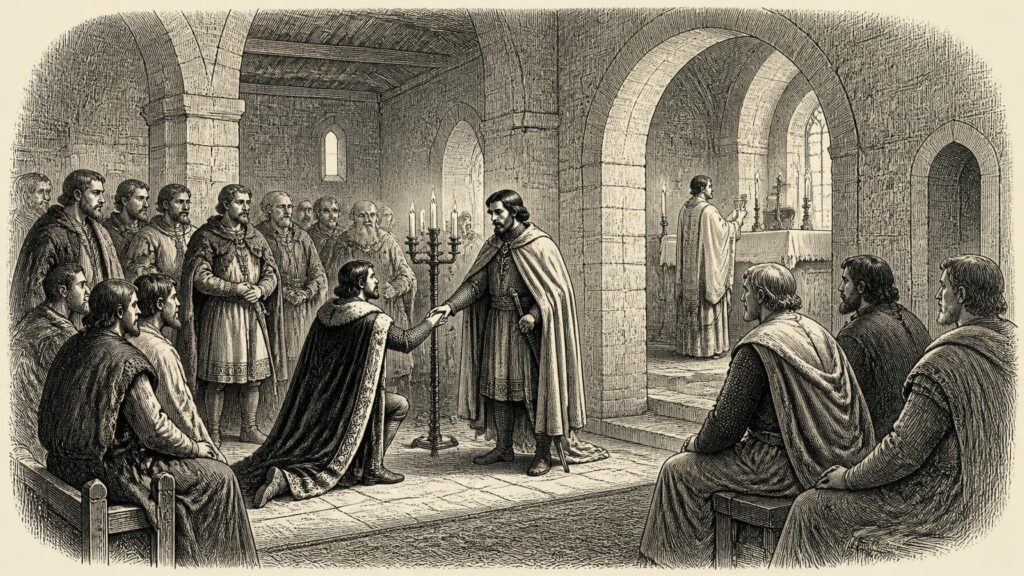
A compromise was eventually reached. On the twenty-first day of Edgecombe’s Dublin stay, conventionally dated to 21 July, Kildare and the other lords assembled at the monastery of St Thomas the Martyr. The earl first rendered homage. During mass he confessed and received absolution from the ecclesiastical penalty incurred through the Simnel rebellion; with his hand held over the consecrated Host, he then swore allegiance to Henry VII. Bishops and lords took corresponding oaths. The rite ended with Te Deum, organ music and ringing bells. Edgecombe placed the king’s livery collar around Kildare’s neck, and the earl wore it openly through Dublin. It was an expertly staged reconciliation: sacrament, public ceremony and royal clothing combined to make renewed obedience visible.
Dublin’s mayor, bailiffs and commonalty then swore on the Gospels in the guild hall. Edgecombe went on to Drogheda and Trim, where civic communities likewise gave fealty and received the king’s pardon. These were not empty formalities. Town corporations possessed seals, controlled local courts and markets, maintained defences, and could supply money, information and maritime access. Henry’s government needed their cooperation as much as it needed Kildare’s. The commissioner’s itinerary therefore joined ports, walled towns and the institutions of the Pale into a single public exercise in political repair.
Pardon, But Not Complete Trust
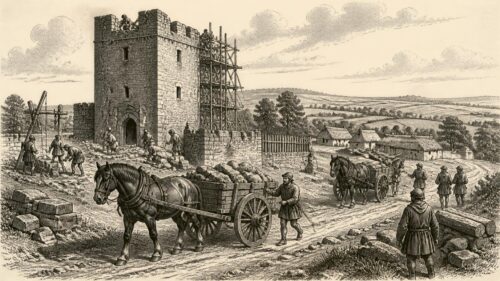
Late in the mission, Kildare and the spiritual and temporal lords again pressed Edgecombe to accept two prominent Simnel supporters: Thomas Plunket, chief justice of common pleas, and James Keating, prior of the Hospitallers at Kilmainham. Edgecombe eventually took Plunket’s homage, but refused Keating. He then installed Richard Archibald, the king’s nominee, as constable of Dublin Castle, an office Keating had retained against royal wishes for more than two years. This was a small but meaningful assertion of crown control over the principal royal fortress in Ireland.
Kildare supplied his sworn certificate and the obligation of his sureties, after which Edgecombe delivered the king’s pardon under the Great Seal. The settlement did not mean that Henry trusted him without reservation, nor that Kildare had surrendered his regional authority. Rather, the crown recognised an inescapable fact: the earl remained the most effective political intermediary in the lordship. Kildare’s lands, marriage alliances, followers and influence across the frontier made him difficult to replace cheaply. The events of 1488 accordingly began a renewed, uneasy relationship between Tudor monarchy and the man later remembered as Gearóid Mór, ‘the Great Earl’.
Force and Lordship Beyond the Pale
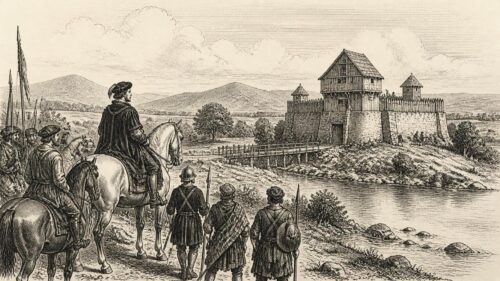
While Dublin negotiated reconciliation, the Irish annals recorded a far wider landscape of local warfare and succession. In the midlands, the Annals of Ulster state that Kildare destroyed the castle of Bilrath, held by the sons of Muirchertach Mag Eochagáin. The annal does not safely establish the precise means of destruction, but the event demonstrates that Kildare’s authority was exercised not only through council and ceremony but through armed intervention beyond the core counties of the Pale.
In Munster, Maurice FitzGerald, earl of Desmond, defeated Conchobhar, son of Toirdelbach Ó Briain, acting at the instigation of another Ó Briain claimant, Toirdelbach son of Tadhg. Such notices show that earls could become active participants in disputes within Gaelic ruling kindreds. Far from being separate worlds, Gaelic and English-speaking lordships were connected by warfare, fostering, marriage, trade, clerical networks and calculated alliances. The political map of Ireland was therefore not a neat division between crown territory and an undifferentiated ‘outside’, but a patchwork of overlapping powers.
Ulster was particularly unsettled. The sons of Mac Mathghamhna raided Conn Ó Néill, lord of Tír Eoghain, and the year brought killings in the competing branches of the Ó Néill kindred. Conn released Niall, son of Seán Buidhe Ó Néill, from captivity around the feast of St Brendan, but took further hostages, including Niall’s two sons. Hostage-taking was a recognised means of securing agreements, yet it also advertised unequal power and often deepened resentment. By the autumn, Conn had hanged two of Niall’s sons. Violence continued in raids and night attacks, including the killing of Cu Uladh Ó Néill during the harvest.
There was nevertheless diplomacy. After All Saints’ Day, Conn Ó Néill travelled to the household of Aodh Ruadh Ó Domhnaill of Tír Chonaill, accompanied by John Maguire of Fermanagh. The annal calls the agreement between Ó Néill and Ó Domhnaill a firm and cordial peace; Conn also made peace with the sons of Seán Buidhe. These were practical settlements between rival lordships, not evidence of permanent stability. They did, however, create room for rulers to attend to succession, tribute and rivals nearer home.
Fermanagh, Connacht and the Friars
Succession remained a recurring concern. Edmund Maguire, king of Fermanagh, died on 4 July. Later, on 4 August, Cathal Mac Maghnusa was made head of his lineage with Maguire’s backing, while another branch leader was proclaimed. Elsewhere, the heads of the Ó Flannagáin, Mag Raghnaill and Mag Aonghusa kindreds changed during the year. Such entries are reminders that lordship was not inherited automatically by primogeniture. Senior kin, military supporters, clerics and powerful neighbours could all influence who was inaugurated or acknowledged as chief.
In Connacht, Aodh Ruadh Ó Domhnaill supported the installation of Feidhlimidh Finn Ó Conchobair and his party. The Four Masters also record a campaign by Ó Domhnaill and Mac Diarmata around the Rock of Lough Key, where a defended position and its surrounding territory were contested. These events underline the strategic importance of lakes, islands, castles and crannógs: they were not merely features of the landscape but strongpoints controlling movement, refuge and local resources.
Religious institutions were active within this political world. Around the feast of St Peter, a chapter of the Friars Minor of the Strict Observance met at Donegal. A provincial chapter brought friars together to deal with discipline, governance and the life of their houses. Its meeting at Donegal illustrates the vitality of the Observant Franciscan reform in late medieval Ireland, which promoted a stricter interpretation of Franciscan poverty and communal discipline. The abbey was also closely linked to the Ó Domhnaill lordship, showing how aristocratic patronage and religious reform could reinforce one another.
The year’s annals preserve smaller but revealing human losses. Henry Ó Sealbhaigh, praised as the finest chanter in the Gaelic world of the northern half of Ireland, died; so did Mael Muire Ó hUiginn, described as an eminent poet. Brian Ó Néill and Mary, wife of Conn Ó Néill, died of smallpox in spring. These notices cannot demonstrate a nationwide epidemic, but they show disease reaching elite households as well as the fragility of learned and liturgical traditions dependent on individual practitioners. The Four Masters also report a destructive windstorm in Connacht which killed several people. For communities reliant on crops, livestock, travel and fragile buildings, severe weather was a direct social and economic hazard.
Thus 1488 was neither merely the year after Simnel nor only a chapter in Tudor state-building. Edgecombe’s mission restored an outward bond between Henry VII and the political community of the Pale, but it did not erase Kildare’s dominance or Waterford’s fears. Beyond the lordship, castles fell, rulers died, hostages changed hands, peace was made and remade, friars gathered, singers and poets were mourned, and illness and weather shaped ordinary insecurity. Ireland entered the closing years of the fifteenth century with no single centre of power, but with many centres capable of bargaining, fighting and preserving their own authority.
Primary Sources
- The Annals of Ulster, Year U1488
- Annals of Ulster otherwise Annala Senait, Annals of Senat
- Annals of the Four Masters, Annal M1488
- Annals of the Four Masters
- Annála Connacht
- The Voyage of Sir Richard Edgecomb into Ireland, in the Year 1488
- The Voyage of Sir Richard Edgecomb into Ireland, Part 3
- FitzGerald, Gerald (Gearóid Mór)
- Payne, John
- O'Neill (Ó Néill), Conn
- O'Neill (Ó Néill), Enrí
- O'Donnell (Ó Domhnaill), Aodh Ruadh
- O'Donnell (Ó Domhnaill), Sir Aodh Dubh
- O'Rourke (Ó Ruairc), Donnchadh
- FitzGerald, Thomas ‘fitz Maurice’
- Holdings: Maurice Regan, interpreter to Dermod Mc Morrogh, his history of the first arrival of the English in Ireland; The voyage of Sir R. Edgcombe into Ireland in 1488; and other papers
- Hibernica Or, Some Antient Pieces Relating to Ireland
- His Majesty's Castle of Dublin
- Annals of Dublin from 1173 to 1500
- Factions, Feuds and Noble Power in the Lordship of Ireland
- Returning to Core Principles
- A History of the Franciscan Order in Ireland
- The Kildare Ascendancy (1470–1541)
- Kildare: The Earls of Kildare