Youghal’s December College1464 CE
In 1464, Ireland was divided among Gaelic lordships, Anglo-Irish magnates, church jurisdictions and Dublin’s limited English administration. Thomas FitzGerald, earl of Desmond and royal lieutenant, negotiated a treaty in Dublin with Mac William Burke and Ó Domhnaill, while rival officials contested authority. Connacht experienced succession wars, burnings, cattle raids, hostage-taking and gallowglass warfare; similar dynastic violence affected Tír Chonaill, Breifne, Fermanagh and Sliabh Lugha. Illness caused numerous deaths, possibly affecting animals. Devotion remained important through miracles, burials and church offerings. On 27 December, Desmond founded Our Lady’s College at Youghal, a collegiate church supporting worship, music, learning and local administration.
Dateline
In 1464, Ireland’s political map was anything but settled. Authority was divided among Gaelic lordships, Hiberno-English magnates, church jurisdictions and the limited institutions of the English lordship centred on Dublin. Yet the year was not simply a catalogue of disorder. Its records show negotiation as well as raiding, religious investment alongside violence, and communities responding to sickness, bereavement and disputed succession. Two developments give the year particular definition: Thomas FitzGerald, earl of Desmond and the king’s lieutenant, sought agreement with powerful Irish leaders; and, on 27 December, he founded Our Lady’s College at Youghal.
A Year Preserved Unevenly
The evidence is unusually rich, but uneven in character. The Annals of Connacht, Annals of Ulster and the later Annals of the Four Masters each preserve notices for 1464. Their entries were written or compiled in different places and at different dates, and names, emphases and occasional details do not always align perfectly. They do, however, agree on a broad picture: conflict was local and recurrent; leading families relied upon armed followings, cattle-raids, hostages and negotiated settlements; and the deaths of individual rulers or heirs could change the balance of a whole district.
The annals should not be treated as a complete census of Irish life. They overwhelmingly record the concerns of elites: kings, lords, clerics, warriors and prominent households. Nonetheless, their references to burned crops, seized cattle, houses and churches, mercenary soldiers, shipping and church offerings allow glimpses of the wider population. For farmers, tenants, craftsmen and townspeople, the consequences of a raid were not abstract politics. Losing animals or a standing crop threatened food, rents, labour and survival through the following season.
Desmond and the Dublin Settlement
At the level of the English lordship, Thomas FitzGerald, eighth earl of Desmond, was the leading figure of the year. He served as deputy lieutenant under George, duke of Clarence, the brother of King Edward IV. Desmond’s authority derived from the Yorkist crown, but it depended in practice on alliances within Ireland. The lordship’s administration did not command the island as a unified state: its officials had to bargain with great Anglo-Irish houses and with Gaelic rulers whose territories lay well beyond the effective reach of Dublin.
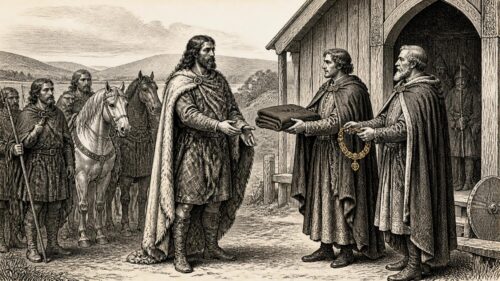
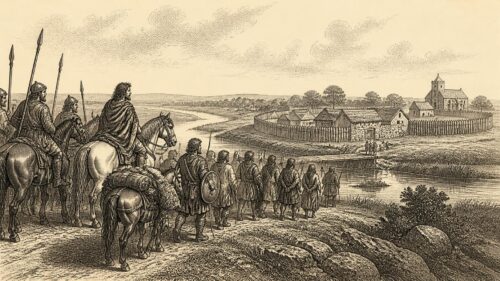
The Annals of Connacht record that Mac William Burke and Ó Domhnaill travelled to Dublin with many “Galls and Gaels” to meet Desmond, and that they made a treaty with him. The formula is important. Mac William Burke represented the powerful de Burgh-descended lordship in Connacht; Ó Domhnaill was a major ruler of Tír Chonaill in the north-west. Their journey demonstrates that Dublin could still serve as a diplomatic meeting-place, while the mixed company of “Galls and Gaels” shows that political action did not divide neatly along ethnic lines. Hiberno-English and Gaelic leaders could negotiate together when interests required it.
The chronology of the surviving annal entries does not allow every stage of this diplomacy to be dated precisely. In the same year, however, the annals state that Desmond arrived back from the king’s household in England carrying gifts and the office of lieutenant. This was a conspicuous demonstration of royal favour. It strengthened his standing, but it did not remove the need to cultivate Irish allies. His grant in January 1464 of the Irish chancellorship for life to his kinsman Thomas FitzGerald, earl of Kildare, likewise illustrates how office, kinship and political influence were intertwined among the great magnates.
Government around Dublin was also visibly contentious. The annals report that the justiciars, the bishop of Meath and Thomas Plunket, accompanied by nine household gentlemen, went to the king’s English residence to complain against one another. A parallel annal tradition associates the dispute with killings in Fingal. Whatever the exact legal issues, the episode exposes a lordship in which senior clerical, judicial and lay figures competed openly for authority. Appeals to the king were part of politics, but were no guarantee of harmony at home.
Connacht: Death, Succession and Cattle
Connacht supplies the densest record for 1464. In late April, Bresal Ó Cellaigh and Máel Sechlainn Ó Cellaigh died within a week while contending for the kingship of Uí Maine, the lordship extending across much of modern east Galway and south Roscommon. Their deaths did not settle the succession. The annals describe a major conflict between descendants of Uilliam Ó Cellaigh and Donnchad Ó Cellaigh, followed by another quarrel among branches of the family. Tír Maine was burned during the struggle. The language is stark, but its implications are clear: political rivalry spread destruction through an inhabited landscape rather than remaining confined to an elite battlefield.
Elsewhere in Connacht, Aodh Mac Diarmata of Moylurg took cattle from Tír Tuathail. The territory submitted to him in return for restoration of its prey, having previously aligned with Clann Donnchada after the death of Tomaltach Mac Diarmata. Cattle were both wealth and political currency. A successful raid punished an opponent, supplied a war-band and publicly asserted lordship; restitution and submission converted military pressure into a new political relationship. Four hundred cows were also taken when the son of Cormac Ballach Mac Donnchada was captured. Such figures should not be read as modern agricultural statistics, but they underline the central place of livestock in the economy and in the language of power.
Armed service appears vividly at Baile Locha Bó, where the sons of Brian Mac Donnchada were routed by rivals and allies. The annalist names Eóin Mac Suibhne, constable of their gallowglasses, among the dead, with sixteen gallowglasses killed beside him. Gallowglasses were heavily armed professional soldiers, commonly recruited through kindreds of Hebridean and Irish origin. Their presence shows that local dynastic conflict could employ specialist military manpower, not merely temporary levies. Yet the fighting also involved capture rather than slaughter alone: Tadc son of Brian, his son and another leading man were taken prisoner, preserving valuable hostages for later negotiation.
The most ceremonially important Connacht death was that of Tadc Ó Conchobair, described as a joint or half-king of Connacht. He died on the Saturday after the first autumn feast of Mary and was buried at Roscommon. The Annals of Connacht emphasise the scale of the funeral: horsemen and armoured gallowglasses surrounded the body as though marching to battle; young levies stood arrayed; poets, learned men and women of Síol Muireadaigh followed in great numbers. Cows, horses and money were offered to the church. This was an act of mourning, but also political theatre. It presented the deceased’s lineage, military resources, cultural patrons and ecclesiastical connections as a still-coherent community at a moment when succession was necessarily in question.
Violence Beyond Connacht
In Tír Chonaill, Conn Ó Domhnaill, a prince praised for his stature and strength, was killed by the sons of Neachtain Ó Domhnaill. The Annals of the Four Masters place the killing at Findruim on 8 May, though such exact dating should be understood as the testimony of that later compilation. The immediate aftermath was destructive. Neachtain’s sons and Ó Néill led a plundering host that burned the country as far as Ballyshannon and drove away cows and horses. The raid was costly: Brian Mag Uidhir and twenty-eight others were left dead behind them. Richard Burke then came to assist Ó Domhnaill with seven shiploads of men, a striking reminder that western and northern waterways were military routes as well as commercial and fishing grounds.
Family conflict also disturbed Breifne and Fermanagh. The annals record the death of Fersithe Mag Uibhne, bishop of the two Breifnes, on 27 November, while members of the Ó Ruairc dynasty captured one another before a peace released Féidlim and Aodh Ó Ruairc. In Fermanagh, Ruaidhrí Glas Mag Uidhir killed two of his own brothers. These were not peripheral incidents. In a political order built around lordly households and kin groups, fratricide, captivity and disputed inheritance could quickly alter regional alliances.
In Sliabh Lugha, around the Mayo–Roscommon borderland, Tomaltach Óg Ó Gadhra was killed by a javelin cast during an attack at Cluain Carthaig. The Annals of the Four Masters characterise the episode as a night attack and name Maurice Mac Diarmata Gall and Edmund Mac Goisdelb among the attackers; the Annals of Connacht gives a closely related but not identical account. The responsible conclusion is not to force the sources into artificial precision, but to recognise the event as a recorded killing within a contested frontier zone where Gaelic and families of settler descent operated in the same violent political world.
Sickness, Faith and a New College
Illness ran through the year’s notices. The Annals of Connacht repeatedly call the affliction colic, recording the deaths of Mac Caba, Domnall Ó Ruairc, several members of the Ó Fergail and Ó Duibhgeannáin families, and Céadach Ó Mórdha, lord of Laois. One troubling entry says that Muirchertach Ó Máel Sechlainn, his wife and three others died within a day and night after going to look at a horse that had died with the same swellings. The Four Masters renders some of these deaths as plague. Neither wording permits a secure modern diagnosis. What can be said is that contemporaries perceived a linked and alarming outbreak affecting people, perhaps animals as well, across several lordships.
Religious life offered both explanation and consolation. The annals say that an image of Mary at Trim worked great marvels in 1464, evidence of a living devotional culture centred on sacred images and pilgrimage. The burial of Tadc Ó Conchobair was inseparable from church patronage, while Lochlainn Ó Máelchonaire was buried at Elphin “under the protection” of God, Patrick and Francis. Such language reveals a society in which salvation, saintly protection, institutional churches and political memory met at death.
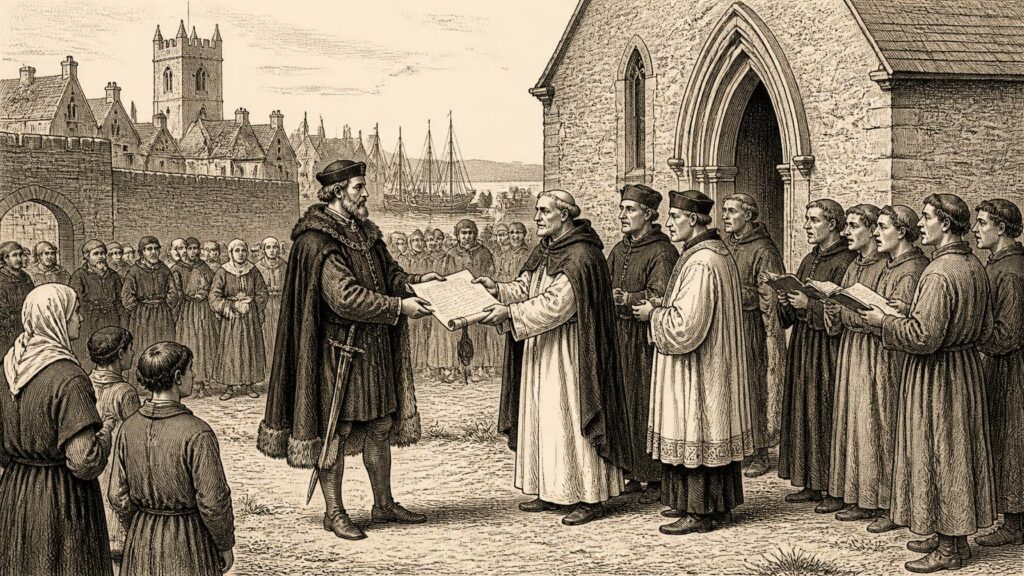
The year ended with an enduring act of religious and cultural patronage. On 27 December, Thomas of Desmond founded Our Lady’s College at Youghal, attached to St Mary’s Church. It was to have a warden, eight fellows and eight singing men. The foundation turned the church into a collegiate establishment while it continued to serve the town as its parish church. Its endowments linked Youghal to surrounding rectories and vicarages, creating a local institution sustained by ecclesiastical revenues rather than by occasional alms alone.
This was not a university in the later or modern sense, and it should not be described as one merely to enlarge its significance. It was, however, a substantial collegiate foundation: a place for clerical worship, music, learning and administration, established in a port town already connected to wider maritime trade. In a year marked by raids, epidemic deaths and contested lordship, Youghal’s new college was a deliberate investment in continuity. It embodied Desmond’s authority in stone, worship and endowment, and it gave the closing days of 1464 a very different legacy from the year’s many burnings and killings.
Primary Sources
- Annála Connacht: Annal 1464
- The Annals of Ulster: Year U1464
- Annals of the Kingdom of Ireland: Volume 4 English Translation
- Annála Connacht
- The Annals of the Four Masters
- Irish Script on Screen: MS A 13, Annals of the Four Masters
- FitzGerald, Thomas fitz James
- FitzGerald, Thomas ‘fitz Maurice’
- Lismore Papers Catalogue: Youghal College
- Irish Historic Towns Atlas: Youghal Text
- Ancient Charters of Youghal 1462–1609 Online
- The Ecclesiastical Antiquities of Youghal: St Mary’s Collegiate Church
- Researches in the South of Ireland
- The County and City of Cork: Account of the Foundation of the Collegiate Church of Youghal
- The Colledge, Ireland Illustrated
- Annals of Loch Cé
- Fitzgerald, Thomas (1426?–1468), Dictionary of National Biography
- Fitzgerald, Thomas (d. 1477), Dictionary of National Biography
- A Discovery of the True Causes Why Ireland Was Never Entirely Subdued
- Grant, 10 September 1464, Henley