Dunamon’s Northern Guest1446 CE
In 1446, Neachtan Ó Domhnaill led an army from Tír Chonaill through Breifne and Connacht, where Mac William of Mayo received and escorted him at Dunamon, demonstrating interlordship alliances and negotiated military movement. Connacht suffered Ó Conchobhair dynastic violence, while Clanricarde intervened in Thomond and mediated a Mac Donnchada partition. Ó Conchobhair Fáilghe raided Meath, exposing the English lordship’s vulnerable frontier. Successions, feuds and retaliatory killings affected Ulster and Leinster, including murder within Fenagh church. Annals also commemorated poets, clerics and devotees. Together, these records depict Ireland as interconnected by kinship, routes and ecclesiastical institutions, but fractured among competing lordships.
Dateline
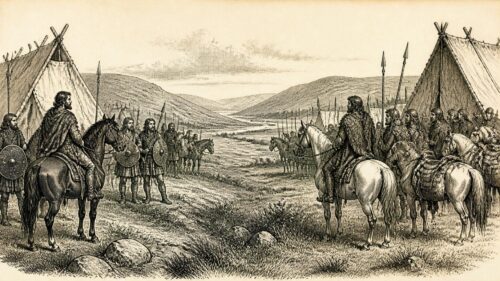
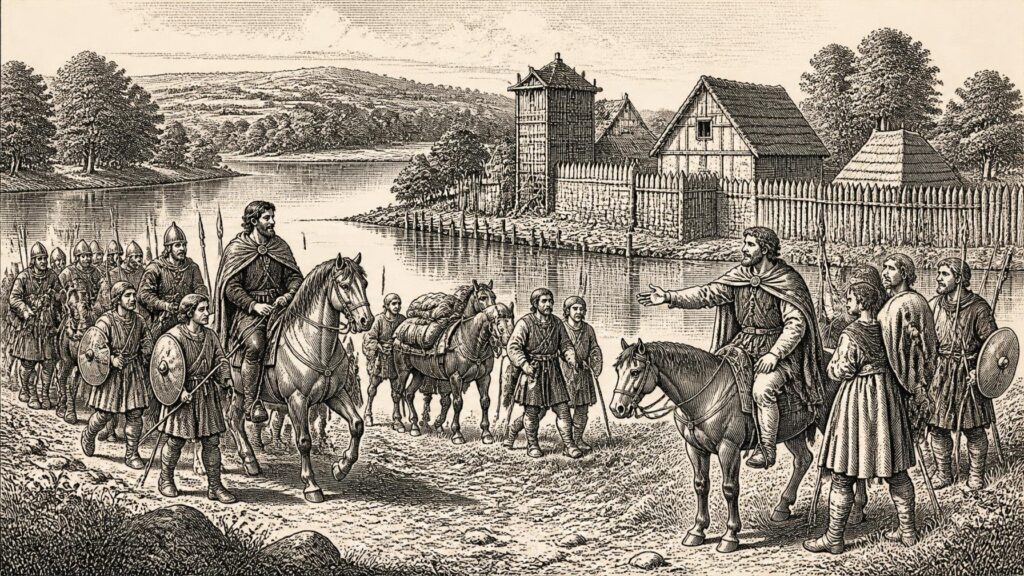
The most revealing Irish event recorded for 1446 was not a pitched battle but a long armed journey. Neachtan Ó Domhnaill, lord of Tír Chonaill, led what the Annals of the Four Masters calls a “great army” south into Connacht to aid allies. The route is unusually carefully set down: through Ó Ruairc country, across Magh Nisse and the Shannon, into Moylurg, through Machaire Chonnacht and Clann Conway. At Dunamon, a strategically placed site beside the Suck in modern County Roscommon, Mac William met him and escorted him onwards to Conmaicne Cúile Toladh. This was an expedition across a succession of lordships, and its reported progress says much about the political geography of mid-fifteenth-century Ireland.
An Army Through Connacht
The annal does not give a day or month for Ó Domhnaill’s march, name the allies he intended to assist, or describe a battle at its end. Those silences matter. It would be unsafe to turn the entry into a campaign of conquest or to assign motives beyond the stated purpose of helping friends. Yet the itinerary itself is significant. Moving a large force from north-west Ulster through Breifne and Connacht required food, guides, negotiated passage and the forbearance—or co-operation—of local powers. An army was not simply a body of fighting men: it travelled with servants, pack animals, supplies and baggage, and it imposed heavy demands upon every district it crossed.
Neachtan had become Ó Domhnaill after the death in captivity of his brother Niall Garbh in 1439. His position was far from secure. Tír Chonaill had endured factional conflict and pressure from the Ó Néills of Tír Eoghain, while the Ó Domhnaills’ connections in north Connacht remained important to their ability to act beyond Donegal. The previous year, 1445, the Four Masters had already recorded an Ó Domhnaill-led host in Sligo, accompanied by Maguire forces and members of the Ó Conchobhair kindred; Sligo was burned and Tomaltach Mac Donnchada of Tírerrill was killed. The 1446 march therefore belongs clearly to a continuing western theatre of alliances and rivalries, although the sources do not prove that the two expeditions formed a single planned campaign.
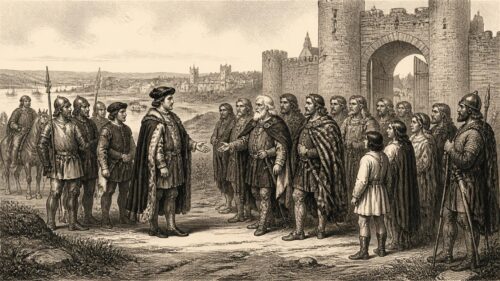
Mac William’s welcome at Dunamon gives the journey its political centre. The title could refer to the head of the northern Burke lordship in Mayo, not the separate Clanricarde Burke lordship of south Connacht. The distinction is important, because the two Burke powers were competitors as well as kinsmen. Their lordships combined Anglo-Norman ancestry with Gaelic political practice, using Irish titles, intermarriage, fosterage and alliances with neighbouring dynasties. An escort by Mac William was not merely ceremonial. It offered protection and proclaimed that Ó Domhnaill’s presence had powerful sponsorship in Connacht.
Connacht’s Divided Kingship
Conflict within the wider Ó Conchobhair dynasty formed the immediate background to such intervention. In Machaire Chonnacht, the plains of central Connacht, Diarmaid Ruadh, son of Tadhg Ó Conchobhair, was killed by the sons of Toirdelbach Ó Conchobhair. The Four Masters adds that Ó Conchobhair Donn, aided by the MacMaurices of Brize and some sons of Feidhlim, killed him at Cúil Ua bhFionntain. The Annals of Ulster also records Diarmaid’s death, though more briefly. The agreement between the two annals makes the killing secure; the exact sequence of manoeuvres and the wider claims of each faction remain unclear.
These were not minor private quarrels. The long division between the Donn and Ruadh branches of the Ó Conchobhairs repeatedly drew in the Burkes, MacDermotts, Mac Donnchadas and other lordships. Control of pasture, tribute, castles, client families and routes across Connacht depended on the outcome. The presence of an Ulster ruler and a Mac William in the same political landscape demonstrates that Connacht was not isolated behind provincial boundaries. It was a meeting ground for powers whose interests extended from Donegal and Fermanagh to Mayo, Galway and Thomond.
War on the Meath Frontier
Farther east, 1446 brought a grave confrontation between Ó Conchobhair Fáilghe of Offaly and the English of Meath. The Four Masters says that much of Meath was plundered and burned, that many inhabitants were killed, and that raiding parties reached as far north as Tara and east towards Cúl Maighe Cláraigh. Brian, son of Calbhach Ó Conchobhair, was captured by the English during the war. The account is emphatic about destruction but does not provide totals, a decisive battle or terms of settlement.
The war exposes the limited and contested character of the English lordship’s power beyond its stronger towns and defended estates. Meath was central to the colony around Dublin, but its western frontier was vulnerable to mobile forces from Offaly. For the people living in the affected districts, war meant more than a clash of lords: crops could be fired, cattle driven away, homes and religious sites threatened, and travel made dangerous. The annal’s reach from Tara eastwards shows that the insecurity was felt close to places loaded with political and symbolic importance. It also shows that Gaelic and English were not sealed-off worlds. Captivity, reprisal and negotiation joined them constantly.
Clanricarde’s Intervention in Thomond
In the west and south-west, a “great war” devastated Thomond. The Four Masters states bluntly that all Thomond was spoiled, that an Ó Briain ruler was taken prisoner, and that Mac William of Clanricarde entered the region, rescued him by force and “set all to rights”. The language is compressed and partisan in its confidence; it does not identify the captors, describe the rescue or tell how durable the settlement proved. Nevertheless, the main facts are clear enough: a crisis within Thomond was serious enough to endanger its ruler, and Uilleag Ruadh Burke of Clanricarde had the military capacity and dynastic standing to intervene decisively.
The episode reflects the close links between Clanricarde and the Ó Briains. Their relationship could be reinforced by marriage, military service and shared interest in the lands around the Shannon estuary and the north Munster–Connacht frontier. It should not be mistaken for a modern alliance of fixed states. Lordships were held together through personal obligations and the authority of leading families, and an effective intervention could enhance the rescuer’s reputation as protector as much as it aided a neighbour.
Clanricarde also acted as arbiter in a Connacht succession dispute. Clann Donnchada, Toirdelbach Carrach Ó Conchobhair and Ó Conchobhair Donn came to Mac William intending to choose a single Mac Donnchada. Instead they agreed to divide the territory between two leaders: John, son of Conchobhar Mac Donnchada, and Tadhg, son of Tomaltach Mór Mac Donnchada. The settlement did not eliminate rivalry; indeed, partition could preserve competing claims. But it prevented an immediate contest from being settled solely by violence, and it displays Mac William’s authority as a broker among neighbouring dynasties.
Succession, Feud and Sacred Space
Leadership changes elsewhere underline how often governance was contested. Ruaidhrí Mac Mathghamhna, lord of Airgialla, died, and his son Aodh Ruadh was chosen as successor “by Ó Néill”, according to the Four Masters. The wording points to the influence that the leading Ó Néill could exert over an eastern Ulster succession. In Hy Faeláin, following the death of Edmund Ó Broin Ó Byrne, Dunlaing Ó Broin was elected in his place. Such entries show that inheritance was not automatic: a successor needed acceptance by kin, clients and powerful neighbours.
Feuding could reach spaces normally associated with sanctuary. Feidhlimidh, son of John Ó Ruairc, was killed in the middle of the church at Fenagh by kinsmen, the sons of Lochlann Ó Ruairc. The Annals of Ulster separately records Feidhlimidh’s killing by the same branch. In Fermanagh, a night raid on Toirdelbach Mag Uidhir’s people by the sons of Mac Giolla Fhinnein led to the burning of Mag Uidhir’s wife, a daughter of an Ó Ruairc lord, and to the killing of Colla Mag Uidhir. Toirdelbach subsequently had some of the Mac Giolla Fhinnein kindred hanged. These are stark reminders that kinship could supply both protection and danger, and that rulers answered attacks with punishments intended to restore authority as well as avenge loss.
Learning, Devotion and Memory
The year’s annals preserve more than warfare. Domnall Ua Cobhthaigh was killed on Croinis in Lough Ennell; the Annals of Ulster calls him both an excellent poet and an excellent leader. Adam Ua Luinín, described as pleasant and learned, died on 5 May. Such notices reveal the public value attached to professional learning. Poets, lawyers, historians, clerics and teachers served lordly households and schools, preserved genealogies and legal knowledge, and shaped reputations through praise and remembrance. Their deaths merited record beside those of kings.
Religious communities also appear in the year’s sparse but suggestive notices. The Four Masters records the death of John Ó Leannáin, prior of Lisgool, while the Annals of Ulster records Owen Ua Leannáin, prior of Lisgabail, on 10 September. The similarity of monastery and surname should not be used to collapse the notices into one person: the surviving annals give different names, and may preserve distinct deaths or divergent traditions. Ulster also notes the death of Finemhain, daughter of Mac Thomas, called a devout nun, and of Domnall Ua Máeláin, remembered as a poor person devoted to God. These brief memorials show that religious standing, learning, hospitality and care for the poor remained recognised measures of a life.
No annal for 1446 offers a firm, island-wide account of weather, harvests, prices or overseas trade. It would be wrong to invent one. What the evidence does show is an Ireland knit together by rivers, roads, ecclesiastical houses, kinship and armed escort—yet repeatedly damaged by local war. At Dunamon, the formal reception of an Ulster army made that interdependence visible: security, influence and movement depended not on one central government, but on the shifting consent and strength of many competing lordships.
Primary Sources
- Annals of the Four Masters: Annal M1446
- The Annals of Ulster: Year U1446
- Annála Connacht
- CELT Project: Annals of the Four Masters
- CELT Project: The Annals of Ulster
- O'Donnell (Ó Domhnaill), Neachtan
- Burke (de Burgh), Uilleag (‘Uilleag Ruadh’)
- O'Connor Faly (Ó Conchobhair Failghe), An Calbach
- O'Connor Faly (Ó Conchobhair Failghe), Conn
- O'Neill (Ó Néill), Enrí
- O'Donnell (Ó Domhnaill), Niall Garbh
- O'Donnell (Ó Domhnaill), Toirdhealbhach
- English Lordship of Ireland and the Irish Sea World: Re-assessing the Origins of the Kildare Ascendancy, c.1390–c.1513
- The Rise and Fall of the Clann Éinrí Aimhréidh Uí Néill: Dynastic Feuding and Geopolitics in the Late Medieval Irish Sea World
- Annals of the Four Masters: Manuscript MS 23 P 6
- Irish Script on Screen: Royal Irish Academy Collection
- Irish Script on Screen: MS C iii 3 (The Annals of the Four Masters)
- Exploring the Irish Annals
- The Annals of the Four Masters
- Annala Rioghachta Eireann: National Library of Ireland Catalogue
- Versions: Irish Annals Manuscripts
- Gazetteer of Ireland