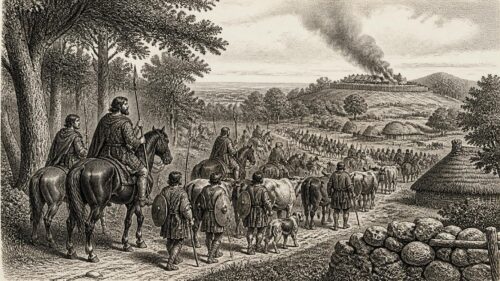
Ballymagauran’s Vengeful Burning1431 CE
In 1431, Ireland experienced raids, reprisals, dynastic conflict and institutional losses. Sir Thomas Stanley’s delayed arrival as royal lieutenant left the English lordship constrained around Dublin, though chancery business continued. After John Maguire was killed in Tullyhaw, Tomás Óg Maguire ravaged the district and burned Ballymagauran. O’Neill, Maguire and O’Reilly devastated MacQuillan territory, while hostage negotiations and O’Donnell rivalries reshaped Ulster. Gaelic and English forces conducted reciprocal raids in Breifne and Leinster. Deaths of bishops, clerics, poets and nobles underscored the fragility of lordship. Warfare damaged crops and homes, yet religious, learned and administrative institutions endured amid mobile local power.
Dateline
The annalists’ heading for 1431 gathers a year of raids, reprisals, political reversals and deaths from every side of Ireland. Its notices are not a diary: few can be assigned to a month or day, and their order does not necessarily show the order in which events happened. Yet they securely place a series of developments within this calendar year. Taken together, they show an island in which authority was intensely local, but never merely local. A killing in Tullyhaw could bring the king of Fermanagh into Cavan; a dispute between Ulster dynasties could imperil crops and homes far from their principal seats; and an incursion into Dublin’s county showed both the reach and the limits of Leinster power.
A New Lieutenant Arrives
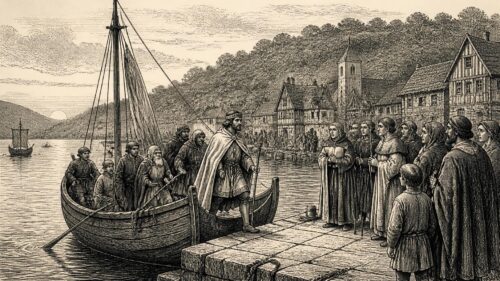
The English lordship of Ireland remained formally subject to the young Henry VI, but its effective power was concentrated in Dublin, the neighbouring counties and a scattering of towns, manors and lordships. In 1431 the Crown appointed Sir Thomas Stanley as lieutenant for a six-year term. Financial difficulties delayed his departure from England, however, and he did not arrive in Ireland until 30 September. That delay matters. For most of the campaigning season, politics beyond the core of the lordship continued without the presence of the new royal governor; even after his landing, he inherited a government constrained by money, faction and limited military reach.
The royal administration was nevertheless more than a distant claim. Calendared Irish chancery material from Henry VI’s tenth regnal year preserves business involving land, pardons and ecclesiastical property. One item records a pardon sought by Gerald fitz Maurice, earl of Kildare; another concerns the temporalities of the religious house at Lismullen. Such records are not evidence for a sweeping recovery of royal power. They do show that the institutions of the lordship—chancery, magnates, religious communities and local landholding—continued to transact business while warfare shaped much of the countryside beyond Dublin.
Cavan Reprisal
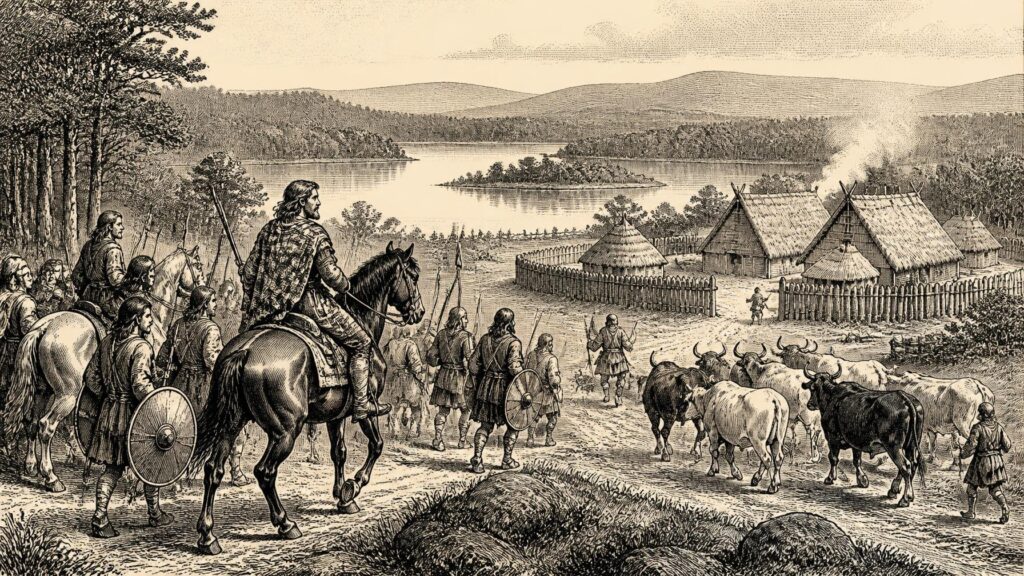
The year’s most sharply drawn episode began with an act described by the annals as treachery. John, son of Cú Chonnacht and grandson of Pilib Maguire, went into Tullyhaw in present-day north-west Cavan after an invitation from its people. He had only seven companions. There, the annals say, he was attacked by forty opponents and killed; Brian Caech, son of Magauran, is named as responsible. Numbers in medieval annals should not be treated as a modern muster roll, but the contrast emphatically conveys the vulnerability of a small party entering a rival lordship under an assurance of safety.
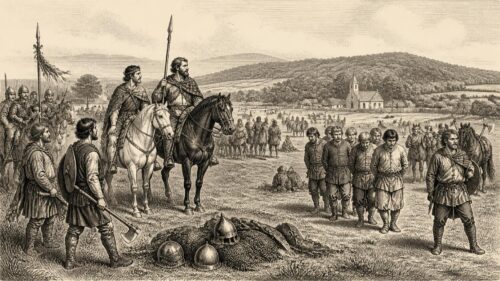
Tomás Óg Maguire, king of Fir Manach, answered with a substantial hosting. His force plundered and ravaged Tullyhaw, killed many of its leading men and burned Ballymagauran, the Magauran centre. The episode illustrates an essential feature of political order in late medieval Ireland. Kinship, lordship and the enforcement of honour overlapped. The death of a kinsman was not handled by a central criminal court; it called for armed redress by the injured dynasty. Burning a settlement was both material punishment and public political speech. It damaged stores, buildings and standing, while announcing Maguire’s capacity to carry war across the border.
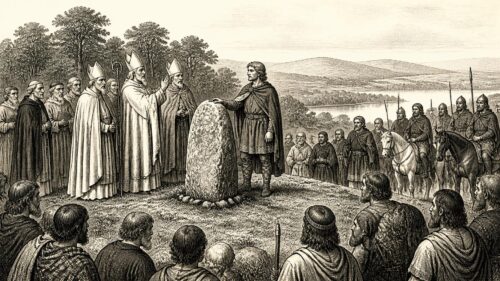
The immediate success should not be mistaken for permanent conquest. Tullyhaw was a contested borderland between Fir Manach, East Breifne and neighbouring powers, where local kindreds could seek allies and retaliate in turn. Tomás Óg had succeeded his father only shortly before this year. The Cavan expedition was therefore also a demonstration that a new Maguire ruler could protect his lineage and exact vengeance. It was power expressed through movement: a host assembled, crossed into an opponent’s territory, took prey and returned.
Ulster’s Unsettled Balance
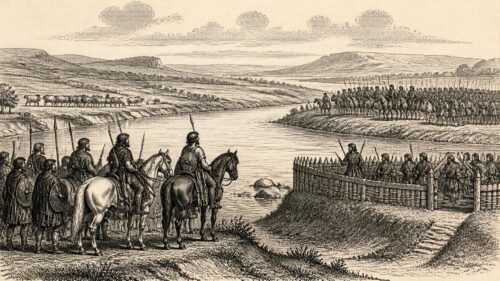
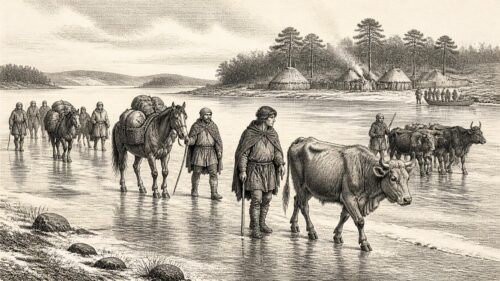
A wider northern campaign linked Eóghan O’Neill of Tír Eoghain with Maguire and O’Reilly against MacQuillan. The annals state that O’Neill entered MacQuillan territory with a great army and with his creaghts—mobile communities and herds accompanying the force—and that the allied leaders plundered the country. The host remained there for about a quarter of a year, destroying corn and burning dwellings before returning to Tyrone. This is one of the clearest indications from 1431 of what warfare meant for ordinary people. The object was not simply a battle between armed elites. Attacking grain and homes struck at the food supply, shelter, livestock economy and capacity of a lordship to sustain followers through the coming seasons.
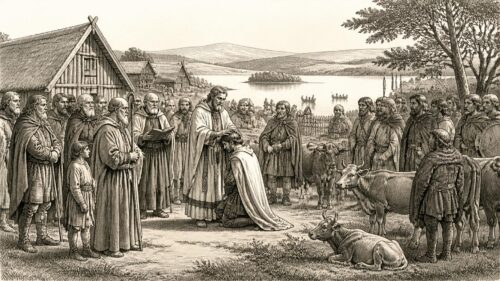
That campaign belongs to the rivalry between the O’Neills of Tír Eoghain and the O’Donnells of Tír Conaill, but alliances were flexible rather than fixed blocks. MacQuillan’s position in the Route and Glens made his lordship important in east Ulster. The assault by O’Neill, Maguire and O’Reilly projected their combined influence towards that zone. At the same time, Niall Garbh O’Donnell’s brother Neachtan captured Henry, Eóghan O’Neill’s son. A conference between Eóghan and Neachtan then settled their dispute, and Henry was released. The sequence demonstrates that capture was an instrument of high politics, creating leverage for negotiation, while a conference could end an immediate crisis without ending the larger rivalry.
Elsewhere in Tír Conaill, Neachtan O’Donnell attacked and captured the castle of Loch Laoghaire from Turlough O’Donnell, carrying away the goods found inside. The annals do not provide enough detail to reconstruct the castle’s garrison or the duration of the operation. They do establish that the O’Donnell kindred’s internal competition was active alongside its confrontation with O’Neill. Dynastic fragmentation was not a sign of political irrelevance: it was one of the principal ways power, land and armed followings were contested.
Raiding the Lordship
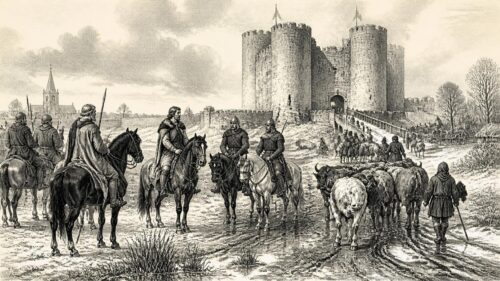
Conflict also crossed the porous frontier between Gaelic lordships and the English-controlled regions. Manus MacMahon made major depredations on the English and killed many of their people. In another encounter, a large English cavalry force set out to plunder Clann Kee, the O’Reilly country. Manus, son of Ardghal MacMahon, was himself on a raid into English districts when he learned of their movement. He pursued them, attacked as they guarded the prey, recovered the spoils, captured some leaders and killed others. The annal’s paired movements are revealing: neither side was simply defending a settled border. Raiding, counter-raiding, seizure of livestock and the taking of prisoners were normal means by which military success became wealth and political credit.
In Leinster, Donnchadh MacMurrough Kavanagh, lord of Leinster, raided into County Dublin. His men routed the English early in the day, killed a number and seized much booty. But the English regrouped, overtook the raiders in the evening while they were burdened with their gains, and inflicted a reverse. Men serving under Mac an Mhidhigh, a son of Tadhg O’Brien, and the two sons of O’Connor Kerry were killed; O’Toole was captured. The entry makes no claim that either side secured a lasting victory. Instead, it records a day whose momentum changed twice. It also shows a Leinster force drawing in associates from beyond its immediate heartland, and the danger of turning a successful raid into a safe withdrawal.
The death of Gerald Kavanagh, described as roy-damna, or a man eligible for Leinster’s kingship, had consequences beyond the obituary formula. Gerald had been a rival to Donnchadh MacMurrough. With Gerald gone, Donnchadh was better placed to restore his position as MacMurrough overlord, although his Dublin expedition shows that renewed standing did not remove the military strength of the lordship’s English communities.
Deaths, Learning and Lordship
Annals measure a year not only through violence but through the loss of people who sustained institutions. The bishops of Clogher and Leighlin died in 1431. Their deaths mattered in dioceses that were religious jurisdictions, landholders and political presences as well as centres of pastoral life. The annals also record the death of Tadhg O’Howen, official of Lough Erne and “a man of literature”, and of Simon Mac Garaghan, a canon of Lisgoole in Fermanagh. These notices point to an educated clerical world embedded in the northern lake district, where legal-administrative offices, canonical communities and learning remained mutually connected.
Gilbert O’Duigennan and Eóghan O’Fialain, identified as a learned poet, also died. Their brief memorials are valuable. Learned families, poets and clerics preserved genealogies, legal knowledge, historical memory and literary culture in households, churches and lordly networks. The year gives no grounds for imagining a single school or manuscript project behind these deaths; it does show that literacy and scholarship were recognised as qualities worthy of record alongside prowess and hospitality.
Other fatalities expose the brittleness of succession. Murtough O’Conor of Corcomroe was killed by the sons of his own brother. Con O’Melaghlin, a roy-damna of Meath, was killed by the people of Annaly and the English of Westmeath, while his brother Corc was taken prisoner. Geoffrey Mac Rannall, head of his lineage, died, as did Donnchadh Mac Giolla Phádraig, son of the lord of Ossory. Such entries are reminders that lordship rested on people, households and relationships rather than impersonal offices. A death, capture or internal killing could rearrange a regional balance with extraordinary speed.
A Year of Mobile Power
For Ireland, 1431 was not defined by one national battle or royal settlement. Its securely dated record instead reveals several interconnected worlds: the Dublin government awaiting a cash-strapped lieutenant; rulers in Fermanagh and Cavan enforcing kinship claims by fire and armed retaliation; northern dynasties combining against a rival while negotiating over captives; and English and Irish forces alike pursuing prey across contested frontiers. The year’s churches and learned men appear not apart from this political landscape, but within it. The burning of Ballymagauran, the destruction of corn in MacQuillan country, and the deaths of bishops, officials and poets together convey a society in which war could be ruinously intimate, yet institutions of lordship, religion and learning continued to organise life.
Primary Sources
- Part 6 of Annals of the Four Masters
- Annals of the Four Masters
- TEI Header for Annals of the Four Masters
- The Annals of Ulster
- TEI Header for The Annals of Ulster
- Annála Connacht
- Maguire (Mág Uidhir), Tomás Óg
- O'Neill (Ó Néill), Eóghan
- O'Neill (Ó Néill), Enrí
- O'Donnell (Ó Domhnaill), Niall Garbh
- O'Donnell (Ó Domhnaill), Neachtan
- MacMurrough Kavanagh (Mac Murchadha Caomhánach), Art Mór
- O'Reilly (Ó Raghallaigh), Eóghan
- O'Rourke (Ó Ruairc), Tadhg
- O'Neill (Ó Néill), Aodh Buidhe
- Stanley, Thomas
- CIRCLE: Irish Chancery Letters of Henry VI (1422–1461)
- Patent Roll 10 Henry VI (1431–1432), Item 1
- Patent Roll 10 Henry VI (1431–1432), Item 19
- Patent Roll, 10 Henry VI, Item 100
- 1431 – King Henry VI: A Chronological Sourcebook
- The Annals of the Four Masters