Mortimer’s Trim Death1425 CE
In 1425, Edmund Mortimer, the king’s lieutenant and earl of March and Ulster, died suddenly at Trim while pursuing agreements with northern Gaelic lords. His death undermined a fragile settlement, followed by arrests of visitors and worsening Ulster conflict. James Butler, earl of Ormond, became lieutenant and negotiated written alliances with the Meic Mathghamhna and Éoghan Ó Néill. In Connacht, Toirrdelbach Ruad Ó Conchobair died and Cathal, son of Ruaidrí, succeeded amid violence. Brian Ballach Mac Uí Néill Buidhe was killed at Carrickfergus. Severe winter weather devastated cattle, crops and people, while records showed religious and learned life across Ireland.
Dateline
In 1425, Ireland’s political map was not altered by a single conquest or parliament, but by sudden deaths, fragile agreements and a punishing season. Edmund Mortimer, earl of March and Ulster and the English king’s lieutenant in Ireland, died at Trim early in the year just as he was attempting to turn meetings with northern Gaelic lords into a workable political settlement. In Connacht, the death of Toirrdelbach Ruad Ó Conchobair ended one kingship and brought Cathal, son of Ruaidrí, to power. In Ulster, an alliance-building effort was damaged by arrests and then by the killing of Brian Ballach Ó Néill at Carrickfergus. Above these struggles came an extended spell of harsh weather, which the Annals of Ulster held responsible for losses of cattle, tillage and people throughout Ireland.
A Lieutenant Dies at Trim
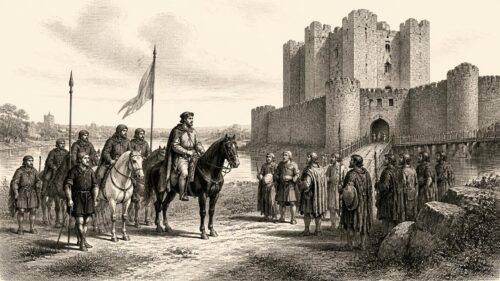
Edmund Mortimer’s death was the year’s most consequential event in the English lordship. Mortimer was both fifth earl of March and earl of Ulster, heir to a family whose Irish claims had once been extensive. Appointed the young Henry VI’s lieutenant in 1423, he had only reached Ireland in September 1424. His late arrival mattered. The Dublin government was divided by rival magnates, while its authority beyond the lordship’s core territories was limited, negotiated and often dependent upon alliances with Gaelic rulers.
The Annals of Ulster records that the earl came to Ireland with many “Saxons” and that leading men went to his household, receiving honour and concord there. Its language should not be mistaken for a neutral administrative record: the annalist distinguished Gaelic people from the earl’s English followers and described the latter collectively as foreigners. Yet the entry preserves important evidence of diplomacy. Among those said to have come were Ó Néill, Éoghan Ó Néill, Nechtain Ó Domnaill and Brian Ballach Mac Uí Néill Buidhe of Clandeboye, while Mac Uibhilín attended separately. These were not minor visitors but figures from the competing political world of Ulster.
The chronology of this episode must be handled cautiously. A contemporary English chronicle tradition places Mortimer’s death at Trim in January 1425, while the Irish annal records the negotiations, completion of a compact and the earl’s death together under its 1425 heading without giving dates for each stage. What is secure is that Mortimer died suddenly, apparently of plague, before his Irish programme could acquire durable form. His body was returned for burial in England, and the estates and title passed to his under-age nephew Richard, duke of York. A grand inherited claim to Ulster therefore remained, but its effective enforcement in Ireland did not.
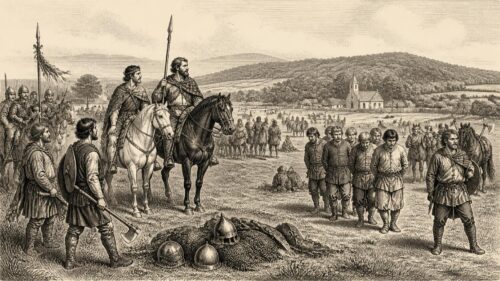
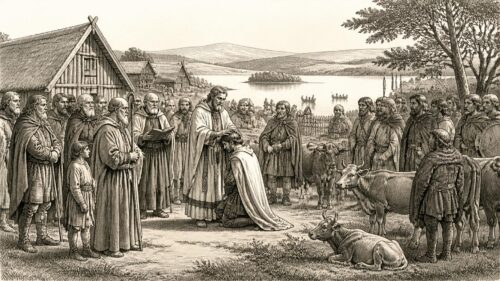
The immediate result was dangerous. According to the Annals of Ulster, men from Meath pursued the Gaelic visitors as they left and captured them, along with other notable members of their kindreds. Brian Ballach, Ó Néill and Mac Uibhilín accepted the judgement of the English of Meath and were released; Éoghan Ó Néill and the son of Ó Domnaill were held amid accusations and “machinations”. The annalist judged these captures a cause of great war across Ulster. Whether every detail reflects the sequence of events exactly, the episode shows how rapidly a ceremonial meeting could turn into coercion, hostage-taking and renewed conflict.
Ormond’s Written Alliances
The crown moved quickly to restore a recognised head of government. A surviving catalogue entry records letters patent of 1 March 1425 appointing James Butler, fourth earl of Ormond, lieutenant in Ireland. Ormond was not an outsider sent to impose a new order. He had served as Mortimer’s deputy and was a powerful lord in his own right, with broad political connections among English and Gaelic elites. His appointment signalled that royal government would rely less on Mortimer’s personal standing and more on the bargaining capacity of a resident magnate.
That bargaining can be dated more securely than many military movements. In May, Ormond entered an indenture with the Meic Mathghamhna of Oriel. On 23 June, an extract from a lost Irish patent roll records another indenture, between Ormond as king’s lieutenant and “Ewegenius Oneyll”, Éoghan Ó Néill of Tír Eógain. The full text is not preserved in that extract, so its clauses should not be invented. Later analysis of the arrangement nevertheless shows its political character: Ormond sought protection for the colony and military co-operation, while offering a reciprocal relationship to an Ulster lord who needed allies in his own dynastic contest.
This was not the absorption of Tír Eógain into an English state. It was a compact between powers that recognised one another’s usefulness. Such agreements could restrain raids, open routes and supply soldiers, but they remained exposed to local rivalries. The settlement of 1425 thus reveals both the reach and the weakness of the lordship: its government could put agreements into written, legal form, yet had to pursue security through personal bonds with rulers beyond its ordinary courts.
A Connacht Kingship Changes Hands
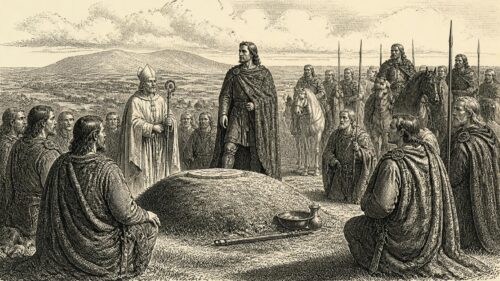
Connacht saw an equally important, though distinct, succession. Annála Connacht records the death and burial at Roscommon of Toirrdelbach Ruad Ó Conchobair, whom it calls king of Connacht and, in heroic language, the “Cú Chulainn of his times”. The praise is an annalistic judgement rather than a measured modern biography, but the manner of wording is revealing: the annalist considered it remarkable that such a formidable ruler died in his bed. Cathal, son of Ruaidhrí Ó Conchobair, succeeded him.
The succession did not create a new, united province. Connacht kingship had long been contested within the Ó Conchobair dynasty and shaped by the intervention of other major kindreds, notably the Mac Diarmatas, the Burkes and the Ó Ceallaigh of Uí Maine. Cathal had previously led the opposing Donn branch of the family; his accession in 1425 was therefore a significant reversal after years in which Toirrdelbach Ruad’s faction had prevailed. It was a change at the summit of a contested regional kingship, not a claim to rule all Ireland.
Conflict followed within the year. Ruaidhrí Óg Ó Ceallaigh attacked followers of Ó Conchobair, but was overtaken at Aba na hEidnige by the sons of Éoghan Ó Conchobair and of Mac an Aba Ó Conchobair. Ruaidhrí Óg was killed, as was Brian, son of Éoghan Ó Conchobair, on the opposing side. Annála Connacht also notes the sudden death from sickness of Brian, son of Éoghan Ó Ceallaigh. These compact notices expose the human scale of succession politics: a king’s death redistributed authority, but it also set cousins, retainers and neighbouring dynasties into motion.
Carrickfergus and a Northern Killing
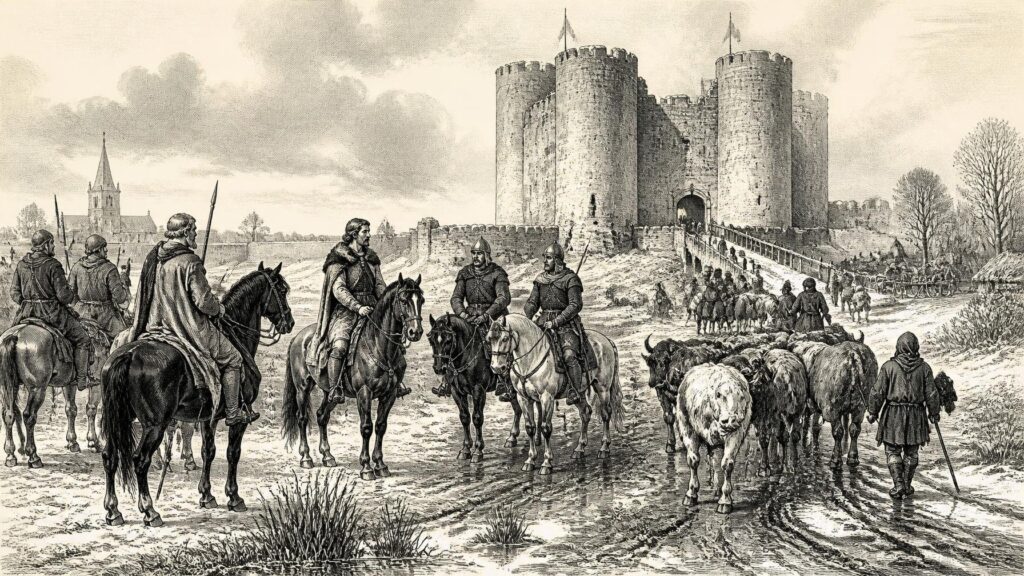
Brian Ballach Mac Uí Néill Buidhe’s death made the northern situation still more volatile. Annála Connacht places his treacherous killing at Carrickfergus in 1425 and praises him as a leading man among both Gaels and English, distinguished for feeding and clothing poor and needy people. The Annals of Ulster likewise reports his killing there, alongside John, son of Henry Ó Néill, by low-ranking servants of “the Rock” – Carrickfergus castle – but adds an important editorial caution that the killing might properly belong to the following year. It is therefore safest to connect the event firmly with the unsettled period beginning in 1425, rather than assigning it a precise day.
The contrast between the descriptions is instructive. The annals remembered Brian not simply as a war leader, but through hospitality, learning and generosity. In a lordship society, the capacity to feed dependants, guests, clerics and the poor was political capital as well as moral virtue. His death at a major royal stronghold also dramatised the tense proximity of Clandeboye power and the English settlement around Belfast Lough.
Winter, Worship and Learning
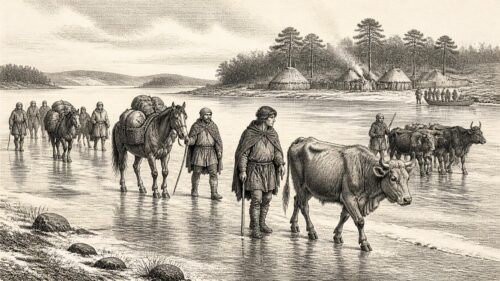
For ordinary households, however, the weather may have been more immediately important than elite manoeuvres. The Annals of Ulster reports “great inclemency” lasting from November Day to May Day, bringing widespread destruction of cattle, loss of tillage and loss of people across Ireland. Entered under 1425, the report evidently describes a winter running from November 1424 into spring 1425. It does not supply temperatures, snowfall or a total of deaths, and it should not be inflated into a precisely documented nationwide famine. But its three stated effects identify the essentials of a rural economy: livestock, crops and human survival were inseparable.
Cattle represented food, dairy produce, draught power, status and wealth; damaged tillage threatened later supplies as well as the current season. A prolonged bad winter could therefore weigh upon tenants, herders, religious houses and lordly households alike. The annalist’s island-wide phrasing may be rhetorical, but the decision to record the episode at all indicates distress on a scale that contemporaries thought exceptional.
The year’s notices also preserve quieter signs of a learned Christian society. Ruaidhrí Ó hUiginn, called an excellent poet, died. Gormlaith, wife of Tighernán Ó Ruairc, was said to have died “a death of penance”, language expressing an ideal of religious preparation at life’s end. The Annals of Ulster gives exact liturgical-style dates for two churchmen: Éoghan Ó Diarmata, a wright and canon of Lisgoole, died on 13 January; Matthew Ó Leannáin, canon of the same house, died on 29 April. Their recording reminds us that craft skill, clerical office and writing were not separate worlds.
At Dunmore in County Galway, an Augustinian friary is first securely mentioned in 1425 and is traditionally attributed to Walter de Bermingham, lord of Athenry. The exact foundation date is disputed: some evidence suggests the community may have existed before 1425. That uncertainty is itself useful. Rather than claiming a certain foundation in this calendar year, 1425 can responsibly be treated as the first documentary landmark for a religious house that would shape the town’s landscape for centuries.
Thus 1425 was a year of interrupted plans. Mortimer’s death removed a lieutenant at the moment of outreach to Ulster; Ormond responded with agreements whose durability could not be guaranteed; Connacht’s kingship changed hands amid local violence; and harsh weather imposed a more universal pressure. The surviving record is dominated by lords, clerics and annalists, yet it also allows a glimpse of the cattle, fields, hospitality, religious houses and vulnerable communities through which political power was experienced.
Primary Sources
- The Annals of Ulster: Year U1425
- Annála Connacht: Annal 1425
- Mortimer, Edmund
- Butler, James
- The English Lordship of Ireland and the Irish Sea World: Re-assessing the Origins of the Kildare Ascendancy, c.1390–c.1513
- The English Lordship of Ireland and the Irish Sea World: re-assessing
- The Rise and Fall of the Clann Einrí Aimhréidh Uí Néill: Dynastic Feuding and Geopolitics in the Late-Medieval Irish Sea World
- Private Sources at the National Archives
- National Library of Ireland Sources Catalogue: James Butler, Earl of Ormonde and Henry VI
- Climate, Disease and Society in Late-Medieval Ireland
- Medieval Irish Chronicles Reveal Persistent Volcanic Forcing of Severe Winter Cold Events, 431–1649 CE
- The Irish Annals and Climate, Fifth–Seventeenth Centuries CE
- Mortimer’s Castle
- Dunmore Augustinian Friary
- Archaeological Assessment: Dunmore Local Area Plan
- N83 Bridge Street Dunmore: Multidisciplinary Constraints Study and Route Options Report
- A Thousand Years of Church Heritage in East Galway
- Annals of Connacht (AD 1224–1544)
- CELT Project: The Annals of Ulster
- CELT Project: Annála Connacht
- CELT Project: Annals of the Four Masters
- O'Connor (Ó Conchobhair), Ruaidhrí
- A Task Too Great for One Dynasty? The Mortimer Earls of March, the de Burghs and Late Medieval Ireland