Tallaght’s 120 Hobblers1378 CE
In 1378, Ireland comprised overlapping political worlds rather than a unified national arena. Around Dublin, the English lordship defended Tallaght against O’Byrne pressure with 120 hobblers, compensated raid losses, mobilised tenants, regulated arms, and guarded Carlow during parliament. Exchequer officials collected debts, valued royal lands and administered payments, demonstrating limited but active government in core counties. Annalistic accounts record killings, rival successions and alliances among Burke, Mac Raghnaill, O’Rourke, Maguire and other lordships. Deaths of a bishop in Rome, scholars, poets and legal authorities reveal ecclesiastical and learned networks. Fragmentary sources portray power as military, fiscal, familial, scholarly and local.

Dateline
For Ireland, 1378 is best understood not as a year of one decisive national event, but as a year in which the limits of lordship were made visible in several places at once. The clearest contemporary administrative traces come from the English lordship’s shrinking but still organised zone around Dublin, while the Irish annals preserve deaths, killings and local fighting among Gaelic and Hiberno-Irish dynasties from Connacht to Fermanagh. These records do not describe a single Ireland. They reveal overlapping political worlds, connected by travel, war, money, learning and the Church, but governed locally.
Some care is essential. The surviving entry for 1378 in the Annals of Ulster consists only of its calendrical heading and a closing request for prayers for Ruaidhrí Ó Luinín, its scribe. Annála Connacht has a manuscript gap beginning in 1378. The fuller narrative comes from the seventeenth-century Annals of the Four Masters, which places events under this year but was compiled long afterwards and uses a chronology that does not always precisely match modern dating. Its notices remain valuable, especially for regional elites and learned families, but they should not be treated as a diary with exact dates for every episode.
A Garrison at Tallaght
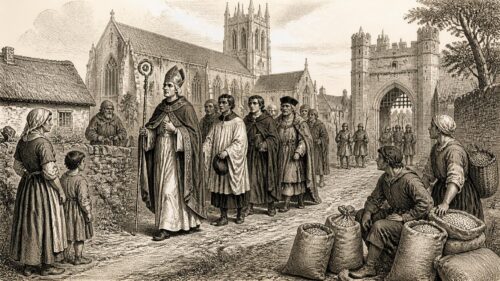
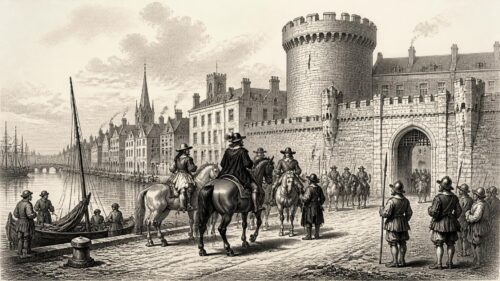
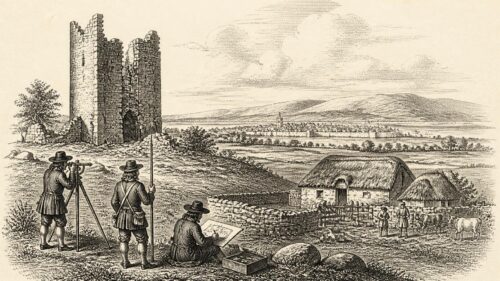
The most vivid securely year-linked development occurred on the south-western approaches to Dublin. Matthew, son of Redmond de Bermingham, took station at Tallaght Castle with 120 hobblers to resist the Ó Broin, or O’Byrne, kindred. Hobblers were lightly equipped mounted soldiers: more mobile and less costly than heavily armoured men-at-arms, and particularly suited to patrolling roads, carrying warnings and answering raids across broken ground. The number should not be mistaken for a field army. It was a frontier detachment, stationed where the settled and taxable districts around Dublin met the uplands and lordships beyond effective governmental control.
Tallaght had long been an exposed ecclesiastical manor of the archbishops of Dublin. Its castle, begun earlier in the fourteenth century, guarded a valuable agricultural district as well as a route towards the Wicklow mountains. The deployment of 120 hobblers shows that the threat was neither imagined nor merely ceremonial. In the same year John de Wade received £20 from the king’s Exchequer for two horses and other goods burned at Tallaght by the O’Nolans. The payment is a small but unusually human piece of evidence: animals, equipment and movable goods could be lost in a raid, while compensation required access to the machinery of royal finance.
These notices do not prove that Tallaght itself was continuously besieged, nor do they permit a reconstruction of every skirmish. They do show a landscape in which defended residences, mounted patrols, local watchfulness and compensation for losses were ordinary parts of life. For tenants and labourers, insecurity could mean interrupted cultivation, danger to livestock and transport, and the burden of supplying troops. The frontier was therefore not a neat line on a map, but a zone where farming, ecclesiastical estate management and military preparedness met.
Calls to Arms and Guarded Towns
The official record reinforces that impression. A proclamation dated 28 March required tenants to perform military service. Its surviving summary does not preserve the full wording, so it would be unsafe to claim precisely who was summoned or how many answered. Even so, it demonstrates that the lordship’s government was seeking to turn obligations attached to landholding into immediate defensive manpower. On 1 July another proclamation forbade the carrying of arms at Dundalk; a week later, on 8 July, persons aged between sixteen and sixty in Dublin were to be called out.
Read together, these measures suggest a government managing security through both mobilisation and restraint. Dublin required men for defence, yet Dundalk also required controls over armed people. Neither proclamation proves a particular battle, invasion or rising. Rather, they point to the difficulty of preserving order in towns and along the northern and southern approaches to the lordship. The same practical anxiety appears in an ordinance assigned to the Irish parliament of 1378: a special guard was to be provided for Carlow and its neighbourhood while parliament sat, and protection was also specified for the justiciar.
That parliamentary measure matters because it makes insecurity visible at the centre of government. Parliament was not a representative institution in a modern sense; it was principally an assembly of the lordship’s political community, its magnates, prelates and local interests. Yet even its meeting required special protection. Carlow, on the Barrow corridor and close to contested Leinster, was an appropriate place for such concern. The ordinance should not be inflated into evidence that all Leinster was collapsing. It does, however, show that the government treated the defence of its officials and political gatherings as a pressing operational matter.
Revenue, Office and Royal Service
Military administration depended on money, and dated Exchequer business provides a useful counterpoint to the raids. On 10 July, officials were appointed to collect sums owing from recently proclaimed royal service and other debts in Dublin, Kildare, Meath and Louth, to value lands and tenements in the king’s hands, and to undertake related work for the Crown. They worked from 15 July to 16 August. At Naas on 21 October, the justiciar, James Butler, earl of Ormond, ordered them £5 in reward for their thirty days’ labour, recording that they had gained substantial profit for the king.
This was not simply bookkeeping. It reveals the geographical core in which the royal administration could still name counties, pursue debts, inspect land and expect officials to travel between Dublin, Naas and the surrounding shires. The phrase about profit is the government’s own assessment, not an independently audited balance-sheet; nonetheless, the work shows active attempts to convert claims into cash. Three days earlier, also at Naas, an order directed payment to Butler of £500 arrears for his annual fee as justiciar for the year ending 7 October. The largest political office in the lordship thus had a stated monetary value, even if arrears themselves hint at the difficulty of keeping government funded.
The contrast is instructive. At Tallaght, royal authority was expressed through hobblers and compensation for burned property. In the core counties, it was expressed through writs, valuation, debt collection and payments authorised by the Exchequer. Both depended on local co-operation. Neither constituted control over the whole island.
Lordships and Violent Successions
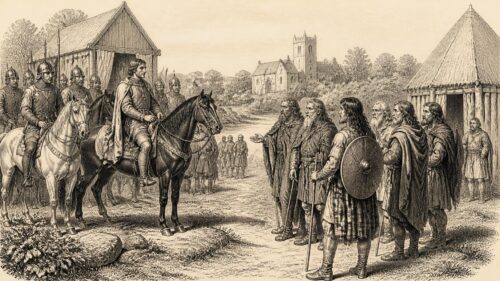
The annalistic notices assigned to 1378 show that conflict was equally embedded in the politics of Gaelic and Gaelicised lordships. Walter Mac William Burke was killed by the O’Malleys, a reminder that the Burkes’ extensive Connacht power was neither unitary nor unchallenged. Fergal Mac Raghnaill was killed by Con, son of Muircheartach Mac Raghnaill; later in the same annal an expedition by rival Mac Raghnaill forces, joined by the two Clann Aodha and Fergal O’Rourke, was defeated by Cathal Rua Mac Raghnaill and his allies, including Diarmait Mac Diarmata. Named dead included Mac Shanly and Mac Gilduff.
Such entries are terse, but their detail matters. They describe alliances formed from kinsmen, affinal relatives and neighbouring rulers, not anonymous ethnic blocs. The same year brought the death of Gilla Críst O’Rourke, lord of Breifne, and the killing of Brian Maguire, heir to the lordship of Fermanagh, by the sons of Art Maguire. Lordship was family property, but succession was not automatic: it required authority, followers, resources and, often, the elimination of rivals. The death of Turlough Mac Suibhne, styled high constable of Connacht, further indicates the continuing importance of military office and service within regional politics.
Violence was not confined to Connacht and the north-west. Tadhg, son of Lochlann Mac Conmara, was killed by a relative described through his maternal connection to an O’Dálaigh woman. Kinship could furnish solidarity, but it could also define the proximity within which disputes became lethal. These notices should not be used to portray medieval Ireland as uniquely disorderly. Comparable struggles over inheritance, service and local power ran through the English lordship as well. What differs is the documentary language and the institutions through which those conflicts appear.
Church, Learning and Hospitality
1378 also records loss in the religious and learned orders that sustained regional society. Cairbre O’Farrell, bishop of Ardagh, died at Rome. The annal praises him in devotional language, but the simple fact of his death there is significant: an Irish bishop could be present at the heart of Latin Christendom. The surviving notice does not say when he travelled, what business brought him to Rome, or whether his death was connected to the papal division that opened later in 1378. Those questions must remain unanswered.
Elsewhere the annal records Donnchadh Mac Brádaigh, chief of Cúil Bríghdin and Tullach Cearbhaill, as a general scholar, and John O’Fialáin as a good poet. Gilla Críst O’Sgingin, an ollamh in history for Cenél Conaill, also died. These are brief memorials, but they confirm that professional learning remained organised around households, churches and lordly patrons. History, poetry, genealogy and law were not decorative accomplishments: they helped articulate rank, inheritance, precedent and collective memory.
The death of Tadhg Mac Aodhagáin, chief brehon of Lower Connacht, is particularly revealing. The annal praises him as a wise man beyond dispute or reproach and says that he maintained a house of general hospitality for all comers. This is not merely praise of private generosity. A brehon was a learned legal authority, and hospitality was a recognised public virtue through which a powerful household displayed resources, attracted dependants and sustained reputation. His passing marks the loss of an individual, but also of an institution of law and patronage rooted in Connacht society.
Thus 1378 leaves no simple national narrative. It offers a defended castle outside Dublin, official calls for service, guarded political institutions and a government collecting what it could. It also offers contested lordships, bereaved learned families, a bishop dying in Rome and a chief jurist remembered for an open house. Taken together, these fragments show an Ireland of active local communities and competing authorities, in which military force, fiscal capacity, lineage, scholarship and Christian institutions all shaped everyday power.
Primary Sources
- Annals of the Four Masters, Annal M1378
- Annals of the Four Masters, Volume 4 English Translation
- Annála Connacht
- The Annals of Ulster, AD 1202–1378
- TEI Header for The Annals of Ulster
- Statute Law Revision Act 2015
- Statute Law Revision Act 2007, Schedule 2
- History of Parliament in Ireland
- Close Roll 2 Richard II (1378–1379), Item 9
- Close Roll 2 Richard II (1378–1379), Item 12
- Memoranda Roll, 1 Richard II (no. 85), Membrane 7
- Memoranda Roll, 1 Richard II (no. 85), Membrane 14
- Memoranda Roll, 1 Richard II (no. 85), Membrane 18
- Memoranda Roll, 1 Richard II, Membrane 33, Item 15
- Memoranda Roll, 1 Richard II, Membrane 36, Item 3
- Memoranda Roll, 3–4 Richard II, Membrane 16, Item 1
- Tallaght Castle and Town
- All Roads Lead to Tallaght
- The Annals of Ulster: Irish Text, AD 1202–1378
- The Annals of Ulster: English Translation, AD 1379–1541