Moylurg Conflict1377 CE
In 1377, Ireland’s regional lordships experienced warfare, fortification, religious loss and constitutional change. Clann Cuilein defeated Richard Burke’s Clanricarde force in Thomond, while Ruaidhrí Ó Conchobair overcame an alliance of Mac William Burke and Uí Maine at Roscommon. In Moylurg, war between Mac Diarmata and Ruaidhrí brought killings and the burning of crops and buildings, before peace and compensation. John O’Ferrall built Lissardowlin Castle in Annaly. Assaroe monastery burned, and prominent clerics and lords died. Edward III’s death, Richard II’s succession, and Robert Wikeford’s chancellorship affected Dublin government, whose authority coexisted with powerful local networks and military retinues across Ireland.
Dateline
The surviving notices for 1377 offer a particularly sharp view of Ireland’s western and midland lordships: not a single national drama, but several contests for authority whose consequences reached crops, settlements, churches and households. The fullest reports come from annals associated with Connacht and from the later Annals of the Four Masters. They firmly place major events in this calendar year, though they seldom provide a month, a battlefield location or the full chain of causes. Their emphases are revealing. They record the deaths of lords and clerics, but also the burning of a monastery, the construction of a castle, a destructive war in Moylurg, and two important victories against powerful rivals.
Victories in Thomond and Connacht
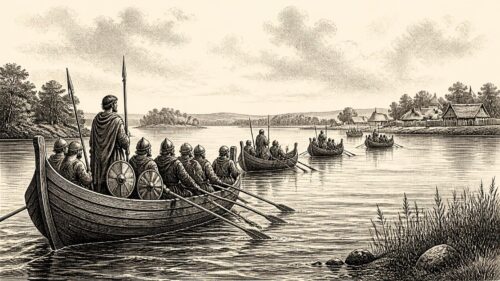
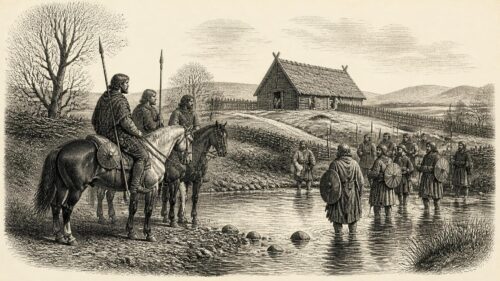
In Thomond, in the region of modern County Clare and adjoining districts, Richard Burke led an army into the territory of Clann Cuilein. The annals say that Clann Cuilein gathered around Mac Con Mara, identified in one version as Cú Mara, and defeated the attacking force of Clanricarde. Theobald, son of Ulick Burke, was killed, together with the three sons of Ó hÉidín; many other leading men of Clanricarde were slain or captured. The Four Masters calls Theobald the head of the ceithearnaigh, or kern, while the Connacht annalist describes him as leader of a great mercenary force. Both formulations underline that this was more than a casual raid: it was a conflict in which organised military followings and prominent kin-groups were committed.
The outcome also complicates any simple division between “Irish” and “English”. The Burkes of Clanricarde descended from Anglo-Norman settlers, but by the later fourteenth century they were deeply embedded in the political world of western Ireland, competing and allying with Gaelic dynasties in ways that cannot be reduced to Crown policy. The Mac Con Mara victory was therefore a local assertion of lordship by Clann Cuilein against a neighbouring power with its own Irish roots and interests. The annals do not give the site or date of the fighting, and it would be unsafe to supply either. Yet the named dead and prisoners make clear that the defeat mattered to the ruling networks of Thomond and Connacht.
Another decisive encounter occurred at Roscommon. Ruaidhrí Ó Conchobair defeated Mac William Burke and Máel Sechlainn Ó Cellaig, lord of Uí Maine. The casualty list was formidable: Richard Burke, brother of Mac William; Domnall, son of Cathal Óg Ó Conchobair; Tadc Óg Ó Cellaig; Ó Mainnín, chief of Sodan; and Mac Dubgaill the gallóglaigh were among those named. The Connacht annalist adds that many people of both high and low standing fell. This victory gave Ruaidhrí a striking military success against an alliance joining Burke and Ó Cellaig interests, but it was not a neat victory of one people over another. An Ó Conchobair kinsman died on the opposing side, a reminder that dynastic politics could divide kindreds as well as unite them.
The mention of Mac Dubgaill as a gallóglaigh points to a wider military development already well established by 1377. Gallóglaigh, originally warriors connected with the Gaelic world of the Scottish islands and western seaboard, served as heavily equipped professional infantry in Ireland. Their presence in the Roscommon casualty list should not be stretched into a numerical estimate of the armies involved. It does, however, show that access to such military specialists was part of the practical power of Connacht lords. Alongside them were local fighting men, horsemen, retainers and the households whose food, livestock and labour sustained campaigning.
War Against the Land
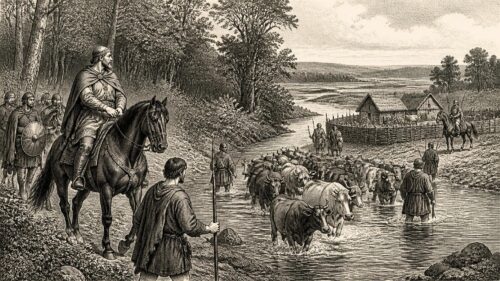
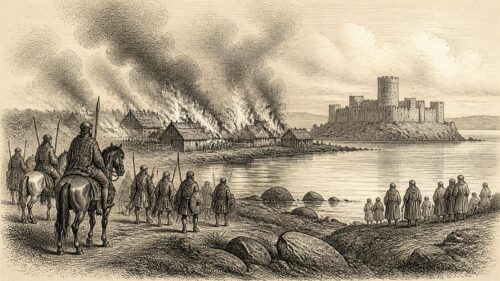
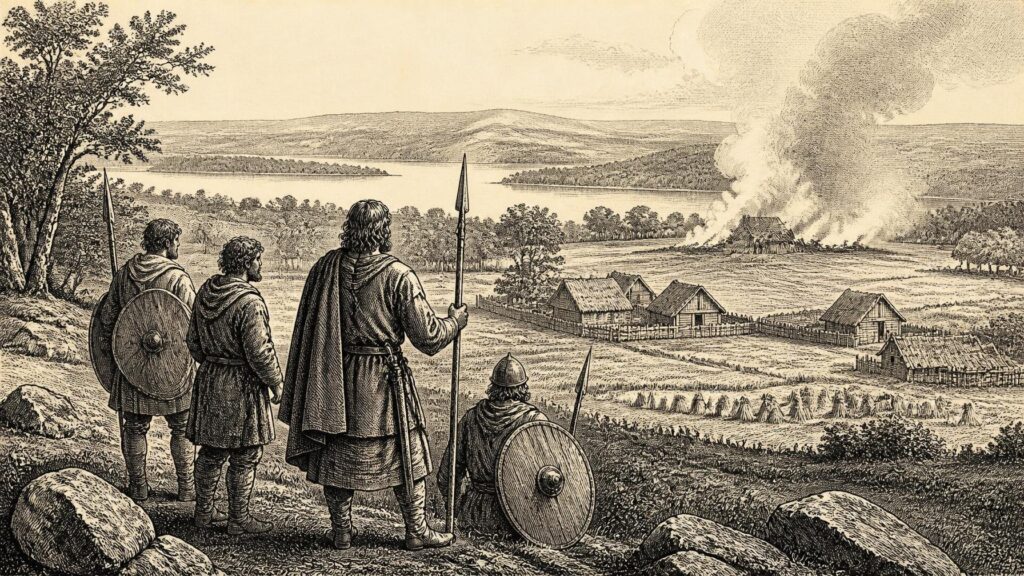
The year’s starkest account of civilian hardship concerns Moylurg, the Mac Diarmata lordship around Lough Key in modern County Roscommon. A “great war” broke out between Mac Diarmata and Ruaidhrí Ó Conchobair. The annals state that Moylurg was spoiled and burned, including its corn and buildings, and that people were killed on both sides. This is firmly assigned to 1377, but neither source identifies a single day of devastation or a complete sequence of operations.
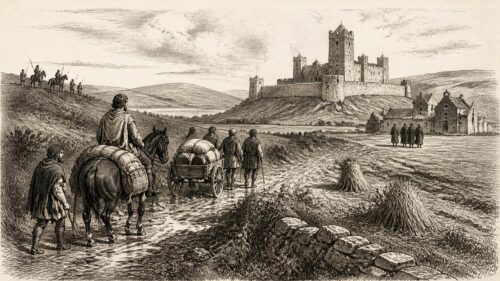
Its wording matters. To burn standing or stored corn was to attack future as well as present subsistence. Buildings could include homes, farm structures and lordly installations; the annals do not itemise them. Nor do they record the names of those displaced, injured or impoverished. Nevertheless, the explicit inclusion of crops tells us that the conflict struck at the material basis of ordinary life. In an agrarian lordship, fields, grain, livestock and seasonal labour were assets through which political dominance was financed and experienced. Destruction of them weakened an adversary while imposing immediate burdens on tenants and dependants.
Yet the entry ends not with annihilation but settlement. Mac Diarmata and Ruaidhrí made peace, and Mac Diarmata received substantial concessions or compensation for the damage done, described as the price of peace. Such compensation was politically significant: it publicly recognised injury, assigned a cost to ending the feud and helped make a settlement enforceable among followers who had suffered losses. The exact terms are lost, so it cannot responsibly be called tribute, ransom or a formal treaty. It was, however, a negotiated conclusion to a war whose violence had devastated a named territory.
A Castle in Annaly
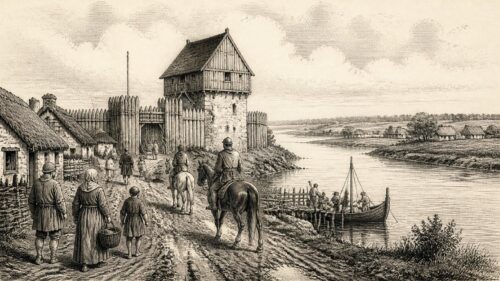
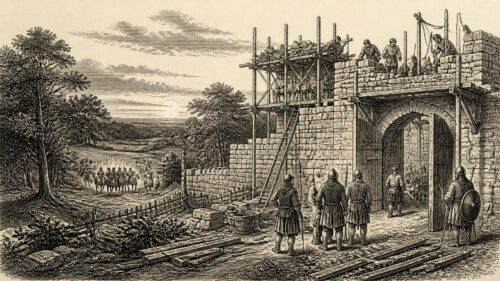
While Moylurg was being ravaged, a new fortified site was recorded in Annaly, broadly corresponding to much of modern County Longford. Seoán Ó Fearghail, or John O’Ferrall, lord of Annaly, built the castle of Lis-ard-abhla, later known as Lissardowlin. This is one of the relatively rare annalistic notices that assigns the construction of a castle to a specific lord and year. The place-name has been understood as the fort of the height or hill of the apple trees, and later antiquarian evidence associated it with a site near Longford.
The entry does not permit a precise reconstruction of the structure. It does not say whether it was a tower, hall, masonry enclosure, timber-and-earthwork complex or a building phase within an older defensive landscape. What can be said is that the word “castle” marked a claim to durable lordship. A defended residence could concentrate retainers, store provisions, oversee routes and provide a visible focus for seigneurial authority. Its construction by an Ó Fearghail lord demonstrates that fortification was not exclusively an inheritance of the Anglo-Norman settlement: Gaelic rulers, too, used castles and strongholds within the political vocabulary of late medieval Ireland.
Churches, Learning and Loss
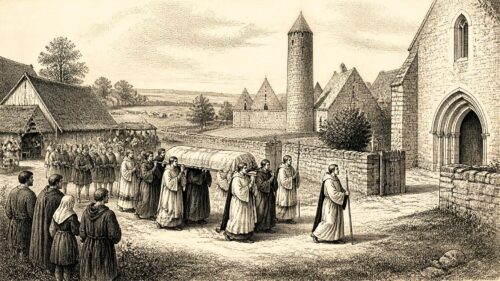
Religious institutions feature repeatedly in the year’s notices. The monastery of Assaroe, beside the Erne near Ballyshannon, was burned. Both major annalistic accounts record the fire, but neither names those responsible or specifies how much of the monastic complex was destroyed. It would therefore be wrong to turn the report into a securely identified military attack. Still, a fire at such a house was a serious local event. A monastery was not merely a place of worship: it held land and livestock, housed religious personnel, received travellers, preserved books and archives, and was woven into the economy and memory of its surrounding region.
Deaths recorded in 1377 show the breadth of ecclesiastical and learned authority. Bishop Ó Cellaig of Clonfert died. Seán Ó Rodacháin, comarba or successor of St Caillin, also died and was called a sage of Ireland. The title indicates an office tied to the heritage of a saint and to the management of a church community, rather than simply a personal devotional distinction. The Four Masters additionally records the death at Rome of Mac Muirgheasa, described as the great dean. His presence in Rome, like other Irish ecclesiastics who travelled for ecclesiastical business, shows that Irish churchmen and institutions retained connections beyond the island even amid local warfare.
Other deaths traced the geography of lordship: Walter, son of Sir David Burke; Sefraid Ó Flannacáin of Clann Cathail; Brian Ó Flaithbheartaigh; Donnchad Ó Cerbaill, lord of Ely; Diarmait Mac Branáin of Corca Achlann; and Fachtna Ó Mórdha of Laois are among those noticed. Obituary entries should not be mistaken for full political biographies, but their selection shows what annalists regarded as losses worth preserving: leaders of kindreds, holders of offices, patrons and learned churchmen. The record of Brian Ó Flaithbheartaigh’s death, for example, does not explicitly style him lord of Iar Connacht, so that title should not be asserted as a certainty for 1377.
A New King, Limited Reach
Events in England directly touched the administration of the Lordship of Ireland. Edward III died on 21 June 1377 and was succeeded by his ten-year-old grandson Richard II. In September, Robert Wikeford, archbishop of Dublin, was appointed chancellor of Ireland; the appointment is dated 26 September. The change of monarch required the renewal of royal authority in documents, seals and offices. Wikeford’s appointment placed a senior churchman, trained in law and already connected to royal service, at the centre of the Dublin administration.
But 1377 itself demonstrates the limits of interpreting Irish history from Dublin or Westminster alone. The Crown’s lordship remained important in the eastern towns and shires and in formal institutions of government. Beyond them, the year’s principal recorded struggles were fought through regional coalitions, kinship, mercenary service, raids, negotiations and compensation. The deaths of Edward III and the appointment of Wikeford mattered constitutionally; the burning of Moylurg’s corn mattered immediately to people living through war. Together, these events reveal an Ireland of overlapping powers, in which local lordships were not marginal to politics but were the places where power was most tangibly exercised.
Source References
Hover over a number to see the source. Select it to open the source.

- [1] Annála Connacht, Annal 1377
- [2] Annals of the Four Masters, M1377
- [3] Annals of the Four Masters: Volume 4 English Translation
- [4] Annala Rioghachta Eireann: Annals of the Kingdom of Ireland, Volume 4
- [5] Wikeford (Wickford, Wykeford), Robert
- [6] The Mediaeval Irish Chancery
- [7] The Calculus of Faction and Richard II’s Irish Policy
- [8] Titles and Heraldry: Princes of Wales Since 1301
- [9] Richard II (r. 1377–1399)
- [10] The Professional Historians of Medieval Ireland
- [11] Richard II and the Wider Gaelic World: A Reassessment
- [12] Urban Rebels in Medieval Connacht: The Revolt of Galway, 1388–9
- [13] Having the Right Kit: Galloglass Fighting in Ireland
- [14] Normans & Natives in Medieval Connacht
- [15] The Later Middle Ages
- [16] Normans Becoming More Irish
- [17] Annála Connacht: CELT Edition
- [18] Annales Hiberniae
- [19] Chronological Synchronisation of the Irish Annals
- [20] Exploring the Irish Annals
- [21] Ardagh History: Lissardowlan Castle Record
- [22] Tower House Construction in Ireland: Documentary Evidence and Dating
Primary Sources
- Annála Connacht, Annal 1377
- Annals of the Four Masters, M1377
- Annals of the Four Masters: Volume 4 English Translation
- Annala Rioghachta Eireann: Annals of the Kingdom of Ireland, Volume 4
- Wikeford (Wickford, Wykeford), Robert
- The Mediaeval Irish Chancery
- The Calculus of Faction and Richard II’s Irish Policy
- Titles and Heraldry: Princes of Wales Since 1301
- Richard II (r. 1377–1399)
- The Professional Historians of Medieval Ireland
- Richard II and the Wider Gaelic World: A Reassessment
- Urban Rebels in Medieval Connacht: The Revolt of Galway, 1388–9
- Having the Right Kit: Galloglass Fighting in Ireland
- Normans & Natives in Medieval Connacht
- The Later Middle Ages
- Normans Becoming More Irish
- Annála Connacht: CELT Edition
- Annales Hiberniae
- Chronological Synchronisation of the Irish Annals
- Exploring the Irish Annals
- Ardagh History: Lissardowlan Castle Record
- Tower House Construction in Ireland: Documentary Evidence and Dating