Downpatrick’s Fallen Lieutenant1375 CE
In 1375, Ireland’s fragmented political order was revealed through warfare, succession, negotiation and administration. Niall Ó Néill defeated the English or Anglo-Irish of Downpatrick, killing Sir James of Malahide and others, demonstrating northern Gaelic strength. In Leinster, Donnchad Caemánach Mac Murchada was treacherously killed, opening the way for Art Mór’s later rise. Connacht rivals exchanged Roscommon and Ballintober castles, while Thomas succeeded Sir Edmund Albanach Mac William Burke. Raids, betrayals and kin killings exposed local insecurity. Annals recorded religiously framed deaths and poet Máel Sechlainn Ó Domhnalláin. William de Windsor’s cash-strapped administration operated as Edward III sought support at Westminster.

Dateline
A Year Recorded in Fragments
The surviving evidence for Ireland in 1375 is concentrated but unusually revealing. Irish annals, written in different regions and preserved in later manuscripts, record a northern victory, a Leinster killing, a negotiated transfer of castles in Connacht, local raids and betrayals, changes of lordship, and the deaths of a poet and several leading figures. English administrative records add another perspective: William de Windsor remained chief governor for Edward III, government finances were strained, and political communication between Ireland and Westminster was becoming more direct. The year cannot be reconstructed day by day. Apart from a few formal documents, the sources rarely give dates within the year, troop numbers or full causes. Yet they show an island whose power was divided among Gaelic lordships, Anglo-Irish communities, church institutions and royal officials, each with its own languages, loyalties and political horizons.
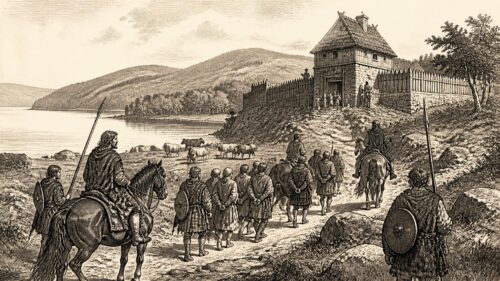
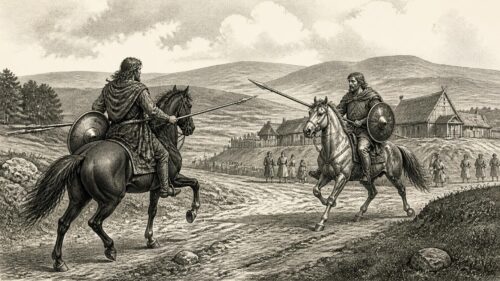
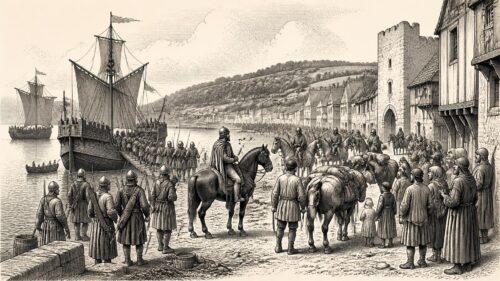
The most dramatic event was a defeat inflicted on the English of Downpatrick by Niall Ó Néill. The Annals of the Four Masters explicitly credit Niall with the victory; the Annals of Connacht and Annals of Loch Cé likewise report a great defeat of the Galls, or foreigners, of Downpatrick. All name Sir James of Malahide and a Burke of Camlin among the dead, along with many others. The annals call James the king of England’s deputy or lieutenant. They do not provide the day of the battle, its exact site beyond Downpatrick, the size of either force, or evidence that the town itself was captured. Those limits matter. What is securely dated is a serious reverse for the English interest in east Ulster during 1375, not a complete account of a campaign.
Niall Ó Néill at Downpatrick
Downpatrick was a significant target in the former earldom of Ulster: a walled Anglo-Irish borough and an ecclesiastical centre in the old territory of Dál Fiatach. A force operating there could draw on the town, nearby estates and the connections of the English lordship, but it was also exposed to the expanding influence of the Ó Néills of Tír Eógain and their allies. The death of a named royal officer, as the annals present Sir James, made the defeat more than an ordinary cattle raid or border skirmish. It demonstrated that royal and colonial authority could be challenged violently well beyond the narrow core of government around Dublin.
The victory belongs in a closely connected northern sequence rather than being treated as an isolated miracle. The annals record another victory by Niall over foreigners in 1374. That earlier success does not explain every circumstance of 1375, but it establishes that Niall was already campaigning against Anglo-Irish interests before the Downpatrick defeat. During the 1360s and 1370s, branches of the Ó Néill kindred were extending their influence in Ulster through warfare, marriage connections and alliances. In that setting, the encounter at Downpatrick was a sharp indication of the fragility of the old Anglo-Norman foothold in the north-east.
It would be misleading, however, to cast the conflict simply as Ireland against England. The Irish annals’ word Galls could denote English or Anglo-Irish opponents, while the families identified as Burke, Bermingham and others had long been rooted in Ireland. Political communities were not neatly separated by descent. Gaelic rulers fought other Gaelic rulers; Anglo-Irish lords formed local interests distinct from Westminster; and people could change sides for payment, protection or kinship. The events recorded elsewhere in 1375 make that complexity unmistakable.
Leinster after Donnchad Caemánach
In Leinster, Donnchad Caemánach Mac Murchada, described by the annals as king of Leinster, was killed treacherously by Galls. The charge of treachery is the annalist’s judgement, and the sources do not identify the killers, venue or immediate political trigger. Even so, the death was consequential. Donnchad belonged to the Mac Murchada Caomhánach dynasty, whose territories and claims lay across the south-eastern midlands, the Barrow valley and the Leinster mountains. His removal created a dangerous opening within a ruling kindred facing pressure from neighbouring Gaelic powers and the English lordship’s towns, manors and highways.
Art Mór Mac Murchada Caomhánach, Donnchad’s nephew, became a leading figure in the dynasty after this killing. Later developments should not be projected backwards too confidently: Art’s greatest power and his famous struggles with Richard II lay in the future. Nonetheless, 1375 was an important threshold. The loss of Donnchad weakened one established leader while the younger Art began to build the alliances and military following that would make him the foremost Leinster ruler of the following decades. Thus an annalistic notice of a killing marks the beginning of a much larger change in regional politics.
Castles as Bargaining Pieces
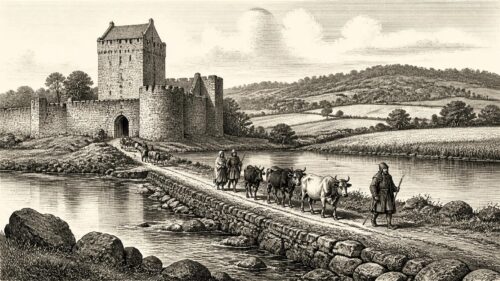
Connacht’s central event was not a battle but a settlement between rivals of the Ó Conchobair dynasty. Toirrdelbach Ruad Ó Conchobair gave Roscommon Castle to Ruaidrí Ó Conchobair in return for Ballintober and additional concessions that the annalist did not list. The wording is important: this was an exchange, not merely a seizure. Control of strongholds could be negotiated, and a castle’s value lay not only in its walls but in the authority, revenues, routes and dependants associated with it.
Roscommon Castle had been founded as a royal English fortress in the thirteenth century, yet by the later fourteenth century it was embedded in the contests of Connacht’s Gaelic dynasties. Ballintober, meanwhile, was another strategically important castle and settlement in the Ó Conchobair sphere. Their exchange illustrates the fragmented political geography of the island. The crown’s historic claims, the inherited prestige of a royal castle, and actual possession on the ground were not the same thing. Local rulers could convert fortifications into the currency of agreement, rivalry and territorial management.
In the west, a second succession followed the death of Sir Edmund Albanach, Mac William Burke. The annals report that he died after penance and anointing, and that his son Thomas succeeded him. This was a lordship of Anglo-Norman origin, but the title Mac William had become a major Connacht institution, tied to regional lordship and local networks rather than simply to commands from England. The same year also brought the death of Mac Feorais of Athenry and of Cathal, son of Cathal Óg, of Clanricarde. Such notices show how frequently the balance between powerful families could shift through death as well as war.
Raiding, Betrayal and Vulnerability
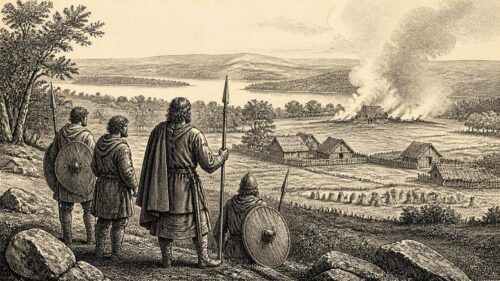
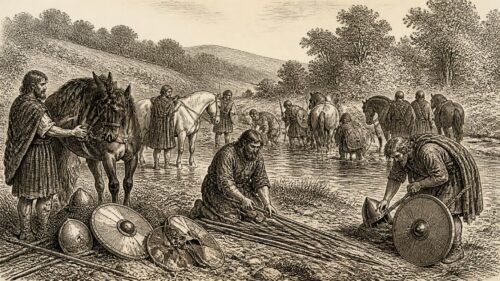
For lesser lords and their followers, 1375 was marked by the harsh mechanics of small-scale conflict. Diarmait Mag Ragnaill raided Cormac Ó Birn, killing Donnchad son of Conchobar an Choppáin and others, and carried away substantial spoils. The annals do not specify precisely what was taken; they do show that raiding remained a means of enriching a lordship and inflicting political loss on a rival. A separate expedition by Cairbre and Eógan, sons of Mag Tigernáin, against the Galls ended disastrously when one of their own people betrayed them for payment. Twenty-five men, including both brothers, were killed and beheaded.
These episodes should not be mistaken for a complete picture of daily life, but they illuminate its insecurity in contested districts. Armed followings needed food, horses, weapons and dependable intelligence. Kinship created obligations, yet the annals repeatedly acknowledge treachery within kindreds: Mac Airtéin, lord of Kinelarty, was killed by a kinsman; Oscar Mag Uidhir was killed by the sons of Donnchad Mag Uidhir. Political authority depended on personal loyalty, and that loyalty could be bought, divided or avenged.
Penance, Poetry and Government
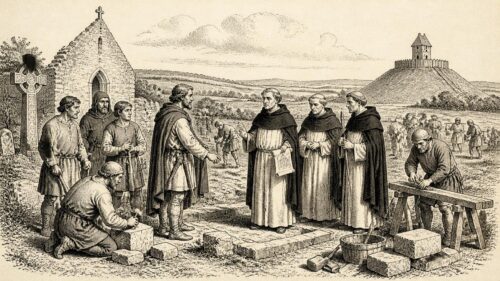
Religion appears in 1375 not as a separate sphere from politics but as part of the language through which rank, illness and death were understood. Cú Uladh Mac Mathghamhna, tanist of Oriel, died after blood-letting, a medical practice intended to restore health but evidently fatal in his case. Sir Edmund Burke’s death was framed as a good Christian ending, following penance and unction. The annals praise Art Mag Uidhir for hospitality and generosity, while Geoffrey Ó Fearghail was remembered as a worthy prospective lord of Annaly for hospitality, prowess and courteous conduct. Such formulae were not empty compliments: generosity to guests, retainers, clerics and learned people was central to the public reputation expected of a successful lord.
The death of Máel Sechlainn Ó Domhnalláin is particularly significant for cultural history. He was described as an ollam, a recognised master, of Síol Muiredaig in poetry; the Four Masters goes further, calling him the most learned man in Ireland in that art. The statement is an annalistic evaluation, not a measurable national survey, but it confirms the standing of professional learned families and the continuing prestige of formal Irish poetry. Their work preserved genealogies, praise, history and political memory for patrons whose authority was constantly being contested.
Meanwhile, the English administration had not vanished. William de Windsor was still governor and keeper of Ireland in 1375, and records show governmental business continuing through Dublin and the royal council. A Dublin parliament held around the octave of Hilary considered a petition from James Butler, earl of Ormond, and royal documentation soon confirmed his right to search for copper or lead within his Irish lordship. Windsor held parliaments in the year while seeking money for government. By the autumn Edward III had taken the exceptional step of summoning the commons of the Irish parliament to appear before him at Westminster. This did not mean that the crown governed the whole island effectively. Rather, it reveals a lordship under fiscal and political pressure, trying to draw support from its Irish subjects while defeats such as Downpatrick exposed its limited reach.
In 1375, then, Ireland was neither a country falling uniformly under English rule nor a land unified under Gaelic recovery. It was a mosaic of contested jurisdictions. Niall Ó Néill’s victory near Downpatrick displayed northern Gaelic strength; Donnchad Caemánach’s killing unsettled Leinster; the Roscommon–Ballintober exchange showed negotiation at the heart of Connacht; and the deaths of lords, a poet and local leaders registered the human turnover on which politics depended. The year’s records are brief, but together they capture a society in which fortresses, family alliances, hospitality, learned status, royal paperwork and sudden violence all shaped power.
Primary Sources
- Annála Connacht, Annal 1375
- Annals of Loch Cé, Annal LC1375
- Annals of the Four Masters, Annal M1375
- The Annals of Ulster, Year U1375
- CELT: Translated Texts at CELT
- Irish Script on Screen: MS A 13, Annals of the Four Masters
- Windsor, William | Dictionary of Irish Biography
- Close Roll 49 Edward III (1375–1376), Item 59 | Virtual Treasury of Ireland
- Calendar of Ormond Deeds, Volume II, 1350–1413
- Negotiating Authority in a Colonial Capital: William of Windsor and Dublin
- MacMurrough Kavanagh (Mac Murchadha Caomhánach), Art Mór | Dictionary of Irish Biography
- Genealogical Tables: Mac Murchada
- Extracts from the Urban Archaeological Survey: Roscommon Town
- Roscommon Castle | Roscommon County Council
- Ballintober Castle Survey
- Wikeford (Wickford, Wykeford), Robert | Dictionary of Irish Biography
- Fasti Ecclesiae Hibernicae, Volume II
- Order, 5 July 1375, Westminster | Reading the Rolls
- The Mediaeval Irish Chancery
- Irish Historical Studies: Urban Rebels in Medieval Connacht: the Revolt of Galway, 1388–9