Scottish Campaign1301 CE
In 1301, Irish annals recorded local conflict, religious deaths and Ireland’s involvement in Edward I’s Scottish campaign. Áed Ó Conchobair and Clann Muirchertaigh raided Mag Cétne, while killings among Muintir Chionaoith and Uí Máel Sechlainn exposed dynastic rivalries. The deaths of Gilla Íosa Mac Fir Bisig, an eminent ollam, Abbess Finnguala of Kilcreevanty, priest Matha Mac Raith and steward Cathal Ó Máel Dúin illuminate Gaelic learning, ecclesiastical leadership and royal administration. Anglo-Irish magnates and forces served in Scotland from late July to November, although the earl of Ulster stayed behind. These fragmentary records reveal interconnected Gaelic and English political worlds.
Dateline
The surviving notices for 1301 do not describe one island-wide crisis, coronation or battle. Instead, they offer a sharply local record: a raid in Connacht, a killing within the Uí Máel Sechlainn kindred, the deaths of religious and learned figures, and the removal of Anglo-Irish military power for Edward I’s Scottish war. Read together, these entries show Ireland as a place of overlapping political worlds. Gaelic lordships maintained their own offices, dynastic rivalries and cultural institutions, while the English crown’s lordship drew men, ships, money and attention across the Irish Sea.
The most detailed Irish account is the Annals of Connacht. Its heading explicitly places the entries in 1301 and supplies the calendrical apparatus familiar to learned annalists: 1 January fell on a Sunday, the year was common rather than embolismic, and it was assigned places within solar, lunar and indiction cycles. Such information was not decorative. Correct calculation of feasts and the liturgical year was a serious scholarly discipline, and the annal’s own commemorations make clear that this knowledge had custodians in Gaelic society.
A Raid in Mag Cétne
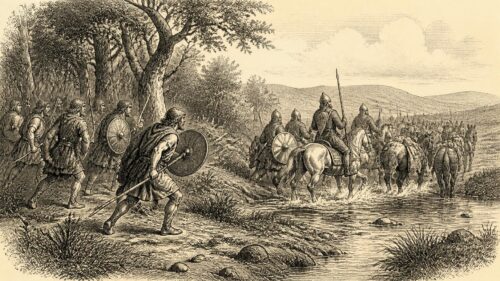
The year’s clearest act of warfare was a “great raid” by Áed son of Cathal Ó Conchobair and Clann Muirchertaigh against Tadg son of Andrias in Mag Cétne. The annal gives no day, battle-site, casualty total or stated cause; those should not be invented. Yet the choice of the word “great” indicates more than a minor cattle theft. A creach could combine the seizure of livestock, food and movable wealth with the deliberate assertion of superiority over a rival. It was a form of warfare that bore directly on households: herds sustained diet, labour, rents, fosterage obligations and political patronage.
Áed belonged to the extensive Ó Conchobair royal kindred of Connacht, but the record does not call him king in this entry. That restraint matters. Connacht’s kingship and its subordinate territories were contested through alliances among branches of the dynasty and associated lordly groups. Clann Muirchertaigh appears alongside Áed both in the raid and in a second, more lethal notice: Muirchertach Mac Con Snama, described as eligible for the chieftainship of Muintir Chionaoith, was killed by that same group. Muintir Chionaoith lay in the Breifne borderland around Lough Allen and the Arigna country. The two entries suggest that the year’s violence reached across Connacht’s northern and eastern connections, but they do not establish that raid and killing were stages of one campaign.
Another dynastic killing was recorded among the Uí Máel Sechlainn. Cormac son of Cormac Ó Máel Sechlainn was killed by the son of Art Ó Máel Sechlainn, identified carefully as his father’s brother’s son. The specificity of the relationship is characteristic of annalistic writing, where descent established both status and motive. It also warns against treating politics as a simple contest between Gaelic and settler communities. Kinship disputes could be as consequential as conflicts across cultural or linguistic boundaries, especially in territories where lordship depended on the support of close agnatic relatives.
A Learned Man Remembered
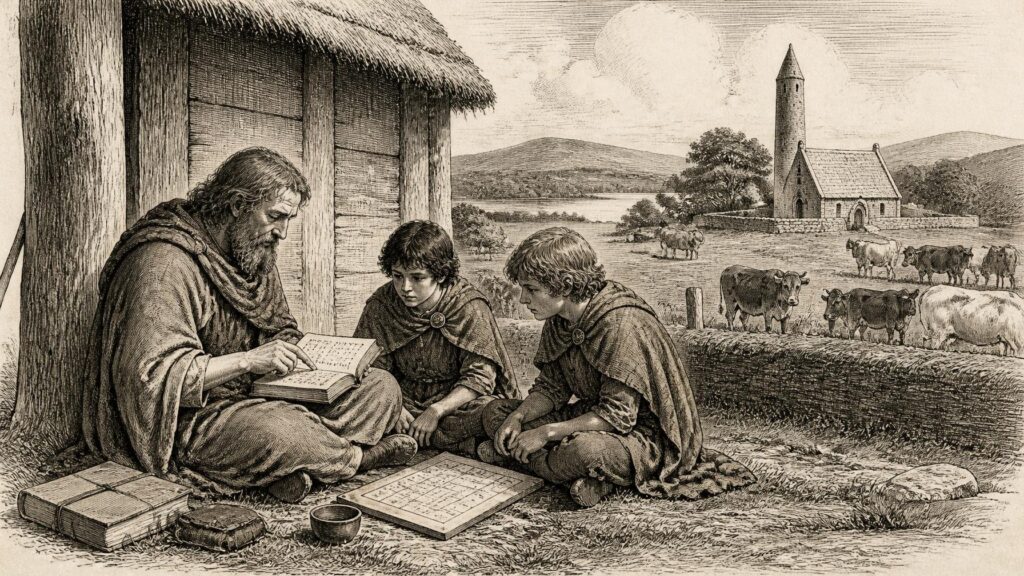
Among the deaths recorded in 1301, that of Gilla Íosa Mac Fir Bisig is the most revealing for the intellectual life of Gaelic Ireland. He was ollam of Uí Fiachrach Muaide, the learned province associated with the north Mayo and south Sligo region. An ollam was not simply a literate cleric or a casual storyteller, but a master recognised at the highest grade of a learned profession. The annalist credits Gilla Íosa with mastery of history, tales, poetry, computus and “many other arts”.
That list captures the breadth of training expected in a major learned household. History preserved dynastic precedent and genealogical memory; narrative and poetry could praise patrons, shape reputations and transmit moral or political knowledge. Computus was the calculation of the ecclesiastical calendar: the complicated reckoning needed to determine Easter and related observances. These fields were interdependent rather than isolated subjects. A man able to handle them could serve a lordly community in law, commemoration, education and the ordering of sacred time. The entry is therefore evidence not merely of one death but of an organised culture of expert learning, taught, rewarded and valued in the Gaelic west.
There is an important limit. No manuscript can safely be attributed to Gilla Íosa on the strength of this notice alone, and the annal does not describe his school, pupils or place of burial. What it does prove is unusually valuable: in 1301 an annalist considered the death of a regional ollam, skilled in both vernacular and calendrical disciplines, an event worthy of permanent record.
Abbess, Priest and Steward
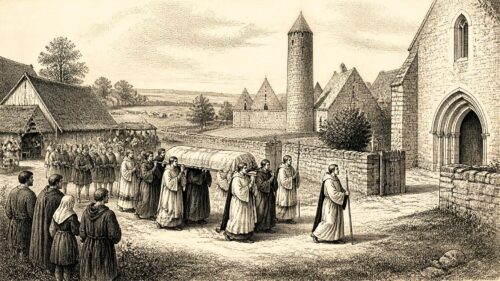
Religious and administrative deaths give the year another texture. Finnguala, daughter of Fedlimid Ó Conchobair and abbess of Kilcreevanty, “rested in Christ”. Her identification by both family and office demonstrates that a woman of the royal Connacht kindred headed an important religious house. Kilcreevanty, or Cill Chraobhnaid, stood in the Tuam–Dunmore region. Its community had strong connections with the Ó Conchobair dynasty and belonged to the Arroasian Augustinian tradition. Finnguala’s death was not merely private bereavement: the loss of an abbess raised questions of succession, management of lands and goods, and the continuing relationship between a convent and its patrons. The annal, however, does not name her successor or report a dispute in 1301.
Matha Mac Raith, “a great priest of Ardcarne”, was also commemorated. The annalist praises him as charitable and humane, a formula which tells us more about admired priestly conduct than about precise acts in his life. Ardcarne, near the Lough Key and Boyle district, was an established ecclesiastical site in a politically connected landscape between Connacht and Breifne. His obituary nevertheless offers a rare glimpse of the local clergy whom communities expected to exercise hospitality and care.
Cathal Ó Máel Dúin of Uí Fiachrach Muaide, named high steward of the king of Connacht, died in the same year. The office shows that Gaelic kingship operated through more than a king and fighting men. Even if the exact duties of this particular steward are not set out, the title signals a recognised senior role within the royal household and political order. His death, like that of the ollam, removed specialised knowledge and connections from the Uí Fiachrach region.
Ireland’s Army in Scotland
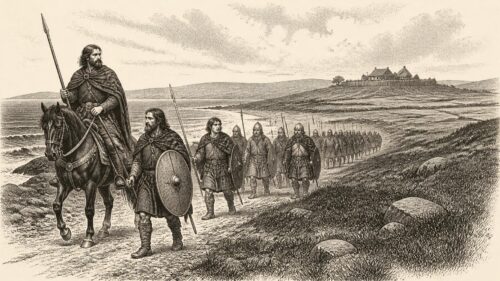
1301 also connected Ireland directly to the continuing war between Edward I of England and his Scottish opponents. The Annals of Connacht state that the king led an army into Scotland, accompanied by Mac Gerailt, Mac Feorais and the leading “Galls” of Ireland, with the notable exception of the earl of Ulster. In the annalists’ usage, “Galls” broadly denoted the English or Anglo-Irish political community; it should not be mistaken for a single uniform population.
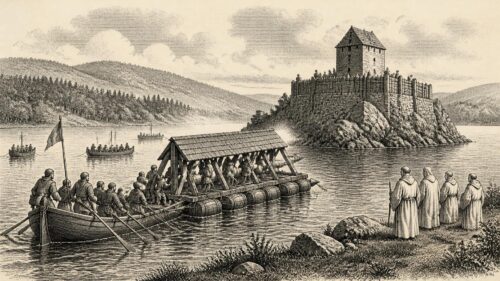
The notice gives a valuable span of service: the Irish contingent was in Scotland from a week before Lammas, 1 August, until All Saints’ Day, 1 November. It concludes bluntly that they did not fully conquer Scotland. Other evidence confirms the heavy Irish contribution. John Wogan, justiciar of Ireland, spent much of 1301 in Scotland heading an Irish force; Peter de Bermingham is independently recorded as fighting there; and the crown had worked to secure magnate participation through favourable pay and remissions of debts. Irish ports and resources were also drawn into the logistics of the expedition.
Richard de Burgh, earl of Ulster, was the conspicuous absentee in the Connacht annal. He had strong links with the Scottish political world and had been summoned for the campaign, but did not go in 1301. His absence should not be read as simple disloyalty: magnates bargained hard over service, cost and reward, while maintaining their own extensive interests in Ireland. Still, the annalist evidently found the omission significant enough to preserve. It reveals how carefully observers tracked the choices of the greatest lords.
For Ireland, the Scottish expedition had consequences beyond the men who crossed the sea. Service removed armed retainers and leading landholders for months; it required transport, victuals and finance; and it tied the administration in Dublin to Edward I’s northern war. Yet the island did not become politically dormant. While Wogan and many magnates were away, local raiding, succession struggles, conventual life and learned work continued. The records of 1301 are fragmentary, but their combination is eloquent: Ireland was neither a remote appendage of the English crown nor a single Gaelic kingdom, but a densely connected society in which local power and wider war constantly met.
Source References
Hover over a number to see the source. Select it to open the source.

- [1] Annála Connacht: Annal 1301 (English translation)
- [2] Annála Connacht: Annal 1301 (Irish text)
- [3] CELT Project: Annála Connacht
- [4] Annals of Loch Cé: Annal 1301 (English translation)
- [5] Annals of Loch Cé: Annal 1301 (Irish text)
- [6] CELT Project: Annals of Loch Cé
- [7] Annals of the Four Masters
- [8] CELT Project: Annals of the Four Masters
- [9] Annala Uladh: Annals of Ulster otherwise Annala Senait, Annals of Senat
- [10] Wogan, John
- [11] Burgh, Richard de
- [12] Bermingham, Peter
- [13] Butler (le Botiller), Edmund
- [14] O'Neill (Ó Néill), Domhnall
- [15] Kilcreevanty Church and Graveyard Conservation Management Plan
- [16] Placenames Database of Ireland
- [17] An tOrdú Logainmneacha Contae na Gaillimhe 2012
- [18] Warfare Between England and Scotland, 1299–1301
- [19] Edward I’s Army
- [20] Edward I in Scotland: 1296–1305
- [21] The Scottish Campaign of Edward I, 1303–4
- [22] Battle of Bannockburn (BTL4)
- [23] The Monastic Orders
Primary Sources
- Annála Connacht: Annal 1301 (English translation)
- Annála Connacht: Annal 1301 (Irish text)
- CELT Project: Annála Connacht
- Annals of Loch Cé: Annal 1301 (English translation)
- Annals of Loch Cé: Annal 1301 (Irish text)
- CELT Project: Annals of Loch Cé
- Annals of the Four Masters
- CELT Project: Annals of the Four Masters
- Annala Uladh: Annals of Ulster otherwise Annala Senait, Annals of Senat
- Wogan, John
- Burgh, Richard de
- Bermingham, Peter
- Butler (le Botiller), Edmund
- O'Neill (Ó Néill), Domhnall
- Kilcreevanty Church and Graveyard Conservation Management Plan
- Placenames Database of Ireland
- An tOrdú Logainmneacha Contae na Gaillimhe 2012
- Warfare Between England and Scotland, 1299–1301
- Edward I’s Army
- Edward I in Scotland: 1296–1305
- The Scottish Campaign of Edward I, 1303–4
- Battle of Bannockburn (BTL4)
- The Monastic Orders