Traigh Eothuile’s Gallowglass Rout1367 CE
In 1367, fragmented political authority shaped Ireland, as English lordship coexisted with powerful Gaelic and Gaelicised dynasties. Following the 1366 Statutes of Kilkenny and Lionel’s departure, Gerald FitzGerald, earl of Desmond, became justiciar, governing with limited resources. In Connacht and Breifne, Clann Muirchertaigh’s armed movement, the burning of a Mac Diarmata stronghold, and counterattacks demonstrated endemic warfare. At Traigh Eothuile, or Beltra Strand, Domnall Ó Conchobair’s coalition destroyed Tadc Ó Conchobair’s gallowglasses. Dynastic violence also killed Derbail Mac Diarmata. In Breifne, Cú Chonnacht Ó Raigillig relinquished lordship for religious life, while several prominent churchmen and learned figures died that year.
Dateline
In 1367, Ireland was not governed from one political centre. The king of England’s lordship retained towns, lordships, courts and revenue machinery, particularly in the east and south-east, but Gaelic and Gaelicised dynasties exercised power across most of the island through lordship, kinship, clientage and force. The year’s securely dated Irish annals are especially rich for Connacht, Breifne and their borderlands. They record an armed migration, the burning of a stronghold, an exceptionally severe defeat of hired infantry, ecclesiastical deaths and a change in the lordship of Breifne. Taken together, these notices show a society in which warfare, landholding, religious office and family alliances were closely entwined.
A Year That Must Be Dated Carefully
1367 is often associated with the Statutes of Kilkenny, but that famous parliament was held in February 1366, under Lionel, duke of Clarence, lieutenant of Ireland. Its long printed title and later tradition have encouraged the use of 1367, while modern scholarship places the meeting in 1366. It should therefore not be treated as a new parliamentary event of this calendar year. It nevertheless formed the immediate legal and political background to 1367 within the English lordship.
The statute’s language is revealing. It complained that many settlers of English descent had adopted Irish speech, dress, riding, law and social ties. It attempted to forbid marriages, fosterage, gossipred and other alliances between English and Irish people; demanded English names and language among the king’s English subjects; and prohibited the use of Brehon law in disputes involving them. It also regulated prices, demanded military preparedness in the marches and tried to direct men away from hurling towards archery and lance-throwing. These provisions were neither a neutral description of Irish life nor proof that they were effectively enforced. Rather, they were an official admission that cultural boundaries in the lordship were porous and that Crown authority depended on local people whom it struggled to control.
That challenge became sharper after Lionel’s departure from Ireland in November 1366. On 20 February 1367 Gerald fitz Maurice FitzGerald, earl of Desmond, was appointed justiciar; he appears to have entered office around 23 April. His appointment brought a great Anglo-Irish magnate into the leading office of government. It also marked a cheaper and more precarious style of administration than Lionel’s heavily subsidised military presence. Desmond could command influence in Munster and among aristocratic networks, but he did not inherit an inexhaustible treasury or a large royal field army. The practical reach of Dublin government in 1367 should not be exaggerated.
Fire and Counterattack in Moylurg
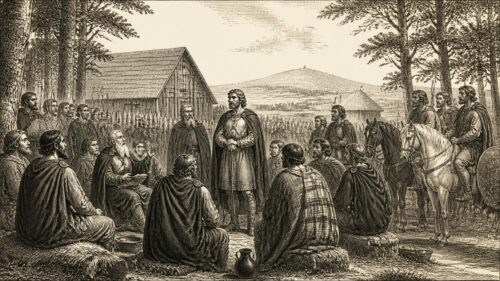
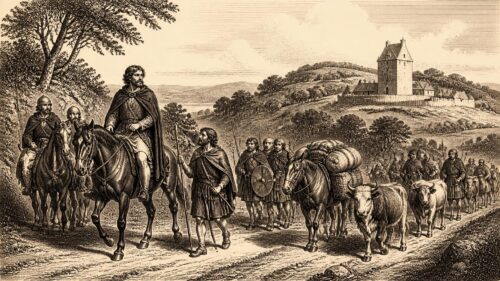
The most substantial events recorded for 1367 occurred in the northern Connacht–Breifne world. Annála Connacht dates its year with a detailed calendrical notice and then reports that Clann Muirchertaigh moved into Magh Nisi. The annal calls this an imirce, a migration or moving expedition. Such a word should not automatically be understood as the permanent resettlement of an entire people: it may indicate the movement of a substantial armed following, dependants and livestock under lordly leadership. Yet it points to mobility on a scale greater than an isolated raid.
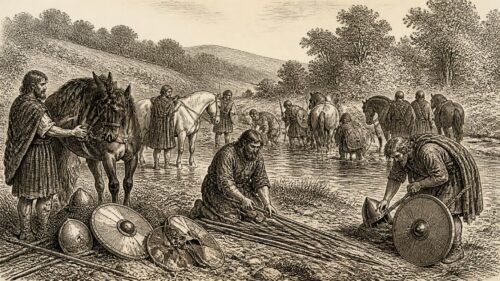
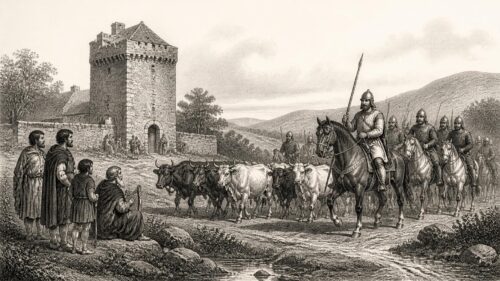
From there, a coalition entered Moylurg, the Mac Diarmata lordship centred in what is now north Roscommon. Its named leaders were Tadc, son of Ruaidri Ó Conchobair; Fergal Mag Tigernain, chief of Tullyhunco; and Diarmait Mag Ragnaill, chief of Muintir Eolais. They had gallowglasses with them. These were professional heavy infantry, commonly recruited from Hebridean and Gaelic-Scottish kindreds or from families long established in Ireland, who served for pay, maintenance or land. Their presence demonstrates that military labour was a major political resource, not an occasional foreign novelty.
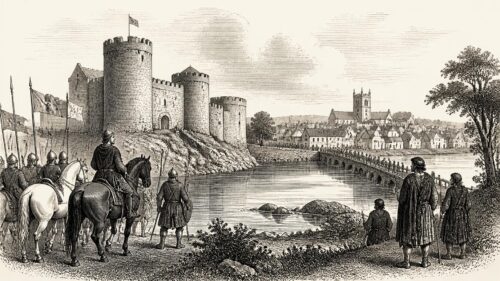
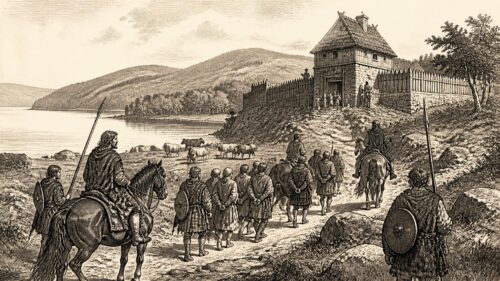
The raiders burned the stronghold of Áed Mac Diarmata. The annals do not permit a reconstruction of the building or an exact date for the attack, but the target was plainly more than an ordinary farmstead: the destruction of a lord’s defended residence struck at authority, stores, shelter and prestige. Fergal Mac Diarmata, ruler of Moylurg, and Áed pursued the attackers, caught them and inflicted losses in battle. The episode captures the rhythm of local war. A mobile coalition sought booty and leverage; the resident lord answered with pursuit; the costs were borne not only by warriors but by those whose cattle, food supplies, dwellings and fields lay on the route.
The Rout at Beltra Strand
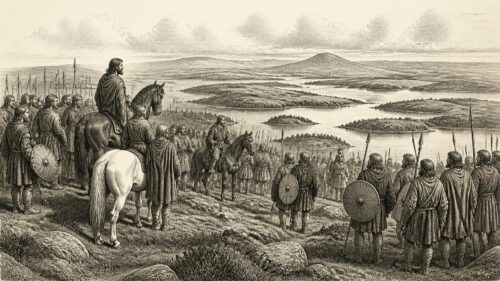
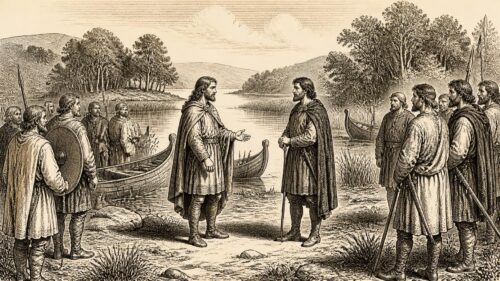
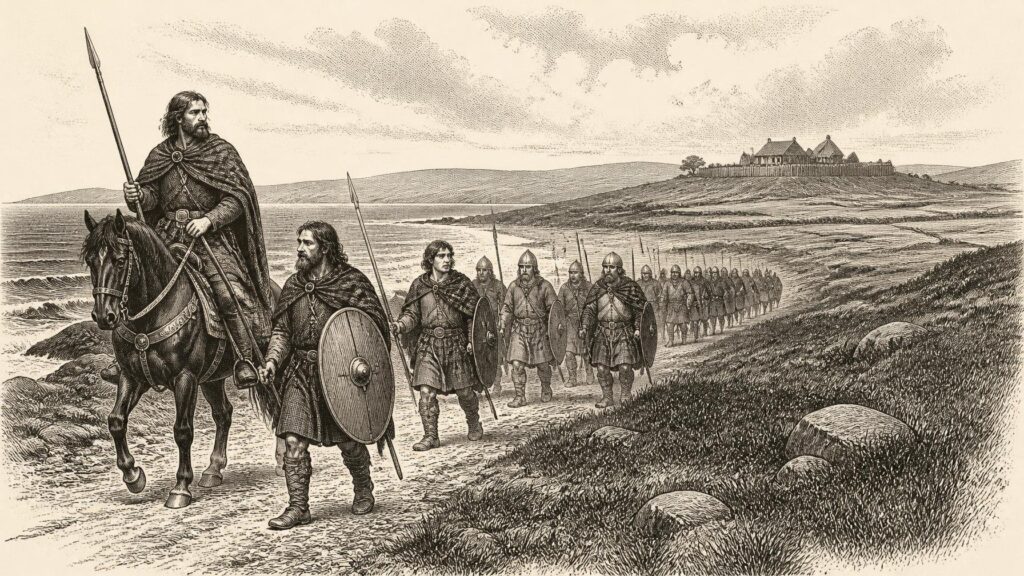
A second battle was far more destructive. Domnall, son of Muirchertach Ó Conchobair, joined with Muintir Ruairc, Clann Donnchada and Teboit Burke and his mercenaries against Tadc, son of Maghnus Ó Conchobair. The forces met at Traigh Eothuile an tSaoir, rendered in the English translation of Annála Connacht as Beltra Strand. The precise modern identification of the place need not be forced; what matters is that the sources locate the encounter on a strand, a terrain where movement, tides and constrained routes may have shaped the fighting.
The annal declares that all Tadc’s gallowglasses, “seven score and ten” — 150 men — were killed. Medieval casualty figures should always be read with caution, especially where chroniclers wished to convey the completeness of a victory. Even so, the named dead underline the seriousness of the defeat: Domnall Mac Somairle, his son Domnall Óg, two sons of Mac Suibhne, a son of Bishop Ó Dubda and Uilliam Mac Sithig were among them. These were not anonymous foot soldiers alone. The loss affected military families and networks whose service connected Connacht, Breifne, Ulster and the western seaways.
The alliance on the victorious side is equally significant. Teboit Burke’s participation with Gaelic lordships shows why a simple division between ‘English’ and ‘Irish’ fails to explain politics on the ground. Burke was a member of a family of Anglo-Norman descent, but his force could operate within regional coalitions whose interests were shaped by lordship, rivalry and opportunity rather than by the categories imposed in the Statutes of Kilkenny. The statute’s fear of cross-cultural alliances was, in this sense, grounded in political reality. Such alliances had long existed and remained indispensable to those seeking power.
Violence continued after the battle. Derbail, daughter of Maelruanaid Mór Mac Diarmata and wife of Ualgarc Ó Ruairc, was killed by Clann Muirchertaigh. Her notice matters because aristocratic women stood at the intersection of dynastic alliances. A killing of this kind could deepen a feud between lordly houses, while marriage created obligations extending far beyond a household. The annal does not tell us the circumstances, and it would be wrong to invent them, but it records a consequence of conflict that reached into kinship and succession.
Breifne, Church and Learning
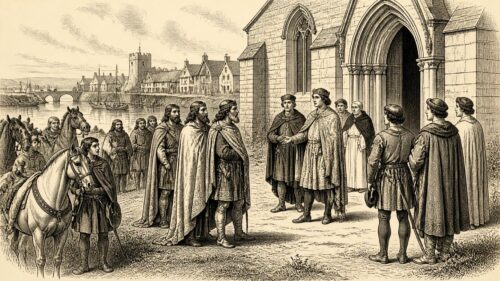
In Breifne, Cú Chonnacht Ó Raigillig ceased to rule and died. The Four Masters preserves a fuller devotional interpretation: he resigned the lordship “for the sake of God” and took holy orders, after which Philip assumed his place. The annals thus present lordship as transferable within a ruling kindred, but also show that a secular career could end in religious retirement. This was not an abandonment of public importance. Ecclesiastical institutions held land, collected dues, offered learned careers and provided prominent families with another sphere of authority.
Church personnel appear repeatedly in the year’s notices. Máel Sechlainn Ó Fergail, bishop of Ardagh, died; so too did Malachy Maguire, archdeacon of Oriel. Sitrecc, son of the erenagh Mag Tigernain, also died. An erenagh belonged to the hereditary lay or clerical custodianship associated with a church site, a reminder that local churches were embedded in family and territorial structures as well as diocesan administration. The deaths of Tadc and Lochlainn, sons of Aengus Ruad Ó Dálaigh, and of Máelmuire Óg Mag Raith, similarly hint at the educated and literary households on which Gaelic lordship relied, although the entries do not describe their particular work.
One grim notice records Máel Sechlainn, son of Sefraid Mac Gilla Patraic, and some followers killed treacherously by “the Galls”, the annalists’ term often used for people of English or Hiberno-Norse and Anglo-Norman background. It does not identify the perpetrators or supply a location. It is evidence of a lethal encounter, not a licence to attach it to a wider campaign without proof. The restraint required here is instructive: the surviving record is vivid but uneven, preserving certain lordly deaths and confrontations while leaving the daily experience of cultivators, craftspeople, traders and children largely unspoken.
An Island of Interlocking Worlds
1367 was consequently not a year in which one authority remade Ireland. In the lordship, the legislation inherited from 1366 sought sharper cultural, legal and military separation just as Gerald of Desmond took office. In the west and north-west, the annals instead reveal political worlds joined by marriage, mercenary service, church office, dynastic competition and armed cooperation across supposed ethnic lines. The burning in Moylurg and the rout at Traigh Eothuile were local events, but their participants stretched across several lordships. They make the year memorable not as a single national turning point, but as a sharply documented instance of how power was made, challenged and defended in late medieval Ireland.
Primary Sources
- Annála Connacht
- Annals of Loch Cé
- Annals of Loch Cé A.D.1014–1590 (Irish text)
- Annals of the Four Masters
- The Annals of Ulster, Year U1367
- A Statute of the Fortieth Year of King Edward III, enacted in a parliament held in Kilkenny
- Statutum de Kilkenkye: original-language edition and editorial record
- Pre-Union Irish Statutes
- The Statute of Kilkenny, for the government of Ireland, 40 Edw. III. (1366–7)
- Lionel (‘of Antwerp’)
- MacMahon (Mac Mathghamhna), Brian Mór
- The Anglo-Irish Colony under Strain, 1327–99
- Sumptuary Law in Ireland, 1170–1537
- The Earl of Desmond and the Governance of Late Medieval Ireland
- Fitzgerald, Gerald (d. 1398)
- FitzGerald, Maurice fitz Thomas
- Annals of the Kingdom of Ireland: table of contents
- Annals of the Four Masters: CELT project record
- Annals of Loch Cé: CELT project record
- Exploring the Irish Annals
- Lordship and Principality: Colonial Policy in Ireland and Aquitaine in the 1360s