Bellaslishen and Roscommon1288 CE
In 1288 Magnus Ó Conchobair seized Connacht after defeating and capturing his brother Cathal at Bellaslishen, a strategic ford near Roscommon. His victory brought plundering, but winter attacks at Ros Mór wounded him and exposed continuing resistance. Recovering, he took hostages in Síl Muiredaig to enforce obedience. Richard de Burgh, Red Earl of Ulster and lord of Connacht, advanced to Roscommon but withdrew amid opposition, although sources dispute subsequent terms. Stephen de Fulbourn, archbishop of Tuam and justiciar, died, prompting William de Bermingham’s election. Changes in church and chancery office reflected contested authority among Gaelic rulers, magnates and royal administration.
Dateline
The year 1288 was decisive in Connacht, though not because it produced a settled victor. Its clearest events belong to the contested heartland of the Ó Conchobair kingdom: a dynastic coup at Áth Slisean, or Bellaslishen, a counterstroke around Ros Mór, and the arrival at Roscommon of Richard de Burgh, the Red Earl of Ulster and lord of Connacht. Taken together, the surviving annals show a province in which kingship depended upon armed followings, hostages, control of routes and the ability to withstand both kinsmen and powerful Anglo-Irish lords.
1288 also brought a conspicuous change in high office. Stephen de Fulbourn, archbishop of Tuam and justiciar of Ireland, died on 3 July. His death removed a royal officer who had combined ecclesiastical authority with the chief executive role in the lordship. The same year’s sources record an election to succeed him at Tuam, while the chancery passed into other hands. In a period when political authority was dispersed between the king’s administration, great lordships and Gaelic dynasties, such personnel changes mattered well beyond the church.
What Can Be Dated
The fullest contemporary narrative comes from the Annals of Connacht, whose annal for 1288 dates the year conventionally from 1 January and records a sequence of events in central Connacht. The Annals of the Four Masters, compiled much later from earlier materials, preserves a closely related account. Both place Magnus, or Maghnus, son of Conchobar Ruad Ó Conchobair, at the centre of the year. The Four Masters call him Manus in their English translation, but the Irish text has Maghnus; modern usage normally renders the name Magnus.
Other evidence needs more care. The Annals of Ulster contain a related entry under their heading U1288, but their manuscript chronology at this point is irregular and the edition itself signals a discrepancy of several years. It is valuable corroboration for the struggle between the Red Earl and Magnus, but it cannot safely settle the precise sequence or outcome of the campaign. Where the sources differ, 1288 should not be made to bear more certainty than it can support.
A Kingship Taken at Bellaslishen
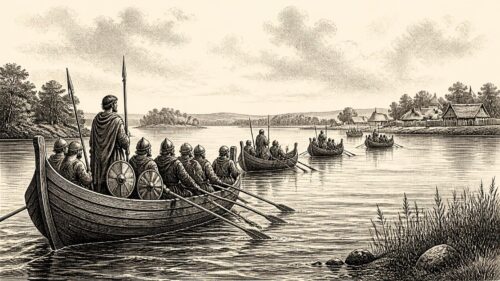
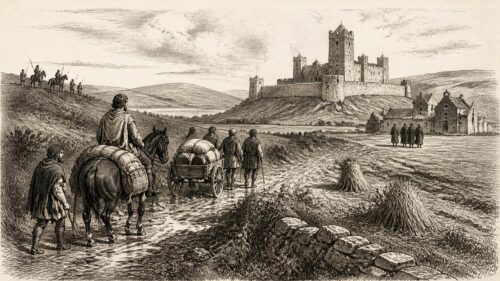
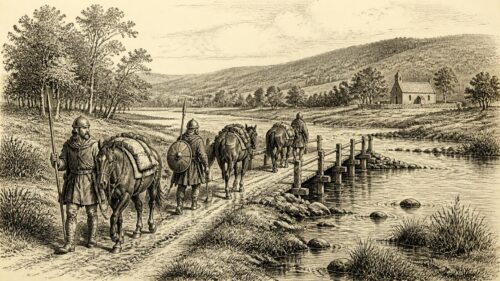
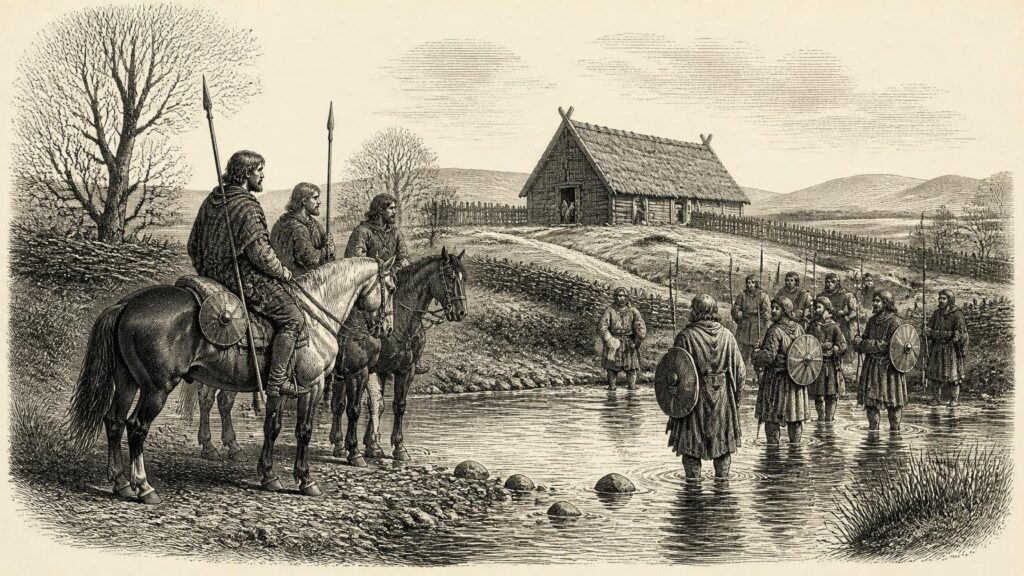
According to the Connacht annalist, Magnus assembled as many Connachtmen, Uí Briúin and Conmaicne allies as he could secure, then moved against his elder brother Cathal, son of Conchobar Ruad. The opposing forces met at Bellaslishen, identified with Áth Slisean, a ford in the Roscommon–Elphin district. This was not a distant border skirmish. A ford was a practical crossing-place and a political choke-point, and the choice of such a location made movement, supply and retreat part of the contest.
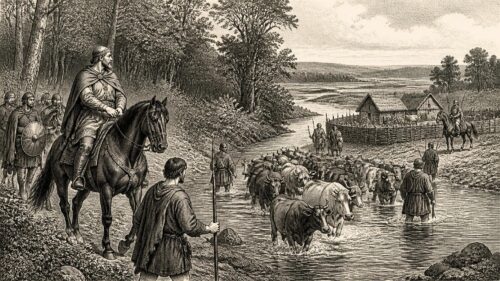
Cathal was captured and his following routed. Magnus deposed him and assumed the kingship of Connacht. The annalist adds that a great part of Connacht was plundered in the aftermath, an important reminder that a change of ruler was experienced not simply as a courtly transfer but through the seizure of animals, food, equipment and movable wealth. The record credits Cathal with a reign of seven and a half years. That detail gives the coup a particular dynastic sharpness: it was the removal of an established brother, not merely another claim in an abstract succession dispute.
The event also illustrates the character of Connacht kingship at this date. A claimant’s ancestry mattered, but descent did not determine succession automatically. Magnus required a coalition; Cathal required an armed household and adherents; and military success at a strategically useful place transformed a contested claim into possession. The territories named in the annal show that local groupings retained political weight. “Connacht” was therefore both a kingdom and a field of competing regional loyalties.
Winter Reversal and Hostages
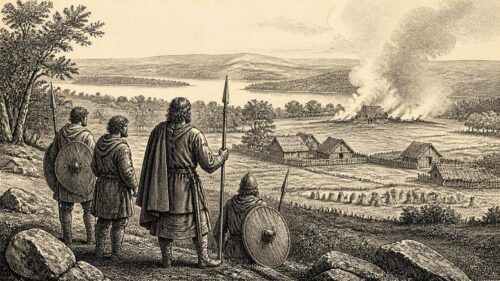
Magnus’s success did not end resistance. In the same winter Toirrdelbach, son of Eogan Ó Conchobair, together with Máel Sechlainn Ó Flannacáin, seized a house from him at Ros Mór, on the advice of Fiachra Ó Flainn. Magnus was wounded; Niall Gelbuide Ó Conchobair was wounded as well; Ragnall Mag Ragnaill, chief of Muintir Eolais, was killed by a single arrow-shot; and some of Magnus’s men were killed. The attackers also carried away horses.
This compact entry gives an unusually close view of conflict below the level of pitched battle. A “house” could mean a defended residence or settlement focus, and its capture was a blow to security and standing. The death of Ragnall shows that leaders of neighbouring peoples could be drawn into an Ó Conchobair quarrel, while the taking of horses was both immediate gain and a reduction of an opponent’s military mobility. The annals do not permit a reconstruction of every participant’s motive, but they make plain that Magnus’s new authority remained vulnerable.
After recovering from his wound, Magnus led a hosting into Síl Muiredaig and took hostages from it. Hostages were not incidental prisoners. They were instruments used to compel obedience, guarantee agreements and demonstrate who could demand submission. Their taking indicates that Magnus was trying to convert battlefield success into a working kingship across the north-central Connacht lands. It also tells us something about ordinary burdens of political instability: communities could be compelled to supply men, provisions and sureties for conflicts conducted in the name of their rulers.
The Red Earl at Roscommon
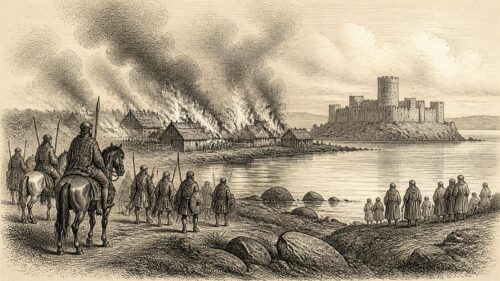
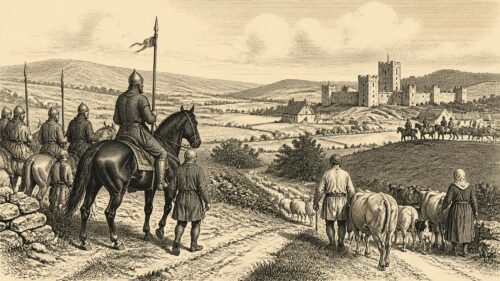
Magnus’s consolidation immediately intersected with the ambitions of Richard de Burgh, the Red Earl. Richard was earl of Ulster and lord of Connacht, one of the most powerful magnates in Ireland. The Connacht annalist records that he marched into the province against Magnus as far as Roscommon. There Magnus, FitzGerald and the king’s men assembled and challenged the Earl to proceed farther. The annal says that Richard then decided to leave the country and disbanded his army.
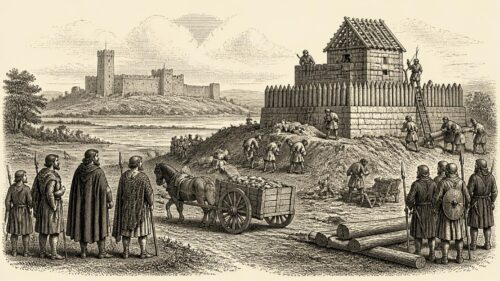
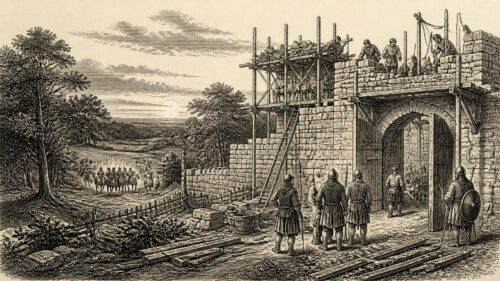
This was a significant check, even if it was not a final settlement. Roscommon was no ordinary stopping-place. A royal castle had been built there in 1269 in a landscape long associated with Ó Conchobair power, and it had repeatedly changed hands in the preceding decades. Archaeological and documentary evidence shows extensive fortification work in the late 1280s, continuing into 1290. It is not possible to assign a particular building operation to 1288, but the castle’s heavily contested presence helps explain why a confrontation there had such political force.
The Ulster annalist describes the same broad episode differently: the Earl reached Roscommon, departed without hostages or authority, but was followed to Miliuc by Magnus, who there met his full demand. The two accounts agree on an Earl’s expedition and on the failure of a straightforward advance beyond Roscommon. They disagree over the final balance of advantage. The responsible conclusion is not that either side won decisively, but that force, negotiation and the threat of further campaigning produced a temporary accommodation whose terms are lost.
For Connacht, this was the larger significance of 1288. Magnus had displaced his brother, but his position could not be secured without reckoning with de Burgh, royal officials and other Anglo-Irish interests. Conversely, the Earl could not simply impose his will by marching west. The province was a frontier of overlapping claims rather than a territory controlled from one unquestioned centre.
Church, Government and Office
Stephen de Fulbourn’s death connected the politics of Connacht to the wider administration of the lordship. A Hospitaller by background, he had served as treasurer and justiciar before becoming archbishop of Tuam in 1286. He died in Dublin on 3 July 1288 and was buried in Christ Church Cathedral. The Connacht annalist simply says that the archbishop of Tuam and justiciar “rested”, but the combination of titles is revealing: a single royal servant had exercised power in government and in a major western archdiocese.
The same annal records the election of Uilliam Mac Feorais, William de Bermingham, to the archbishopric of Tuam. Election was not the end of the process. Papal confirmation followed in May 1289, and the temporalities were not received until September 1289. Thus the firmly year-specific development was the election, not a completed installation. It nevertheless marked the advance of a member of the influential Bermingham family of Athenry into the leading ecclesiastical office of Connacht.
The Four Masters additionally record the death of Michael Mac an tSaoir, bishop of Clogher. Meanwhile William de Beverley is conventionally placed in office as chancellor of Ireland from 1288; an inquisition held before Candlemas 1289 identifies him as chancellor. These changes underline the dependence of royal government upon literate clerks, seals, writs, accounts and judicial process, even while its authority was being contested militarily in Connacht.
A Year of Limited Evidence
There is no securely dated annalistic report for 1288 of a nationwide famine, epidemic, harvest failure or exceptional weather in Ireland. It would be misleading to invent one from the silence of the record. What the evidence does reveal is a society repeatedly exposed to the costs of mobilisation: plundering after Bellaslishen, a house taken at Ros Mór, horses seized, a chief killed, and hostages extracted from Síl Muiredaig. Religious institutions, castles and administrative offices stood beside kin-groups and military followings as the structures through which people encountered power.
In that sense, 1288 was less a year of resolution than of recalibration. At Bellaslishen, Magnus Ó Conchobair took Connacht by defeating and capturing his brother. At Roscommon, the Red Earl’s intervention demonstrated that no Connacht king could ignore the lordship’s military reach. Yet the Earl’s failure to press beyond the assembled opposition showed the limits of that reach. The new king survived the immediate test, but the fractured settlement of 1288 ensured that Connacht’s contest for authority was far from over.
Primary Sources
- Annála Connacht: Annal 1288
- Annals of the Four Masters: Annal M1288
- The Annals of Ulster: Year U1288
- Annala Uladh: Annals of Ulster otherwise Annala Senait, Annals of Senat
- Annála Connacht
- Annals of the Four Masters
- Fulbourn, Stephen de
- Burgh, Richard de
- Bermingham, Peter (Piers) of Athenry
- Inquisitions and Extents of Medieval Ireland
- Roscommon Castle-South West Tower
- Roscommon Castle
- Roscommon Castle, County Roscommon Urban Archaeology Survey
- Roscommon Abbey
- National Monuments in State Care: Roscommon
- Tuam: Irish Historic Towns Atlas Text
- Notes on the Early History of the Dioceses of Tuam, Killala and Achonry
- The Archbishops of Tuam
- Annals of Ireland by Friar John Clyn: Bibliography and Source Description
- The Annals of Ireland by Friar John Clyn
- Annales Breves Hiberniae
- Exploring the Irish Annals
- CELT Published Texts
- CELT Frequently Asked Questions
- The Origin and History of Irish Names of Places, Volume II