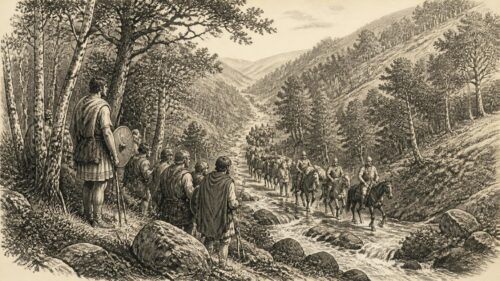
Áed Buidhe’s Fall1283 CE
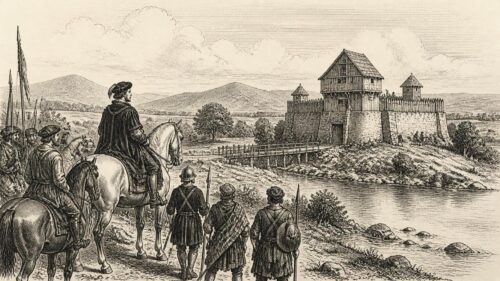
In 1283, Áed Buidhe Ó Néill, king of Tír Eógain, was killed by rivals from Airgíalla and Breifne, destabilising northern politics and encouraging a contested succession. In Connacht, the wounding and death of Tadc Ó Conchobair illustrated dynastic rivalry and the political value of custody. Domnall Ruad Mac Carthaig of Desmond countered a plot with support from prominent Anglo-Irish lords, securing a negotiated settlement involving livestock. Dublin and Christ Church suffered a serious fire, exposing urban vulnerability. Together, these events reveal Ireland as a network of competing lordships, temporary alliances, ecclesiastical institutions, commerce, violence and negotiation across the whole island.

Dateline
In 1283, Ireland’s political map was not divided simply between an English colony and an Irish hinterland. Power was exercised through overlapping lordships, alliances, tribute relationships, church lands and towns. The year’s surviving notices are brief, but they illuminate that complexity particularly well. In the north, the killing of Áed Buidhe Ó Néill, king of Tír Eógain, removed a formidable Gaelic ruler. In Desmond, Domnall Ruad Mac Carthaig answered an internal plot by assembling a force that included leading Anglo-Irish magnates. In Dublin, a destructive fire damaged Christ Church and part of the city. These were separate events, yet together they show an island in which local conflict, political co-operation and urban vulnerability were closely entwined.
A Killing in Tír Eógain
The most consequential firmly dated development of the year in the Irish annals was the death of Áed Buidhe Ó Néill. The Annals of Connacht, Annals of the Four Masters and later historical scholarship agree that he was killed in 1283 by Brian Mac Mathghamhna (MacMahon), with the Airgíalla, and Gilla Ísu Ruad Ó Raghallaigh (O’Reilly). No surviving source securely supplies a day, place or detailed battle narrative. It is therefore safer to speak of a killing in the course of the year than to recreate a battlefield or assign motives beyond the rivalries evident in the record.
The annalists’ language nonetheless conveys the scale of the loss. The Four Masters, writing centuries later from earlier material, celebrated Áed as outstanding in generosity and valour, powerful in war, and a man qualified for the kingship of Ireland. Such praise was conventional in elite obituaries and should not be read as a neutral description. But it confirms that Áed’s death mattered far beyond his immediate following. He was lord of Cenél nEógain, the principal Ó Néill polity in Tír Eógain, broadly corresponding to much of modern County Tyrone and adjoining districts. Control there was central to northern politics: routes linked Ulster’s coast, the Foyle basin, Lough Neagh and the borderlands of Airgíalla and Breifne.
Áed had not been an isolated opponent of the Anglo-Irish world. His career had involved war, accommodation and shifting alliances. In 1281 he had defeated an invading force associated with Domnall Óc Ó Domhnaill at Disertcreaght, and English interests in Ulster had been among the forces aligned with him. The coalition that killed him in 1283 similarly cautions against a simple ethnic reading. Brian MacMahon was a leading figure of Airgíalla, while Gilla Ísu Ruad Ó Raghallaigh belonged to the powerful O’Reilly kindred of east Breifne. Their action was an assertion of neighbouring Gaelic interests against an overmighty king, not merely a border clash.
The immediate political consequence was uncertainty. Áed’s descendants later gave their name to Clann Aodha Buidhe, or Clandeboye, a major Ó Néill branch. Yet he was not followed smoothly by a son. Domnall Ó Néill, son of Brian who had died at the battle of Down in 1260, appears to have taken the kingship of Tír Eógain after Áed’s death, while Niall Cúlánach Ó Néill also retained a claim. The contest did not end in 1283; it became a lasting weakness that outside lords, especially Richard de Burgh, earl of Ulster, would exploit in later years. For contemporaries, the death of Áed Buidhe therefore changed not just one lordship’s leadership but the balance among Tír Eógain, Airgíalla, Breifne and the earldom of Ulster.
Connacht and the Cost of Rivalry
Two other entries from 1283 point to the political texture of the west. Tadc, son of Domnall of Erris Ó Conchobair, was wounded by the people of Luighne, or Leyney, delivered to Cathal Ó Conchobair, and later died of his wound. The notice is spare but revealing. The Ó Conchobair dynasty had many branches, and the title “king of Connacht” did not make the province a unified state. Rival candidates, regional peoples and Anglo-Irish lords all influenced its politics. The handing over of a wounded noble indicates that custody itself was a political act: prisoners were valuable as guarantees, bargaining counters and symbols of dominance.
The same year is also associated, in the Annals of Ulster’s sequence, with deaths among the Mac Diarmata rulers of Moylurg, the Ó Mannacháin of the Three Tuaths and learned churchmen around Elphin. The chronology of that annalistic section is problematic, and these notices cannot all responsibly be treated as securely occurring in calendar year 1283. They are best used as broader context rather than as additions to the year’s event list. What can be said with confidence is that the lordships of central Connacht were densely interconnected by kinship, clientship, ecclesiastical office and conflict. The shorter 1283 notices about Tadc’s death belong to that political environment.
For most people, such contests were experienced less as constitutional change than as danger to stock, crops and movement. Cattle remained a principal store of wealth; raiding and counter-raiding could strip a household of its livelihood, while a lord’s ability to protect dependants was central to his reputation. Roads and waterways carried merchants, clerics, messengers and armed parties alike. A contested frontier such as Leyney, between powerful interests in Connacht and the north-west, was not an empty margin but a lived landscape of farms, churches and seasonal pasture.
Desmond’s Unusual Coalition
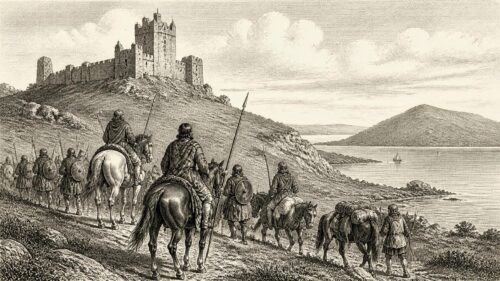
In the south-west, the Annals of Inisfallen preserve the year’s fullest political narrative. Domnall, son of Domnall Cairprech, and other members of Uí Chairpri allegedly plotted against Domnall Ruad Mac Carthaig, king of Desmond. Once warned, the king assembled a hosting. Crucially, the force included not only the army of Desmond but leading “foreigners” of Ireland: Thomas de Clare; Maurice fitz Maurice and Thomas fitz Maurice of the FitzGerald affinity; John de Barry; the Roches; the Condons; and others.
The wording is important. “Foreigners” was the annalist’s term for the descendants and political communities of the Anglo-Norman settlers, not a claim that every participant had newly arrived from abroad. The list demonstrates that late thirteenth-century Munster could not be understood as two sealed societies. Domnall Ruad was a Gaelic king, but in 1283 he mobilised prominent Anglo-Irish lords to confront a threat within a Gaelic regional polity. Their participation likely rested on immediate interests—land, cattle, military service, friendship and local security—rather than any abstract loyalty to one nation.
The campaign did not produce a neat triumph. The Clann Shelbaig, associated with the Uí Chairpri stronghold, abandoned it and dispersed westwards through difficult country, including the western lands, Creakan, Béarra and wherever refuge could be found in Desmond. The English-speaking magnates secured neither prey nor spoils. Domnall Ruad instead made an agreement with them concerning the cattle of Uí Chairpri and obtained herds and horses on his own lands. The outcome was therefore a negotiated assertion of royal authority, not simply a sack or conquest. Cattle and horses were the practical currency of settlement: livestock could feed a household, equip a retinue, supply mounts, compensate allies and demonstrate who had prevailed.
This episode also places Thomas de Clare in Ireland before his later, better-known involvement in Thomond. His presence beside FitzGerald, Barry, Roche and Condon interests shows the reach of Munster’s aristocratic networks. It would be misleading, however, to infer a permanent alliance from one mobilisation. Medieval coalitions were often temporary, and the same families could be partners in one dispute and adversaries in the next.
Dublin and Christ Church Ablaze
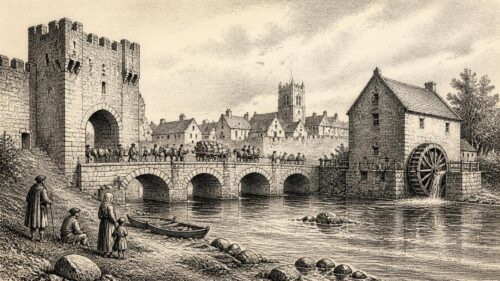
In Dublin, the Irish annals record that “Dublin and Christ Church” were burned or damaged in 1283. A later account of the cathedral tradition places the fire on 11 January and says that it injured the priory’s steeple, dormitory, chapter house and cloisters. The exact date comes from later reporting rather than the concise annal entries, but the fire itself is firmly associated with this year. It was a serious urban and religious disaster, striking both a populous port and one of the chief ecclesiastical institutions of the English lordship.
Christ Church was more than a place of worship. Its Augustinian community, cathedral clergy, archives, estates and rights connected Dublin’s religious life with administration and property across a wide area. Damage to sleeping quarters and the chapter house disrupted communal routine as well as fabric. The reported willingness of citizens to contribute to restoration before rebuilding their own homes, preserved in later cathedral history, suggests both the scale of damage and the cathedral’s civic importance. Such a response should not be romanticised: rebuilding also protected the standing, employment and economic activity bound up with the cathedral precinct.
The fire occurred while Stephen de Fulbourn was justiciar and treasurer of Ireland. His administration had reopened the mints at Dublin and Waterford in 1281; they ceased operation by 1283 after striking a very large quantity of coin. This belongs to the wider setting of the year, rather than to the fire itself. It nonetheless shows that Dublin was an administrative, monetary and commercial centre of a lordship tied closely to King Edward I’s wider dominions. Coin, customs, rents and official records moved through the city even as its timber-built streets and major religious houses remained highly exposed to fire.
An Island of Connected Lordships
Thus 1283 should not be reduced to a list of deaths and disasters. Áed Buidhe’s killing exposed the fragility of northern kingship and opened a succession struggle. The Desmond hosting revealed a Gaelic king drawing Anglo-Irish magnates into a regional settlement over rebellion and livestock. Dublin’s fire showed the vulnerability of a growing colonial capital, while the contemporary minting programme indicates the resources being drawn from Ireland into royal government. The evidence is uneven, and some annals preserve later compilations rather than eyewitness testimony. Yet the securely placed events of the year offer a clear picture: Ireland was a country of strong local powers, mobile alliances and institutions whose fortunes could turn suddenly through violence, negotiation or flame.
Primary Sources
- Annals of the Four Masters, Volume 3: Annal M1283
- Annals of the Four Masters, Volume 3: Irish Text
- Annals of Connacht
- Annála Connacht: Irish Text
- Annals of Inisfallen: Part 80
- Annals of Inisfallen: Irish Text
- The Annals of Ulster
- Annala Uladh: Annals of Ulster Otherwise Annala Senait
- O'Neill (Ó Néill), Aed Buide
- O'Neill (Ó Néill), Domhnall
- O'Reilly (Ó Ragallaig), Matthew (Matha) Ruad
- Fulbourn, Stephen de
- Christ Church
- Cathedrals, Christ Church and St. Patrick's
- Inquisitions and Extents of Medieval Ireland
- The Rise and Fall of the Clann Éinrí Aimhréidh Uí Néill: Dynastic Feuding and Geopolitics in the Late Medieval Irish Sea World
- Mná Maithe Mumhan
- The Castle of Dún Mic Oghmainn and the Overlordship of Carbery
- Mac Carthaigh's Book
- List of Published Texts at CELT