Connacht Castles1265 CE
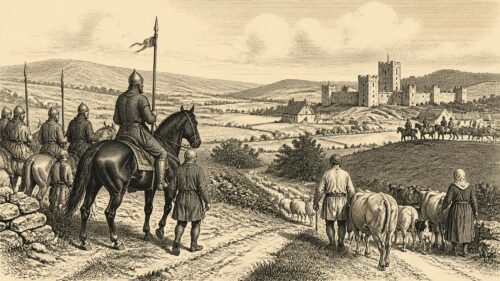
In 1265, Connacht underwent rapid political and military change. King Fedlimid Ó Conchobair died and was buried at the Dominican priory in Roscommon, while his son Áed na nGall succeeded him, asserted authority through a destructive hosting into Uí Fhailge, and eliminated a dynastic rival by blinding. Áed also led the demolition of castles at Sligo, Bannada and Ráth Ard Craibe, challenging Anglo-Irish lordship, though Sligo was soon rebuilt. Ballintober Abbey burned, under unknown circumstances. Deaths and elections altered church leadership, and negotiations at Kilmaine ended in killings. Wider Anglo-Irish conflicts influenced Connacht’s unstable balance of power during this year.
Dateline
In 1265, the political map of Connacht was redrawn through the death of a king, the swift accession of his son, and a striking attack on castles in the north-west. The year’s Irish annals are unusually rich for this region. They record the demolition of Sligo castle and the destruction of two neighbouring strongholds; the burning of Ballintober monastery; changes in the bishoprics of Elphin and Leyney; a violent failed meeting at Kilmaine; and the death of Fedlimid Ó Conchobair, king of Connacht. These were not separate local incidents. Together they reveal a province in which Gaelic rulers, Anglo-Irish lords, churchmen and communities lived amid rapidly shifting military and political power.
Fedlimid Ó Conchobair’s Death
The decisive event was the death of Fedlimid Ó Conchobair, son of Cathal Crobderg, king of Connacht. The Annals of Connacht and Annals of Loch Cé record it under 1265, and both provide an exceptionally generous obituary. Fedlimid is praised as protector of his province and friends, formidable against enemies, and a man of honour in both Ireland and “Saxon-land”. Such language should not be read as neutral biography: it is a commemorative judgement shaped by Connacht loyalties. Yet it shows the stature that Fedlimid had acquired after more than three decades in a kingship constrained by the expansion of de Burgh lordship and Anglo-Irish settlement.
His burial was itself politically meaningful. Fedlimid was interred in the Dominican priory at Roscommon, which he had granted to the Friars Preachers. Founded in 1253 and consecrated a few years later, that house linked an Irish king to one of the newest and most influential religious orders in western Christendom. Burial there expressed devotion, patronage and dynastic standing at once. It also reminds us that the religious life of Connacht was not separate from its politics: monasteries and friaries received land, protection, burial patrons and, at times, the dangerous attentions of armies.
The annals say that Fedlimid died after receiving unction and performing penance, presenting his death as a spiritually prepared end. That formula tells us more securely about the ideals valued by the annalist than about the details of his final illness. What can be firmly placed in 1265 is the transfer of rule that followed. His son Áed mac Fedlimid Ó Conchobair, often known as Áed na nGall, assumed the kingship of Connacht.
Áed’s Hard Succession
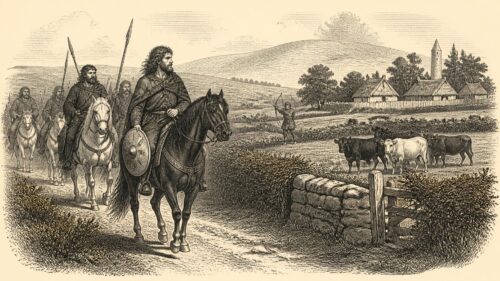
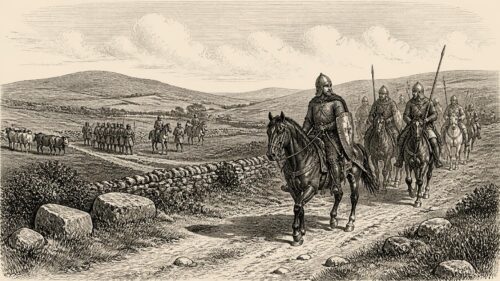
Áed did not mark his succession with a quiet ceremonial transition. The Annals of Loch Cé state that he carried out his slógad, or royal hosting, against Uí Fhailge in the midlands, where burnings and killings took place. A royal hosting was more than a raid for plunder. It was a public assertion that a new ruler could command followers, cross political boundaries and exact submission or resources. The entry does not permit a precise route, date or tally of victims, but it securely shows that violence was used immediately to demonstrate authority beyond Connacht itself.
On his return to Athlone, Áed blinded Cathal, son of Tadc Ó Conchobair, who subsequently died. Blinding was a brutal act of dynastic politics, but it also had a constitutional logic in medieval Gaelic kingship: a bodily blemish could disqualify a man from rule. The episode therefore indicates that the new king faced a rival within the wider Ó Conchobair kindred, not merely enemies beyond the province. Athlone, on the Shannon crossing between Connacht and the midlands, was an apt place for such a demonstration of control. It had long been a meeting-point where Gaelic kings and representatives of the English lordship negotiated, threatened one another and made peace.
The Castles of Sligo
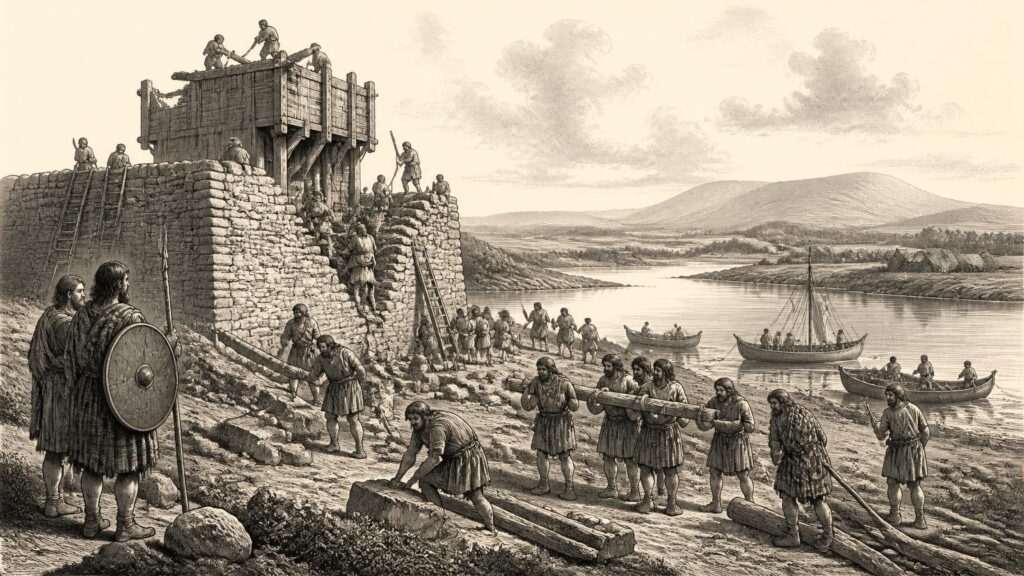
While the succession unfolded, Áed attacked the fortifications that helped sustain Anglo-Irish influence in north Connacht. The Annals of Connacht report that he pulled down Sligo castle and also destroyed the castles of Bannada and Ráth Ard Craibe. The Annals of Loch Cé agree, as does the later Annals of the Four Masters, though the latter additionally associates an Ó Domhnaill force with the attack. Because the nearer Connacht annals name Áed alone, it is safest to say that his leadership is firmly attested while the precise composition of his army is less certain.
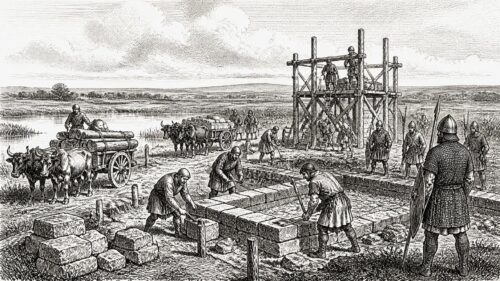
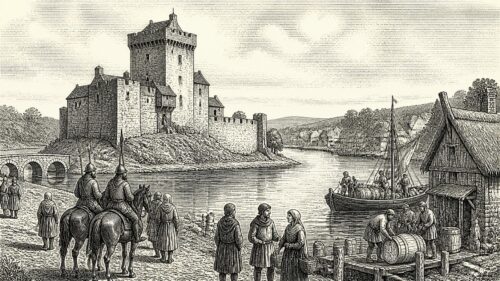
These were meaningful targets. A castle was not simply a defended residence. It was a base from which a lord’s officers could supervise estates, store provisions, shelter armed men, control movement and draw a surrounding district into a network of rents, labour services and protection. Sligo stood beside an important river and harbour system, at the meeting of routes linking Connacht, Ulster and the sea. Its destruction, together with that of Bannada and Ráth Ard Craibe, struck at infrastructure rather than merely winning a field encounter.
The demolition also demonstrates the practical limits of colonial lordship in the west. Anglo-Irish castles could be founded, garrisoned and supplied, but their survival depended on local alliances and the ability to move men and food through contested country. The Irish Historic Towns Atlas notes that Sligo’s castle was rebuilt within a few years. Thus 1265 was not the permanent removal of Anglo-Irish power from the region. It was, however, a conspicuous reversal: an incoming Connacht king had shown that these fortifications could be taken down.
Fire at Ballintober
The burning of the monastery of Tobar Phádraig, now Ballintober Abbey in County Mayo, was another grave event recorded under the year. The annals do not identify the people responsible, the scale of the blaze, or whether the destruction extended through every monastic building. Later architectural study associates the 1265 fire with rebuilding work, particularly in the nave, but the contemporary record should be allowed to say no more than that the monastery was burned.
Even that brief statement conveys much. Ballintober had been founded in 1216 by Cathal Crobderg, Fedlimid’s father, for Augustinian canons. It was therefore both a religious community and a monument to the ruling Connacht dynasty. Its church, clergy, workshops, stores, lands and dependent tenants represented accumulated labour and wealth. A fire at such a place endangered manuscripts, vestments, food supplies and domestic accommodation as well as sacred space. Whether caused by warfare, feud or accident cannot responsibly be determined from the surviving entry; its impact on a major ecclesiastical and dynastic centre is beyond doubt.
Bishops, Clergy and a Broken Parley
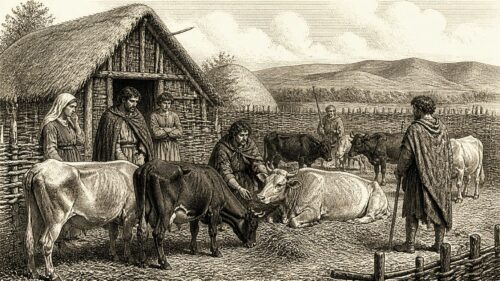
Church leadership changed markedly in 1265. Tomas mac Fergail Mac Diarmata, bishop of Elphin, died, as did Tomas Ó Maicín, bishop of Leyney. Máel Brigte Ó Grúgáin, the erenagh of Elphin, also died. An erenagh was a hereditary ecclesiastical office-holder with important responsibilities in the management of church lands and local religious resources. The clustering of these deaths in the annals shows that a diocese was sustained by more than its bishop: its institutional life rested on clergy, landholders, tenants and families embedded in the locality.
Maurice, son of Niall Ó Conchobair, was elected bishop of Elphin. Election was an important step, but it should not be confused with consecration or with uncontested possession of office; the annal records the election and no more. Nonetheless, the choice of a man from the Connacht ruling kindred illustrates the close relationship between ecclesiastical office and elite networks.
A meeting called by Tomaltach Ó Conchobair, archbishop of Tuam, ended still more ominously. He met David Prendergast and the Mac Murchadha at Kilmaine, but many of the archbishop’s people were slain there. The sources do not explain the dispute or identify all participants. They do establish that an archbishop could convene negotiations across Gaelic and Anglo-Irish political lines, and that neither his position nor the language of conference guaranteed safety. Diplomacy was a necessary tool in thirteenth-century Ireland, but it operated under the continual threat of armed coercion.
Connacht Within Wider Conflict
The year also belonged to a wider Anglo-Irish world. Walter de Burgh, earl of Ulster and lord of Connacht, had recently fought Maurice FitzGerald in a destructive struggle over power and property. A settlement was brokered on 15 April 1265, enabling leading Irish magnates to take part in the royalist cause during the crisis of Simon de Montfort’s rebellion in England. This did not end competition in Ireland, but it altered the immediate balance around Connacht at precisely the moment of Fedlimid’s death and Áed’s accession.
The Annals of Ulster and Annals of Loch Cé also notice the war between the English king and Simon de Montfort. Their brief notices confirm that political news from across the Irish Sea mattered to Irish annalists. They should not, however, be used as exact accounts of events in England: annalistic year-headings and details can be displaced, and one southern chronicle places under 1265 a report resembling the royal capture at Lewes in 1264. For Ireland, the important point is not a reconstructed English battlefield chronology, but the fact that the struggle framed the choices of magnates whose estates and military power extended into Ireland.
One further northern episode is dated unevenly across the annals. Murchadh Mac Suibhne was captured by Domnall Mac Maghnusa, delivered to the earl de Burgh, and died in prison. Loch Cé places it in 1265, while other compilations assign it differently. It therefore belongs to the turbulent mid-1260s, but cannot safely bear the weight of a firmly dated 1265 narrative.
A Province Remade
By year’s end, Connacht had a new king whose first recorded acts combined outward attack with ruthless management of dynastic competition. Three castles had fallen in the Sligo region, a great Augustinian house had burned, and leading church offices had changed hands. The death of Fedlimid closed an era of survival and negotiation; Áed’s actions announced a more openly confrontational phase. The evidence does not permit a complete portrait of every household affected by these events. It does show, with unusual clarity, how warfare, lordship, religion and settlement were entwined in the lived experience of Connacht in 1265.
Source References
Hover over a number to see the source. Select it to open the source.

- [1] Annála Connacht: Annal 1265
- [2] Annals of Loch Cé: Annal LC1266
- [3] Annals of the Four Masters: Annal M1265
- [4] The Annals of Ulster: Year U1265
- [5] Annals of Inisfallen: Annal AI1265
- [6] Annála Connacht: Annal 1264
- [7] Annála Connacht: Annal 1266
- [8] O'Connor (Ó Conchobair), Fedlimid
- [9] Burgh, Walter de
- [10] Ua Conchobair, Cathal Mór Crobderg
- [11] Ua Conchobair, Ruaidrí
- [12] Irish Historic Towns Atlas: Sligo
- [13] Ballintubber Abbey, County Mayo
- [14] St Patrick, Ballintober
- [15] An Introduction to the Architectural Heritage of County Mayo
- [16] County Roscommon Urban Archaeology Survey: Dominican Priory of St Mary
- [17] A History of the Irish Dominicans, Volume I
- [18] Exploring the Irish Annals
- [19] CELT: Annals of Ulster, Editorial and Source Information
- [20] CELT: Annals of the Four Masters, Editorial and Source Information
- [21] CELT: Annals of Inisfallen, Editorial and Source Information
- [22] CELT: List of Published Texts
Primary Sources
- Annála Connacht: Annal 1265
- Annals of Loch Cé: Annal LC1266
- Annals of the Four Masters: Annal M1265
- The Annals of Ulster: Year U1265
- Annals of Inisfallen: Annal AI1265
- Annála Connacht: Annal 1264
- Annála Connacht: Annal 1266
- O'Connor (Ó Conchobair), Fedlimid
- Burgh, Walter de
- Ua Conchobair, Cathal Mór Crobderg
- Ua Conchobair, Ruaidrí
- Irish Historic Towns Atlas: Sligo
- Ballintubber Abbey, County Mayo
- St Patrick, Ballintober
- An Introduction to the Architectural Heritage of County Mayo
- County Roscommon Urban Archaeology Survey: Dominican Priory of St Mary
- A History of the Irish Dominicans, Volume I
- Exploring the Irish Annals
- CELT: Annals of Ulster, Editorial and Source Information
- CELT: Annals of the Four Masters, Editorial and Source Information
- CELT: Annals of Inisfallen, Editorial and Source Information
- CELT: List of Published Texts