Hostages at Mag Ailbe996 CE
In 996, Brian Boru, king of Munster, took hostages from Uí Cheinnselaig and territories west of the Liffey at Mag Ailbe, demonstrating expanding influence in Leinster without establishing uncontested national rule. Annalistic chronology differs, requiring caution over dates and causal links. Deaths of rulers in Uí Cheinnselaig and Osraige accompanied regional instability and succession. Armagh suffered a major fire attributed to lightning, although other chronicles report plundering and burning by Airgialla. In the north, Áed of Ailech defeated raiders at Glenn Rige. These events reveal competing lordships, vulnerable churches, military power, and Brian’s growing leverage before the 997 division agreement.
Dateline
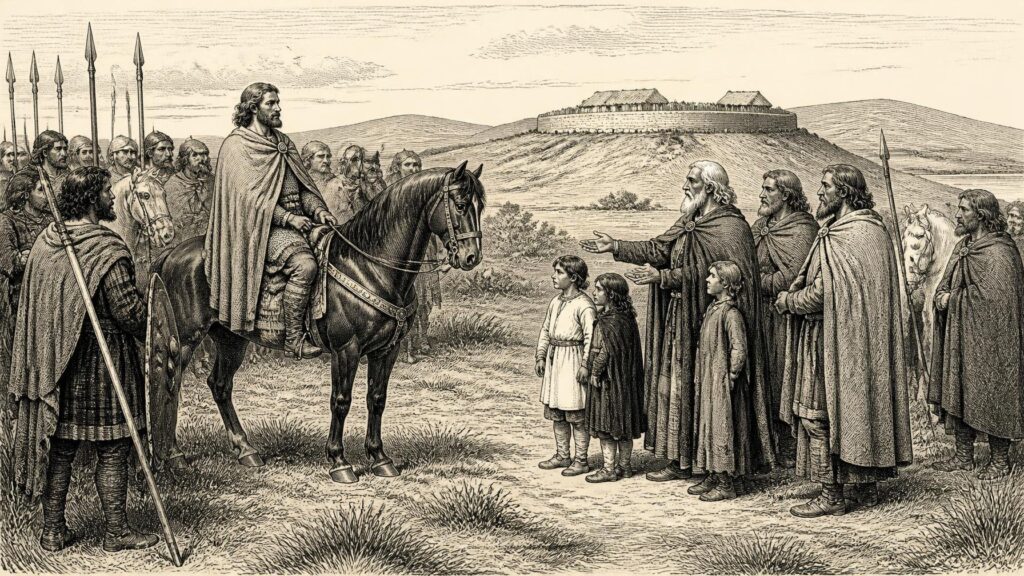
For Ireland in 996, the safest starting point is an unusually revealing but compact annal from the south. The Annals of Inisfallen record that Brian son of Cennétig took the hostages of Uí Cheinnselaig and of the lands west of the Liffey at Mag Ailbe. No day or season is supplied, and the terse notice does not narrate a battle. Yet it captures a substantial political development: Brian, king of Munster and head of the Dál Cais, was extending authority into Leinster while Máel Sechnaill mac Domnaill remained king of Tara and the foremost ruler of the midlands.
The year must, however, be handled with care. Irish annals use overlapping and sometimes displaced chronological systems. The Annals of Ulster label their relevant entry “AD 995 alias 996”; the later Annals of the Four Masters place much related material under 995; Inisfallen assigns Brian’s taking of hostages to 996. These are not grounds for discarding the evidence, but they rule out the pretence that every occurrence can be attached to a modern calendar date. This article therefore treats the hostage-taking as an event explicitly entered under 996 at Inisfallen, while identifying related notices and disagreements rather than silently harmonising them.
Brian’s Leinster Advance
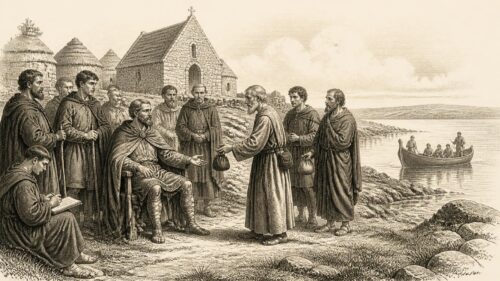
Hostages were not merely symbols. Their delivery placed named dependants or relatives in another ruler’s custody as security for submission, peace, tribute or military obligations. To take them was to establish a continuing claim, not simply to win a single encounter. Inisfallen’s wording matters because it names two constituencies: Uí Cheinnselaig, the important Leinster dynasty of the south-east, and the territory west of the Liffey. Together they indicate an advance across a broad stretch of Leinster political geography, not an isolated local settlement.
Mag Ailbe, as named by the annalist, was the setting of this submission; the notice does not permit a confident reconstruction of Brian’s route, camp, numbers or terms. It does show that his power was being exercised beyond Munster by means familiar to Irish kingship: an armed progress, negotiation under pressure, and the acquisition of human guarantees. In a country with no unitary state administration, hostage custody was one of the practical instruments through which an overlord could turn a claim into enforceable influence.
This was not yet Brian’s uncontested rule over Ireland. That later outcome should not be projected backwards. In 996, Máel Sechnaill still held Tara, and northern, midland, Leinster, Connacht and Scandinavian rulers all retained their own interests and armed followings. Nevertheless, the Inisfallen record is an important marker of Brian’s rise. Its significance becomes clearer in the following annal, which records Brian and Máel Sechnaill meeting at Port dá Chaineóc and dividing Ireland, in traditional terms, between Leth Moga in the south and Leth Cuinn in the north. That agreement belongs to 997 in Inisfallen, not to this year; it is useful only as context for the scale of the leverage Brian had begun to accumulate in 996.
Deaths and Succession in the South-East
The political map was also altered by deaths. The Annals of Ulster name Diarmait son of Domnall, king of Uí Cheinnselaig, and Gilla Pátraic son of Donnchad, king of Osraige, among the dead in their entry aligned “995 alias 996”. Inisfallen likewise records Gilla Pátraic’s death and states that Cellach son of Diarmait succeeded to the kingship of Osraige.
These notices illuminate why hostages and political pressure mattered so much. Uí Cheinnselaig had just lost a king, while Osraige, positioned between Munster and Leinster, underwent a succession. Neither kingdom was a passive piece on a larger board: each had its own ruling lineage, church connections and military resources. But succession could create opportunities for stronger neighbours. Brian’s demand for Leinster hostages and the change of ruler in Osraige belong to the same regional atmosphere of recalibrated loyalties, even where the annals do not spell out a direct causal link.
Other annalistic traditions preserve more violent versions of this southern upheaval. Chronicon Scotorum and the Annals of Tigernach, under 996, state that Gilla Pátraic was killed by Dondubán son of Ímar, and that Dondubán was then killed by the Leinstermen. The Four Masters, compiling centuries later from older materials, similarly presents a chain of killing and retaliation. These accounts offer a plausible picture of factional conflict, but their different chronological placements counsel restraint. What is firm is that the death of the Osraige king and a change in its kingship were remembered as events of this narrow period.
Armagh: Fire, Cattle and Authority
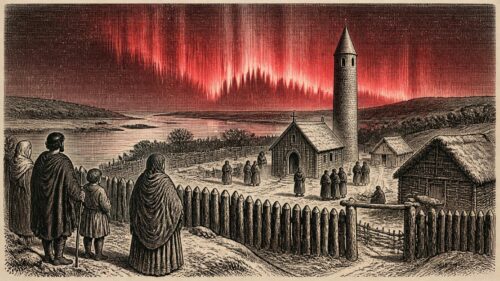
The year’s most striking ecclesiastical report concerns Armagh, the principal church of Patrick. The Annals of Ulster say lightning struck Ard Macha and left no oratory, stone church, vestibule or wooden sanctuary unburnt. Inisfallen likewise attributes the burning to lightning and describes devastation extending to a steeple, houses and an elder’s dwelling within the ecclesiastical enclosure. These parallel notices make a major destructive fire at Armagh one of the best-supported events connected with 996.
The wording gives a rare glimpse of the built environment. Armagh was not simply a single stone church. It was an enclosed religious settlement containing substantial stone structures but also wooden buildings, ancillary spaces and residences. Lightning could therefore produce a disaster that was both sudden and socially wide-ranging: worship places, accommodation, storage, workshops and books may all have been endangered, though the annals do not itemise the losses. Rebuilding would have demanded timber, labour, food for workers and the mobilisation of church revenues and patrons. That last point is an inference from the scale of destruction, not an event directly narrated by the sources.
Yet the surviving chronicles do not speak with one voice about Armagh. Chronicon Scotorum and Tigernach, in notices headed 996, say that the Airgialla plundered Armagh, carried off cattle and burned its houses, churches and bell-tower. Chronicon Scotorum gives the striking total of one hundred score cattle. It is possible that the traditions preserve different aspects of a troubled period, or that later transmission has conflated distinct disasters; the evidence cannot securely decide. What should not be done is to turn the variation into a confident story of a single raid disguised as lightning, or vice versa.
Even so, the cattle notice is valuable. Cows were portable wealth: food, dairy produce, breeding stock, status and a means of compensating followers or religious communities. The reported seizure from Armagh therefore speaks to the material foundations of an ecclesiastical centre, not merely to a dramatic number in a chronicle. It also shows that powerful churches could be targets in regional warfare. Sacred authority did not place their herds, households or dependent lands beyond the reach of armed neighbours.
A Church Community Under Pressure
Armagh’s importance rested on more than buildings. Its claim to Patrician primacy was supported by churches, landed resources, personnel and texts, including the early ninth-century Book of Armagh, made at the site and preserving a carefully constructed dossier of Patrician authority. A fire in 996 thus threatened a community whose religious prestige had political consequences across Ireland. The designation comarba, usually rendered “successor” or “heir”, carried institutional weight: it linked an office-holder to the authority of a saint and to the property and networks attached to that saint’s church.
Inisfallen places the death of Dub dá Leithe, described as successor of Patrick and of Colum Cille, in its 996 entry. Other chronicles date his death later: Chronicon Scotorum enters it under 998, while the Four Masters place it in 998 and add an age and a June date. The discrepancy is too substantial to present his death as firmly dated to 996. It does, however, underline the close association between Armagh’s disaster and the standing of its leading ecclesiastics in the annalists’ memory.
Conflict Beyond the Southern Arena
Events in the north warn against treating 996 as a story only of Brian and Leinster. The Annals of Ulster record that the Conaille, Mugdorna and northern Brega raided Glenn Rige. Áed son of Domnall, king of Ailech, caught them and defeated them; Matudán ua Cróngilla, king of Conaille, was killed, together with “very many” others, given as 200. The number should be read as the annalist’s reported total, not a modernly verifiable casualty count, but the notice clearly marks a significant northern victory for Áed.
This was a landscape of several competing regional powers. Ailech’s ruler could punish raiders from neighbouring peoples, while Airgialla, Conaille, Brega and Ulaid remained consequential forces. Neither Brian’s hostage-taking nor Máel Sechnaill’s kingship erased those realities. Ireland’s politics worked through overlapping lordships, kin-groups, churches and client communities. A ruler’s prestige depended on repeated success: gaining hostages, defending cattle, defeating raiders, protecting churches and rewarding allies.
What the Year Can—and Cannot—Show
The evidence for 996 is rich in particular events but thin on harvests, prices, disease, migration, long-distance commerce or ordinary domestic life. There is no sound basis for inventing a famine, a nationwide economic boom or a decisive Dublin campaign for this calendar year. Nor should the Irish Sea world be reduced to a simple contest between “Irish” and “Vikings”: Scandinavian-descended rulers and towns were embedded in Irish political systems, even though Dublin does not dominate the securely relevant notices for 996.
What emerges instead is a year of leverage and vulnerability. Brian’s Leinster hostages showed the expanding reach of Munster power; royal deaths exposed the instability of regional succession; Áed of Ailech demonstrated northern military strength; and Armagh’s burning revealed how exposed even Ireland’s foremost ecclesiastical centre could be to catastrophe and conflict. Together, these developments illuminate the political conditions from which the better-known settlements and wars of the closing years of the tenth century would grow.
Primary Sources
- Annals of Inisfallen, AI996–AI1001
- Annals of Inisfallen
- The Annals of Ulster, U996
- The Annals of Ulster
- The Annals of Tigernach, T993–T1002
- TEI Header for The Annals of Tigernach
- Chronicon Scotorum, CS995–CS998
- Chronicon Scotorum
- Annals of the Four Masters, M993–M1002
- Annals of the Four Masters
- The Annals of Ulster: CELT Electronic Edition
- Irish Chronicles and Their Chronology
- Chronological Synchronisation of the Irish Annals
- The Rock of Cashel
- High Crosses
- Irish School of Illumination
- Ardagh Ringfort
- The Book of Armagh: Dublin, Trinity College, MS 52
- The Liber Angeli
- The Bank of America Merrill Lynch–TCD Gospel Books Project
- The Leabhar Oiris
- Irish Sagas: Bóroma Background
- Annals of Inisfallen to Go on Public Display in University College Cork