Glendalough and Glún Iairn983 CE
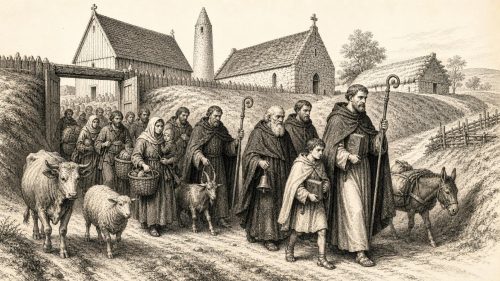
In 983, amid disputed annalistic dating, Ireland experienced overlapping conflicts rather than a unified war. Máel Sechnaill of Mide and his Dublin half-brother Glún Iairn routed Domnall Claen of Leinster and Ímar of Waterford, then ravaged Leinster. Dubliners plundered the wealthy monastic centre of Glendalough, illustrating the town’s complex political role. Brian mac Cennétig launched a fleet expedition into Connacht, suffered losses, and extended pressure through Osraige and Leinster by plunder and hostage-taking. Annals note ecclesiastical deaths at Lismore and Armagh, revealing institutions enduring amid warfare. The year demonstrates interconnected yet fragmented powers competing through kinship, raiding, waterways and coercion.
Dateline
A Year of Overlapping Wars
In the conventional calendar year 983, Ireland’s annals record a striking conjunction of warfare: a coalition led by Máel Sechnaill mac Domnaill defeated enemies from Leinster and Waterford; Dubliners plundered the great ecclesiastical settlement of Glendalough; and Brian mac Cennétig sent a fleet into Connacht while pressing hard upon Osraige and Leinster. These were not episodes in a single national war. They were campaigns within a politically divided island, where kings, church communities and the rulers of the coastal towns competed through alliance, raiding, hostage-taking and control of routes.
The evidence needs handling with care. The Annals of Ulster label their notice “AD 982 alias 983”, a reminder that annalistic year-headers do not always align neatly with the modern calendar. Modern editions conventionally place the entries discussed here in 983. The main accounts are short, and their authors do not provide battle-sites, dates within the year, army sizes or a continuous narrative. Yet the convergence of the Annals of Ulster, Chronicon Scotorum and the Annals of Tigernach makes the principal eastern conflict securely associated with this year.
Máel Sechnaill’s Unusual Alliance
The most prominent entry tells how Máel Sechnaill, king of Mide and claimant to the over-kingship of Ireland, joined forces with Glún Iairn, son of Amlaíb, against Domnall Claen, king of Leinster, and Ímar of Port Láirge, the Scandinavian-Irish port at Waterford. The annals call the result a battle-rout. Many men were killed or drowned, among them Gilla Pátraic, son of Ímar. The sources do not identify where the encounter occurred. Drowning may indicate fighting beside water or a disastrous flight across it, but that is all that can responsibly be said.
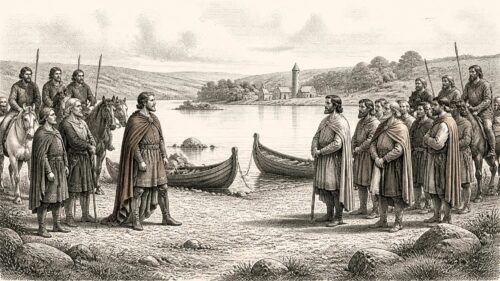
The alliance itself is the real clue to the politics of 983. Máel Sechnaill and Glún Iairn were maternal half-brothers: the Annals of Tigernach explicitly describes Glún Iairn as a son of Amlaíb and of Máel Sechnaill’s mother. Kinship could therefore cross the supposed divide between “Irish” and “Viking”. Glún Iairn belonged to the ruling family of Dublin, while Máel Sechnaill was of Clann Cholmáin, the powerful southern Uí Néill dynasty of Mide. Their co-operation did not make Dublin subordinate to Mide, nor does it show a permanent partnership. It does show that family connection and immediate advantage could outweigh cultural labels.
Máel Sechnaill had become the leading king of the midlands after the death of Domnall ua Néill in 980. His victory at Tara over Dublin’s forces that year had greatly altered the balance of power around the Irish Sea. By 983, however, Dublin remained a formidable fortified and commercial centre, and Waterford was an active rival port with its own ruler, Ímar. The fighting of 983 should therefore be read not as the final defeat of a foreign presence, but as a contest among established Irish and Hiberno-Scandinavian powers for influence over Leinster, the east coast and the inland approaches to Dublin.
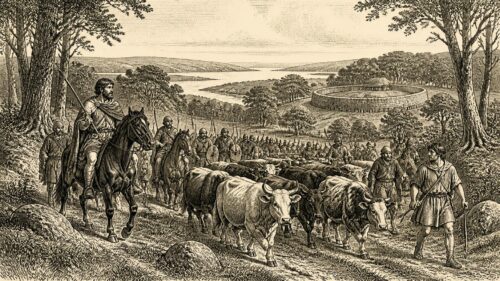
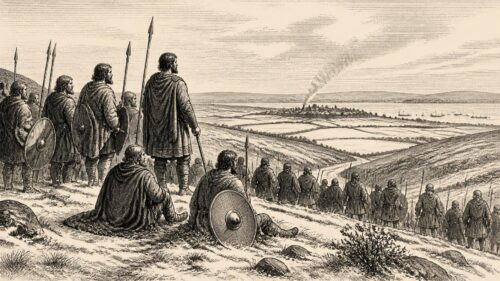
Domnall Claen’s position was especially precarious. The annals name him as king of Leinster, but kingship there depended upon relationships with competing branches of the Leinster dynasties, neighbouring rulers and the Dublin elite. After the defeat, Máel Sechnaill is said to have harried Leinster “to the sea”. That terse phrase describes more than a victory parade. An army moving across Leinster could seize livestock and food, destroy stores, exact submissions and render local kings less able to support their lord. It also indicates the reach of Máel Sechnaill’s campaigning force, rather than proof that he had permanently absorbed Leinster into his own kingdom.
The Annals of Tigernach add a grim, personal notice: Domnall Claen blinded Gilla Caemgen son of Cinaed. Blinding was a political act as well as a bodily injury, capable of excluding a man from royal competition under contemporary ideas of fitness to rule. The annal does not state why it happened or identify its wider consequences. Still, set beside the rout and the subsequent ravaging, it conveys a year in which Leinster’s internal hierarchy was under exceptional pressure.
Glendalough Plundered
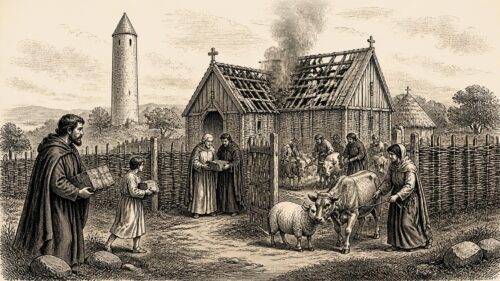
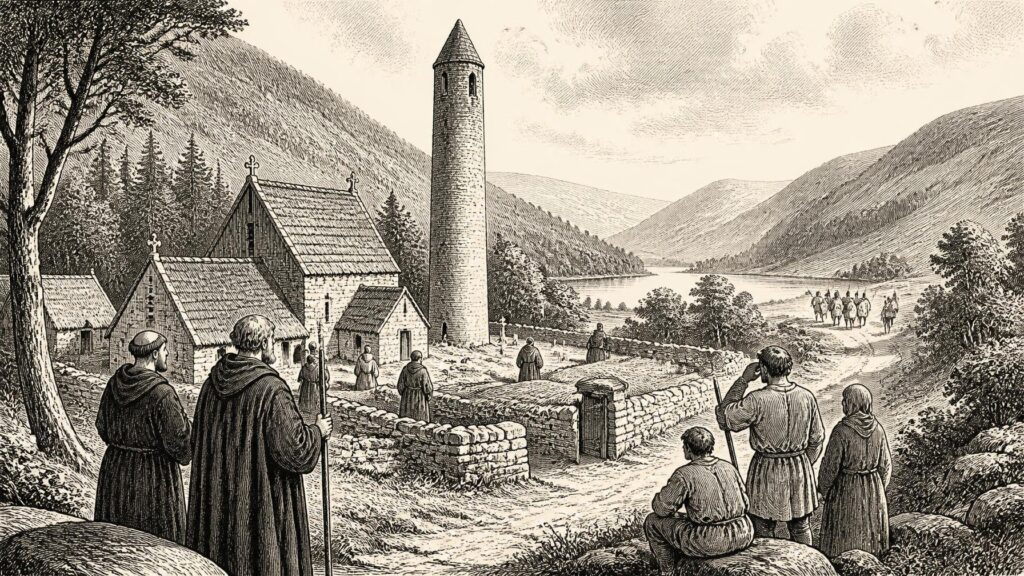
In the same year, the foreigners of Dublin plundered Glendalough, or Gleann Dá Loch, the monastic settlement in the Wicklow mountains. Both Chronicon Scotorum and the Annals of Tigernach record the attack. They do not say which individuals led it, which buildings were entered, how much was taken, whether captives were carried off, or whether the community resisted. It would be unsafe to supply such details from imagination.
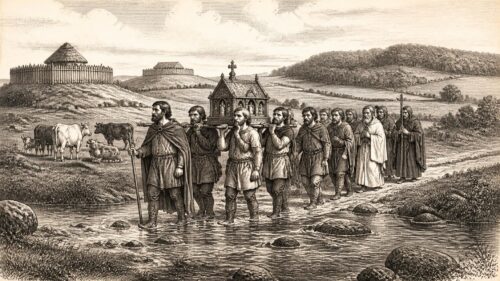
Nevertheless, the choice of target is historically intelligible. Glendalough was a major religious centre associated with St Kevin, with churches, burial grounds, clerics, dependants, agricultural resources and the offerings of visitors. It was not an isolated hermitage. A monastery of this kind was simultaneously a sacred place, a landed institution and a focal point for travel and exchange. Its valuables might include metalwork, books and liturgical equipment; its surrounding estates supplied food, labour and livestock. To plunder Glendalough was consequently an attack on wealth, authority and the prestige of a Leinster institution.
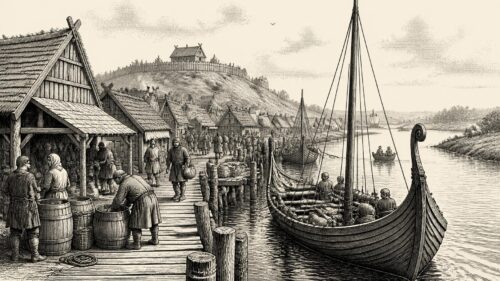
It would be misleading, though, to picture the raid as a simple collision between pagan raiders and a wholly separate Christian society. By the late tenth century, Dublin was a long-established town whose inhabitants and rulers were entangled in Irish dynastic politics. Archaeology reveals a settlement of houses, workshops, quays and trade, sustained by craft production, farming connections and maritime exchange. Dubliners could be raiders, merchants, allies, employers and political rivals; the same urban community was not reducible to any one of those roles. The annal’s phrase “foreigners of Dublin” identifies a political group, not an uncomplicated religious category.
There is a sharp irony in the year’s record. Glún Iairn, a Dubliner and Máel Sechnaill’s ally against Leinster and Waterford, appears in the same annalistic year as a Dublin attack on Glendalough, a leading Leinster church. No source says that Glún Iairn ordered the raid, and he should not be assigned responsibility without evidence. But the juxtaposition underlines the fractured character of authority: a king’s kinsman could join him in one conflict while men identified with that king’s town struck elsewhere for reasons the annals leave unstated.
Brian’s Western Offensive
The southern perspective preserved in the Annals of Inisfallen gives 983 a second centre of gravity. It reports that Brian mac Cennétig brought a large fleet into Connacht. Part of his force was killed there, including Máel Sechnaill son of Coscrach, Finn son of Dubchrón and Lochlainn son of Máel Sechnaill, described as a royal heir of Corcu Modruad in north Clare. Brian’s officials then went overland into Uí Briúin, in Connacht, where a great mutual slaughter occurred between them and the local force.
This was a serious expedition, not a passing raid. A fleet allowed men and supplies to move along the Shannon and connected waters, while the separate overland movement suggests a campaign operating on more than one front. The annal’s wording also makes clear that Brian suffered losses. It is tempting to treat every recorded expedition by the future Brian Boru as a straightforward step towards inevitable supremacy. The evidence for 983 is less flattering and more useful: Brian projected force beyond Munster, but encountered determined resistance and paid a price for doing so.
Brian was not yet high king of Ireland. His ambitions were being built through campaigns, submissions and the disruption of competitors. Inisfallen further records his capture of Gilla Pátraic son of Donnchad, king of Osraige, followed by the plundering of Osraige and the taking of hostages. Hostages were not merely prisoners seized in battle. They were instruments for enforcing agreements, compelling good conduct and advertising dominance. The entry also says that Brian took Leinster hostages at Mag Ailbe. It gives no date within the year and no terms of settlement, but it shows that Brian was seeking leverage east of his Munster base while Máel Sechnaill was simultaneously operating in Leinster.
The overlap did not mean that either ruler commanded a coherent half of Ireland. Rather, it reveals a crowded political field. Mide, Leinster, Osraige, Connacht, Munster and the coastal towns were linked by waterways, marriage alliances, tribute demands and armed expeditions. A king’s claim to wider authority had to be repeatedly performed through raids, hostage-taking, assemblies and negotiated submission.
Church Offices and Local Continuity
War dominates the notices, but 983 also records changes in religious office. Cormac son of Máel Ciaráin, successor of Mochutu and abbot of Lismore, died. Muiredach son of Muirecán, prior of Armagh, also died; so did Áed ua Mothráin, successor of Da-Sinchell, after being fatally wounded. Such brief obituaries point to institutions whose influence rested on land, learning, ritual authority and networks of dependants. Succession in a major church was therefore a matter with social and political consequences, even when the annals do not explain the process.
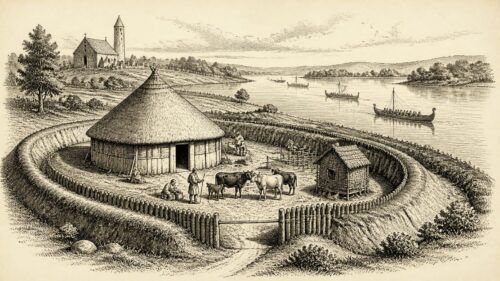
For most people, the year’s crises were likely experienced locally: the movement of armies, loss or seizure of cattle, demands for provisions, insecurity on roads and waterways, and the changing claims of neighbouring rulers. Yet continuity mattered too. Fields still had to be worked, stock tended, boats maintained and communities supplied. The annals preserve the exceptional moments—routs, raids, captives and deaths—not the full texture of ordinary labour.
What survives from 983 is thus not a story of one Ireland moving in one direction. It is a tightly dated glimpse of contest: Máel Sechnaill and his Dublin half-brother won a battle whose site is unknown; Glendalough was plundered by Dubliners; Brian’s western fleet met resistance; and ecclesiastical communities marked the deaths of their leaders. Together, these notices show an island connected by sea, river and road, yet divided among ambitious and adaptable powers.
Primary Sources
- The Annals of Ulster, Year U983
- Chronicon Scotorum, Annal CS983
- Annals of Tigernach, Annal T983
- Annals of Inisfallen, Annal AI983
- Annals of Inisfallen, Irish Text, Annal I983
- Annals of the Four Masters, Annal M983
- Annals of the Four Masters, Irish Text, Annal 983
- Chronicon Scotorum: Document Details and Editorial Notes
- Annals of Inisfallen: Bibliographic Record
- Annals of Inisfallen, Pre-Patrician Section: Source Description
- Annals of the Four Masters: Editorial and Manuscript Information
- CELT: List of Published Texts
- The Viking Age in Ireland
- Viking
- 950–1450: Vikings, Normans and Medieval Mints
- Glendalough Monastic Site and Visitor Centre
- Glendalough Monastic Site and Visitor Centre Highlights
- Life in Glendalough
- The Vikings in Ninth-Century Ireland: Sources and Settlements
- Vikings in Early Medieval Ireland: Church-Raiding, Politics and Kingship
- Viking Raids on Irish Church Settlements in the Ninth Century: A Reconsideration of the Annals
- The Practice of Irish Kingship
- Gasaitear na hÉireann